The Voynich Manuscript: Why Can’t Anyone Read It?
The Voynich Manuscript has puzzled scholars for centuries. Its unknown script, strange illustrations and complex patterns still resist every serious attempt at decipherment.
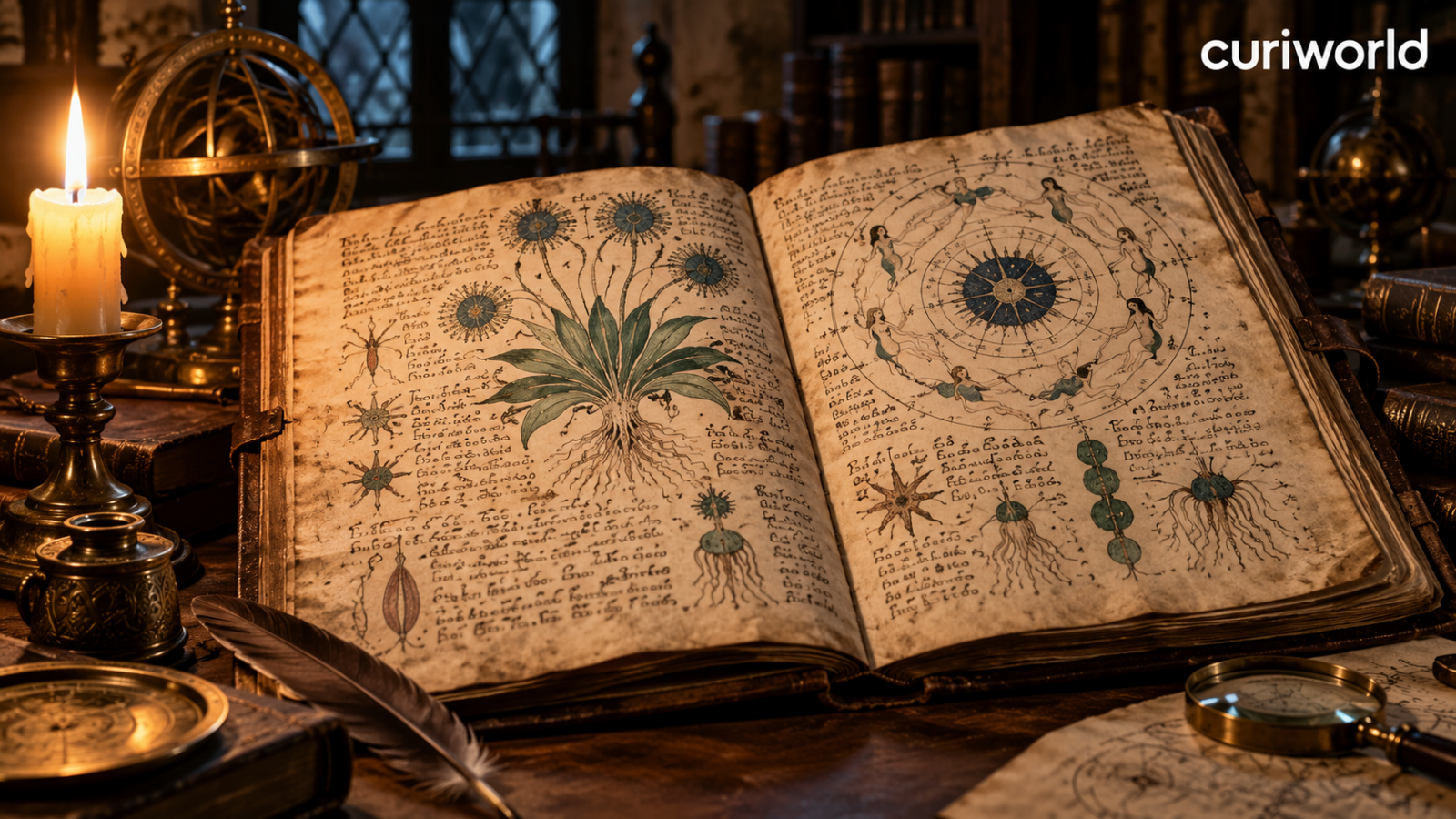
The Voynich Manuscript can be photographed in extraordinary detail, transcribed into computer-readable symbols and analyzed with modern statistics.
What nobody can reliably do is read it.
The centuries-old book contains page after page of unfamiliar writing surrounded by strange plants, astronomical diagrams, circular charts and drawings of human figures. Researchers have proposed languages, codes, ciphers and even elaborate hoaxes as explanations.
None has produced a translation that other scholars can independently verify across the manuscript.
That is what makes the Voynich Manuscript different from an ordinary lost language. The problem is not simply that we do not know what the words mean. We do not even know with certainty what kind of writing system we are looking at.
What Is the Voynich Manuscript?
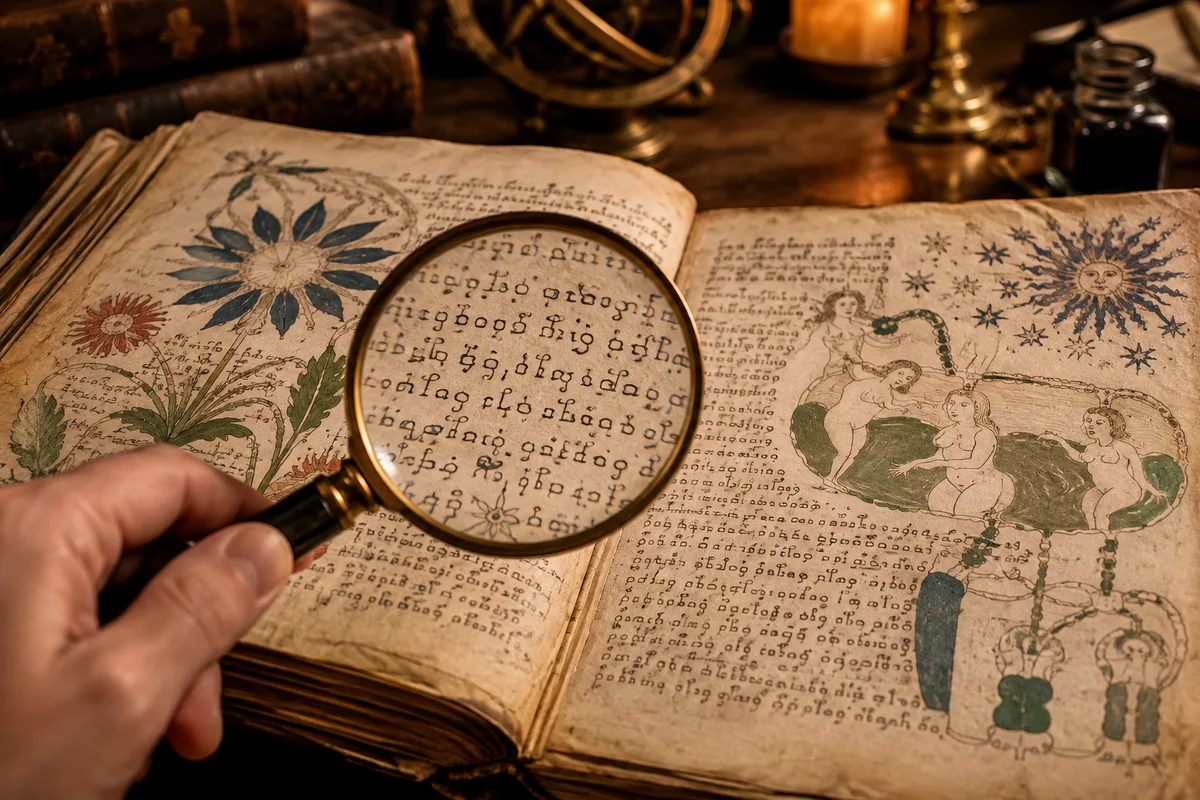
The Voynich Manuscript, formally known as Beinecke MS 408, is held by Yale University’s Beinecke Rare Book and Manuscript Library.
Its pages are filled with an unidentified script written alongside unusual illustrations.
According to Yale’s Beinecke Library, scientific examination is consistent with manuscript materials from the 15th century. Yale describes the book as having been produced in Central Europe, although its author remains unknown.
The manuscript is usually divided by its illustrations into several broad sections involving:
- plants
- astronomy and astrology
- bathing or anatomical-looking scenes
- cosmological diagrams
- pharmaceutical-style drawings of roots and herbs
- pages that may contain recipes
Those images appear as though they should help explain the writing.
So far, they have not.
Why Is the Voynich Manuscript So Hard to Read?
The biggest problem is that decipherers are missing several things that normally help unlock an unknown text.
There is no known alphabet.
There is no confirmed language.
There is no dictionary.
There is no bilingual inscription.
There is no known author explaining how the writing works.
And there is no securely identified passage whose meaning can serve as a starting point.
When the Egyptian hieroglyphs were deciphered, the Rosetta Stone provided versions of essentially the same text in different writing systems.
The Voynich Manuscript has no equivalent.
Researchers therefore have to work backward from patterns alone.
We Don’t Even Know Whether It Is a Cipher
Calling the manuscript a “code” may already make an assumption that has not been proven.
The script could theoretically represent:
- an ordinary language written in an unknown alphabet
- an existing language transformed through a cipher
- heavily abbreviated writing
- a constructed language
- a more complicated encoding system
- or text generated by a process that was never intended to represent normal language at all
Each possibility requires a different method of attack.
A simple substitution cipher, for example, might replace every normal letter with another symbol. Frequency analysis could eventually expose the pattern.
But if one Voynich symbol can represent several things—or several symbols combine to represent one sound—the problem becomes much harder.
The researchers do not know the rules because discovering the rules is itself part of the mystery.
The Writing Looks Structured, Which Makes the Mystery Worse
The text does not look like someone simply filled pages with completely random symbols.
Certain glyphs appear more often in particular positions. Some combinations recur frequently. Words or word-like groups show recognizable statistical patterns.
A 2013 study published in PLOS ONE compared the manuscript with natural-language texts and found that many of its statistical properties were compatible with real language rather than random text.
A later review by Yale linguists Claire Bowern and Luke Lindemann, published in the Annual Review of Linguistics, argued that there are good reasons to investigate the manuscript as language rather than dismissing it as meaningless medieval gibberish.
But this still does not tell us what the words mean.
Recognizing that a sequence behaves somewhat like language is very different from translating it.
New Research Shows Why Statistics Alone Cannot Solve It
The statistical evidence is not completely settled.
A study published in Cryptologia in September 2026 examined unusual character patterns inside Voynich words. It found that some characteristics differed substantially from the natural and constructed languages used for comparison.
More importantly, the researcher showed that a verbose substitution cipher could reproduce several of the manuscript’s unusual statistical features.
You can view the study through Taylor & Francis.
That does not mean the Voynich Manuscript has finally been proven to use that particular cipher.
It means something more important for understanding the mystery: statistical patterns that look meaningful do not automatically reveal how the text was produced.
Researchers can discover structure without discovering meaning.
The Illustrations Are Helpful—but Not Helpful Enough
At first glance, the pictures seem like the obvious key.
If a page shows a plant beside several paragraphs of writing, perhaps the text describes that plant.
The problem is identifying exactly what the illustration represents.
Some plants resemble recognizable species. Others appear unusual, stylized or possibly composite. Even if a researcher believes a drawing represents a particular herb, that does not reveal which nearby group of symbols means its name.
The astronomical and zodiac-like pages create the same problem.
They provide clues about possible subject matter without providing a reliable translation key.
A picture can suggest, “This page may be about plants.”
It cannot tell us which symbol means “root,” “water,” “medicine” or anything else.
There May Be More Than One Writing Pattern
Researchers have also noticed that the manuscript is not completely uniform.
In the 20th century, cryptanalyst Prescott Currier identified two major statistical varieties in the text, now commonly referred to as Currier A and Currier B.
That does not necessarily mean the manuscript contains two different spoken languages.
The differences could reflect different writers, sections, subjects, dialects or encoding practices.
But it creates another obstacle.
A method that appears promising on one group of pages may not behave the same way on another.
Instead of solving one unknown writing system, researchers may be dealing with several layers of variation inside the same book.
What Would a Real Decipherment Need to Do?
Claims that somebody has “solved the Voynich Manuscript” appear regularly.
The problem is not producing a few convincing-looking words.
With enough freedom to assign meanings to symbols, almost anyone can make a short passage appear to say something plausible.
A convincing solution would need to do much more.
It should provide a consistent system that explains the script across large portions of the manuscript. The same symbols and rules should behave consistently. Translations should produce coherent language rather than isolated words selected because they fit an illustration.
Most importantly, other researchers should be able to apply the method independently and reach comparable results.
That has not happened.
Yale still describes the manuscript as undeciphered.
Has AI Decoded the Voynich Manuscript?
No accepted AI-based translation currently exists.
Artificial intelligence can help researchers search for patterns, compare symbol frequencies, cluster pages and test possible linguistic structures much faster than a person working manually.
But AI faces the same fundamental problem as human researchers: there is no confirmed translation against which its results can be checked.
Modern translation systems normally benefit from enormous quantities of known language data. The Voynich Manuscript offers one relatively small document written in an unknown system with no verified parallel text.
An algorithm may discover that two symbols often appear together.
That still does not tell it what those symbols mean.
AI can make Voynich research more powerful. It cannot manufacture the missing evidence.
Could the Entire Manuscript Be a Hoax?
Possibly—but “hoax” does not necessarily mean modern forgery.
The physical manuscript itself is genuinely old. The question is whether the writing contains meaningful information.
Some researchers have proposed that a historical author could have generated convincing pseudo-language to create the appearance of an important secret book.
Other statistical studies have argued that the internal structure is too language-like to dismiss so easily.
The debate remains unresolved.
And even proving that the writing was generated mechanically would leave another question: why did someone put so much effort into producing it?
Who Was Voynich?
The manuscript was not written by someone named Voynich.
Wilfrid M. Voynich was a Polish-American rare-book dealer who acquired the manuscript from a Jesuit collection near Rome in 1912.
Its history extends much further back.
Yale records Holy Roman Emperor Rudolf II among the manuscript’s early owners. By the 17th century, it had reached scholars who were already trying to understand the mysterious text.
Voynich brought the manuscript to wider modern attention, and his name became permanently attached to it.
After passing through several owners, it was donated to Yale’s Beinecke Library in 1969.
High-resolution scans are now available through Yale, meaning researchers around the world can inspect the manuscript without handling the fragile original.
Why Has Nobody Been Able to Read the Voynich Manuscript?
Because researchers are trying to solve several unknowns at the same time.
They do not know the author.
They do not know the language.
They do not know the writing system.
They do not know whether the symbols represent sounds, letters, syllables, abbreviations or encrypted information.
They do not have a bilingual key.
And although the illustrations suggest possible subjects, they rarely provide meanings precise enough to anchor a translation.
At the same time, the writing contains enough structure to resist an easy explanation as random nonsense.
That combination is exactly what keeps the Voynich Manuscript alive as a mystery.
It gives researchers patterns—but not meanings.
Clues—but no key.
And every time a proposed solution seems to unlock one part of the book, the real test remains the same: can the same method reliably explain the rest?
So far, the answer is no.
For another historical mystery where popular claims have often become more dramatic than the surviving evidence, see Curiworld’s investigation of what really happened to the Mary Celeste.
Sources
- Yale Beinecke Rare Book & Manuscript Library — The Beinecke Cipher (Voynich) Manuscript
- Bowern & Lindemann — The Linguistics of the Voynich Manuscript, Annual Review of Linguistics
- Amancio et al. — Probing the Statistical Properties of Unknown Texts, PLOS ONE
- Kinnison — The Voynich Manuscript’s Positional Entropy Collapse, Cryptologia





Join the discussion