Why Do Cats Suddenly Run Around the House for No Reason?
Cats can go from sleeping peacefully to racing through the house in seconds. Those chaotic “zoomies” are usually less random than they appear.
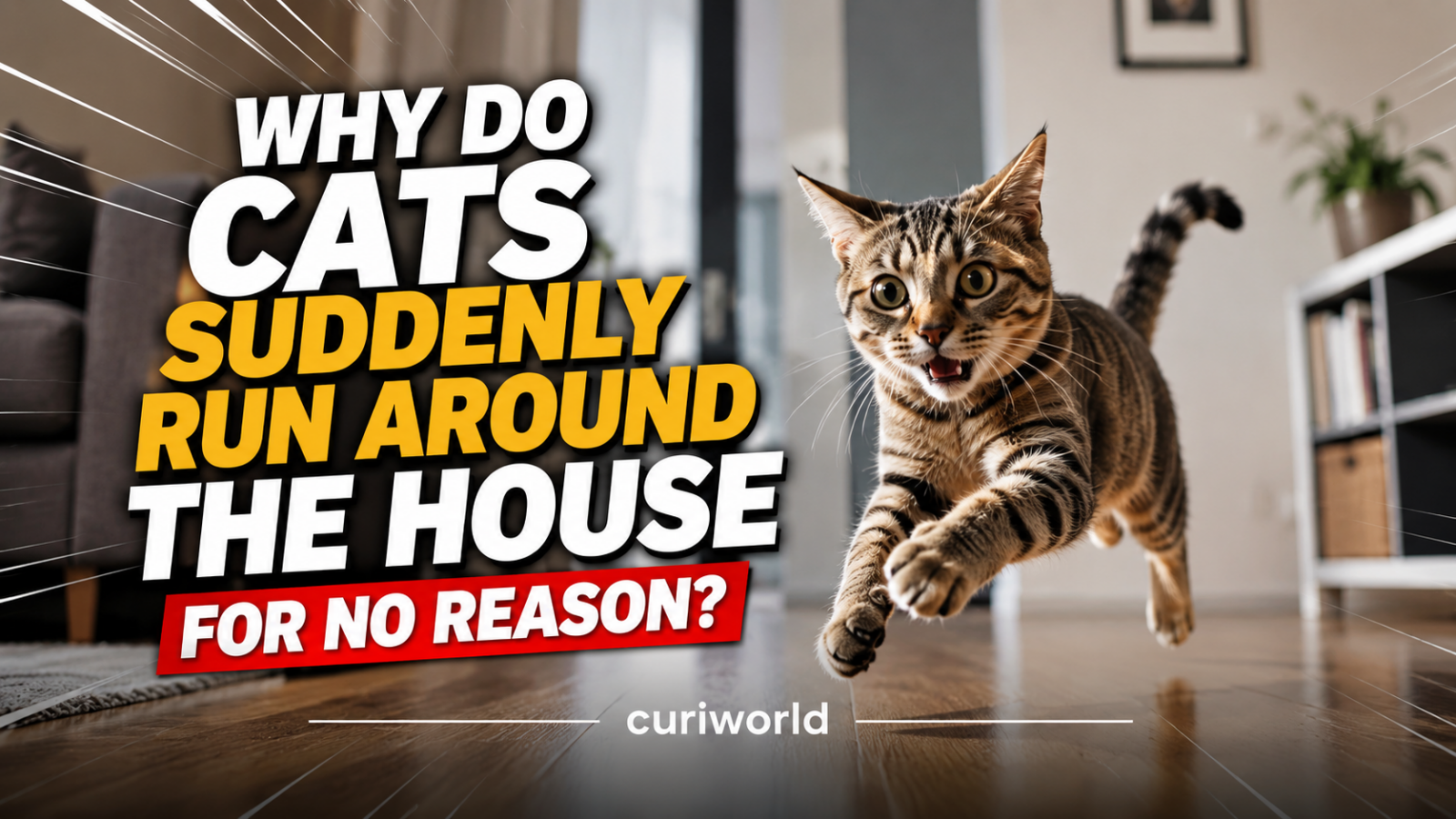
One moment your cat is asleep on the sofa. Seconds later, they are sprinting down the hallway, jumping onto furniture, making a sharp turn around a doorway, and racing into another room as if something invisible is chasing them.
These sudden bursts of energy are commonly called “the zoomies.” You may also see them described as frenetic random activity periods, or FRAPs. Despite how chaotic they look, occasional zoomies are usually a normal part of feline behavior.
Dogs can show a similarly dramatic burst of running for overlapping—but not identical—reasons. See why dogs get the zoomies for the canine version.
And although they often appear to happen for absolutely no reason, there is usually more going on than humans can see.
Cat Zoomies Are Usually a Burst of Stored Energy
Cats spend a remarkable amount of time resting. A comfortable indoor cat may sleep, nap, or quietly observe its surroundings for much of the day.
But cats are not designed for continuous low-level activity.
Their natural hunting behavior involves long periods of watching and waiting followed by short, intense movements: stalking, chasing, jumping, grabbing, and pouncing.
A domestic cat no longer has to hunt for every meal, but those behavioral instincts remain.
That helps explain why a cat can look completely relaxed and then suddenly accelerate across the room at full speed. A few minutes of intense movement may simply provide an outlet for energy that has been building during a long period of rest.
This can be especially noticeable in indoor cats that have fewer opportunities to climb, explore, chase, and hunt.
Cats are not the only pets that release energy in sudden high-speed bursts. Dogs have their own version too, and Curiworld explains why dogs get the zoomies.
Why Do Cats Often Get the Zoomies at Night?
Anyone who has been awakened by a cat racing across the bedroom at 3 a.m. may suspect that cats specifically schedule their exercise for the least convenient hour possible.
There is a biological reason nighttime and evening activity are common.
Cats are often described as crepuscular, meaning they tend to be especially active around dawn and dusk. These are also times when many of the small animals their ancestors hunted would have been active.
Domestic cats can adjust their schedules around human routines, however. A cat that sleeps through a quiet afternoon may become much more active when people arrive home, lights switch on, food appears, and the household becomes interesting again.
So a late-evening zoomie may be a combination of natural activity rhythms and a day spent conserving energy.
Your Cat May Be Rehearsing Hunting Behavior
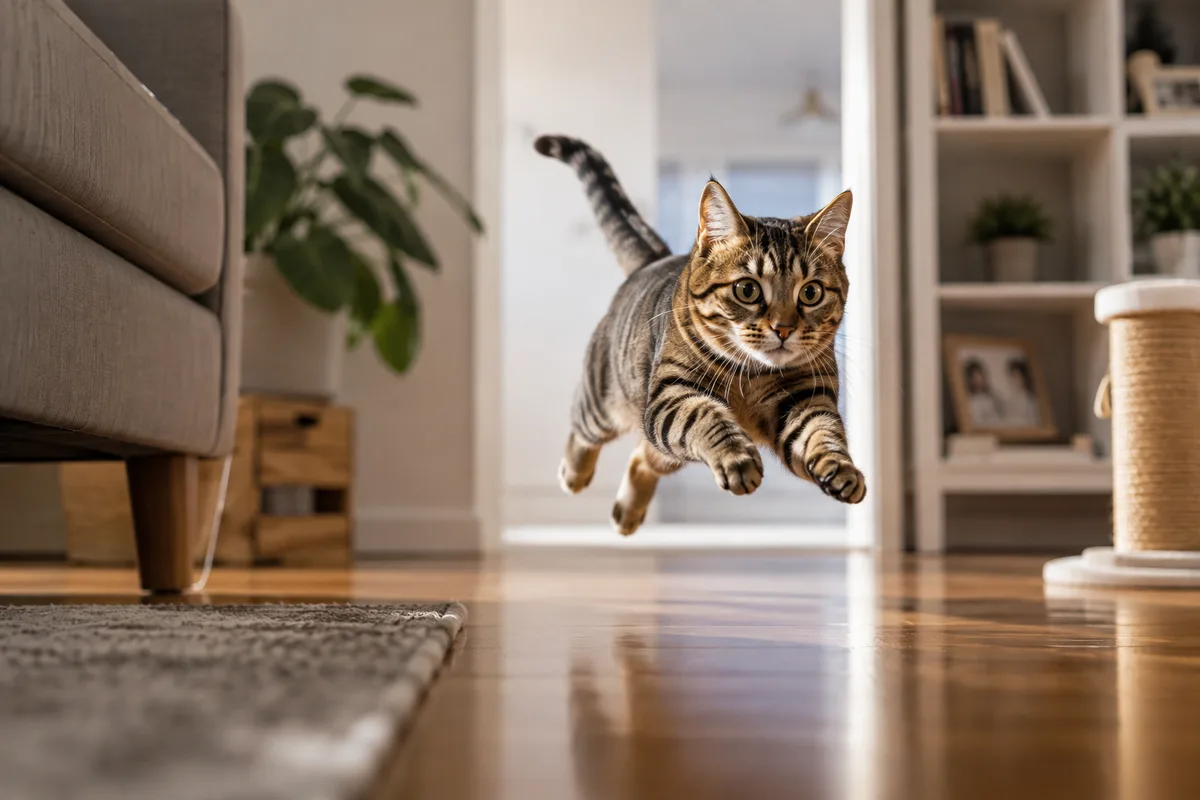
Watch a cat during the zoomies and some of the movements may look surprisingly familiar.
A sudden sprint.
A low crouch.
A rapid change of direction.
A leap onto furniture.
A pounce at a toy—or at apparently nothing.
These movements overlap with behaviors cats use during hunting and play.
Indoor cats do not lose their predatory instincts simply because their food arrives in a bowl. They still benefit from opportunities to stalk, chase, climb, scratch, pounce, and capture.
This is one reason interactive play can be so valuable.
A wand toy, moving toy, ball, or other safe object that behaves somewhat like prey can give a cat a controlled way to express the same behavioral sequence.
The goal is not necessarily to eliminate zoomies. For most healthy cats, there is no need to do that. It is to make sure the cat has enough appropriate opportunities to be physically and mentally active.
Why Do Cats Run Around After Using the Litter Box?
There is one version of the zoomies that has puzzled cat owners for years: the post-litter-box sprint.
A cat uses the litter box, jumps out, and immediately races through the house.
Several explanations have been proposed.
The physical sensation of relief after eliminating may produce a burst of excitement in some cats. Another theory involves stimulation of the vagus nerve during defecation, which may affect bodily sensations.
But there is not strong evidence proving one universal explanation for every cat.
The important point is that a brief burst of activity after using the litter box can occur in otherwise healthy cats.
What deserves more attention is a change in litter-box behavior accompanied by signs such as straining, repeated attempts to urinate or defecate, crying, blood, constipation, diarrhea, or obvious discomfort.
That is no longer simply a funny zoomie.
Kittens and Young Cats Usually Zoom More
Age makes a difference.
Kittens and young cats tend to have higher energy levels and spend more time playing, exploring, chasing, and practicing physical skills.
For them, racing through the house several times a day may be completely ordinary.
Older cats can still have zoomies too. A senior cat occasionally deciding to sprint down the hallway is not automatically a reason for concern.
The more useful thing to watch is whether the behavior has changed.
A 12-year-old cat that has always had an energetic five minutes after dinner may simply be following its normal routine.
A 12-year-old cat that suddenly becomes unusually restless, hyperactive, hungry, vocal, or unable to settle deserves closer attention.
Behavioral change often matters more than the behavior itself.
Sometimes the Trigger Is Something You Cannot See
Your cat may appear to be chasing absolutely nothing.
That does not necessarily mean nothing happened.
Cats perceive their environment differently from humans. Their hearing can detect sounds we may miss, and small movements can quickly attract their attention.
A sudden zoomie might begin with:
- an insect moving across the room;
- a noise from another part of the house;
- another pet becoming active;
- a toy shifting;
- excitement after play;
- someone arriving home;
- a sudden movement outside a window;
- an unfamiliar smell or sound.
You see a cat suddenly sprinting.
Your cat may have experienced a perfectly clear trigger three seconds earlier.
Excitement Can Cause Zoomies Too
Not every burst of running is about unused energy.
Cats can also become highly stimulated by positive events.
Some cats race around after a successful play session. Others become energetic before meals, when a favorite person arrives home, or after interacting with another cat.
Think of zoomies less as one specific behavior with one specific cause and more as a visible release of high arousal or energy.
Different cats may reach that point for different reasons.
Boredom Can Make the Problem More Noticeable
Having zoomies does not automatically mean a cat is bored.
Even cats with excellent environments can suddenly race around.
But an indoor cat with few opportunities to play, climb, scratch, investigate, or hunt may have fewer appropriate ways to use its energy.
A cat-friendly indoor environment should provide more than food and a place to sleep.
Useful enrichment can include:
- interactive play sessions;
- scratching surfaces;
- climbing structures;
- elevated resting places;
- hiding areas;
- puzzle feeders;
- toys that can be rotated;
- opportunities to watch the outside world safely;
- simulated hunting and foraging activities.
Even relatively short play sessions can make a meaningful difference because cats naturally tend to perform intense activity in bursts.
What Does a Normal Zoomie Look Like?
A typical zoomie usually begins suddenly, lasts for a relatively short period, and ends just as quickly.
The cat then returns to normal life.
They may sit down.
Start grooming.
Eat something.
Look out the window.
Or go straight back to sleep as though the previous 60 seconds never happened.
That quick return to ordinary behavior is part of what makes normal zoomies so recognizable.
The cat is energetic, not necessarily distressed.
When Sudden Running May Mean Something Else
Running itself is rarely enough to identify a health problem.
Context matters.
Pay closer attention if a cat’s sudden activity is accompanied by other behavioral or physical changes, particularly if the cat is middle-aged or older.
Potential warning signs include:
- unexplained weight loss;
- a major increase in appetite;
- increased thirst or urination;
- persistent restlessness;
- unusual vocalization;
- vomiting or diarrhea;
- difficulty settling or sleeping;
- apparent pain;
- confusion or disorientation;
- dramatic changes in normal behavior.
For example, hyperthyroidism is relatively common in middle-aged and older cats. Cornell University’s College of Veterinary Medicine notes that signs can include weight loss, increased appetite, increased thirst and urination, vomiting, diarrhea, and hyperactivity.
That does not mean an older cat with zoomies has hyperthyroidism.
It means that a new pattern of unusual hyperactivity combined with other symptoms is worth discussing with a veterinarian instead of assuming it is simply playful behavior.
Should You Stop Your Cat From Getting the Zoomies?
Usually, no.
If your cat appears healthy and the behavior is brief and playful, zoomies are generally something to accommodate rather than suppress.
What you can do is make the environment safer.
A cat traveling through the house at high speed has very little interest in your decorative vase.
Keep unstable objects away from common running routes, secure potentially dangerous furniture, and make sure windows and balconies are protected.
If your cat regularly becomes extremely energetic at night, try scheduling an interactive play session in the evening.
Use toys that allow stalking, chasing, and pouncing, and occasionally let the cat successfully catch the “prey.” A game that can never be completed may be less satisfying than one that allows the cat to finish the hunting sequence.
Food puzzles and small foraging activities can also add useful stimulation during the day.
Your Cat Probably Has a Reason—Even If You Missed It
Cat zoomies are funny partly because humans see only the dramatic ending.
We see a sleeping animal suddenly become a four-legged missile.
What we may not notice is everything that happened beforehand: hours of rest, a natural activity rhythm, a tiny sound, an exciting movement, a successful trip to the litter box, pent-up energy, or a moment when hunting instincts suddenly found an outlet.
For most healthy cats, those brief sprints are simply another expression of normal feline behavior.
So when your cat tears through the hallway, bounces off the sofa, makes an impossible turn, and then casually begins grooming as though nothing happened, there probably was a reason.
It just made more sense to your cat than it did to you.
Sources
PetMD — Why Do Cats Get the Zoomies?
https://www.petmd.com/cat/behavior/why-do-cats-get-zoomies
Cornell University College of Veterinary Medicine — Hyperthyroidism in Cats
https://www.vet.cornell.edu/departments-centers-and-institutes/cornell-feline-health-center/health-information/feline-health-topics/hyperthyroidism-cats







Join the discussion