Why Does Time Feel Faster as We Get Older?
Why do years seem to shrink with age? Psychology points to memory, routine, attention, and the way we reconstruct our lives.
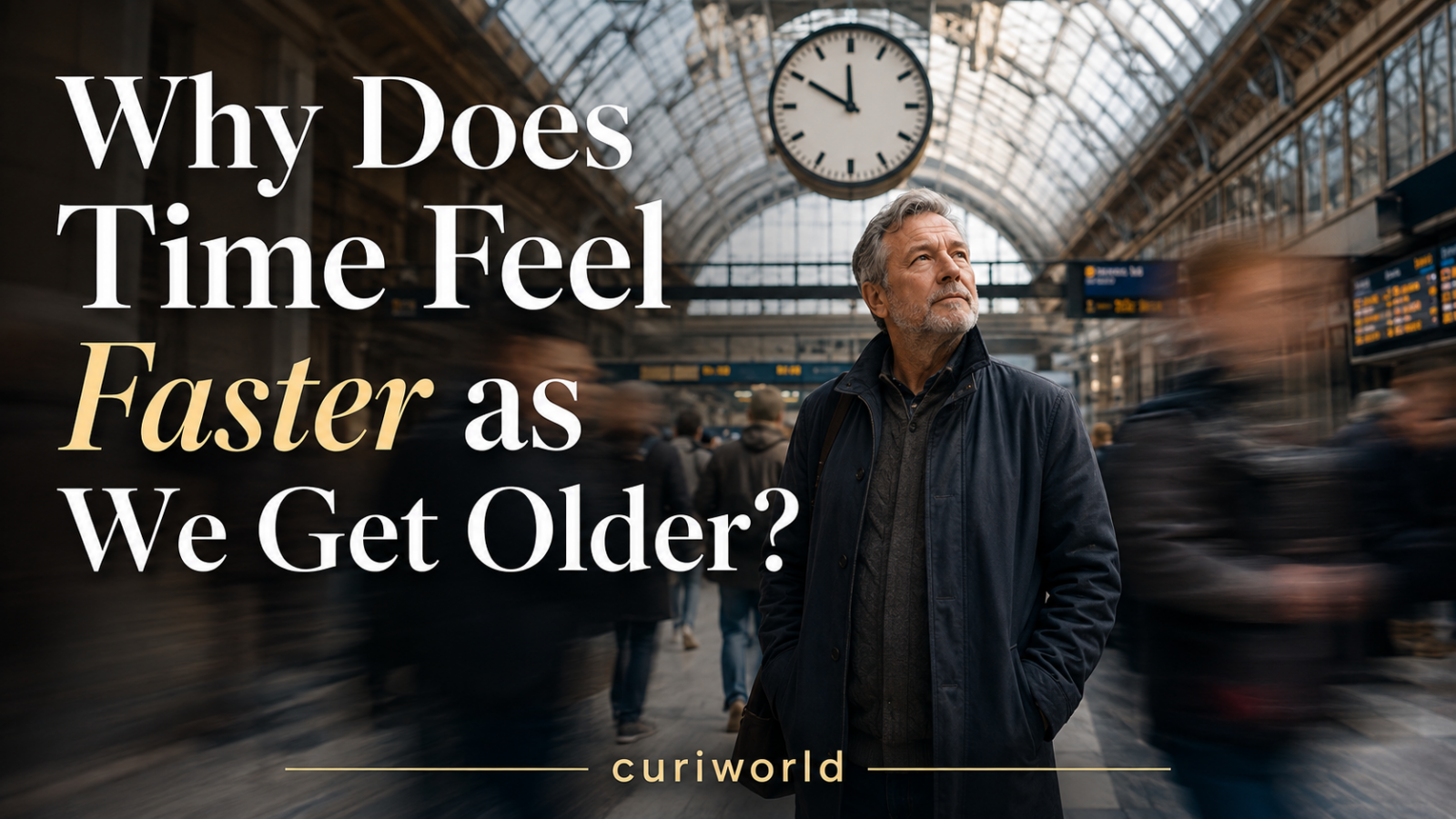
A childhood summer can seem almost endless. Later in life, an entire year can disappear between two birthdays.
The clocks have not changed, but our experience of time clearly can. The most interesting part is that science does not support the simple idea that every minute literally begins to feel faster as we age. The age effect appears much more strongly when people look back across years or decades than when researchers ask how quickly time seems to be moving at an ordinary moment.
That distinction changes the question. The mystery is not simply why older brains have a “faster clock.” It is how memory, attention, routine, emotion, and the structure of a life combine to create the impression that the years are shrinking.
Time Does Not Speed Up in Every Sense
Psychologists distinguish between estimating how long something lasted and judging how quickly time seemed to pass. Those sound similar, but experiments suggest they are not the same mental process.
In a well-known study involving 499 people between the ages of 14 and 94, researchers found some evidence that perceived time passage changes with age. Yet the effects were relatively modest: age explained only a small portion of the differences in how people experienced time.
Other research complicates the popular story further.
An experience-sampling study comparing younger and older adults found no significant difference between the groups in how quickly time seemed to be passing during everyday life. Instead, emotional state and engagement with an activity were more closely related to the immediate experience of time.
The strongest age-related pattern tends to appear over much longer periods.
A 2026 study in Memory & Cognition examined adults between ages 20 and 91. Older age was associated with a faster perceived passage of the previous decade, while the relationship was much weaker for the previous year.
So the familiar phrase “time speeds up as you get older” is partly right, but too broad. What seems especially vulnerable to compression is remembered life time.
Memory Gives Time Its Landmarks

Imagine two months with exactly the same number of days.
During the first, you start a new job, visit an unfamiliar city, meet several new people, and learn a new skill. During the second, your schedule barely changes.
Both months occupy the same amount of calendar time. Looking back, however, the first may feel considerably more substantial.
One reason is that memory does not preserve life as a continuous recording. Our recollections are organized around events, changes, transitions, and other distinctive information.
Sensory cues can become especially powerful memory landmarks. See why certain smells can bring back vivid memories years later.
Research on routine has demonstrated this effect experimentally. Periods containing more repetitive activity can later be remembered as shorter than periods containing greater variation.
That makes intuitive sense. A week containing five nearly identical workdays provides fewer obvious mental boundaries than five days filled with substantially different experiences.
But “more novelty equals slower time” is still too neat.
Recent research exploring autobiographical time perception suggests that routine may contribute to the feeling that time has passed quickly, but the effect is not perfectly consistent. Periods associated with personal growth can also be remembered as having passed rapidly.
Memory matters, but there is no single novelty switch controlling the speed of life.
Our sense of time is not the only way memory can make experience feel strangely familiar; déjà vu has its own fascinating explanation.
New Research Points to Memory Encoding, Not Simply the Number of Memories
Recent research offers an especially useful refinement.
In a 2026 study, researchers asked adults how quickly the previous year and previous ten years seemed to have passed. They also examined autobiographical memories and several aspects of cognitive functioning.
A simple memory-density explanation would predict that older adults feel decades have passed quickly because they can retrieve fewer meaningful memories from them.
That is not what the researchers found.
Older participants still described their autobiographical memories as vivid and meaningful. Neither the number of memories they produced nor their subjective value fully explained how quickly the decade seemed to have passed.
Instead, faster perceived passage of the previous decade was associated with poorer performance on a delayed-memory task designed to measure the ability to encode and later retrieve new information.
This does not prove that changes in memory encoding cause years to feel faster. The study was cross-sectional, meaning it compared people of different ages rather than following the same individuals across decades.
Still, it suggests a more interesting possibility: what matters may not simply be how many life events you can consciously list later, but how densely new information was encoded while those years were being lived.
What About the “Each Year Is a Smaller Fraction of Your Life” Theory?
One of the most popular explanations is also one of the oldest.
When you are 10 years old, one year represents one-tenth of the life you have lived. At 50, a year represents only one-fiftieth. From that perspective, each successive year becomes proportionally smaller.
The arithmetic is appealing, and proportionality may help explain why age differences become more noticeable when people judge decades rather than much shorter periods.
But there is an important distinction between a persuasive metaphor and a demonstrated psychological mechanism.
There is no established evidence that the brain literally calculates each year as a percentage of total lifespan and adjusts subjective time accordingly.
If this theory were the complete explanation, age alone should predict the experience of time much more consistently than research suggests it does.
It is better understood as one possible way of describing the experience, not as a proven internal clock mechanism.
A Moment Can Fly Yet Become a Long Memory
There is another apparent contradiction hiding in everyday expressions about time.
A fascinating afternoon can be over before you know it. A boring wait can feel endless.
Yet months later, the interesting afternoon may occupy far more space in memory than the uneventful one.
Both impressions can be genuine because experienced time and remembered time are different judgments.
When people are absorbed in an enjoyable activity, they may pay less attention to the passing minutes. Time can therefore seem to move quickly in the moment.
Looking back later, however, a varied experience may contain many more memory landmarks.
Consider a week-long trip to an unfamiliar place. The days may seem to move quickly while you are occupied with new surroundings. Once home, the same week can feel unusually rich and extended in memory because it contains distinct places, meals, conversations, journeys, and surprises.
A routine week can produce the reverse effect. Monday through Friday happened, but fewer memorable boundaries may separate one day from another.
That is why asking “Did time feel fast while it was happening?” can produce a very different answer from “How long does that period feel when you remember it?”
Routine, Time Pressure, and Attention Also Matter
Age does not happen in isolation. Life itself changes.
Work schedules, family responsibilities, commuting, and repeated habits can make adult life more structured than childhood. Research has found that perceived time pressure, routine, and the declining frequency of unfamiliar experiences can all influence judgments about how quickly longer periods seem to pass.
That helps explain why two people of the same age can experience a year very differently.
A highly repetitive period may blur together. Another year filled with transitions, learning, relationships, travel, or unfamiliar environments can leave many recognizable chapters.
Attention matters too.
When attention is focused directly on time—during a delayed flight, an uncomfortable wait, or a tedious meeting—minutes can seem painfully slow.
When attention is absorbed elsewhere, hours may disappear almost unnoticed.
Mood, expectations, memory, routine, and attention all interact with age. Researchers increasingly treat subjective time as the result of several processes rather than a single biological timer.
Age is part of the story, not the whole story.
Why Childhood Often Feels So Much Longer
Childhood contains something adulthood often has less of: firsts.
The first day at a new school. The first long trip. The first close friendship. The first time visiting another city. The first concert, competition, sleepover, or major family event.
A child’s world is filled with unfamiliar information.
New experiences require attention because the brain cannot rely as heavily on established routines. They also create clearer boundaries in memory. One school year may contain dozens of distinct milestones that later divide it into recognizable chapters.
Adult life can become more predictable.
The route to work is familiar. The supermarket is familiar. Weekends may follow a pattern. Many tasks can be completed with less conscious attention because they have been repeated hundreds of times.
This does not mean adults stop forming meaningful memories. Nor does it mean childhood literally runs in slow motion.
It means that childhood often contains a higher density of experiences that feel distinct from what came before.
Looking backward, that density can make the period seem larger.
Can You Make Time Feel Slower?
There is no scientifically established technique that can make a 24-hour day subjectively expand on command.
And making every moment feel slower would not necessarily be pleasant. Boredom, frustration, pain, and waiting can make minutes drag.
A more useful goal may be to make months and years feel less interchangeable.
Research on memory and routine suggests several practical ways to create more distinguishable periods:
- Introduce meaningful variation into otherwise repetitive weeks.
- Learn skills that require genuine concentration.
- Visit unfamiliar places, even within your own city.
- Change routines occasionally instead of always following the same sequence.
- Create distinct occasions that divide long stretches of ordinary life into recognizable chapters.
- Give important experiences your attention instead of constantly dividing it between multiple screens and distractions.
None of these habits can guarantee that time will feel slower.
Nor does science show that endlessly chasing novelty is a formula for making life feel longer. Constant stimulation can become routine too.
The more useful idea is that memory benefits from distinctions.
A year containing several memorable transitions may leave a richer mental structure than one in which months repeatedly resemble each other.
The Clock Is Steady. Our Memory of the Journey Is Not.
The feeling that time accelerates with age is real for many people, but there is probably no single explanation behind it.
The evidence points toward a combination of factors: how memories are encoded, how repetitive life becomes, how much attention we give to our surroundings, how emotionally engaged we are, and how we reconstruct long periods after they have passed.
Age can influence all of these processes without acting as a simple speed control for the brain.
That is why a joyful afternoon can vanish in an instant yet remain enormous in memory years later—and why several routine months can disappear almost without leaving a boundary between them.
The calendar moves at exactly the same pace it always has.
What changes is the number and richness of the landmarks we leave behind.
Sources
Alice Teghil, Sebastian Wittmann, Adele Lifrieri et al. — “Memory encoding for new information, not autobiographical memory load, is linked with age-related differences in subjective time passage over the past decade” — Memory & Cognition (2026)
Springer Nature article
Marc Wittmann & Sandra Lehnhoff — “Age Effects in Perception of Time” — Psychological Reports (2005)
PubMed record
Sylvie Droit-Volet & John Wearden — “Passage of Time Judgments Are Not Duration Judgments: Evidence from a Study Using Experience Sampling Methodology” — Frontiers in Psychology (2016)
Frontiers article








Join the discussion