Why Doesn’t the US Use the Metric System?
The US never completely rejected the metric system—in fact, Americans use it every day. The real story is why miles, pounds and inches never disappeared.
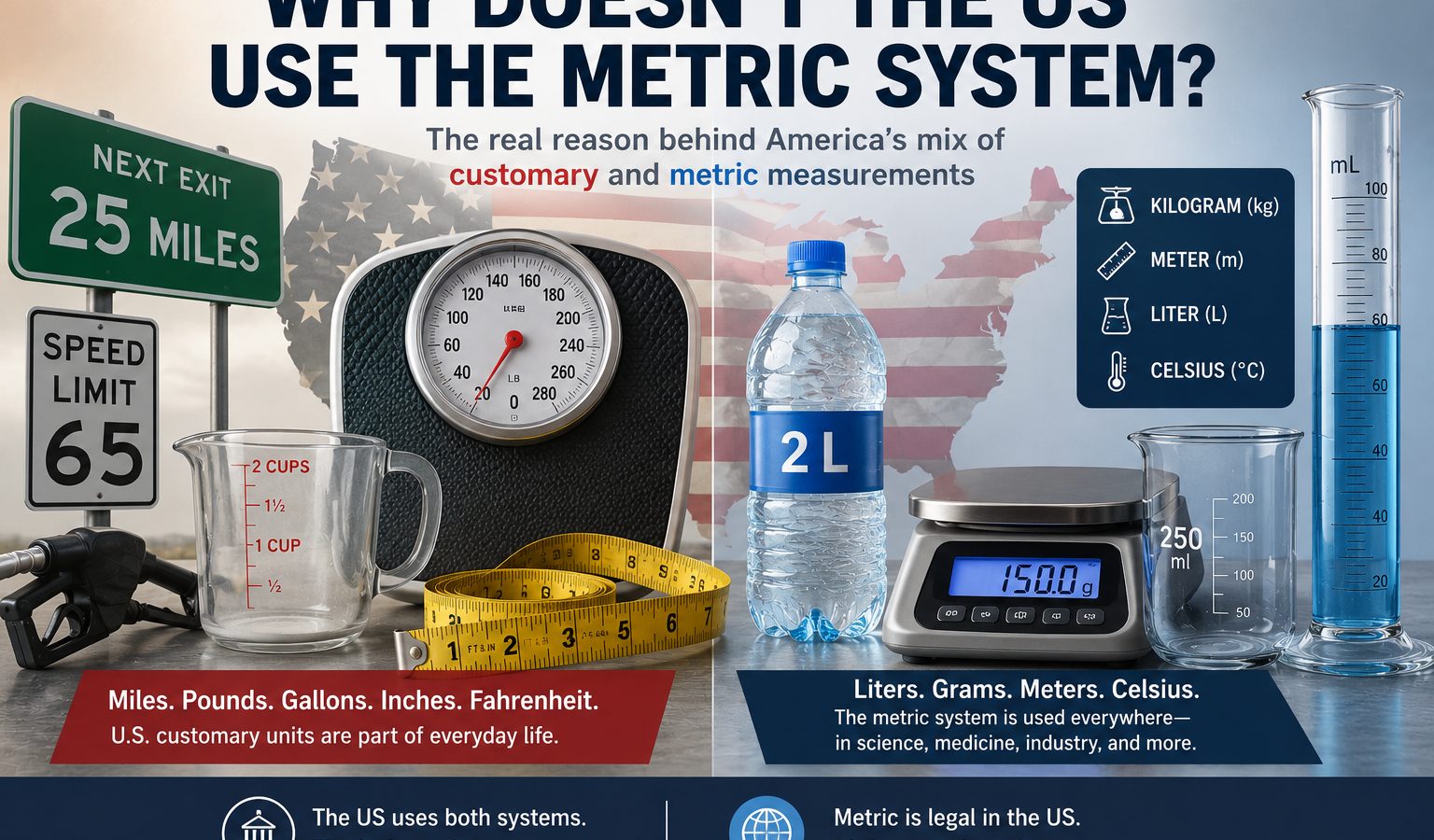
Drive through the United States and the signs tell you how many miles remain. Check the weather and you’ll probably see degrees Fahrenheit. Buy milk and you may take home a gallon.
Then walk into a pharmacy and find medicine measured in milligrams. Pick up a two-liter bottle of soda. Look under the hood of a car and you’ll encounter metric measurements almost immediately.
So does the United States actually use the metric system?
Yes—much more than the usual joke suggests.
The better question is why the US never made metric units the dominant language of everyday measurement. The answer isn’t that Americans rejected metric measurement outright. The country legalized the metric system in the nineteenth century and later made it the preferred system for trade and commerce. But conversion remained largely voluntary, while miles, pounds, feet, inches and gallons were already deeply embedded in daily life and infrastructure.
The result is the unusual hybrid system Americans live with today.
First, the US Does Use the Metric System
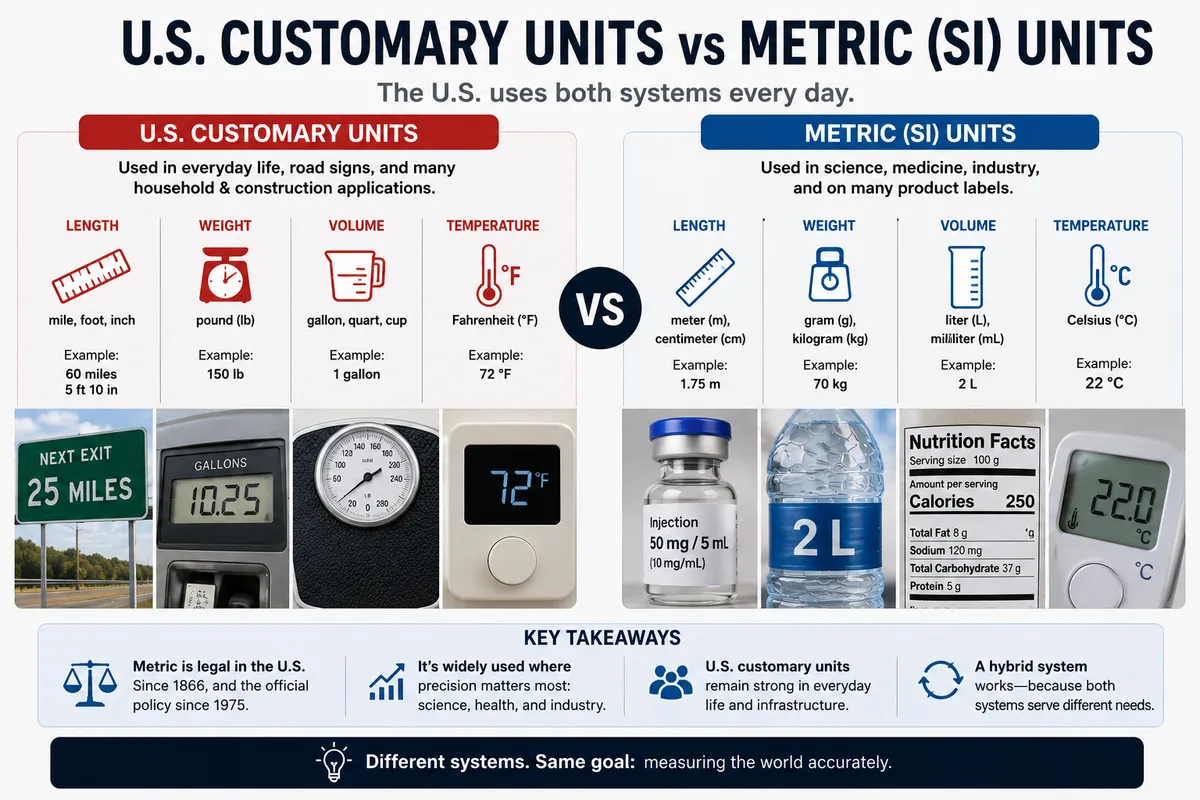
The idea that the United States simply “doesn’t use metric” is one of the biggest misconceptions surrounding the subject.
According to the National Institute of Standards and Technology (NIST), the US is better described as a hybrid measurement system, where metric and U.S. customary units routinely coexist.
You can see that without entering a laboratory.
Soft drinks are commonly sold in liters. Nutrition and pharmaceutical measurements use grams and milligrams. Many automotive, scientific, medical and industrial applications rely heavily on metric units. Product labels frequently display both systems.
Metric measurement isn’t foreign to the United States.
It just never completely displaced the older customary units people encounter in everyday situations.
What Does the US Use Instead?
The familiar American system is properly called U.S. customary units.
That distinction matters because you’ll often hear people say that America uses the “imperial system.” U.S. customary and British imperial units share historical roots, but they are not identical systems.
Some units even have different values.
A U.S. gallon, for example, is smaller than an imperial gallon. The same is true for several related liquid measures.
So the global comparison isn’t simply:
Metric vs Imperial
A more accurate description is:
SI (metric) vs U.S. customary units
In everyday American life, those customary units remain highly visible: miles for road distances, feet and inches for height, pounds for body weight and Fahrenheit for weather temperatures.
America Considered Metric Measurement Surprisingly Early
Metric measurement isn’t a recent arrival in American law.
The Metric Act of 1866 made it legal to use the metric system in the United States. The country was also one of the original signatories to the Metre Convention in 1875, which established an international framework for measurement standards.
So the United States wasn’t isolated from metric development.
The bigger issue was conversion.
Existing American measurements were already woven into commerce and daily life. Legalizing another system didn’t automatically cause businesses, builders, manufacturers and consumers to abandon the units they already understood.
That distinction—between allowing metric units and requiring a transition to them—would become crucial a century later.
What Happened in 1975?
This is often where simplified versions of the story say, “America tried to go metric and failed.”
The reality is more interesting.
President Gerald Ford signed the Metric Conversion Act of 1975, establishing a national policy for increasing metric use. But the American transition was not designed as an immediate compulsory replacement of customary measurements.
It was voluntary.
That matters enormously.
Countries that carried out broad metrication programs could coordinate changes across government, education, road signs, commerce and industry. A voluntary approach lets individual businesses, organizations and consumers decide when switching makes sense.
That reduces the disruption of an abrupt nationwide conversion.
It also makes change much slower.
NIST still describes U.S. metrication as a process in which different industries move toward SI at different speeds.
Then the US Made Metric the “Preferred” System
American metric policy went further in 1988.
Congress amended the Metric Conversion Act and designated the metric system as the preferred system of weights and measures for United States trade and commerce.
Federal agencies were also directed to use metric measurement in business-related activities when economically feasible, subject to practical exceptions.
That sounds very different from the idea that the United States somehow refuses to recognize metric measurement.
It does.
What the country generally hasn’t done is impose a complete mandatory conversion on everyday civilian life.
That is why an American highway can still show miles while a bottle beside the driver is labeled in liters.
Why Is Switching So Difficult?
Imagine changing a measurement system only as a matter of vocabulary.
Instead of saying 10 miles, people learn to say about 16 kilometers. Instead of buying a pound of something, they ask for roughly 454 grams.
That doesn’t sound impossible.
But measurement systems aren’t stored only in people’s heads. They’re built into physical and economic systems.
Road signs use miles. Construction materials come in familiar dimensions. Recipes use cups and ounces. Real estate is described in square feet. Tools, machinery, packaging, building practices, regulations and countless existing documents were created around familiar units.
Replacing all of that at once would create costs.
Businesses also face a practical question: if their customers expect inches and pounds, what advantage do they gain by forcing those customers to switch?
This is one reason voluntary metrication can become self-reinforcing. People continue using customary measurements because businesses support them, while businesses continue supporting them because customers use them.
Neither side has a strong reason to move first.
Familiar Standards Are Surprisingly Hard to Replace
We’ve already seen the same pattern with A4 and Letter paper sizes.
A4 belongs to an internationally standardized system with an elegant mathematical structure. Yet Letter remains deeply established in the United States because printers, forms, offices and filing systems already work with it.
Measurement is an even larger version of that problem.
People don’t experience inches or miles as an unusual national standard when they grow up using them. They experience them simply as measurement.
Ask an American how tall someone is and “six feet” can produce an immediate mental picture. Say “183 centimeters” and some people may need to convert it first.
Neither number describes the person more accurately merely because it belongs to one system or the other.
Familiarity is powerful.
The same kind of historical lock-in appears far beyond measurement. Roads, vehicles and everyday habits can preserve a convention for generations, which helps explain why countries still drive on different sides of the road.
Why Are Science and Medicine Different?
Some fields have much stronger reasons to use internationally consistent units.
Science is an obvious example. Research crosses borders constantly, and a common measurement language makes collaboration and comparison easier. The International System of Units, or SI, provides that shared framework.
Healthcare also makes extensive use of metric measurements. Medication quantities may be expressed in milligrams, while laboratory and clinical measurements frequently use SI or metric units.
Internationally connected manufacturers may have similar incentives.
A company designing products for markets around the world gains little from maintaining completely separate measurement practices when suppliers and customers already work in metric units.
This explains why U.S. metrication isn’t uniform.
Different parts of the economy encounter different incentives to change.
Sometimes Americans Don’t Even Notice They’re Using Metric
One of the most interesting aspects of American measurement is how normal certain metric units have become.
A two-liter bottle doesn’t feel particularly European or scientific in an American supermarket.
A 5K race is another familiar example.
Consumers routinely encounter milligrams on medication and grams on food labels. Mechanics and engineers work with metric components. Photography and electronics contain numerous measurements that cross easily between international markets.
NIST notes that many American industries have effectively adopted metric practices in response to business and market demands.
Metrication can therefore happen quietly.
A country doesn’t necessarily wake up one morning, replace every road sign and announce that conversion is complete.
Industries can change one at a time.
Aren’t American Units Ultimately Connected to Metric Anyway?
Here’s the part that makes the “America doesn’t use metric” claim especially misleading.
Modern U.S. customary units are legally defined in relation to metric units.
For example, the international yard is defined as exactly 0.9144 meter, which means an inch is exactly 25.4 millimeters.
The relationship has deep roots in American measurement policy. NIST notes that U.S. customary units of mass and length have been defined in metric terms since the Mendenhall Order of 1893, with modern definitions continuing to rely on SI.
So even when someone measures a piece of wood in inches, the standardized inch itself ultimately has an exact relationship to the meter.
Metric measurement is more deeply embedded in the American system than everyday appearances suggest.
Would Going Fully Metric Still Have Advantages?
Using one measurement system can eliminate unnecessary conversions.
That matters because conversion errors aren’t always harmless.
One of the most famous examples occurred with NASA’s Mars Climate Orbiter in 1999. A mismatch involving metric and U.S. customary units contributed to the loss of the spacecraft.
The lesson isn’t that customary units are inherently dangerous. The problem was mixing measurement systems without handling the conversion correctly.
Maintaining two systems creates opportunities for exactly that kind of mistake.
A fully metric environment could also simplify some international manufacturing, trade and technical communication.
But potential long-term benefits still have to compete with the immediate cost and inconvenience of changing established practices.
That trade-off has shaped American metrication for decades.
Will the US Ever Become Fully Metric?
There is no simple deadline waiting in the future.
Under current U.S. policy, metric adoption has largely developed along a continuum. Some sectors are already heavily metric, others routinely use both systems, and many areas of everyday life remain dominated by customary units.
That means the United States could continue becoming more metric without a dramatic national “switch.”
International manufacturing encourages metric use. Science and medicine already depend heavily on it. Consumers encounter metric quantities every day.
Meanwhile, miles, inches, pounds and Fahrenheit remain culturally and practically entrenched.
The most realistic future may therefore look much like the present, only with metric measurement gradually appearing in more places.
The Bottom Line
The United States doesn’t avoid the metric system nearly as completely as popular culture suggests.
Metric measurement has been legal in the country since 1866. The Metric Conversion Act of 1975 established a national metrication policy, and Congress later designated metric as the preferred measurement system for U.S. trade and commerce.
What America didn’t do was force a rapid, universal conversion of everyday life.
Instead, metrication remained largely voluntary. That allowed established U.S. customary units to survive wherever the cost or inconvenience of switching outweighed the immediate benefit.
The result is the system Americans use today: miles on highways, liters in supermarkets, pounds on bathroom scales and milligrams in medicine cabinets.
So the answer to “Why doesn’t the US use the metric system?” is slightly unexpected.
It does. It just never stopped using the other system.
Sources
National Institute of Standards and Technology — The Reason the U.S. Doesn’t Use the Metric System
National Institute of Standards and Technology — Metrication in Law








Join the discussion