13:00 or 1 PM? Why Countries Tell Time Differently
Why does 18:00 feel completely normal in one country and unusual in another? The answer lies in convention, clarity and how different parts of the world learned to tell time.
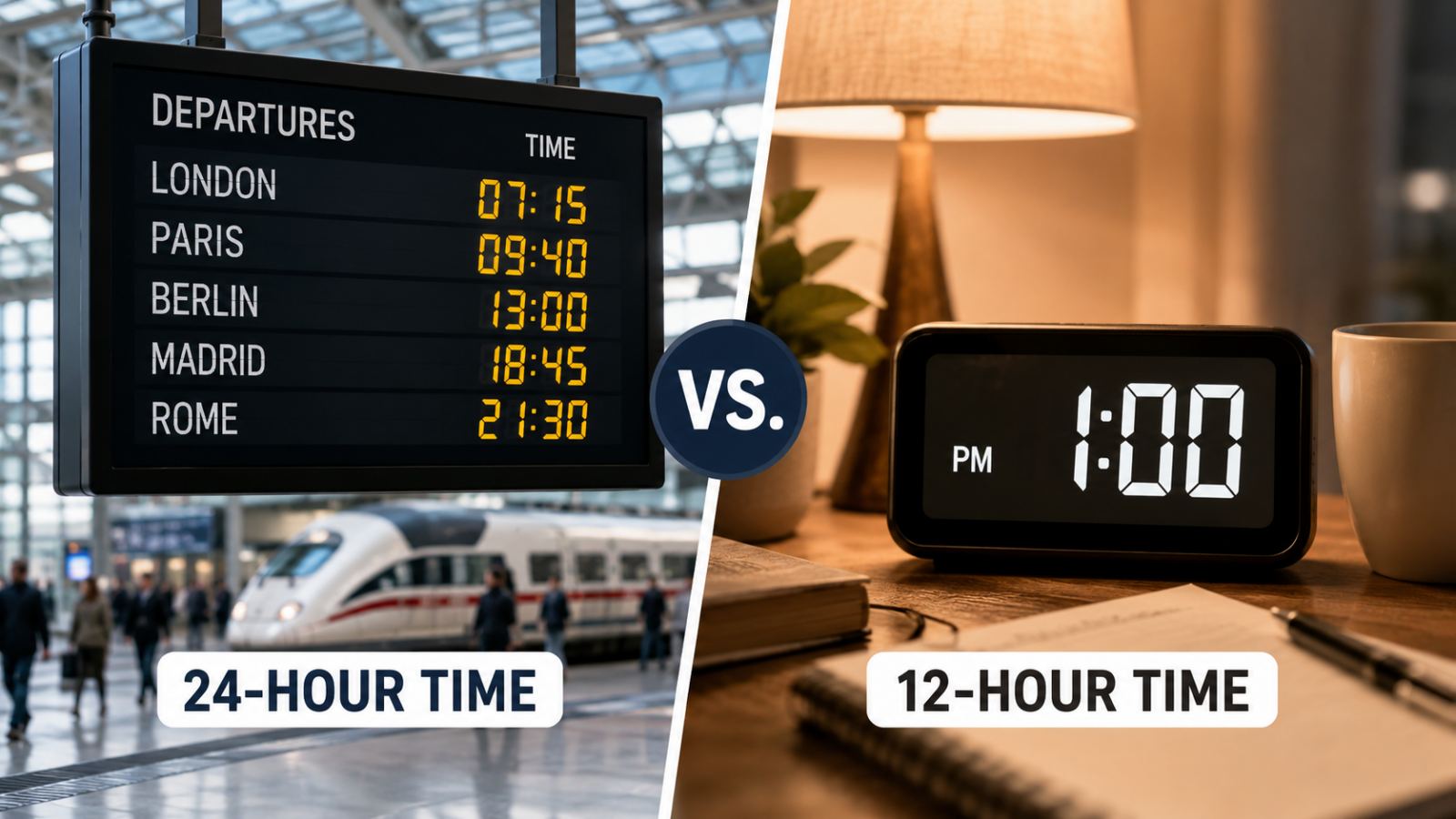
A train departure at 18:45 and a dinner reservation at 6:45 PM describe the same point in the evening, but they belong to two different ways of writing time. The 24-hour clock is familiar on timetables, phones and official schedules across much of the world, while the 12-hour clock with AM and PM remains especially common in everyday American English.
So why do some countries use 24-hour time? The practical advantage is straightforward: every hour of the day has its own number, so there is no need to specify AM or PM. Local habits explain why one format feels more natural than another, while transport, healthcare, computing and international standards have given the 24-hour clock an especially useful role when ambiguity matters.
Time notation is only one everyday standard that developed differently around the world. Paper followed another path, which is why A4 and US Letter are still different sizes.
How the 24-Hour Clock Works
The 12-hour clock divides a day into two cycles. After 12:59, the numbers begin again at 1:00, which means AM or PM is needed when context isn’t enough.
The 24-hour clock continues counting after noon. 13:00 is 1:00 PM, 18:30 is 6:30 PM, and 23:00 is 11:00 PM. Midnight marks the beginning of the next cycle at 00:00.
For afternoon and evening times, the quickest conversion is to subtract 12 from the hour. That turns 16:00 into 4:00 PM and 21:30 into 9:30 PM. After a little exposure, the conversion often stops feeling like a calculation at all.
The real benefit is that 08:00 and 20:00 can never be mistaken for each other. One is eight in the morning; the other is eight in the evening.
Why Is 24-Hour Time Common in So Many Places?
There wasn’t a single international decision that divided the world into “24-hour countries” and “12-hour countries.” Time notation developed alongside local language, custom and institutions, and those conventions became familiar through repeated use.
The 24-hour system does, however, solve a practical problem very neatly. A time such as 19:15 contains all the information needed to identify which part of the day is meant. Writing 7:15 requires either PM or enough context for the reader to infer it.
That distinction matters most when a misunderstanding has consequences. Train stations, airports, hospitals, emergency services and technical systems handle large numbers of times every day, often without the conversational context that makes “seven tonight” obvious.
Official European usage provides a good example. The European Commission’s English Style Guide prefers the 24-hour system and recommends forms such as 09:30, 12:00 and 14:00. It still allows the 12-hour system in less formal writing, which reveals something important: these formats can coexist rather than replacing one another.
Writing 19:00 Doesn’t Mean Saying “Nineteen Hundred”
This is where the phrase “countries that use 24-hour time” can be misleading. Someone may read 19:00 on a railway departure board and then tell a friend, “I’ll see you at seven.” Written convention and spoken language don’t have to match exactly.
That is common because conversation supplies context. If two people are arranging dinner, “seven” is unlikely to mean seven in the morning. A railway database can’t safely make the same assumption.
The pattern is similar to European date formats. A country can develop a familiar convention for displaying information without requiring people to speak in precisely the same format.
This is also why it is too broad to say that “Europe uses 24-hour time.” Usage varies by country, language and situation. What is common in a timetable or official document may not be the way friends describe the same time over dinner.
Why Does the United States Usually Use AM and PM?
In everyday American life, the 12-hour clock is deeply established. Store hours, invitations, appointments and ordinary conversation commonly use times such as 9:00 AM or 6:30 PM.
Most of the time, the system works without difficulty because context fills in what the numbers leave out. “Lunch at one” and “dinner at seven” rarely need AM or PM in conversation.
Once a convention becomes familiar to an entire population, there is little incentive to replace it simply because another system is more common elsewhere. This is a recurring feature of everyday standards. The system people already know often has the strongest advantage of all: everyone around them understands it.
The United States isn’t unfamiliar with 24-hour notation, either. It appears in military and other settings where eliminating uncertainty between morning and evening is useful. The difference is that it never displaced the 12-hour clock as the dominant convention of ordinary civilian life.
Is 24-Hour Time the Same as Military Time?
Not exactly, although the terms are often used interchangeably in the United States.
Both systems number the hours continuously through the day, but ordinary civilian 24-hour notation typically uses a colon:
18:30
Military-style notation may appear as:
1830
and can follow additional conventions involving pronunciation and time zones.
So a train ticket displaying 18:30 isn’t using “military time” in any meaningful military sense. It is simply using the 24-hour clock.
Why Timetables and Technical Systems Favor It
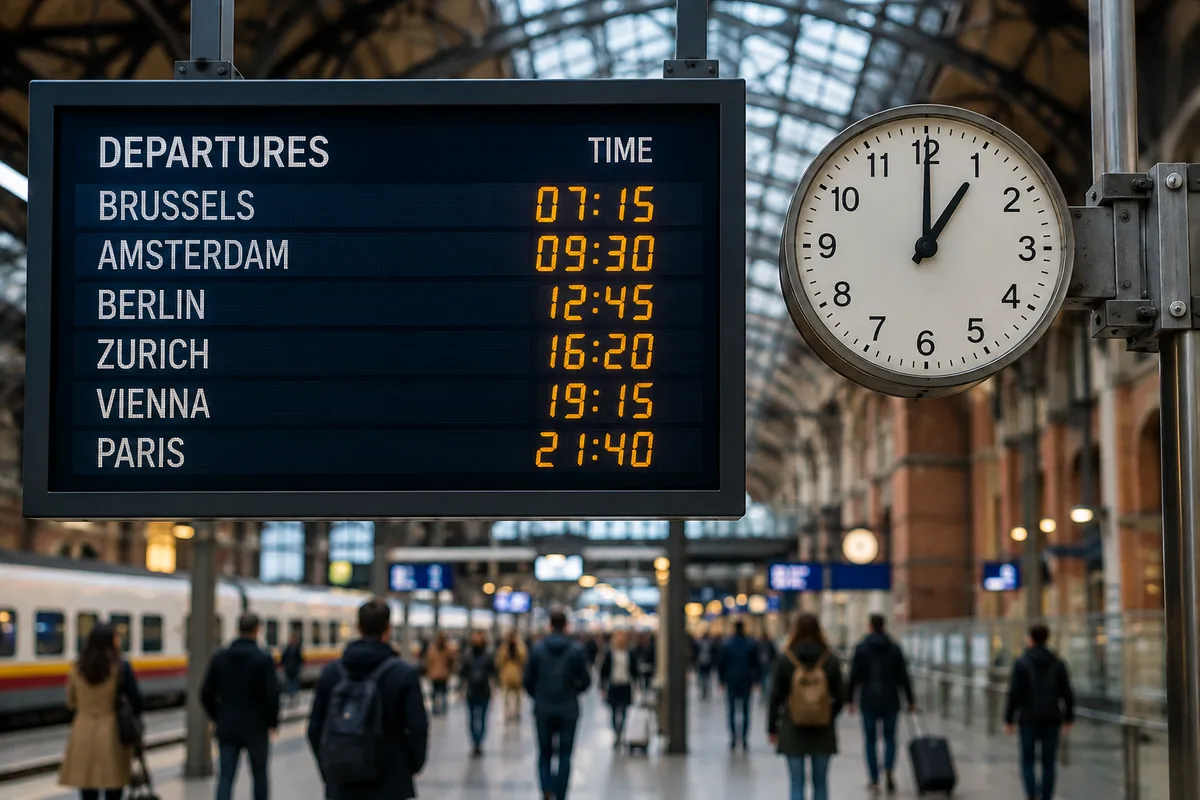
Imagine a schedule containing two departures simply labeled 7:15. One leaves in the morning and one in the evening. Without AM, PM or another clue, the schedule is incomplete.
Write them as 07:15 and 19:15, and the problem disappears.
The same clarity can be valuable when recording medical observations, coordinating international operations or storing dates and times in computer systems. A notation that removes one possible ambiguity becomes more useful as the number of records grows.
ISO 8601, the international standard for representing dates and times in information exchange, uses times based on the 24-hour clock. The currently published ISO 8601-1:2019 standard covers representations of Gregorian calendar dates and 24-hour-clock times, including their use with Coordinated Universal Time.
That doesn’t make the 24-hour clock inherently superior for every conversation. It makes it particularly well suited to situations where information needs to be interpreted consistently by different people—or different machines.
What About Noon and Midnight?
The transition around noon is simple in 24-hour notation:
11:00 → 12:00 → 13:00
Midnight is commonly represented as 00:00 at the beginning of a date. The European Commission’s style guidance also recognizes 24:00 when referring to the end of a given date, with 24:00 on one day representing the same instant as 00:00 on the following day.
The 12-hour system has a familiar complication here: 12 AM and 12 PM are easy to confuse. Writing “noon” or “midnight” can often be clearer when using ordinary English.
With the 24-hour system, the progression through the end of the day is visually straightforward:
22:00 → 23:00 → 00:00 → 01:00
The clock resets when the new day begins.
Why Doesn’t Everyone Just Use the Same Clock?
Because both systems already work.
If an entire community understands that an office opens at 9 AM and a movie begins at 8 PM, changing the notation offers little everyday benefit. Likewise, someone who has grown up seeing 14:00 and 20:30 doesn’t experience those times as complicated or unusually formal.
Digital technology has made coexistence even easier. Phones, computers and many other devices can display either format. International travelers can learn the conversion quickly, while transport and technical systems can use 24-hour notation where precision is valuable.
This is the same reason many everyday systems survive even when they differ across borders: changing a familiar convention has a cost, while keeping it usually doesn’t.
Is One System Actually Better?
For casual conversation, there is no universal winner. Familiarity and context matter more than notation.
For schedules and information exchange, the 24-hour clock has a clear practical advantage because each numerical time identifies a unique part of the day. 08:00 and 20:00 require no additional AM or PM label.
The 12-hour clock, meanwhile, fits naturally into the everyday speech of countries where it is already established. Most conversations don’t need the precision of a railway timetable or hospital record.
That is why the two systems continue to coexist rather than one eliminating the other.
The Difference Is Smaller Than It Looks
The contrast between 13:00 and 1 PM can initially feel like another major international difference, but both systems are doing exactly the same job. They simply encode the information differently.
The 24-hour clock became especially useful in contexts where ambiguity between morning and evening needs to disappear. The 12-hour clock remained deeply embedded in everyday language and culture in places such as the United States. Many countries comfortably move between formal 24-hour notation and more conversational ways of speaking about time.
Once you recognize that distinction, a foreign timetable becomes much less mysterious.
13:00 and 1 PM are the same moment. What changes across borders is the convention used to describe it.
Sources
European Commission — English Style Guide
International Organization for Standardization — ISO 8601-1:2019








Join the discussion