A4 vs Letter: Why Are Paper Sizes Different in the US and Europe?
A4 and US Letter look almost identical, but they belong to two very different systems. Here's why their dimensions differ—and why neither standard disappeared.
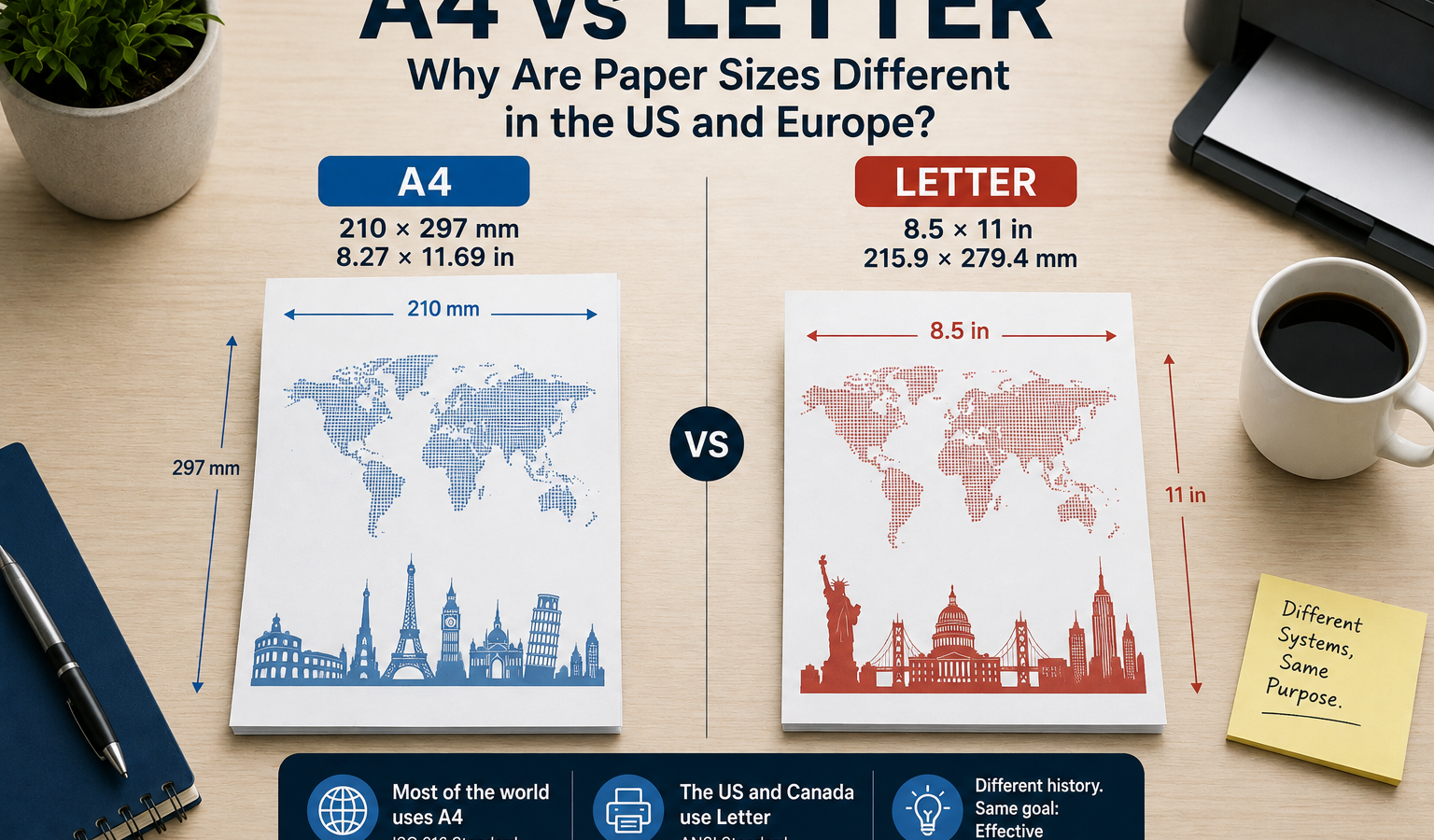
Open the print menu on almost any computer and you’ll eventually encounter a choice that seems oddly specific: A4 or Letter?
The two sheets look nearly identical until you place them on top of each other. A4 is slightly narrower and taller, while US Letter is a little wider and shorter. That small difference can be enough to shift margins, move page breaks or make a document designed in one country print awkwardly in another.
So why are paper sizes different in the US and Europe? The answer is another story of standards developing separately and becoming difficult to replace. Much of the world eventually adopted the ISO paper system, while the United States continued using Letter and other North American sizes that were already deeply established.
A4 vs Letter: What’s the Actual Difference?
Let’s start with the measurements.
A4: 210 × 297 mm, or about 8.27 × 11.69 inches
US Letter: 8.5 × 11 inches, or 215.9 × 279.4 mm
That means Letter paper is slightly wider, while A4 is noticeably taller.
For an ordinary printed page, the difference may seem trivial. But documents are designed around margins, headers, footers, tables and page breaks. A layout created specifically for A4 doesn’t always fit perfectly onto Letter without scaling or reflowing, and the reverse is also true.
The more interesting difference, however, isn’t the dimensions themselves. It’s the system behind them.
Paper is not the only everyday convention that differs between the United States and much of Europe. Even the order used to write a calendar date changes, which helps explain why Europe commonly writes dates day-month-year.
Why Is A4 Such an Unusual Size?
A4’s dimensions—210 × 297 mm—look strangely precise if you don’t know how the system works.
They aren’t arbitrary.
A4 belongs to the ISO 216 A-series, which includes familiar sizes such as A3, A4 and A5. The series is built around a clever geometric rule: each size keeps approximately the same proportions when the sheet is cut in half.
The aspect ratio is 1:√2, or roughly 1:1.414.
That mathematical relationship gives the system one of its most useful features. Fold an A4 sheet in half parallel to its shorter side and you get two A5 sheets with the same proportions. Put two A4 sheets together along their long edges and you get an A3 sheet with the same proportions.
The sequence continues:
A3 → A4 → A5 → A6
Each step halves the area without changing the basic shape of the page.
That makes resizing documents unusually convenient.
What Is So Useful About the A-Series?
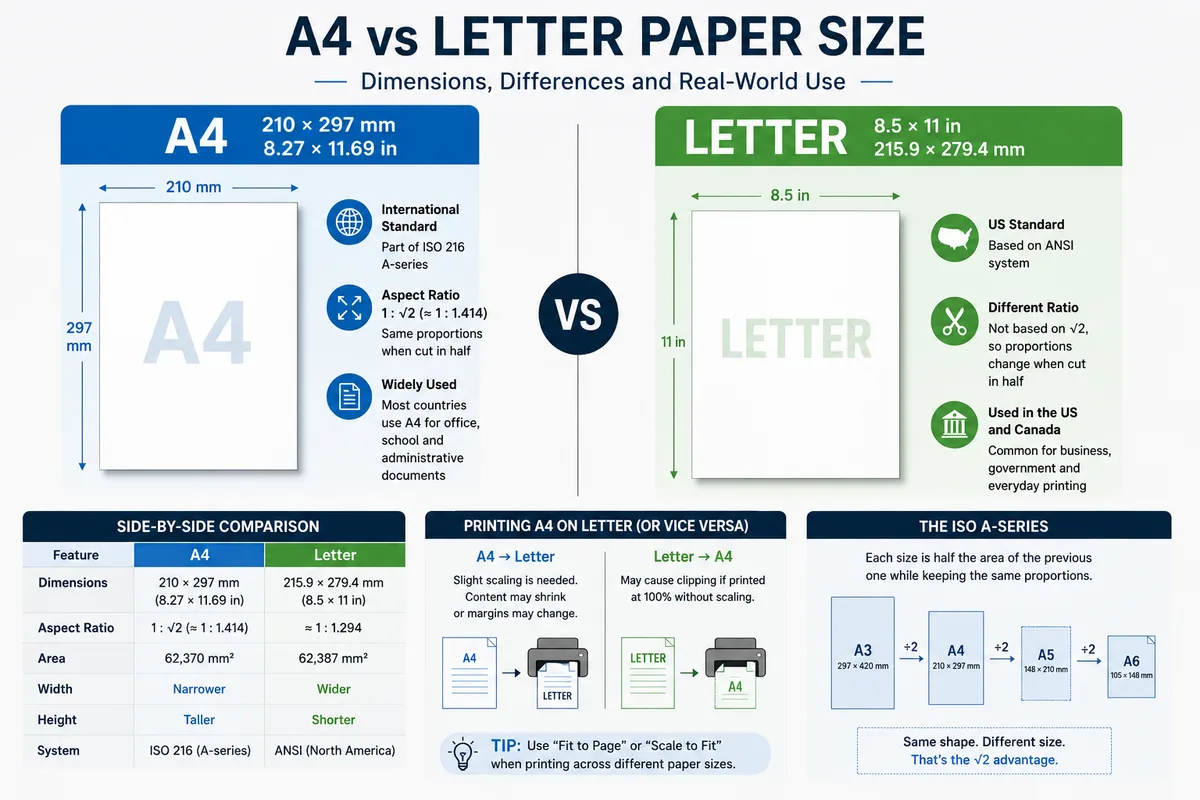
Imagine designing a poster on A3 paper and needing a smaller A4 version.
Because the two sheets have the same aspect ratio, the entire design can be scaled down proportionally without changing its shape. Text, images and margins all shrink together.
The same principle works in the other direction.
An A4 document can be enlarged to A3 while preserving its proportions. An A5 booklet can be produced by folding A4 sheets.
At the top of the series is A0, which has an area of approximately one square meter. Each successive size is created by halving the previous one.
This creates a connected family of paper sizes rather than a collection of unrelated dimensions.
ISO 216 standardizes the A and B series for writing paper and certain types of printed material used for administrative, commercial and technical purposes. A4 became the everyday office size across much of the world.
Once you understand the geometry, 210 × 297 mm stops looking random.
So Why Does the United States Use Letter Paper?
US Letter comes from a different paper-size tradition.
The familiar 8.5 × 11-inch sheet became deeply embedded in American offices, government paperwork, printers, filing systems and commercial printing long before international paper standards became relevant to everyday users.
American standards later formalized a family of paper sizes around existing North American practices. In the ANSI system, ANSI A corresponds to the familiar 8.5 × 11-inch Letter sheet.
Unlike the ISO A-series, Letter paper does not have the 1:√2 aspect ratio. Cutting an 8.5 × 11-inch sheet in half therefore doesn’t produce smaller sheets with exactly the same proportions.
That doesn’t prevent Letter from working perfectly well as office paper. It simply means it belongs to a different standardization philosophy.
By the time A4 became widely established internationally, the United States already had an enormous ecosystem built around Letter.
Printers supported it. Filing cabinets were designed for it. Forms used it. Businesses bought it. Government agencies produced documents on it.
Switching wasn’t just a matter of choosing a slightly different sheet at the stationery store.
Why Didn’t the US Switch to A4?
This is where paper sizes become part of the larger story of everyday standards.
A4 has an elegant mathematical structure, but elegance alone isn’t enough to make an established system disappear.
For Americans, Letter already works.
Replacing it nationally would mean updating document templates, printing workflows, forms, office supplies, filing systems and equipment settings across countless organizations. Modern printers can usually handle both sizes, but the broader administrative habit remains deeply established.
The situation is related to why the US doesn’t use the metric system. A widely used standard gains momentum simply because people, businesses and infrastructure are already organized around it.
This doesn’t mean the United States never uses metric measurements or A-series paper. It means an existing domestic standard remained strong enough that there was little practical pressure for wholesale replacement.
Sometimes the hardest standard to replace isn’t the worst one.
It’s the one everyone already has.
Is A4 Really Used Everywhere Outside the US?
A4 is extremely widespread internationally, but it’s better to avoid saying that every country outside the United States uses exactly the same paper system in every context.
ISO paper sizes dominate everyday office and administrative use across much of the world, including Europe and many countries in Asia, Africa and elsewhere.
North American practices remain different. Letter is strongly associated with the United States and is also widely encountered in Canada.
There are also specialized formats that don’t fit neatly into the A4-versus-Letter comparison. Books, newspapers, photographs, architectural drawings and other printed materials can follow their own standards.
Even ISO 216 itself isn’t intended to dictate the size of every printed object. Its scope focuses on writing paper and certain classes of administrative, commercial and technical printed matter.
So when people say “Europe uses A4,” they’re usually talking about ordinary office and document paper—not every piece of paper produced on the continent.
Can You Print an A4 Document on Letter Paper?
Usually, yes.
Modern software and printers can often scale an A4 document to fit Letter paper automatically. The reverse is also generally possible.
But there can be consequences.
Because A4 is taller and narrower, shrinking it onto Letter may slightly reduce the entire page. Printing at 100% without scaling can cause content near an edge to fall outside the printable area.
A document with generous margins may print with no obvious problem. A tightly designed form, certificate, label or legal document can be more sensitive.
If a document must preserve its exact physical dimensions, automatic scaling may not be appropriate.
For ordinary PDFs, the safest approach is to check the paper setting before printing and use “Fit,” “Scale to Fit” or an equivalent option when exact dimensions aren’t required.
Why Does a PDF Sometimes Look Fine but Print Wrong?
A PDF can preserve a page’s intended dimensions even when the printer contains different paper.
That’s useful because the document doesn’t silently redesign itself when opened on another computer. But it also means a PDF created as A4 remains A4 even if the printer tray contains Letter.
The printer or software then has to decide what to do with the mismatch.
It may shrink the page.
It may center the document.
It may warn you that the requested paper isn’t available.
Or, depending on the settings, it may crop content that falls outside the printable area.
This is why international document sharing can occasionally produce the classic complaint: “It looks right on my screen, but the printed version is wrong.”
The document may be fine.
The paper underneath it is different.
Which Paper Size Is Better?
If we’re judging the underlying system, A4 has an undeniable geometric advantage.
Its √2 aspect ratio makes proportional scaling between A-series sizes simple and predictable. That’s an elegant feature for printing, copying and document design.
But everyday standards aren’t chosen in a vacuum.
Letter paper works because the American ecosystem is already designed around it. Offices don’t need mathematically related page sizes to write reports, print invoices or sign contracts.
For most people, the “better” size is therefore the one their printer, forms and workplace expect.
The difference becomes important mainly when documents cross between systems.
A Small Difference That Reveals a Bigger Pattern
A4 versus Letter might look like an insignificant stationery question, but it illustrates something much larger.
Standards often become invisible once we grow up with them.
An American opening a fresh pack of Letter paper doesn’t think, “I’m using a North American paper standard.” A European loading A4 into a printer doesn’t usually think about the square root of two.
Both simply think of it as paper.
Only when a document crosses borders does the hidden standard suddenly become visible.
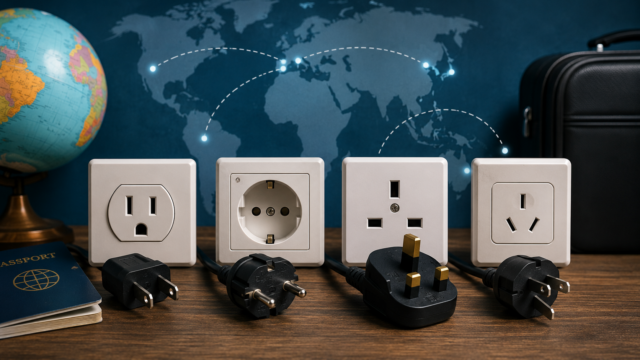
That’s the same pattern behind different date formats, clock systems, electrical outlets and many other everyday conventions. They feel universal until we encounter a place where people made a different choice.
The Bottom Line
A4 and US Letter are different because they come from two different standardization systems.
A4 measures 210 × 297 mm and belongs to the ISO 216 A-series, whose 1:√2 aspect ratio allows sheets to be halved or enlarged while preserving the same proportions.
US Letter measures 8.5 × 11 inches and remained the dominant office-paper format in the United States because American businesses, government agencies, printers and filing systems were already built around it.
Neither sheet prevents you from writing the same words or printing the same document.
The difference becomes noticeable when a page designed for one has to fit the other.
And that tiny mismatch in your printer tray tells a surprisingly familiar story: once the world builds around a standard, even something as simple as a sheet of paper can become difficult to change.
Sources
American National Standards Institute — Standard Paper Sizes: ISO and ANSI Formats







Join the discussion