Why Do Countries Use Different Voltage and Frequency?
Why does the US commonly use 120V/60Hz while much of Europe uses 230V/50Hz? The answer lies in the early history of electrical grids—and the enormous cost of changing them.
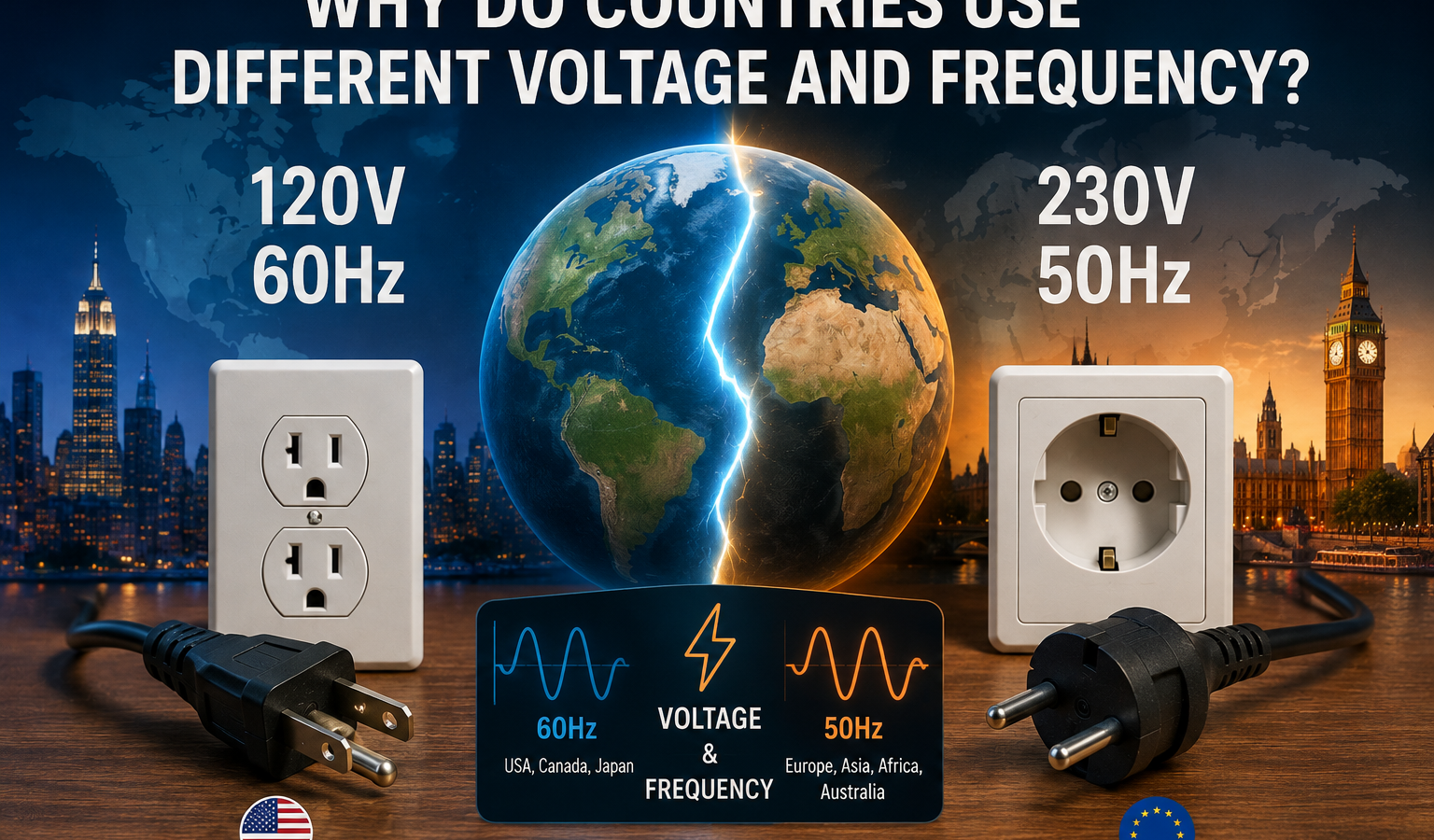
Plug in a phone charger in New York and the outlet typically supplies around 120 volts at 60 hertz. Take the same charger to much of Europe and the electricity behind the socket is closer to 230 volts at 50 hertz.
The difference is invisible until you look at the tiny specifications printed on an appliance—or until a device designed for one electrical system meets another.
So why do countries use different voltages and frequencies? The answer is mostly historical. Electrical grids were built locally and nationally before the world had a common household electricity standard. Different engineering choices became established, infrastructure grew around them, and eventually changing an entire country’s system became far more difficult than simply keeping it.
Voltage and Frequency Are Two Different Things
Before looking at why the standards differ, it helps to separate voltage from frequency.
Voltage, measured in volts (V), can be thought of as the electrical potential that pushes current through a circuit. Household supply voltage varies by country and electrical system.
Frequency, measured in hertz (Hz), describes how many cycles per second alternating current completes. A 50 Hz supply cycles 50 times per second; a 60 Hz supply cycles 60 times per second.
These characteristics are related to the same electrical supply, but they aren’t interchangeable.
The United States commonly supplies household electricity at around 120 V and 60 Hz, while many countries use systems in the 220–240 V and 50 Hz range.
That difference wasn’t created to make international travel difficult. It is a legacy of how modern electrical grids developed.
Electricity Wasn’t Standardized Globally From the Beginning
When electric power systems began expanding in the late nineteenth and early twentieth centuries, there was no worldwide authority deciding what every future wall socket should supply.
Cities and countries developed networks using technologies available to them, often through competing utilities and manufacturers. Engineers made decisions about generation, transmission, motors, lighting and distribution based on the needs and equipment of the time.
Even the fundamental question of how electricity should be distributed was contested. Early systems included direct current (DC), while alternating current (AC) gained a major advantage because transformers allowed voltage to be increased for efficient long-distance transmission and reduced again for use closer to consumers.
As AC grids expanded, particular voltages and frequencies became associated with particular systems.
Once thousands—and eventually millions—of generators, transformers, motors, appliances and buildings were designed around those choices, they stopped being temporary engineering decisions.
They became infrastructure.
Why Did 50 Hz and 60 Hz Both Survive?
There is nothing magical about either 50 Hz or 60 Hz that makes one universally correct.
Early AC systems experimented with different frequencies. Over time, standardization occurred within electrical networks because generators connected to the same AC grid need to operate in synchronization.
North America’s large interconnected grids operate at 60 Hz. Much of Europe standardized around 50 Hz.
Once those frequencies became deeply established, changing them would have affected far more than household outlets. Power stations, industrial machinery, motors, transformers and other grid equipment were designed around the existing system.
That helps explain why both standards survived.
International standardization eventually became much stronger, but by then the world’s major electrical networks were already built.
Why Do Some Countries Use Around 120 V and Others Around 230 V?
Voltage followed a similarly path-dependent history.
Early electric lighting played an important role in the development of lower-voltage distribution systems in North America. As networks expanded, equipment and appliances were manufactured to work with the electrical supply already available.
Elsewhere, higher household voltages became standard.
There are engineering trade-offs involved. For the same amount of power, a higher voltage allows a lower current. Since electrical losses and conductor requirements are related to current, higher voltage can offer practical advantages in distribution and appliance design.
But that doesn’t mean a country using 230 V can simply declare that every outlet will become 120 V—or vice versa.
The voltage at the wall is only the visible end of a much larger system. Changing it would affect distribution equipment, building wiring, protection devices and an enormous installed base of appliances.
The question therefore isn’t simply, “Which voltage would we choose if we started today?”
The world isn’t starting today.
Why Not Convert the Whole World to One Standard?
On paper, a single global voltage and frequency sounds convenient.
In practice, the transition would be enormous.
Think about everything connected to an electrical grid: homes, offices, factories, elevators, refrigerators, heating systems, industrial motors, street infrastructure and countless other devices.
Now imagine changing the electrical characteristics those systems were designed to receive.
Even if a new global standard offered some technical advantage, the cost of replacing or adapting existing infrastructure could dwarf the benefit.
Modern international standards therefore often focus on making equipment safe and compatible with established supply systems rather than expecting every country to rebuild its grid around one identical household standard.
IEC standards, for example, define preferred standard voltage values for electrical supply systems and equipment design while accommodating established electrical systems.
Global standardization doesn’t always mean making everything identical.
Sometimes it means creating predictable rules for a world where differences already exist.
Your Phone Charger May Already Handle Both Systems
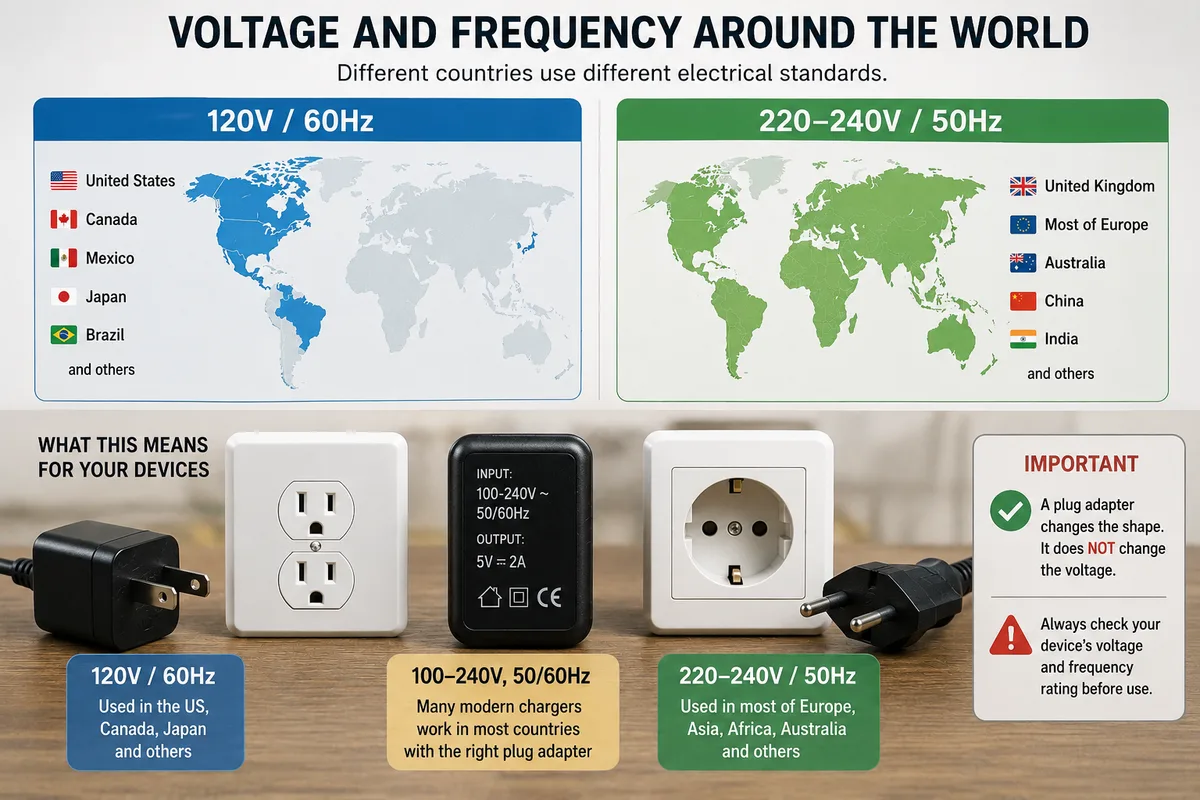
Modern electronics have made these international differences much easier to live with.
Look closely at a laptop or phone charger and you may see something similar to:
INPUT: 100–240 V ~ 50/60 Hz
That little line is extremely useful.
It generally means the power supply is designed to operate across that input voltage and frequency range. A charger rated this way can often be used in both 120 V/60 Hz and 230 V/50 Hz countries, provided you can physically connect it to the local socket.
That is one reason travelers can take the same laptop or phone across continents without carrying a heavy voltage transformer.
But don’t assume every electrical device works this way.
The rating printed by the manufacturer matters.
A Plug Adapter Does Not Change the Voltage
This distinction is worth repeating because it is one of the easiest travel mistakes to make.
As we explained in our guide to electrical outlets around the world, countries can use different physical plug and socket designs.
A travel adapter solves that physical problem. It allows one plug shape to connect to another socket shape.
It does not automatically convert 230 V into 120 V.
If your device says 100–240 V, 50/60 Hz, that may not matter because the power supply was designed for both systems.
If it says only 120 V, 60 Hz, plugging it into a 230 V supply simply because an adapter makes it fit can be unsafe and may damage the appliance.
A physical connection is not proof of electrical compatibility.
When Does Frequency Actually Matter?
Frequency can be less obvious to travelers than voltage, but certain devices care about it.
Equipment containing AC motors, clocks or components whose operation depends directly on the supply frequency may behave differently when operated on the wrong frequency. Motor speed, timing, heating and overall performance can potentially be affected depending on the device’s design.
Modern electronic power supplies are often much more flexible. Again, a label showing 50/60 Hz indicates that the manufacturer designed the device for both common mains frequencies.
This is why checking the actual equipment rating is more useful than relying on broad rules such as “electronics are fine” or “you always need a converter.”
Different devices handle foreign electrical supplies differently.
Why Can’t Two Connected Grids Run at Different Frequencies?
Frequency isn’t merely a number printed on appliances. It is a fundamental operating characteristic of an AC power grid.
Generators and interconnected parts of an AC system operate in synchronization around the grid’s nominal frequency. In the United States, major interconnected systems operate around 60 Hz, and grid operators continuously balance generation and demand to keep frequency within acceptable limits.
If electricity demand suddenly rises or a large generator goes offline, frequency can shift. Grid controls and operators respond to restore the balance.
That gives some perspective on why converting a national system from 50 Hz to 60 Hz isn’t comparable to changing a household setting.
Frequency is built into the operation of the grid itself.
Is 230 V Better Than 120 V?
It’s tempting to turn the difference into a competition, but “better” depends on what is being evaluated.
Higher voltage can deliver the same power at lower current, which has engineering advantages. Different systems also use different wiring practices, protective devices and safety standards designed around their operating voltage.
A 120 V system isn’t simply an unfinished version of a 230 V system, and a 230 V country isn’t using “more powerful electricity” in the everyday sense.
Both can support modern homes and economies.
The important issue is that equipment and infrastructure are designed for the system in which they operate.
The World Standardized Around the Differences
The most interesting part of this story is that global electrical compatibility improved without every country adopting identical household electricity.
Manufacturers increasingly design electronics for broad input ranges. International standards provide common reference values and safety requirements. Travel adapters solve physical plug differences, while appropriately designed power supplies can accommodate multiple voltages and frequencies.
In other words, technology adapted to the world’s existing electrical systems instead of requiring the world’s electrical systems to become identical.
That is much easier than rewiring countries.
The Bottom Line
Countries use different voltages and frequencies because modern electricity developed before there was a single global household standard. North America became strongly associated with systems around 120 V and 60 Hz, while 230 V and 50 Hz became common across much of Europe and many other parts of the world.
Once those choices were embedded in power stations, grids, buildings and appliances, replacing them became enormously difficult.
Today, the difference matters less for many small electronics because power supplies marked 100–240 V, 50/60 Hz are designed to operate across both major systems. Other appliances may not be so forgiving.
And that leads to the most useful rule for travelers:
Don’t judge electrical compatibility by whether the plug fits. Check the voltage and frequency rating on the device.
The plug is only what you can see. The electrical system behind it is what actually matters.
Sources
U.S. Department of Energy — Electricity 101
International Electrotechnical Commission — IEC 60038: Standard Voltages








Join the discussion