Left or Right? How the World Ended Up Driving on Different Sides
Why do some countries drive on the left while others drive on the right? The answer reaches back long before cars, shaped by historical travel customs, empires, neighbors and transportation systems.
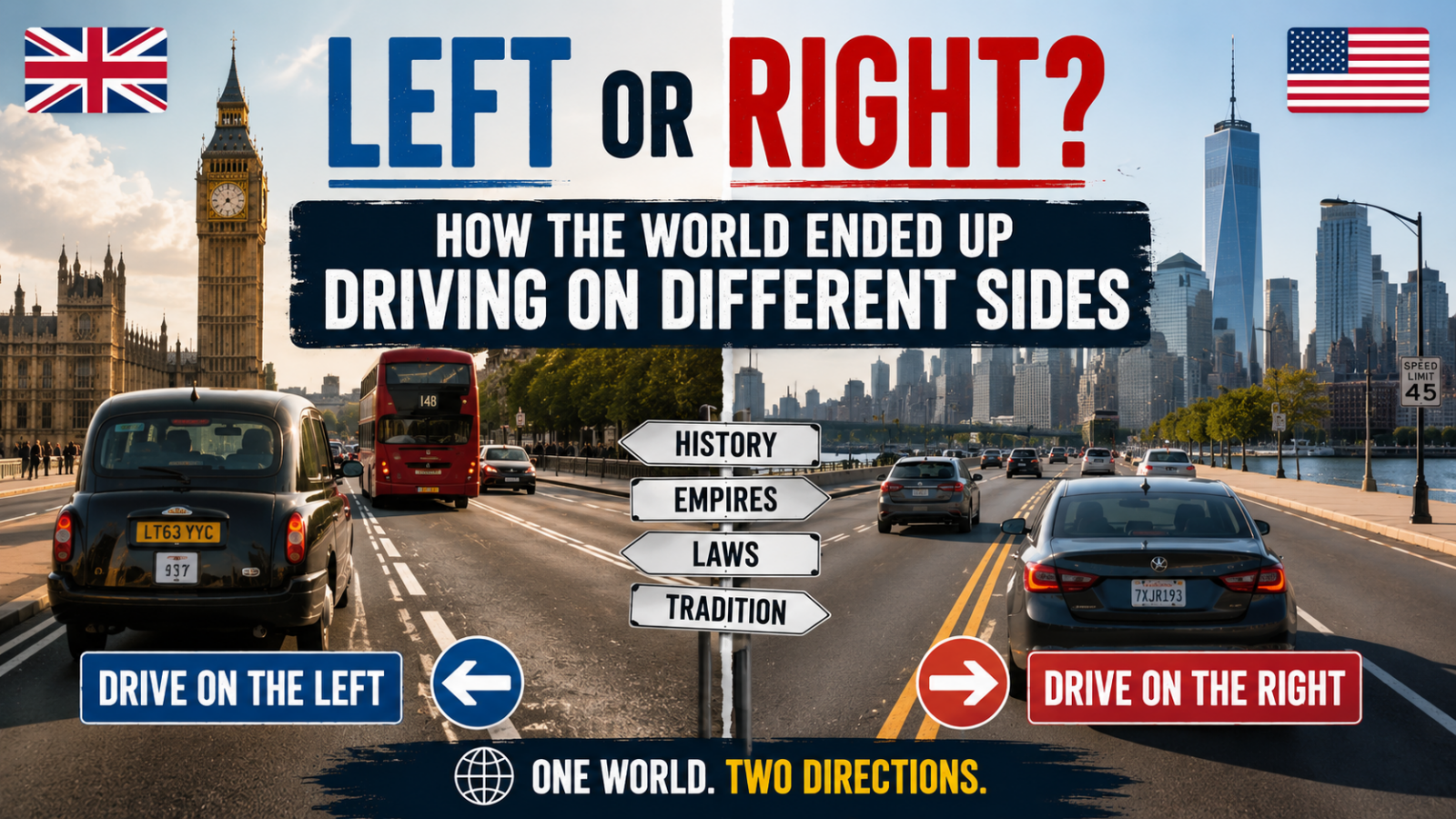
Drive out of an airport in London, Tokyo or Sydney and one difference becomes obvious almost immediately: traffic keeps to the left. Do the same in Paris, New York or Istanbul and vehicles keep to the right. In a world where cars, road signs and highways share so many common standards, why did we never agree on which side of the road to use?
The answer is less about cars than history. Left- and right-side travel conventions existed long before the automobile, and different countries eventually turned those customs into formal rules. Empires, neighboring countries and expanding transportation networks helped spread them. Once roads, vehicles and driver habits were built around one side, changing became a massive undertaking.
That kind of infrastructure lock-in appears in other systems too. Electrical grids developed along separate historical paths, which helps explain why countries use different voltage and frequency.
Driving Sides Existed Long Before Cars
People needed road conventions centuries before engines appeared. Pedestrians, horse riders, carts and carriages all had to pass one another, and predictable movement made busy roads easier to navigate.
One popular explanation says medieval riders tended to keep left because most people were right-handed and wanted their dominant arm closer to approaching strangers. It is a memorable theory, and it may reflect some historical travel habits, but it is too neat to explain the modern traffic map on its own. Today’s left-right divide developed gradually as local customs became regulations and those regulations spread across larger political territories.
Britain ultimately formalized left-side travel. The rule became embedded in its road system and remains part of modern British driving: the UK Highway Code instructs motorists to keep left except in circumstances such as overtaking or where signs indicate otherwise.
Why So Many Former British Territories Drive on the Left
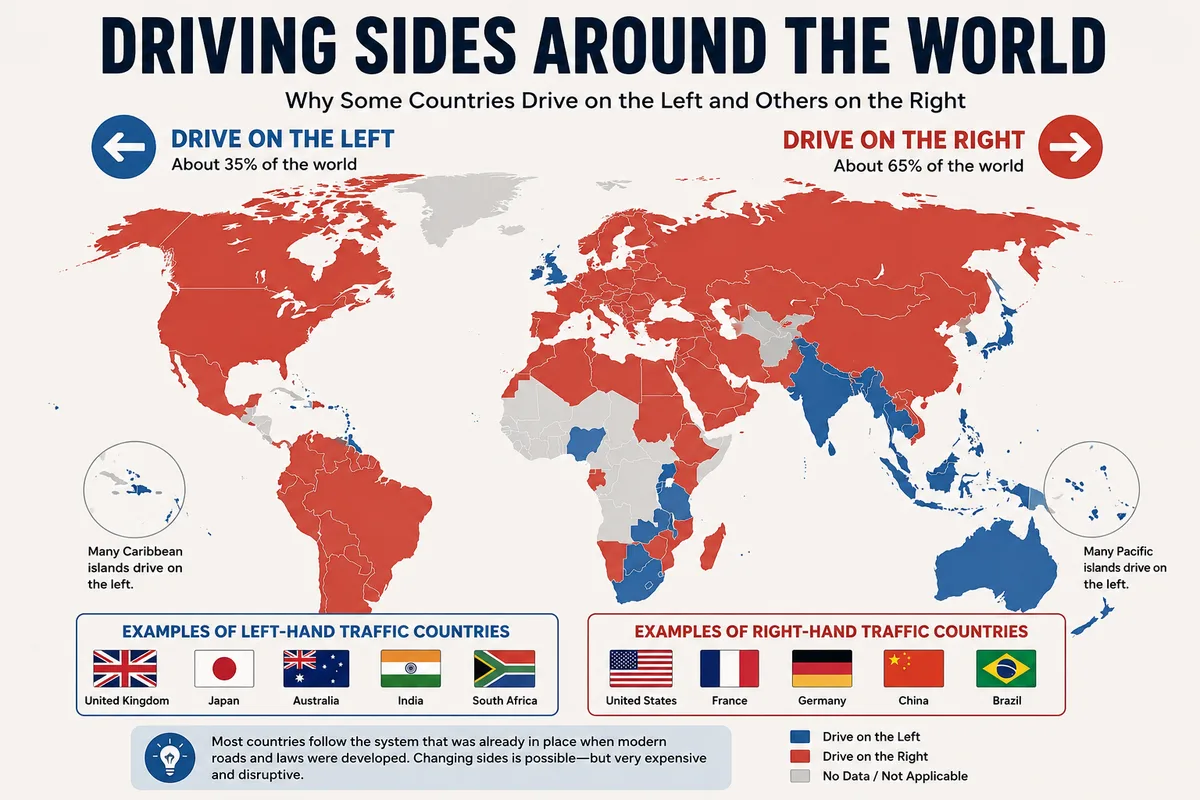
Britain’s global influence helps explain one of the most noticeable patterns on today’s traffic map. Australia, India, New Zealand and South Africa all drive on the left, as do a number of other countries and territories with historical British connections.
Colonial administrations exported far more than language and legal institutions. Railways, road practices and transportation rules often traveled with them. When former colonies became independent, there was not necessarily a practical reason to replace an established traffic system that people already knew and infrastructure already supported.
That is why countries thousands of miles apart can share the same basic road convention today. But British influence is only part of the story.
Why Does Japan Drive on the Left?
Japan is an important reminder that “former British colony” is not a complete explanation for left-hand traffic. Japan was never part of the British Empire, yet vehicles there also keep left.
Japan had its own historical travel practices, while British engineering played a role in the development of the country’s early modern railways during the nineteenth century. Left-side operation became established in transportation as Japan modernized, and the convention eventually became part of its broader traffic system.
This illustrates the larger point: there was no single event that divided the planet into left-driving and right-driving countries. Different histories sometimes produced the same result.
Why Does Most of Europe Drive on the Right?
While Britain consolidated a left-side system, right-hand travel became dominant across much of continental Europe. France was an important center of right-side traffic, and political changes during the Napoleonic era helped reinforce and spread right-side conventions across parts of Europe.
Napoleon is sometimes credited with “inventing” right-hand traffic, but that simplifies a much longer story. Road customs existed before him. What increasingly powerful governments did was standardize rules across larger territories, reducing the mixture of local practices.
Eventually, standardization mattered more than the original reason for choosing a side. Once everyone was expected to follow the same rule, roads and transport systems began evolving around it.
Why Didn’t the World Standardize Later?
By the time international travel became commonplace, switching sides was no longer a simple matter of changing a law. Modern transportation infrastructure had been designed around existing traffic directions.
Changing sides can affect intersections, roundabouts, highway entrances, road signs, bus stops, toll booths, traffic lights and lane markings. Vehicle design matters too: countries that drive on the left commonly use cars with the steering wheel on the right, while right-driving countries generally do the opposite.
Then there is human behavior. Drivers develop automatic habits about where to look, which lane to enter after turning and how to approach a roundabout. Pedestrians learn which direction to check first before crossing. A nationwide switch temporarily disrupts millions of those learned behaviors.
Once a system works, changing it can cost a great deal while offering relatively little benefit.
Sweden Actually Changed Sides
That doesn’t mean switching is impossible. Sweden provides one of the most famous examples.
Until 1967, Sweden drove on the left even though neighboring Norway and Finland used right-hand traffic. On September 3 of that year, Sweden officially switched to driving on the right in an event known as Dagen H, named after the Swedish word högertrafik, meaning right-hand traffic.
The transition required extensive preparation. Road markings and signs had to change, intersections needed modifications and the public had to learn a new routine. Traffic was carefully controlled during the switch itself.
Sweden proved that a country can change sides. The scale of the operation also helps explain why most countries have little desire to try.
Why Is the Steering Wheel Usually on the Opposite Side?
The terms can sound confusing at first. A country with left-hand traffic usually has vehicles with the steering wheel on the right, while a country with right-hand traffic usually has vehicles with the steering wheel on the left.
The arrangement places the driver closer to the center of the road, generally giving a better view of approaching traffic and helping with maneuvers such as overtaking.
There are exceptions, especially in countries that import large numbers of vehicles designed for a different traffic system. So the side of the road and the position of the steering wheel are related, but they are not interchangeable terms.
Is Driving on the Left More Dangerous?
There is no simple reason to consider one side inherently safer merely because it is left or right. A traffic system works primarily because everyone using the road follows the same convention.
Road design, speed, enforcement, vehicle safety, driver behavior and pedestrian infrastructure are far more important variables. The unusual risk often appears when someone accustomed to one system suddenly drives in the other.
A tourist may consciously remember to “keep left” and still instinctively look the wrong direction before entering traffic. Roundabouts and turns can be especially disorienting because years of muscle memory suddenly work against the driver.
The problem isn’t that left is wrong or right is right. It’s inconsistency with what your brain expects.
Why Do Countries Keep Their Existing System?
Because history eventually becomes infrastructure.
A traffic rule established generations ago now determines how roads are designed, where drivers sit, how buses operate and what children learn before they ever receive a license. The original historical reason becomes less important than everything built around the decision afterward.
This is why the modern traffic map can look like a collection of historical fingerprints. British influence helps explain left-hand driving across several continents. Continental European history helps explain much of the right-driving world. Other countries, including Japan, arrived at their systems through different paths.
At borders where opposite systems meet, special road designs may even be needed to move vehicles safely from one side to the other.
The World Never Really Chose a Side
There is no physical law requiring cars to drive on the left or the right. Either system can function perfectly well as long as everyone follows the same rule.
International transportation therefore learned to accommodate both rather than forcing the entire world to adopt one. The United Nations’ Vienna Convention on Road Traffic recognizes road systems in which traffic keeps either right or left, reflecting a division that was already deeply established.
So why do some countries still drive on the left? Because centuries of local customs, government rules, political influence and transportation development produced different standards—and those standards became increasingly difficult to change.
Britain’s historical influence explains much of today’s left-driving world, but not all of it. Right-hand traffic followed its own path toward dominance elsewhere. Once highways, vehicles and everyday habits developed around those choices, there was little reason to start over.
Neither side is naturally the correct side. The correct side is the one everyone around you expects you to use.








Join the discussion