Day, Month, Year: Why Europe Writes Dates Differently
Why does much of Europe put the day before the month while Americans usually do the opposite? The answer lies in language, convention and standards—and explains why a simple date can mean two different things across borders.
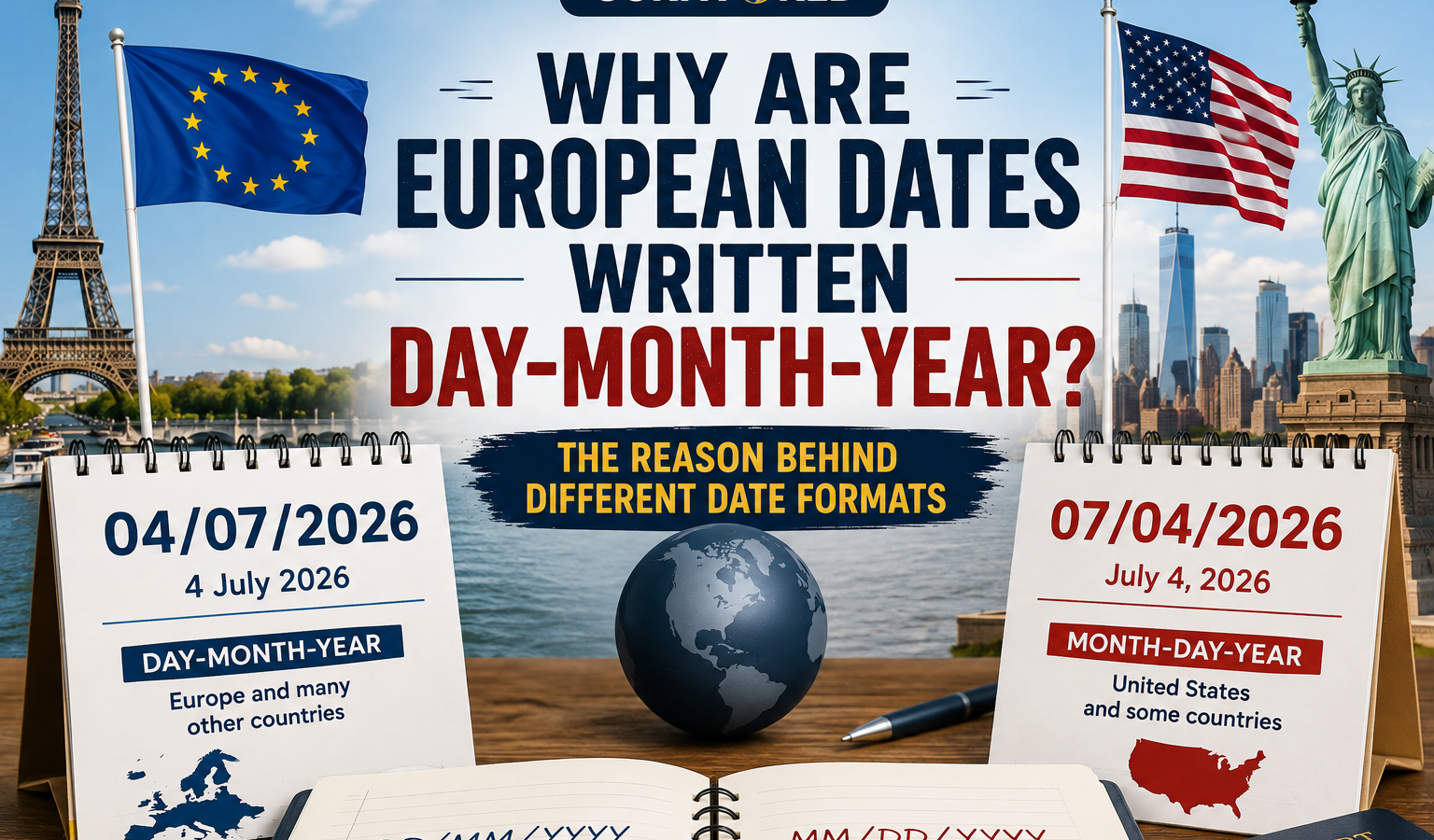
A date as simple as 04/07/2026 can describe two completely different days.
To many Europeans, it means 4 July 2026. To an American reader, it is likely to mean April 7, 2026. Neither interpretation is a mistake; they come from different conventions for arranging the same three pieces of information.
So why is day-month-year common across Europe while the United States usually puts the month first? There was no international meeting where one side chose the “logical” format and the other rejected it. Like driving on different sides of the road, date formats grew out of language, writing habits and standards that became familiar enough to survive.
How Are Dates Usually Written in Europe?
There isn’t one single “European date format” used identically in every country. Separators and written conventions vary by language and context, but day before month before year is widespread.
A date might therefore appear as:
25/12/2026
25.12.2026
25 December 2026
The exact punctuation isn’t the important part. The underlying order is:
DAY → MONTH → YEAR
European Union English-language guidance follows this pattern in running text. The European Commission’s English Style Guide, for example, uses forms such as 6 June 2016 and specifically contrasts this with American month-day-year usage.
For readers accustomed to the European convention, the sequence feels so ordinary that there may seem to be nothing to explain. The confusion begins when it meets another system.
Why Does Day Come Before the Month?
There is a tempting answer: because the units progress from smaller to larger.
A day is shorter than a month, and a month is shorter than a year, so:
day → month → year
does form an intuitive ascending sequence.
That’s a useful way to remember the format, but it shouldn’t be mistaken for its complete historical origin. Date notation wasn’t designed from scratch by a modern standards committee. Written dates developed through language and administrative practice over long periods, and conventions differed between places.
In British English, expressions such as “the fourth of July” naturally put the day before the month. Written forms such as 4 July follow the same order. Similar day-first structures became conventional across many European languages and institutions.
Once a format becomes normal in government documents, schools, newspapers, forms and everyday writing, familiarity does much of the work needed to preserve it.
Then Why Does the United States Put the Month First?
American English commonly reverses the first two elements:
MONTH → DAY → YEAR
So July 4, 2026 becomes:
07/04/2026
That arrangement also reflects ordinary language. Americans commonly say “July fourth” rather than “the fourth of July,” even though both expressions are understood.
Written American dates therefore often follow the spoken order: month first, then day, then year.
The important point is that the American system isn’t simply a European format written “backwards.” It is a convention with its own linguistic and historical continuity.
Once it became established in American administration, publishing and everyday life, there was little practical reason for people inside the United States to replace it merely because other countries preferred another order.
The Real Problem Appears When Dates Are All Numbers
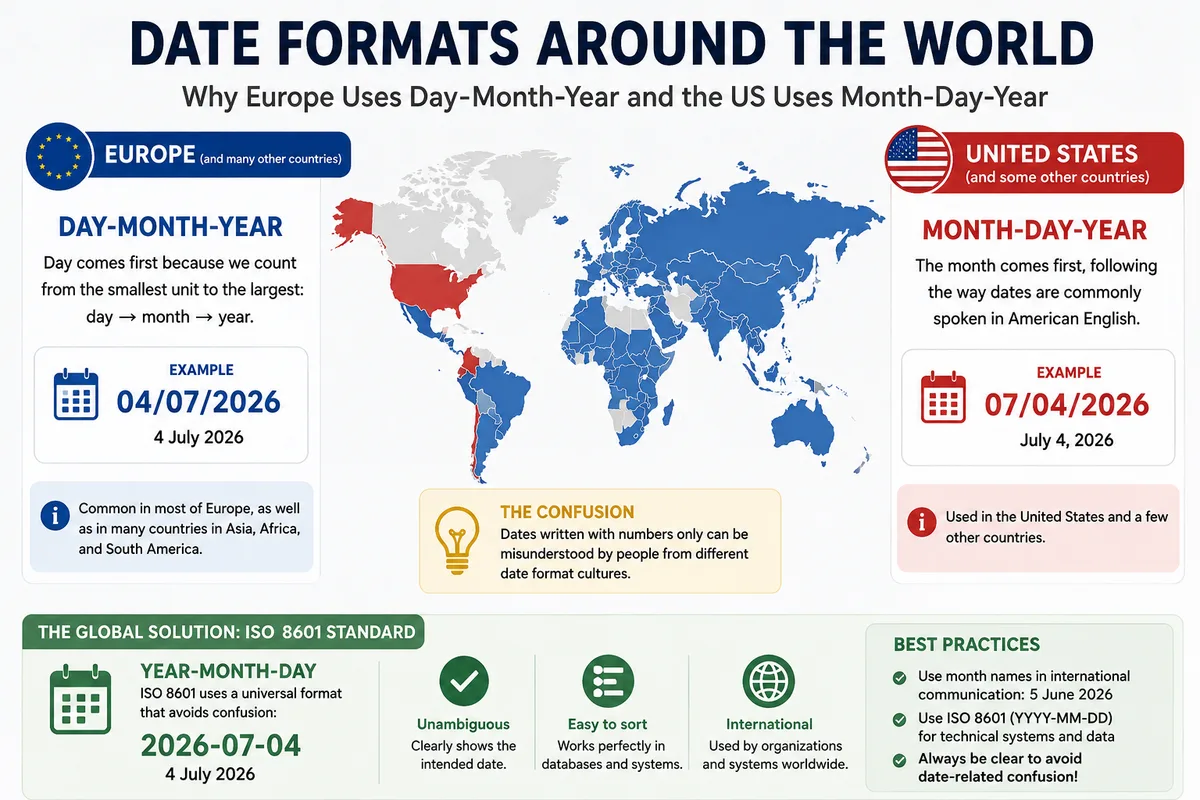
Writing 4 July 2026 and July 4, 2026 creates little confusion. The month is visible as a word.
Write the same dates numerically and things become much less comfortable.
Consider:
03/08/2026
A day-first reader sees 3 August 2026.
A month-first reader sees March 8, 2026.
Both readings are perfectly plausible because both 3 and 8 can represent either a month or a day.
The ambiguity disappears with something like 23/08/2026, because there is no 23rd month. But international communication cannot depend on waiting for a date to become mathematically impossible to misread.
That is why travel bookings, international business, software and legal documents often benefit from formats that make the intended order explicit.
Why Not Make the Whole World Use One Format?
We could—and in some contexts, we already do.
The problem is that everyday conventions are remarkably persistent. A date format isn’t just a technical standard stored in a government manual. People encounter it from childhood on calendars, school forms, receipts, websites, newspapers, invitations and official documents.
Changing it would require millions of people to abandon a habit that already works perfectly well within their own country.
This is similar to why some countries drive on the left. Once a system is deeply embedded in everyday life and infrastructure, being different from another country’s system isn’t necessarily enough reason to replace it.
Date formats are a much smaller system than road traffic, of course, but the underlying idea is familiar: standards become sticky because everyone around you already understands them.
ISO 8601 Offers a Third Answer
There is another format that avoids choosing between Europe’s day-first convention and America’s month-first convention:
YEAR → MONTH → DAY
The international ISO 8601 standard uses:
YYYY-MM-DD
So July 4, 2026 becomes:
2026-07-04
At first glance, that can look unusual to people who don’t use it in everyday writing. But it has a major advantage: the order is explicitly standardized and therefore avoids the ambiguity of dates such as 04/07/2026. ISO describes the standard as a way to reduce uncertainty created by differing date conventions.
The format also sorts neatly in chronological order when dates are written as text:
2026-07-04
2026-07-05
2026-08-01
2027-01-01
Year changes first, then month, then day. That makes the format particularly useful for databases, filenames, technical systems and international information exchange.
It doesn’t mean everyone is expected to write birthday invitations this way. ISO 8601 solves a different problem: communicating dates without having to guess which national convention the writer intended.
Why Writing the Month as a Word Is Often Better
For ordinary international communication, there is an even simpler solution.
Instead of:
05/06/2026
write:
5 June 2026
Now there is almost nothing to decode.
The European Commission’s English Style Guide recommends full dates in running text in precisely this kind of form.
This matters more than it might seem. A misunderstood date on a casual message is inconvenient; a misunderstood date on a flight booking, contract, payment deadline or medical appointment can have real consequences.
When your audience may include people from different countries, spelling out the month is often worth the few extra characters.
Dates Aren’t the Only Everyday System That Changes Across Borders
Date order feels natural mainly because we see the same pattern repeatedly.
Travel somewhere else and another pattern can feel equally natural to everyone around you.
The same thing happens with time. Many countries and institutions routinely use the 24-hour clock in contexts where Americans may be more accustomed to AM and PM.
Neither convention makes time move differently. Neither date format changes the calendar.
These systems simply encode familiar information in different ways.
That is what makes them interesting: some of the most ordinary things in daily life aren’t universal at all. We only notice the convention when we encounter someone else’s.
So Which Date Format Is Best?
It depends on what you’re trying to do.
For everyday communication inside a country, the familiar local format is usually the easiest because readers already understand it.
For international prose, writing the month as a word—5 June 2026, for example—removes much of the ambiguity.
For technical systems and information exchange, ISO 8601’s YYYY-MM-DD provides a standardized, unambiguous structure.
The important distinction isn’t really between a “correct” European system and an “incorrect” American one. Both work when everyone knows which convention is being used.
Problems arise when the reader doesn’t.
The Bottom Line
Day-month-year is common across Europe because date conventions developed through language and long-established writing practices, then became embedded in everyday and institutional use. American English standardized around a month-day-year pattern that also reflects its familiar spoken form.
Neither system causes much trouble at home. The problem appears when a numerical date crosses borders.
04/07/2026 may look perfectly clear until you realize that two readers can see two different days.
That’s why international standards such as ISO 8601 use YYYY-MM-DD, and why spelling out the month remains one of the simplest ways to avoid confusion.
A date may be universal.
The way we write it isn’t.
Sources
European Commission — English Style Guide
International Organization for Standardization — ISO 8601 Date and Time Format








Join the discussion