Why Are Electrical Outlets Different Around the World?
Why can a charger fit the wall at home but become useless after crossing a border? The answer lies in the history of electrical grids, safety standards and infrastructure.
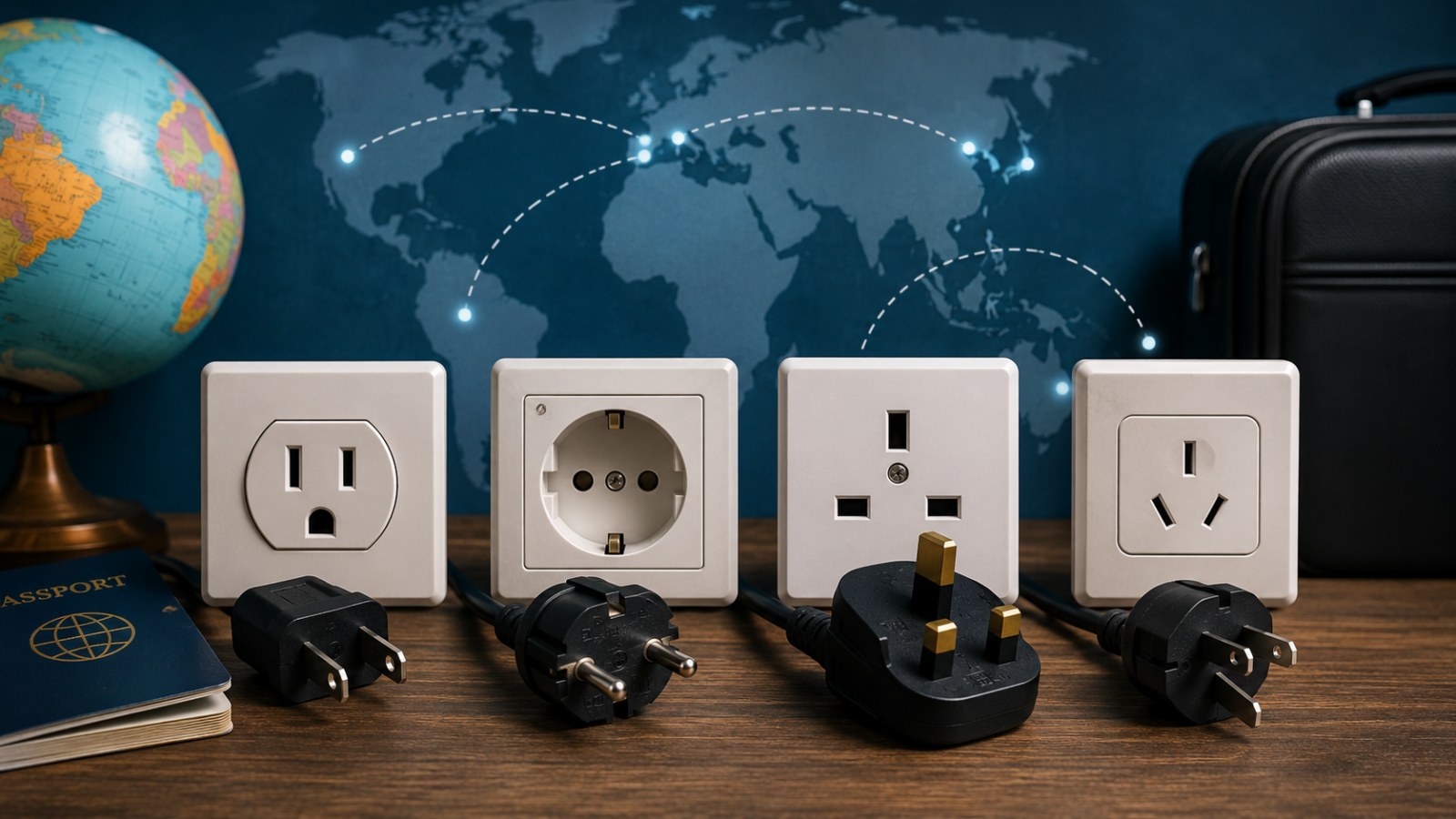
Pack a phone charger for an international trip and you may discover that one of the most ordinary objects in your home suddenly doesn’t fit the wall. The United States commonly uses flat-pronged plugs, much of continental Europe is familiar with round pins, and the United Kingdom has its distinctive three rectangular pins.
It can seem strange that a world capable of standardizing everything from shipping containers to USB connections never settled on a universal wall outlet. So why are electrical outlets different around the world?
The short answer is that national electrical systems developed at different times, under different technical rules and safety priorities. By the time international travel and consumer electronics became routine, millions of homes were already wired around established local standards. Replacing them all would be enormously expensive.
There Was No Universal Outlet When Electricity Arrived
Today’s plug problem makes more sense when you remember that household electricity wasn’t introduced as one coordinated global project.
Electrical networks grew city by city and country by country. Engineers, manufacturers, utilities and governments made decisions based on the technology, regulations and infrastructure available to them at the time.
Different solutions became established in different places.
Once a particular socket was installed in millions of buildings and manufacturers began making appliances to fit it, that design gained a powerful advantage: compatibility with everything already there.
This is why the modern world has multiple national and regional plug systems rather than one design. The International Electrotechnical Commission (IEC) documents standardized household plug and socket systems used across its member countries, reflecting just how established those differences have become.
Why Do Plug Shapes Matter?
A plug does more than physically hold a charger in the wall. Its contacts create an electrical connection, and depending on the system, additional features may provide grounding, polarity or protection against accidental contact.
That helps explain why plugs can differ in more than appearance.
Some have two pins; others have three. Pins may be round, flat or rectangular. Certain sockets are recessed, while others include shutters designed to reduce access to live contacts.
The shape also acts as a form of compatibility control. A device designed for one system cannot necessarily be inserted into another.
But this leads to an important distinction: plug compatibility and electrical compatibility are not the same thing.
An adapter may make your plug physically fit a foreign socket without changing the electricity supplied to your device.
Why Does Europe Often Use Round Pins?
Much of continental Europe is associated with plugs using round pins, although describing this as a single “European plug” oversimplifies the situation.
Several related systems are used across Europe, and socket designs can differ in how they provide grounding and other features. Some plugs work across more than one compatible socket system, which can make the differences less obvious to travelers.
The broader reason these designs remain common is the same reason other national standards survive: they became embedded in electrical infrastructure.
Once homes, offices, hotels and appliances are built around a particular system, switching to a completely different plug provides little benefit to the people who already use it successfully.
Why Is the British Plug So Big?
The British Type G plug is probably one of the easiest designs to recognize. It uses three rectangular pins and is noticeably bulkier than many two-pin plugs.
Its size isn’t simply a design quirk.
The UK system is governed by the BS 1363 series of standards. Modern BS 1363 plugs incorporate specific safety and construction requirements, and standard UK plugs include a fuse. The British Standards Institution describes the system as covering safety, construction, dimensional accuracy, testing and marking for 13-amp plugs and socket outlets.
That fuse is one reason the plug needs more internal space than many simpler designs.
The system also uses an earth connection where required, while compliant socket designs incorporate safety features as part of the wider standard.
From a traveler’s perspective, the British plug may look unnecessarily substantial. From an electrical-engineering perspective, its shape is the visible result of a particular national wiring and safety system.
Why Doesn’t the World Replace Them With One Universal Plug?
There have been efforts toward greater international standardization. The difficulty isn’t designing a plug that could work well.
The difficult part is replacing what already exists.
Imagine changing the outlet standard of an entire country. Homes, schools, offices, hotels, factories and public buildings could require new sockets. Existing appliances might need adapters or replacement plugs. Manufacturers and retailers would have to support the transition, while electricians would have to ensure that new components remained compatible with the country’s electrical system and safety rules.
All of that costs money.
Meanwhile, the existing system already works for the people living there.
That creates a classic standardization problem: a new system may be technically attractive without being attractive enough to justify replacing millions of working installations.
The IEC has developed international standards for plugs and sockets, but national systems remain widespread. A European Commission review of plug and socket standardization noted that an IEC international household system intended as a possible replacement for older systems had seen only limited national adoption.
A technically standardized solution is therefore very different from a globally adopted one.
Plug Type Isn’t the Only Difference Between Countries
This is the part travelers need to pay particular attention to.
A different plug shape is immediately visible. Differences in the electricity behind the socket are not.
Countries can operate their household electrical systems at different nominal voltages and frequencies. That means successfully fitting a plug into an outlet does not automatically mean an appliance is designed for the electricity available there.
We’ll look at why countries use different voltages and frequencies separately, because it is a different question from why plug shapes vary.
For travel purposes, the distinction is essential.
A plug adapter changes the physical connection. It does not automatically change the voltage supplied to your appliance.
Adapter or Voltage Converter: What’s the Difference?
Suppose you travel with a charger whose plug doesn’t fit the socket in your hotel.
A travel adapter can provide the physical connection between the two plug systems.
It does not necessarily convert the electrical supply.
Many modern phone and laptop chargers are designed to accept a broad input range. You can often find this information printed in tiny lettering on the charger itself, with an input specification such as 100–240 V, 50/60 Hz.
If the device supports the local supply, a suitable plug adapter may be all that is required.
But appliances designed for only one voltage range can be a different story. Devices containing heating elements or powerful motors deserve particular attention.
The safe approach is to check the manufacturer’s input rating rather than assuming that an adapter makes any appliance usable anywhere.
Why Are There So Many Plug “Types”?
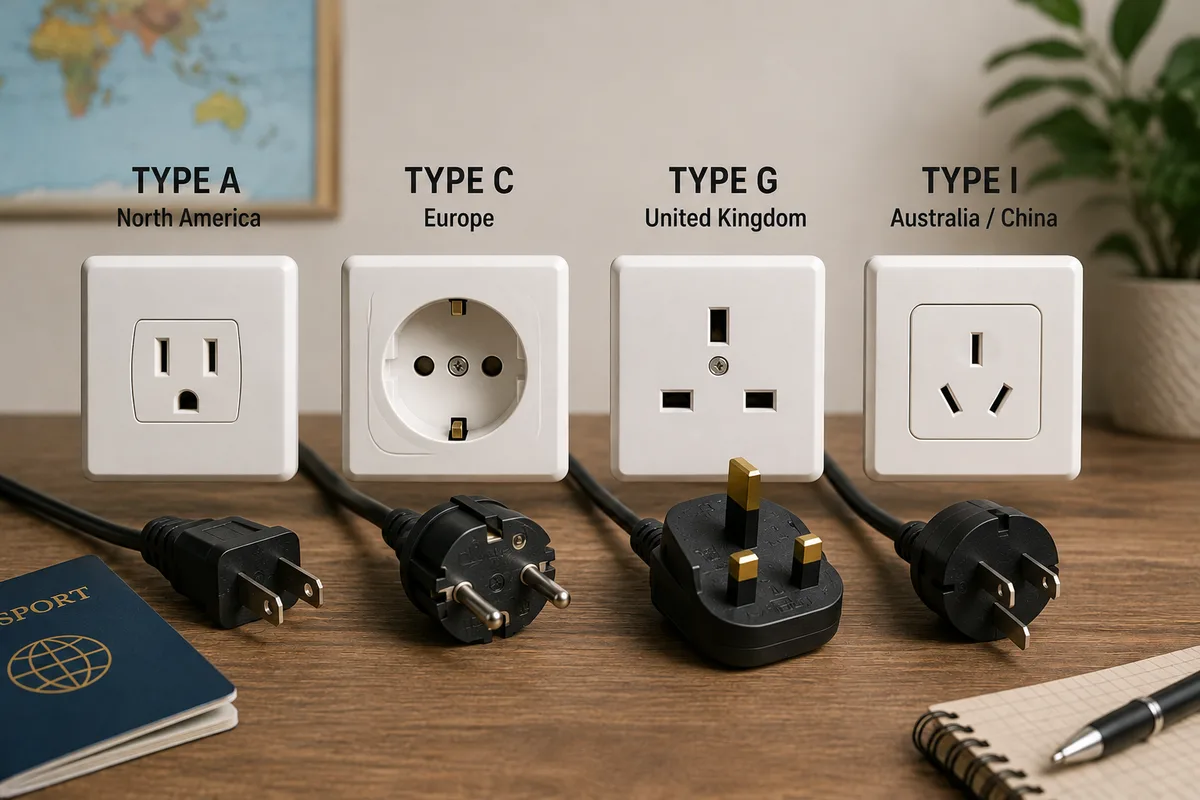
Travel guides commonly organize plugs into lettered categories such as Type A, B, C and G. These labels make an otherwise complicated international landscape easier to discuss.
For example, travelers commonly associate:
Type A and B with the United States and parts of the Americas;
Type C with many destinations in continental Europe;
Type G with the United Kingdom and several other countries.
But the letters shouldn’t create the impression that the world’s electrical infrastructure was originally designed as one tidy A-to-whatever system. They are a convenient way of identifying different established plug configurations.
Actual compatibility can be more nuanced. Some countries use more than one socket type, and certain plugs can fit compatible sockets belonging to related systems.
For a traveler, checking the specific destination remains more useful than assuming an entire continent uses one plug.
Could USB-C Eventually Solve the Problem?
USB-C is making one part of international charging much easier, but it doesn’t eliminate the wall outlet problem.
A USB-C cable can connect the same phone, tablet or laptop in many countries. Yet the charger supplying power to that cable still has to connect to the local electrical system somehow.
Hotels, airports and newer buildings increasingly provide USB charging ports, which can reduce the need to interact directly with local socket types for small electronics. But homes and electrical grids power far more than phones.
Refrigerators, washing machines, kettles, televisions, vacuum cleaners and countless other appliances still depend on national electrical infrastructure.
A universal device connector and a universal household electrical outlet solve two different problems.
Why Different Outlets Are Likely to Stay
Electrical outlets are a good example of how technological history becomes almost invisible until we travel.
At home, the socket on the wall doesn’t feel like a national standard. It simply feels like a socket. Only when your plug no longer fits do you notice that another country made different choices decades ago.
Those differences survived because electrical systems developed independently, safety standards evolved differently and existing infrastructure made wholesale replacement impractical.
The result may be inconvenient for international travelers, but it isn’t random.
Each plug and socket belongs to a larger electrical system that has been refined around the buildings and appliances already using it.
And that explains why the world still hasn’t settled on one universal outlet: changing the plug is easy; changing everything behind it isn’t.
Sources
British Standards Institution — BS 1363: 13A Plugs, Socket-Outlets, Adaptors and Connection Units








Join the discussion