Why Do We Turn Down the Music When Looking for an Address?
Turning down the music does not improve your eyesight. It reduces competing information when navigation, working memory and visual attention suddenly demand more of your brain.

You are driving through an unfamiliar neighborhood.
The music is playing normally.
Then you get close to your destination.
Suddenly the road becomes confusing. House numbers are hard to see. The navigation app says the turn is somewhere ahead.
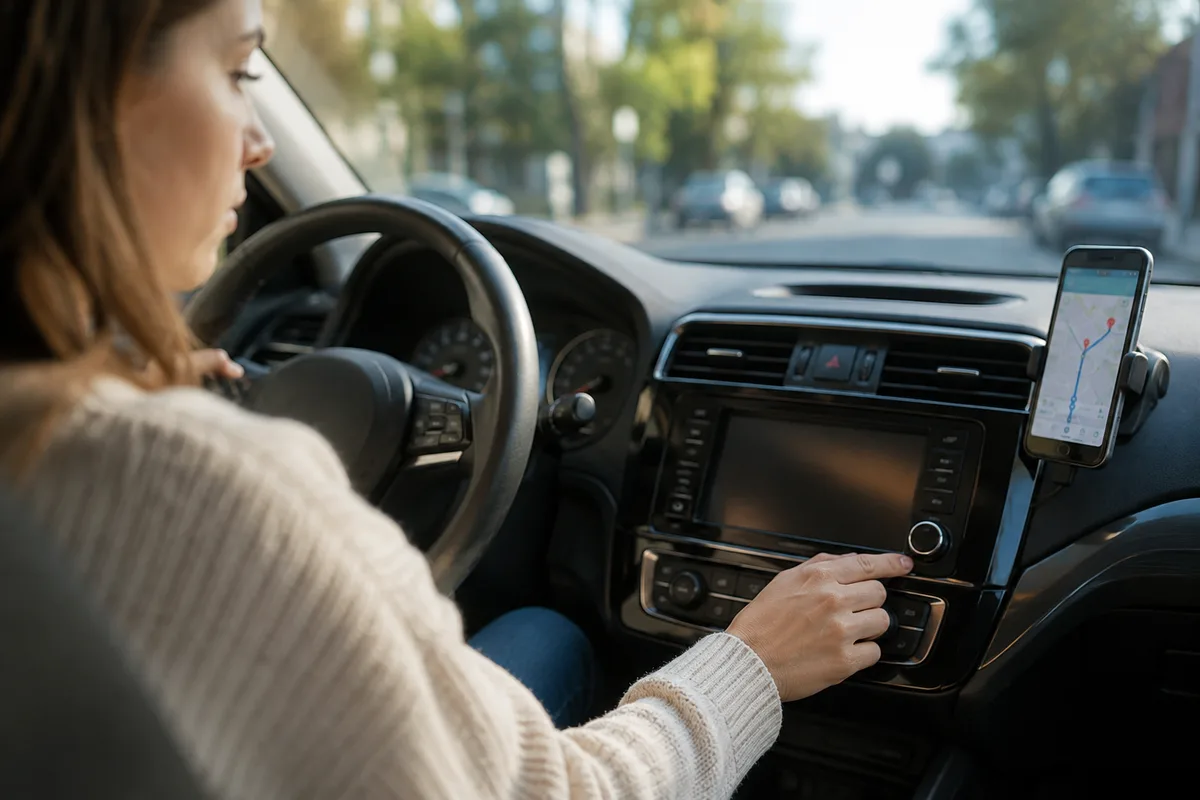
Without thinking, your hand reaches for the volume control.
You turn the music down.
Which raises an obvious question:
Why would making the car quieter help you see an address?
Your ears are not reading the street signs.
Yet the behavior makes surprisingly good sense.
The most likely explanation is not that sound directly interferes with vision. It is that attention and working memory are limited resources. When a visual-navigation task suddenly becomes more demanding, reducing unnecessary sound can lower the amount of competing information your brain has to manage.
In other words:
You are not turning the music down so your eyes can work better. You are reducing cognitive load so more attention can be devoted to the difficult task.
Research on driving supports this broader idea: listening to music can increase mental effort, even when driving performance itself does not necessarily worsen.
Driving Is Already a Multitasking Problem
Driving feels simple when the road is familiar.
But your brain is continuously handling several tasks at once.
You are monitoring:
- lane position,
- speed,
- traffic lights,
- pedestrians,
- other vehicles,
- mirrors,
- road signs,
- navigation,
- and unexpected hazards.
Much of this becomes highly practiced.
On a familiar road, you may perform many actions almost automatically.
That leaves enough mental capacity to:
- listen to music,
- talk to a passenger,
- think about dinner,
- or mentally plan the rest of the day.
Then something changes.
You enter an unfamiliar street.
Now you need to find:
2147 Oak Street.
Suddenly the task is no longer routine.
You have to inspect every building.
Remember the number.
Compare it with the numbers passing by.
Watch for the correct turn.
Listen to navigation instructions.
Avoid missing the entrance.
The cognitive demand has increased.
That is often the moment the music starts feeling like “too much.”
Your Brain Has Limited Attentional Capacity
Attention is not an unlimited spotlight that can fully illuminate every task at once.
Different activities compete for processing resources.
When the total demand is low, that competition may not matter.
But when one task becomes difficult, irrelevant information can become more disruptive.
NHTSA defines distraction broadly as anything that diverts attention away from safe driving, including interacting with stereo and navigation systems. It distinguishes visual, manual and cognitive forms of distraction.
Music normally requires little deliberate attention.
But “little” is not the same as zero.
Your brain still processes:
- rhythm,
- lyrics,
- melody,
- changes in volume,
- emotional meaning,
- and unexpected sounds.
When the driving task suddenly becomes demanding, reducing that auditory stream can make the overall mental environment simpler.
Why Does Silence Feel Helpful When the Problem Is Visual?
This is the strange part.
You are searching visually.
So why remove auditory information?
Because the brain does not operate as completely isolated sensory departments.
Seeing, hearing, remembering and deciding all interact with higher-level attentional systems.
Suppose you are trying to read tiny house numbers while also remembering:
“The entrance should be just after the pharmacy.”
At the same time, a song with lyrics is playing.
The song does not physically block your view.
But your brain is still processing it.
Reducing the volume removes one stream of information competing for attention.
That can make the demanding task feel easier.
Working Memory Matters Too
Finding an address is not purely visual.
You are also holding information temporarily in your mind.
You may need to remember:
- the street name,
- the building number,
- whether the destination is before or after an intersection,
- the navigation instruction you just heard,
- which side of the road it should be on.
That temporary mental workspace is called working memory.
Working memory has limited capacity.
When extra information competes with what you are trying to maintain, performance can become more difficult.
Curiworld’s article Why Do We Forget Why We Walked Into a Room? explores a related effect: when attention is divided and working memory is already under strain, a simple intention can become harder to maintain.
Finding an address creates a similar general challenge.
You want the goal:
“Find number 2147.”
to remain mentally prominent.
Turning down the music removes some competing input.
Does Music Actually Make Driving Worse?
This needs a careful answer.
Not always.
Research does not support the simple claim:
music = bad driving.
A 2023 systematic review and meta-analysis looked at 19 studies examining music during driving. The effects varied depending on factors such as volume, music characteristics and driving conditions. Music could increase mental load, but some outcomes were neutral or even beneficial under certain circumstances.
Another driving-simulator study found that listening to music increased drivers’ reported mental effort, yet did not reduce overall driving performance in the tested conditions. The researchers suggested drivers may compensate by allocating additional mental effort.
That distinction is important.
Music does not have to make you drive badly for your brain to recognize:
“This situation would be easier with less stimulation.”
Complex Situations Change the Equation
Consider two driving situations.
Situation A
You are driving a highway you use every day.
Traffic is light.
Your route is familiar.
Music may require almost no noticeable additional effort.
Situation B
You are entering a complicated downtown intersection.
You need to:
- change lanes,
- read several signs,
- follow navigation,
- locate a building,
- and watch pedestrians.
The same music now exists inside a much busier cognitive environment.
Research on cognitive load during driving suggests that effects depend heavily on the specific task. Demanding or unfamiliar subtasks that rely on cognitive control can be more vulnerable to additional mental load than highly automated driving behaviors.
That matches everyday experience remarkably well.
You do not usually turn down your favorite song on an empty highway.
You do it when:
“Wait… where exactly am I supposed to turn?”
Why Do We Also Turn Music Down When Parking?
Parking creates a similar situation.
Especially when parallel parking or entering a tight space, your attention shifts toward:
- mirrors,
- vehicle position,
- nearby cars,
- pedestrians,
- steering angle,
- distance estimates.
The task becomes visually and spatially demanding.
Turning the music down reduces competing stimulation.
Again, silence does not improve the optical resolution of your eyes.
It simply creates a cleaner attentional environment.
Why Do Passengers Sometimes Stop Talking Too?
This is another clue.
Imagine driving through an unfamiliar city while your passenger is telling an elaborate story.
Everything is fine until you reach a complicated intersection.
Then you say:
“Hang on a second.”
The conversation stops.
You make the turn.
Then you say:
“Okay, what were you saying?”
This is the same basic strategy.
Conversation demands:
- language processing,
- memory,
- social attention,
- and response planning.
When the driving task becomes temporarily difficult, the brain prioritizes.
The conversation waits.
The road does not.
Lyrics May Demand More Attention Than Background Sound
Not all music is equally cognitively demanding.
A familiar instrumental track may fade into the background.
A new song with prominent lyrics may capture more attention.
Research on music and driving is mixed, but characteristics such as volume and tempo can influence mental load and behavior. For example, a simulator study involving novice drivers found higher mental load and poorer hazard-perception scores with fast-tempo music compared with slower conditions.
That does not mean fast songs automatically cause accidents.
It means the details of the auditory environment matter.
The more attention the sound attracts, the more likely you may be to reduce it when another task suddenly becomes difficult.
Volume Matters Too
A barely audible song and extremely loud music do not create the same sensory environment.
The systematic review of music and driving found that volume was one factor associated with changes in driving behavior and mental load.
High-volume music can also make important external sounds harder to notice.
That can include:
- emergency sirens,
- horns,
- unusual vehicle noises,
- or cues from outside the car.
So lowering the music near a complicated destination may help in more than one way.
It can reduce cognitive competition and make external auditory information easier to detect.
Is This an Automatic Brain Reflex?
Probably not in the strict biological-reflex sense.
There is no special neurological mechanism known as:
“address-search music suppression reflex.”
The behavior is better understood as a practical form of self-regulation.
People often adjust their environment when concentration becomes difficult.
You may:
- mute the TV while reading an important email,
- ask someone to stop talking while calculating something,
- close browser tabs while solving a problem,
- turn off a podcast while navigating somewhere unfamiliar.
The shared pattern is simple:
task difficulty rises → irrelevant stimulation becomes less useful → stimulation gets reduced.
Why Don’t We Notice the Music Until the Task Gets Hard?
Attention is selective.
When a task is easy, the brain can often handle background stimulation without difficulty.
Music may even help with:
- boredom,
- alertness,
- mood,
- or monotony.
The problem becomes noticeable only when the main task needs additional cognitive resources.
That is why the music can suddenly feel distracting even though it was perfectly comfortable 30 seconds earlier.
Nothing about the song changed.
The demands of the task changed.
The Brain Can Compensate for Extra Load
One interesting finding from driving research is that people do not simply remain passive when cognitive demand rises.
They adapt.
Drivers may:
- slow down,
- concentrate harder,
- stop talking,
- reduce music,
- increase following distance,
- or postpone another task.
This is sometimes called compensatory behavior.
The 2012 simulator study on music found evidence that participants increased mental effort while listening to music, potentially helping them maintain performance despite the additional cognitive demand.
Turning down the radio may be another everyday version of that same adaptive strategy.
Does Music Compete With Vision Directly?
Not necessarily.
It would be misleading to say:
“Your ears steal power from your eyes.”
The relationship is more subtle.
The competition happens largely at the level of:
- attention,
- working memory,
- decision-making,
- and cognitive control.
Your visual system can still receive information while music is playing.
But determining:
“Is that building 2145 or 2147?”
requires more than simply seeing the image.
You must interpret it, compare it with your goal, make a decision and respond.
Those higher-level processes are where mental load becomes important.
Navigation Apps Add Another Layer
Modern driving adds yet another information stream.
Navigation systems provide:
- spoken instructions,
- maps,
- distance countdowns,
- street names,
- lane guidance,
- alerts.
NHTSA explicitly includes navigation-system interaction among activities that can divert driver attention.
Used appropriately, navigation is extremely helpful.
But when you are already trying to interpret a complicated road layout, loud music can compete with spoken directions.
Lowering the music makes the important auditory signal easier to hear.
In that situation, turning down music may help not only attention but signal clarity.
Why Do We Sometimes Turn the Music Completely Off?
The harder the task feels, the more aggressively we may simplify the environment.
For a mildly confusing road:
volume down.
For a difficult parking maneuver:
music off.
For a chaotic intersection:
everyone be quiet for ten seconds.
It is a crude but effective prioritization system.
The brain is essentially saying:
“One thing at a time.”
Can Silence Actually Improve Concentration?
Not universally.
Some people concentrate well with background music.
Others prefer silence.
The effect depends on:
- the person,
- the task,
- the music,
- familiarity,
- volume,
- and environmental conditions.
The safer conclusion is not:
silence always improves performance.
It is:
When cognitive demand rises, reducing irrelevant input can make it easier to concentrate on the task that matters most.
That fits both experimental research on mental workload and everyday behavior.
This Is Not Just a Driving Habit
You can observe the same pattern elsewhere.
People often turn off or reduce music when they:
- read complicated instructions,
- proofread important text,
- perform mental arithmetic,
- reverse a car,
- assemble furniture,
- search for a lost object,
- or listen for a faint sound.
The senses involved may differ.
The underlying strategy is similar:
reduce competing information.
Frequently Asked Questions
Why do people turn down the radio when looking for an address?
Finding an address increases visual attention, working-memory and decision-making demands. Lowering music reduces competing auditory information and can make it easier to focus on navigation.
Does turning down music actually help you see better?
Not directly. Your eyesight does not become sharper. The benefit is more likely related to attention and cognitive load.
Is listening to music while driving distracting?
It can increase mental load, but the overall effect on driving depends on the music, volume, driving conditions and driver. Research does not support treating all music as equally harmful.
Why do I turn the music down when parking?
Parking requires close visual-spatial attention and frequent decisions. Reducing background sound can simplify the mental environment while you focus on mirrors, distance and vehicle position.
Why do people ask passengers to be quiet at difficult intersections?
Conversation itself requires attention and language processing. Temporarily stopping the conversation frees more attention for navigation and hazard monitoring.
Does loud music make driving harder?
High volume can increase mental load and may also mask useful sounds outside the vehicle. The effect varies with circumstances, but reducing volume in demanding situations is sensible.
Final Thoughts
Turning down the music when looking for an address seems irrational only if we imagine the brain as separate independent systems:
eyes see, ears hear, end of story.
Real attention does not work that way.
Driving through an unfamiliar area requires:
- seeing,
- remembering,
- deciding,
- navigating,
- predicting,
- and reacting.
When that workload suddenly increases, the brain looks for something it can remove.
The song is optional.
The road is not.
So your hand reaches for the volume knob.
Not because quieter music makes the house numbers physically larger.
But because sometimes the simplest way to think more clearly is to make the world around you a little less busy.
Sources
PubMed — The Influence of Music on Mental Effort and Driving Performance








Join the discussion