Why Do Your Ears Pop on an Airplane? What Cabin Pressure Is Doing
Your ears pop during flights because changing cabin pressure creates a temporary pressure difference across your eardrum. The Eustachian tube is what fixes it.
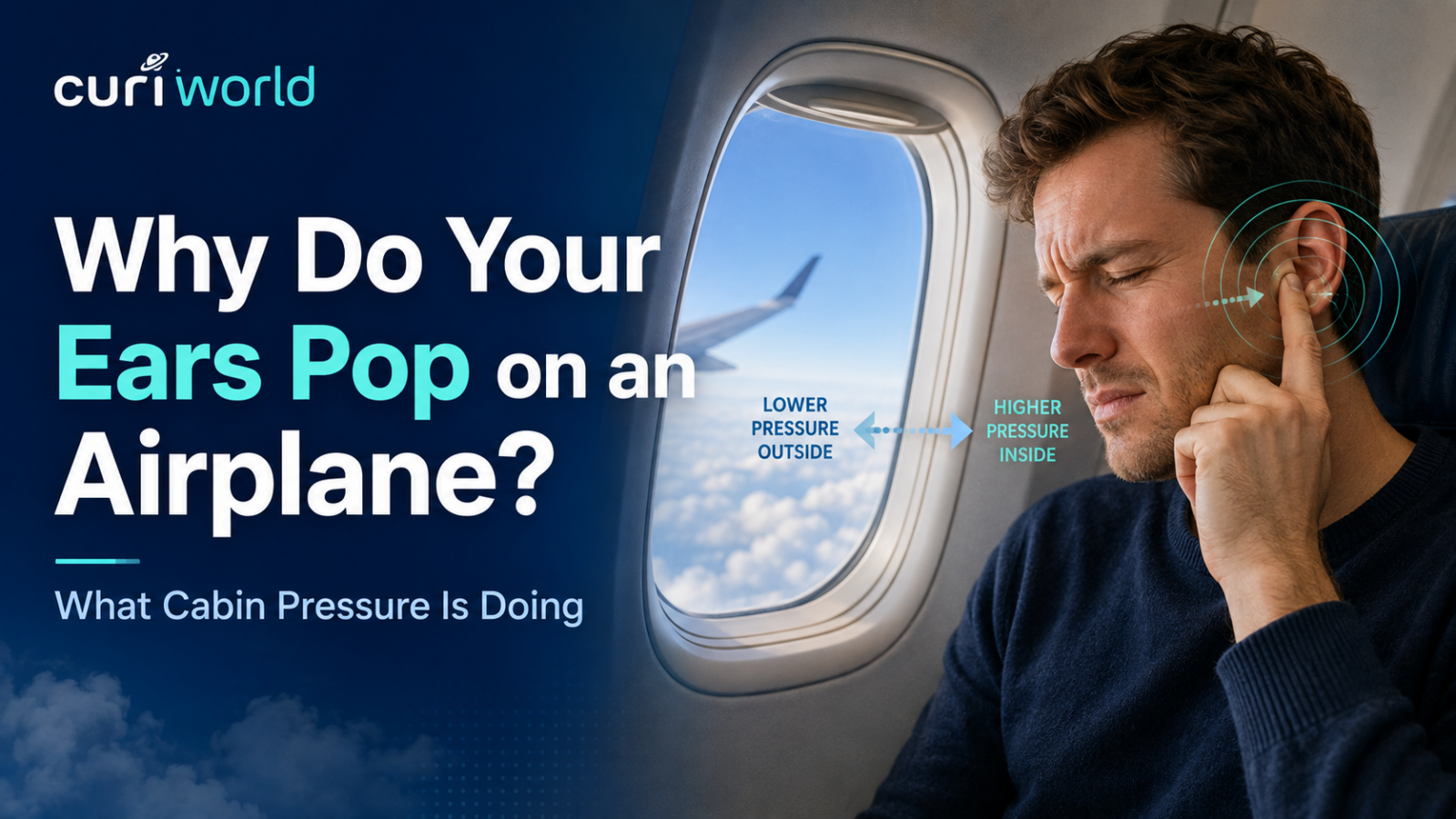
The plane starts descending.
A few minutes later, your ears feel blocked.
Sounds become muffled. Pressure builds behind your eardrums. You swallow, yawn, or chew gum—and suddenly:
pop.
Everything sounds normal again.
This familiar experience happens because the air pressure inside an airplane cabin changes during ascent and descent, while a small air-filled space inside your ear has to keep up.
The “pop” is not your ear doing something wrong.
In most cases, it is actually the moment your ear successfully equalizes the pressure on both sides of your eardrum.
The key structure responsible is a narrow passage called the Eustachian tube.
Your Middle Ear Contains Air
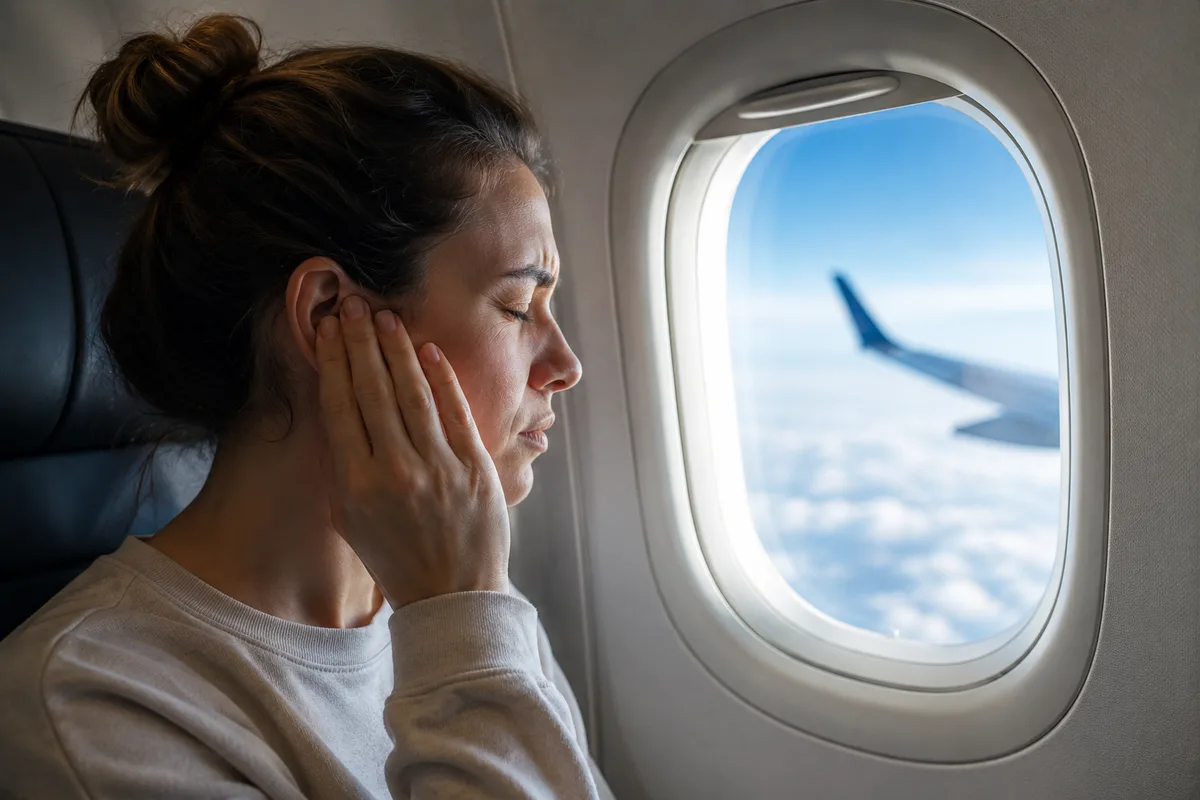
The part of the ear involved in airplane pressure is the middle ear.
It sits behind the eardrum and normally contains air.
For the eardrum to move efficiently, the air pressure on the inside of the eardrum should stay reasonably close to the pressure in the surrounding environment.
That is easy while you are sitting at home.
The atmospheric pressure around you changes relatively slowly.
An airplane is different.
Commercial aircraft climb thousands of feet within minutes, and although the cabin is pressurized, its pressure still changes significantly during the flight.
The CDC notes that commercial aircraft cabins are generally maintained at a pressure equivalent to roughly 6,000–8,000 feet above sea level, rather than sea-level pressure.
Your ears therefore have to continually adjust.
The Eustachian Tube Is Your Ear’s Pressure Valve
The middle ear is connected to the back of the nose and upper throat through a narrow channel called the Eustachian tube.
Most of the time, that tube is closed.
It opens briefly during actions such as:
- swallowing,
- yawning,
- chewing,
- and certain movements of the throat.
When it opens, air can move between the throat and middle ear.
That allows pressure on the two sides of the eardrum to become more equal.
This is why swallowing during a flight can suddenly make your hearing feel clearer.
You have essentially opened a tiny biological pressure valve.
What Happens During Takeoff?
As the airplane climbs, cabin pressure decreases.
The air already trapped inside your middle ear is temporarily at a higher pressure than the surrounding cabin.
That air expands and needs a way out.
According to the FAA, during ascent the expanding middle-ear air can push the Eustachian tube open and escape toward the nasal passages, helping equalize the pressure.
For many people, this happens almost automatically.
You may notice:
- mild fullness,
- a small click,
- or several gentle pops.
Sometimes you barely notice anything at all.
Descent Is Usually More Noticeable
Landing is often when passengers experience the most discomfort.
As the aircraft descends, cabin pressure increases.
Now the situation reverses.
The pressure outside the eardrum becomes higher than the pressure inside the middle ear.
Air has to move into the middle ear through the Eustachian tube to restore balance.
But this direction can be harder to accomplish automatically.
That is why people often spend the final 20 minutes of a flight:
- swallowing,
- yawning,
- chewing gum,
- moving their jaw,
- or trying to “pop” their ears.
The FAA specifically notes that passengers need to periodically open the Eustachian tube during descent to equalize middle-ear pressure.
What Is the Actual “Pop”?
Imagine the pressure on the two sides of your eardrum gradually becoming unequal.
The eardrum bends slightly because one side is pushing harder than the other.
That can create:
- fullness,
- muffled hearing,
- pressure,
- discomfort,
- or pain.
Then the Eustachian tube opens.
Air moves.
Pressure equalizes.
The eardrum returns toward its normal position.
The sudden change can create the sensation or sound we describe as:
pop.
So the pop is usually not something breaking.
It is pressure being released or restored.
Why Does Your Hearing Become Muffled?
Your eardrum needs to vibrate freely when sound waves reach it.
When a pressure difference stretches or pushes the eardrum away from its normal resting position, it cannot move quite as normally.
That can make sounds seem temporarily:
- quieter,
- duller,
- farther away,
- or “underwater.”
Once the pressure equalizes, normal movement returns and hearing often clears quickly.
This is why a single swallow can sometimes make the entire cabin suddenly sound louder.
Why Does Swallowing Help?
Swallowing activates muscles around the Eustachian tube.
Those muscles can briefly pull the tube open.
Air can then move through the passage and equalize middle-ear pressure.
Yawning works for a similar reason.
Chewing gum is not magically absorbing pressure.
It simply encourages repeated:
chewing → swallowing → jaw movement
which increases the chances of the Eustachian tube opening.
That is why these simple behaviors are useful during descent.
Why Does the Valsalva Maneuver Work?
If swallowing and yawning do not work, some people use the Valsalva maneuver.
The basic technique involves:
- closing your mouth,
- pinching your nose,
- and gently attempting to exhale through the blocked nose.
This raises pressure behind the nose and can help push air through the Eustachian tubes.
The FAA includes this as a pressure-equalization technique when ordinary swallowing or yawning is not enough.
The important word is gently.
This is not a competition to blow as hard as possible.
Forceful pressure can be uncomfortable and may be inappropriate for some people.
Why Is Flying With a Cold So Much Worse?
This is where an ordinary pressure change can turn painful.
The Eustachian tube opens into the area behind the nose.
If you have:
- a cold,
- sinus congestion,
- significant allergies,
- or another upper respiratory problem,
the tissues around the tube can become swollen.
That makes the passage harder to open.
The airplane continues descending.
Cabin pressure rises.
But your middle ear cannot equalize.
The pressure difference increases.
The result can become much more painful than an ordinary ear pop.
The CDC identifies blocked Eustachian tubes as the main reason middle-ear barotrauma occurs during air travel.
What Is Airplane Ear?
When pressure cannot equalize properly, the condition is commonly called airplane ear, ear barotrauma, or barotitis.
Mild cases may cause:
- pressure,
- fullness,
- temporary discomfort,
- popping,
- or muffled hearing.
More significant pressure differences can produce stronger pain.
Rare complications can include hearing problems, dizziness, tinnitus, fluid accumulation or even eardrum injury. The CDC notes that severe complications are uncommon but possible.
For most healthy passengers, however, the temporary pressure sensation resolves during or shortly after the flight.
Why Do Children Often Have More Trouble With Ear Pressure?
Anyone who has been on a flight with small children has probably noticed that descent can be difficult.
Children’s Eustachian tubes differ anatomically from those of adults and may not equalize pressure as efficiently.
Babies also cannot deliberately yawn or perform a pressure maneuver on command.
The CDC recommends encouraging swallowing during descent.
For infants, that might mean:
- nursing,
- bottle feeding,
- or sucking on a pacifier.
Older children may be able to drink, swallow repeatedly or chew gum when age-appropriate.
The mechanism is the same:
swallowing helps open the Eustachian tube.
Should You Sleep During Landing?
Sleeping is not automatically dangerous, but there is one practical issue.
When you are awake, you naturally:
- swallow,
- move your jaw,
- yawn,
- notice developing pressure,
- and respond to discomfort.
During sleep, swallowing becomes less frequent.
The FAA therefore notes that waking sleeping passengers before descent can help them actively equalize pressure.
If you are someone whose ears regularly become painful during landing, staying awake through the descent may make pressure management easier.
Why Does One Ear Pop Before the Other?
Your two Eustachian tubes do not necessarily behave identically.
One side may:
- open more easily,
- be slightly more congested,
- have different anatomy,
- or equalize a few seconds earlier.
That can produce the strange sensation of:
one normal ear + one blocked ear.
A few swallows later, the second ear may pop too.
Occasional asymmetry during a flight is not unusual.
Persistent one-sided problems, especially when accompanied by pain or hearing changes, deserve more attention.
Why Can Your Ears Keep Popping After Landing?
Pressure does not always equalize the instant the wheels touch the runway.
If the Eustachian tube has been slow to open, your ears may remain:
- clogged,
- crackly,
- slightly muffled,
- or prone to repeated popping
for a while afterward.
As normal swallowing and jaw movements gradually ventilate the middle ear, the sensation often resolves.
The FAA advises medical evaluation if an ear block does not clear shortly after landing.
Severe pain, significant hearing loss, bleeding or marked dizziness should not simply be ignored as “normal airplane ears.”
Why Is Cabin Pressure Different From Outside Pressure?
At cruising altitude, the atmospheric pressure outside a commercial aircraft is far too low for a normal passenger cabin.
So the fuselage is pressurized.
But airlines generally do not maintain the exact pressure you experience at sea level.
Instead, the cabin is maintained at a pressure corresponding to a lower altitude than the aircraft’s actual altitude.
For example, an aircraft might physically be flying above 30,000 feet while the cabin environment feels more like being at several thousand feet.
That pressure difference influences many parts of the flight experience.
Curiworld already explains how aircraft engineering manages it in Why Do Airplane Windows Have Tiny Holes?. The breather hole helps manage pressure between layers of the window assembly.
Cabin Pressure Changes More Than Your Ears
Your ears are one of the most obvious places where changing cabin pressure becomes noticeable.
But they are not the only part of your flight experience affected by the cabin environment.
Lower pressure and very dry cabin air can also change sensory perception.
That is part of the reason food can taste different on an airplane.
Together, these articles form an interesting reminder:
An airplane cabin may look like an ordinary room with seats.
Physically, it is a carefully controlled environment operating under conditions very different from your living room.
How Can You Reduce Ear Pressure During a Flight?
For ordinary pressure changes, simple actions are often enough:
- Swallow frequently during descent.
- Yawn deliberately.
- Sip water.
- Chew gum if appropriate.
- Move your jaw.
- Stay awake during descent if ear pressure is usually a problem.
- Equalize early instead of waiting until the pain becomes severe.
If necessary and appropriate, a gentle Valsalva maneuver may help.
The FAA emphasizes that equalization should not be delayed until severe pain has already developed, because opening the Eustachian tube can become more difficult once the pressure difference is large.
Should You Fly With a Bad Cold?
This deserves more caution.
Severe nasal congestion can make pressure equalization difficult.
The CDC notes that travelers with significant ear, nose or sinus infections or severe congestion may consider postponing flying because blocked pressure pathways increase the risk of pain or barotrauma.
Medication decisions are more individual.
Decongestants are not appropriate for everyone, can have side effects, and recommendations differ by age and medical history.
For children especially, medications should not be given simply to prevent airplane ear without appropriate medical guidance. The CDC notes that antihistamines and decongestants have not shown benefit for routine ear-pain prevention in children and highlights age-related safety restrictions.
When Should Ear Pain After Flying Be Checked?
Most pressure-related symptoms improve after landing.
Consider medical evaluation if you develop:
- severe or persistent ear pain,
- hearing loss that does not improve,
- significant dizziness,
- persistent ringing in the ear,
- fluid or blood coming from the ear,
- or pressure that remains substantially blocked after the flight.
Those symptoms can indicate more than the ordinary temporary pressure difference most travelers experience.
Frequently Asked Questions
Why do ears pop during takeoff and landing?
Cabin pressure changes as the aircraft climbs and descends. Your Eustachian tubes open to move air between the middle ear and throat, equalizing the pressure on both sides of the eardrum. The sudden equalization can feel like a pop.
Is ear popping on a plane normal?
Yes. Mild popping, fullness or short-lived pressure changes are common during flights. The pop itself often means pressure has successfully equalized.
Why is landing worse than takeoff?
During descent, cabin pressure increases and air has to enter the middle ear through the Eustachian tube. This direction of equalization can be more difficult, particularly if the tube is congested.
Does chewing gum really help airplane ears?
It can help indirectly because chewing increases swallowing and jaw movement, both of which can encourage the Eustachian tube to open.
Why do my ears hurt more when I have a cold?
Congestion can narrow or block the Eustachian tube, making it harder for middle-ear pressure to equalize as cabin pressure changes.
Can airplane pressure damage your eardrum?
Severe barotrauma can rarely cause complications including eardrum perforation, hearing problems or dizziness. Ordinary temporary popping is much more common and usually resolves without injury.
Final Thoughts
Your ears pop on an airplane because an air-filled chamber inside your head is trying to keep pace with a changing environment.
The cabin climbs.
Pressure falls.
The plane descends.
Pressure rises.
Your eardrum feels the difference.
Then the Eustachian tube opens.
Air moves.
Pop.
Pressure is equal again.
What feels like a strange annoyance is actually a clever piece of human anatomy doing exactly what it is designed to do.
And the next time your ears suddenly clear during landing, you are feeling—in real time—the physics of air pressure interacting with one of the body’s smallest pressure-control systems.
Sources
CDC Yellow Book — Air Travel
CDC: Air Travel and Barotrauma
Federal Aviation Administration — Medical Facts for Pilots: Ear Block
FAA: Ear Block and Pressure Equalization








Join the discussion