Why Do Bubbles Stick to the Side of a Glass?
Those tiny bubbles clinging to a glass are often born there. Microscopic imperfections, dissolved gas, and surface forces explain the surprisingly complex physics.
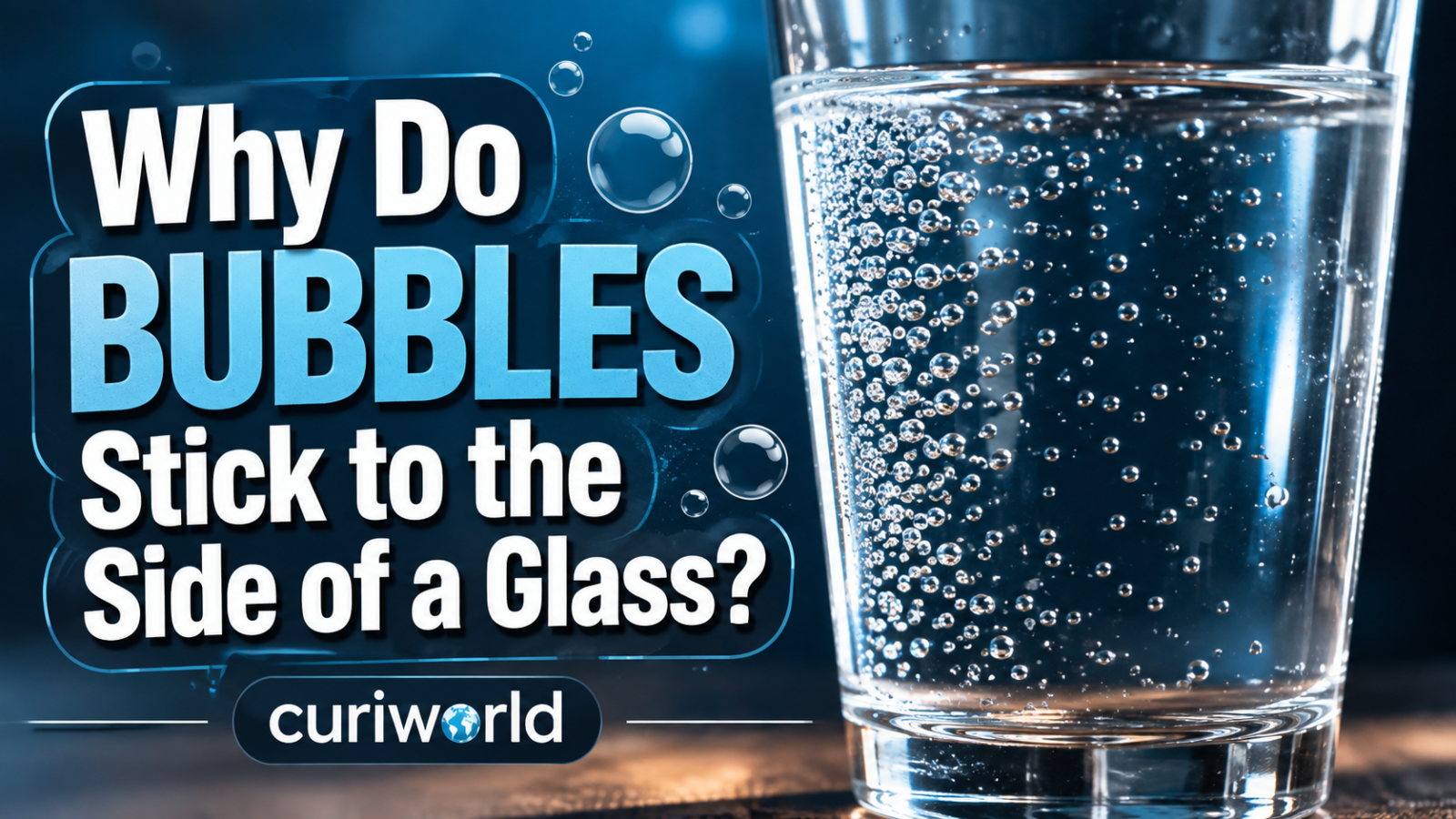
Pour sparkling water into a glass and look closely. Tiny bubbles often appear in neat clusters or streams along the inner wall. Leave an ordinary glass of water sitting for a while and you may notice something similar: small bubbles collecting on the sides even though the drink was never carbonated.
It looks as though the bubbles floated through the liquid and somehow became stuck to the glass.
Often, that is not what happened.
Bubbles often form directly on the glass rather than floating over and becoming stuck there. Microscopic scratches, fibers, dust and tiny cavities create nucleation sites where dissolved gas can collect and grow into a visible bubble.
The bubble remains attached while surface tension and contact-line forces hold it to the glass. As it grows, buoyancy becomes stronger until the bubble finally detaches and rises to the surface.
Why Tiny Scratches and Fibers Create Bubbles on Glass
A drinking glass may look perfectly smooth.
At a microscopic scale, it usually is not.
Its surface can contain tiny scratches, pits, dust particles, mineral deposits, or microscopic fibers left behind by a cloth or paper towel. Even imperfections far too small to see can matter to a forming bubble.
Creating a completely new gas bubble in the middle of a liquid requires energy because the liquid has to create a new gas-liquid interface.
A microscopic cavity makes that job easier.
A tiny pocket of gas can remain trapped inside the irregularity. Dissolved gas molecules in the surrounding liquid can then enter that pocket, allowing it to grow into a visible bubble.
That is heterogeneous nucleation: bubble formation assisted by an existing surface or particle rather than occurring spontaneously in the middle of the liquid.
It explains why bubbles often appear repeatedly from exactly the same spot.
The bubble leaves.
Another begins growing in its place.
Why Don’t Bubbles Usually Start in the Middle of the Water?
A bubble can in principle begin away from a surface, but creating a brand-new gas-liquid interface inside the bulk liquid requires a larger energy barrier.
A microscopic cavity, fiber or rough spot makes the process easier because a tiny gas pocket can already exist there.
That is why visible bubbling often begins at:
- scratches on glass,
- fibers,
- dust particles,
- rough surfaces,
- or deliberately etched points.
The glass is not “creating” the gas.
It is providing an easier place for dissolved gas to become a visible bubble.
Carbonated Drinks Make the Effect Much Easier to See
The process becomes especially obvious with sparkling water, soda, beer, or sparkling wine because these drinks contain substantial amounts of dissolved carbon dioxide.
Carbonated beverages are bottled or canned under pressure, allowing more carbon dioxide to remain dissolved in the liquid.
Opening the container reduces the pressure.
The liquid can no longer keep as much carbon dioxide dissolved, so some of that gas begins escaping.
The challenge is getting the first tiny bubble started.
Microscopic nucleation sites on the glass provide convenient starting points.
Research on champagne has shown this process in remarkable detail. Scientists examining bubble formation found that many bubble streams originated from tiny cellulose fibers attached to the wall of the glass. Microscopic gas pockets inside those fibers acted as nucleation sites, collecting dissolved carbon dioxide until a bubble grew large enough to detach.
That is why a sparkling drink can produce a striking vertical stream of bubbles from one apparently ordinary point on the glass.
There may be nothing special about the liquid at that exact location.
The special part is the microscopic surface beneath it.
Why Does Shaking a Carbonated Drink Make the Problem Worse?
Shaking does not magically create more carbon dioxide.
The gas was already inside the sealed drink.
What shaking can do is create and distribute more small gas pockets and disturb surfaces throughout the liquid.
When the container is opened and pressure suddenly drops, those gas pockets can become convenient starting points for rapid bubble growth.
That is why a shaken carbonated drink can foam much more violently after opening.
The same basic principle is involved: dissolved gas escapes more easily when it has places where bubbles can begin growing.
Why Doesn’t the Bubble Immediately Float Away?
Gas is less dense than liquid, so buoyancy is constantly encouraging a bubble to rise.
Why, then, does a bubble remain attached to the side of the glass while it grows?
Because buoyancy is not the only force involved.
The bubble meets the glass along what physicists call a three-phase contact line: the boundary where gas, liquid, and the solid glass surface meet.
Surface tension, wetting behavior, microscopic roughness, and contact-line pinning can all help hold the bubble in place.
Imagine a small bubble growing from a microscopic scratch.
At first, it has very little volume, so its upward buoyant force is weak. The surface forces keeping it attached can be strong enough to prevent it from moving.
As more gas enters the bubble, its volume increases.
So does the upward force.
Eventually, the balance changes.
The bubble reaches a point where buoyancy and other forces pulling it away from the surface overcome the forces holding it there.
Then it detaches and rises.
This creates the familiar rhythm:
grow, detach, rise, repeat.
Why Do Larger Bubbles Break Free More Easily?
Buoyancy depends strongly on bubble volume.
As a bubble grows, the upward force acting on it increases faster than the forces associated with the small region where it remains attached to the glass.
Eventually, the balance tips.
The bubble can no longer remain pinned to the same microscopic site and it detaches.
This is why a nucleation site often seems to “wait” while a bubble grows, then suddenly releases it and begins producing another one.
Why Do Some Spots Produce Bubble After Bubble?
Watch a glass of sparkling water closely and one spot may produce bubble after bubble from exactly the same location. This happens because the nucleation site can retain a tiny gas pocket even after the previous bubble detaches.
A tiny pocket of gas can remain trapped in a fiber, scratch, or cavity. Carbon dioxide from the surrounding liquid diffuses into that pocket and starts the growth cycle again.
The result can be a remarkably regular chain of bubbles rising through the drink.
Those elegant bubble trails in sparkling wine are therefore not random decorations.
They are evidence of microscopic structures on the glass.
Why Do Bubbles Sometimes Rise in a Perfect Line?
A vertical stream of bubbles usually comes from one active nucleation site repeatedly producing bubbles.
After one bubble detaches, a microscopic gas pocket can remain behind in the same cavity or fiber.
Dissolved gas then diffuses into that pocket until another bubble grows large enough to detach.
Because each new bubble starts from almost exactly the same point, the bubbles appear to rise in a neat column.
The line is therefore not caused by the bubbles “following” one another.
They are simply being born from the same microscopic location.
Does a Dirtier Glass Produce More Bubbles?
Sometimes—but “dirty” is not quite the right word.
A perfectly clean and extremely smooth surface may offer relatively few good nucleation sites.
Introduce microscopic fibers, scratches, particles, or rough areas and more potential nucleation sites become available.
That can increase visible bubbling in a carbonated drink.
This does not mean an unwashed glass produces better carbonation. Residues can alter flavor, foam, wetting behavior, and cleanliness in undesirable ways.
The interesting point is simply that microscopic texture matters.
Some glassware designed for sparkling beverages even uses deliberately etched nucleation points at the bottom of the glass. These engineered imperfections encourage a steady stream of bubbles from a chosen location.
Instead of trying to eliminate nucleation, the glassmaker uses it.
Why Do Some Beer and Champagne Glasses Have Etched Dots at the Bottom?
Those tiny markings can be intentional nucleation sites.
A manufacturer can create a small roughened or etched area that traps microscopic gas pockets and encourages carbon dioxide bubbles to form repeatedly from the same place.
The result is a controlled stream of bubbles rising through the drink.
So in this case, the imperfection is not a flaw.
It is part of the glass design.
Why Do Bubbles Appear in Plain Water?
Carbon dioxide explains the dramatic bubbling in soda and sparkling wine, but what about ordinary tap water?
Water naturally contains dissolved gases from the air, mainly nitrogen and oxygen.
How much gas remains dissolved depends partly on temperature and pressure.
A cold glass of water poured from a faucet can gradually warm toward room temperature. As conditions change, some dissolved gas may come out of solution.
Again, the easiest places for bubbles to begin forming are often surfaces.
Tiny gas pockets grow at microscopic imperfections in the glass until they become visible.
This is why a glass of ordinary water left on a table can develop bubbles along its walls even though nobody added carbonation.
Those bubbles are not evidence that the water has suddenly started producing gas chemically.
Much of the gas was already there—just dissolved and invisible.
Are Bubbles on a Glass of Water a Sign That the Water Is Bad?
Usually, no.
Small bubbles appearing on the inside of a glass after water has been sitting for a while are commonly explained by dissolved gases leaving the water as temperature and pressure conditions change.
They are not, by themselves, evidence that the water is contaminated or undergoing a dangerous chemical reaction.
What matters more for water safety is the source of the water, local drinking-water guidance, unusual odor or color, and any known contamination warning.
The bubbles alone are normally just a physical effect.
Temperature Changes What You See
Temperature can make the effect more noticeable because gases generally become less soluble in water as temperature rises. As a cold drink warms, some dissolved gas can leave the liquid and feed bubbles growing at active nucleation sites.
In a carbonated beverage, warming also speeds the loss of carbon dioxide, which is one reason a warm soda tends to lose its fizz faster than a cold one.
More available gas means more growth at active nucleation sites.
Temperature is not creating the scratches or fibers on the glass. It is changing how readily gas leaves the liquid and feeds the bubbles growing there.
The glass provides the starting point.
The liquid supplies the gas.
Temperature changes many familiar everyday materials in less obvious ways too. Curiworld also explains why metal feels colder than wood even when both are at the same temperature.
Why Does Warm Soda Lose Its Fizz Faster?
Carbon dioxide is generally more soluble in colder liquid.
As a carbonated drink warms, it becomes easier for dissolved CO₂ to leave the liquid.
Once a bubble begins growing at a nucleation site, additional dissolved carbon dioxide can diffuse into it.
That is why warm carbonated drinks tend to release gas more readily than cold ones.
Temperature does not create the carbonation.
It changes how easily the dissolved gas stays in solution.
Are These the Same Bubbles You See Before Water Boils?
The underlying idea of nucleation is related, but the gas can have a different origin.
In water that is merely sitting in a glass, visible bubbles often contain gases that were previously dissolved in the water.
As water approaches boiling, vapor bubbles become increasingly important. These contain water vapor and tend to form at nucleation sites on the walls or bottom of the container.
Surface irregularities again make bubble formation easier.
That is also why extremely smooth containers can sometimes allow water to become unusually hot before vigorous boiling begins: there may be fewer convenient places for vapor bubbles to start.
So the everyday bubbles on a cold glass and the bubbles involved in boiling are not identical phenomena, but both demonstrate the importance of surfaces in bubble formation.
One useful clue is temperature.
Small bubbles can appear on the bottom or sides of a pot before the water reaches a full boil because dissolved gases are leaving the warming water.
Closer to boiling, water-vapor bubbles become increasingly important.
So not every bubble you see while heating water is automatically a steam bubble.
Why Do Bubbles Sometimes Stick to a Straw Too?
For essentially the same reason.
A plastic straw may look smooth, but under magnification it contains microscopic surface features.
Those irregularities can trap tiny gas pockets and become nucleation sites when the straw enters a carbonated drink.
That is why bubbles suddenly appear all over a straw that looked completely bubble-free seconds earlier.
The same principle helps explain why dropping a rough or porous object into a carbonated liquid can trigger vigorous fizzing.
More microscopic cavities mean more potential places for bubbles to begin.
The same principle can apply to ice cubes, spoon surfaces and other objects in a drink: roughness, trapped gas pockets and wetting behavior can create convenient places for bubbles to form or remain attached.
A Perfectly Smooth Glass Would Look Surprisingly Different
In an exceptionally clean, microscopically smooth glass, the same sparkling drink may show fewer bubbles along the wall because there are fewer effective nucleation sites. The liquid can contain the same amount of dissolved carbon dioxide while looking much less active.
This reveals an important distinction:
The number of visible bubbles is not a direct measurement of how much gas is dissolved in the drink.
It also depends on how easily bubbles can nucleate.
A glass covered with effective nucleation sites can look dramatically more active than a smoother glass holding essentially the same beverage.
The Bubble Is Showing You a Surface You Cannot See
The tiny bubbles clinging to a glass are doing something surprisingly useful: they are making microscopic imperfections visible.
A spot that appears perfectly smooth to your eye may contain a scratch, fiber, cavity, or particle capable of trapping gas.
Dissolved molecules gather there. A bubble grows. Surface forces temporarily hold it in place. Buoyancy eventually wins, and the bubble rises.
Then the process may begin again from the same invisible point.
So the next time you see a perfect line of bubbles climbing the side of a sparkling drink, the interesting part is not only the bubbles.
It is the microscopic landscape of the glass that made them possible.
Sources
Advances in Colloid and Interface Science — Surface Nanobubbles: Theory, Simulation, and Experiment







Join the discussion