Who Should Consider NIPT? When a Fetal DNA Test May Be Useful
NIPT is no longer reserved for high-risk pregnancies. Learn who can consider fetal DNA screening—and when another genetic test may provide a better answer.
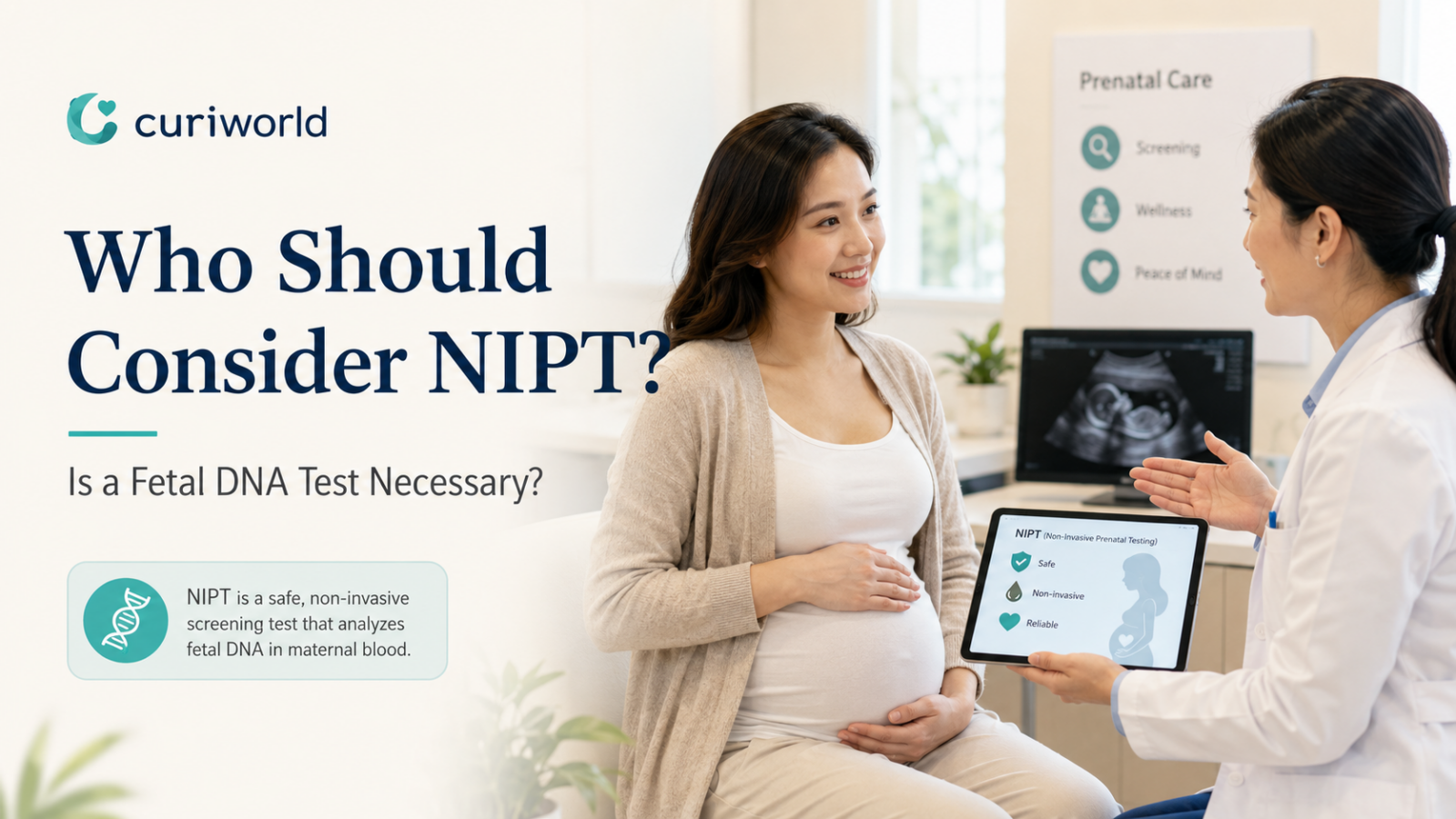
NIPT is not reserved only for high-risk pregnancies. Current professional guidance recommends that cell-free DNA screening for common trisomies be routinely available to all pregnant patients, regardless of maternal age or baseline risk. However, NIPT remains optional: being eligible for the test does not mean every pregnant person needs to have it.
NIPT—also called cell-free DNA screening—is especially worth discussing when a patient wants highly accurate screening for common fetal aneuploidies, while certain abnormal ultrasound findings, previous genetic conditions or known familial risks may make genetic counseling or diagnostic testing more appropriate.
If you want the test basics first, see how NIPT works and what it can screen for before deciding whether the screening fits your situation.
Should Everyone Get NIPT?
No. NIPT should be available as a screening option to all pregnant patients, but professional guidance does not say that everyone must have it. After appropriate counseling, patients may choose screening, diagnostic testing when appropriate, or decline prenatal genetic testing.
The Society for Maternal-Fetal Medicine, in guidance endorsed by the American College of Obstetricians and Gynecologists, recommends making cfDNA screening routinely available to all obstetrical patients for the common fetal aneuploidies:
- Down syndrome — trisomy 21
- Edwards syndrome — trisomy 18
- Patau syndrome — trisomy 13
The recommendation is about access and choice, not obligation.
A person can choose prenatal screening, choose diagnostic testing in appropriate circumstances, or decline genetic testing after discussing the options with their healthcare professional.
Asking “Who needs NIPT?” can therefore be misleading because there is no simple checklist that divides pregnant patients into people who should and should not have the test. The decision depends on personal preferences, screening goals, pregnancy findings and whether screening or diagnostic information is needed.
This is an important change from older advice that often framed NIPT mainly as a test for patients considered “high risk.”
Current SMFM guidance, endorsed by ACOG, recommends routinely making cfDNA screening for trisomies 21, 18 and 13 available to all obstetrical patients, regardless of maternal age or baseline aneuploidy risk.
That still does not mean testing is mandatory.
Is NIPT Only Recommended After Age 35?
No.
Maternal age still influences the baseline chance of some chromosome conditions, but current professional guidance does not restrict cfDNA screening to patients aged 35 or older.
NIPT for the common trisomies should be available to pregnant patients of all ages.
Age can still matter when interpreting individual risk and discussing prenatal testing options, but it is no longer an eligibility requirement for being offered cfDNA screening.
Is NIPT Necessary During Pregnancy?
No. NIPT is not a mandatory part of pregnancy care.
It provides information about the probability of selected chromosome conditions, but having that information is a personal decision.
Some people want early information about chromosomal risk because it may help them prepare for additional testing, pregnancy management, delivery planning, or simply understand the pregnancy more clearly.
Others may decide that screening would not change their decisions or that they prefer another prenatal screening approach.
Good prenatal counseling should explain:
- what the test screens for;
- what it does not screen for;
- what a low-risk result means;
- what a high-risk result means;
- what may happen if the result is inconclusive;
- and what diagnostic tests may be offered afterward.
The question is therefore less about whether NIPT is universally “necessary” and more about whether the information it provides is useful to the individual patient.
The most accurate way to phrase the decision is not “Do I need NIPT?”
It is:
“What information do I want from prenatal genetic testing, and what would I do with the result?”
Some patients prefer highly sensitive screening.
Others prefer diagnostic testing.
Others decline genetic testing altogether.
Professional guidance supports informed choice rather than one mandatory pathway for every pregnancy.
Why Is Maternal Age Often Mentioned With NIPT?

Maternal age has historically played a major role in prenatal chromosome screening because the probability of some fetal chromosome abnormalities, particularly trisomies, increases with age.
This is why people aged 35 or older at delivery often encounter discussions about prenatal genetic screening early in pregnancy.
But age should not be treated as a gatekeeper for NIPT.
Younger pregnant patients can also have pregnancies affected by chromosome abnormalities, and current guidance no longer restricts cell-free DNA screening to an advanced-maternal-age group.
A more accurate way to think about age is:
Age influences baseline probability, but it does not determine whether someone is allowed or expected to have NIPT.
Every pregnant patient should have an opportunity to discuss prenatal screening options.
What If an Earlier Prenatal Screening Test Shows Increased Risk?
This is another situation in which genetic testing discussions often become more important.
Traditional prenatal screening approaches may include maternal serum markers, ultrasound measurements, or combinations of the two.
If an earlier screening result suggests an increased chance of a chromosome condition, the next step depends on the specific result and the patient’s preferences.
This is where the difference between screening and diagnosis becomes essential.
NIPT is itself another screening method. It cannot confirm that a fetus has Down syndrome, Edwards syndrome, Patau syndrome, or another chromosome condition.
Depending on the circumstances, a healthcare professional may discuss:
- cell-free DNA screening;
- genetic counseling;
- detailed ultrasound assessment;
- chorionic villus sampling (CVS);
- or amniocentesis.
The strongest next step is not automatically “do NIPT.”
For some patients, particularly when the existing findings already indicate substantial concern, proceeding to a diagnostic test may provide more useful information than performing another screening test.
What If an Ultrasound Shows Something Unexpected?
Ultrasound findings can also change the conversation.
NIPT analyzes chromosome-related DNA signals. Ultrasound examines fetal anatomy.
These are not interchangeable tests.
If an ultrasound identifies a structural abnormality or another finding associated with chromosome conditions, the healthcare team may discuss genetic counseling and additional testing.
In some situations, diagnostic testing may be more informative because NIPT only screens for a defined group of chromosome abnormalities and cannot evaluate every genetic cause of an ultrasound finding.
A normal NIPT result also does not cancel out an abnormal ultrasound finding.
Likewise, a low-risk fetal DNA result cannot rule out every:
- chromosome abnormality;
- genetic syndrome;
- single-gene disorder;
- structural abnormality;
- or developmental condition.
This is one reason routine ultrasound remains important even when NIPT results are reassuring.
What If There Was a Previous Pregnancy With a Chromosome Condition?
A history of a previous pregnancy affected by a chromosome abnormality is another reason prenatal genetic testing may deserve more detailed discussion.
The appropriate approach depends on what happened in the previous pregnancy.
If a previous pregnancy involved trisomy 21, trisomy 18, trisomy 13, or another chromosome finding, a healthcare professional or genetic counselor can review:
- the exact previous diagnosis;
- whether the chromosome change was random or potentially inherited;
- parental chromosome information where relevant;
- the estimated recurrence risk;
- and whether screening or diagnostic testing is more appropriate in the current pregnancy.
NIPT may be one option, but it should not automatically replace individualized genetic counseling.
What About a Family History of a Genetic Disorder?
This is where the phrase “fetal DNA test” can become particularly misleading.
NIPT does not screen for every inherited genetic disorder.
Standard NIPT is primarily designed to estimate the chance of common chromosome-number abnormalities such as trisomies 21, 18, and 13.
A family history could involve something completely different—for example, a single-gene disorder or an inherited chromosome rearrangement.
In that situation, standard NIPT may not answer the family’s actual genetic question.
The useful first question is not:
“Should I get NIPT because genetic disease runs in my family?”
It is:
“What exact condition is present in the family, and which test can detect it?”
A genetic counselor may recommend reviewing medical records or previous genetic test results before deciding what type of prenatal testing is appropriate.
Sometimes carrier screening, targeted genetic testing, CVS, amniocentesis, or another diagnostic approach may be more relevant than standard NIPT.
What If One Parent Has a Known Chromosome Rearrangement?
Known parental chromosome findings deserve individualized evaluation.
For example, some people carry a balanced chromosome rearrangement without having health problems themselves, while the rearrangement can affect reproductive risk.
The correct prenatal testing strategy depends on the specific chromosome finding.
NIPT should not be assumed to detect every possible unbalanced chromosome rearrangement.
Where a known familial chromosome abnormality exists, genetic counseling and diagnostic testing may provide information that standard screening cannot.
Is NIPT Particularly Useful for Someone Who Wants to Avoid Invasive Testing?
One major advantage of NIPT is that it uses a maternal blood sample and does not require an invasive procedure. This differs from chorionic villus sampling (CVS), which samples placental tissue, and amniocentesis, which samples amniotic fluid.
NIPT therefore does not carry the procedure-related pregnancy risks associated with these invasive sampling procedures.
But this advantage comes with a trade-off.
NIPT provides a screening result.
CVS and amniocentesis can provide diagnostic genetic information.
Someone who wants the most definitive answer about a particular chromosome condition may therefore choose diagnostic testing after counseling rather than relying solely on screening.
What If NIPT Comes Back High Risk?
A high-risk NIPT result is not a diagnosis.
Current ACOG guidance recommends that a positive cfDNA result be followed by genetic counseling, detailed fetal evaluation, and an offer of diagnostic testing with CVS or amniocentesis.
Confirmation matters because NIPT estimates risk rather than establishing a diagnosis. CVS or amniocentesis may be offered to determine whether the suspected chromosome abnormality is actually present.
Important medical or pregnancy decisions should therefore not be based on treating a positive NIPT result as if it were definitive.
What If NIPT Comes Back Low Risk?
A low-risk result means the chance of the conditions included in the screening panel has been substantially reduced.
It does not mean every possible fetal condition has been excluded.
NIPT does not replace routine prenatal care or the recommended fetal anatomy ultrasound.
Nor does it provide a complete genetic profile of a fetus.
This limitation is particularly important for people choosing NIPT because of a family history. A negative result for trisomy 21, 18, and 13 may provide reassurance about those conditions while saying nothing about the specific disorder that exists in the family.
When Might NIPT Not Be the Best First Question?
There are situations in which asking only whether to have NIPT may be too narrow.
A broader discussion may be more useful when:
- an ultrasound shows a significant fetal abnormality;
- a previous pregnancy had a confirmed genetic or chromosome disorder;
- one parent has a known chromosome rearrangement;
- there is a specific inherited condition in the family;
- another prenatal screening result is high risk;
- or a patient wants a definitive answer rather than a risk estimate.
The choice may then involve not only NIPT but also genetic counseling and diagnostic testing.
Who Should Get NIPT?
Any pregnant patient who wants prenatal screening for common chromosome abnormalities can discuss NIPT with their healthcare professional.
You do not need to be 35 or older, have an abnormal earlier screening result, or have a family history of a genetic condition to be offered NIPT.
At the same time, factors such as maternal age, previous pregnancy history, ultrasound findings, earlier screening results, and known genetic conditions can change both the probability of a chromosome disorder and the type of testing that provides the most useful answer.
And that leads to the most important distinction in this subject:
Being eligible for NIPT is not the same as NIPT being the right test for every genetic question.
For common trisomy screening, cell-free DNA is one of the strongest screening tools available. When there is a specific abnormal finding or known genetic risk, individualized counseling may point toward diagnostic or targeted testing instead.
This article is intended for general educational information and does not replace individualized prenatal care, medical advice, genetic counseling, or diagnosis.
Once someone decides to consider screening, the next practical question is when the test can actually be performed. Here is when NIPT can be done and how long results usually take.






Join the discussion