When Can You Get a Fetal DNA Test? NIPT Timing and Result Wait Times
NIPT can generally be performed from around 10 weeks of pregnancy, but how quickly results arrive depends on the laboratory and testing process.
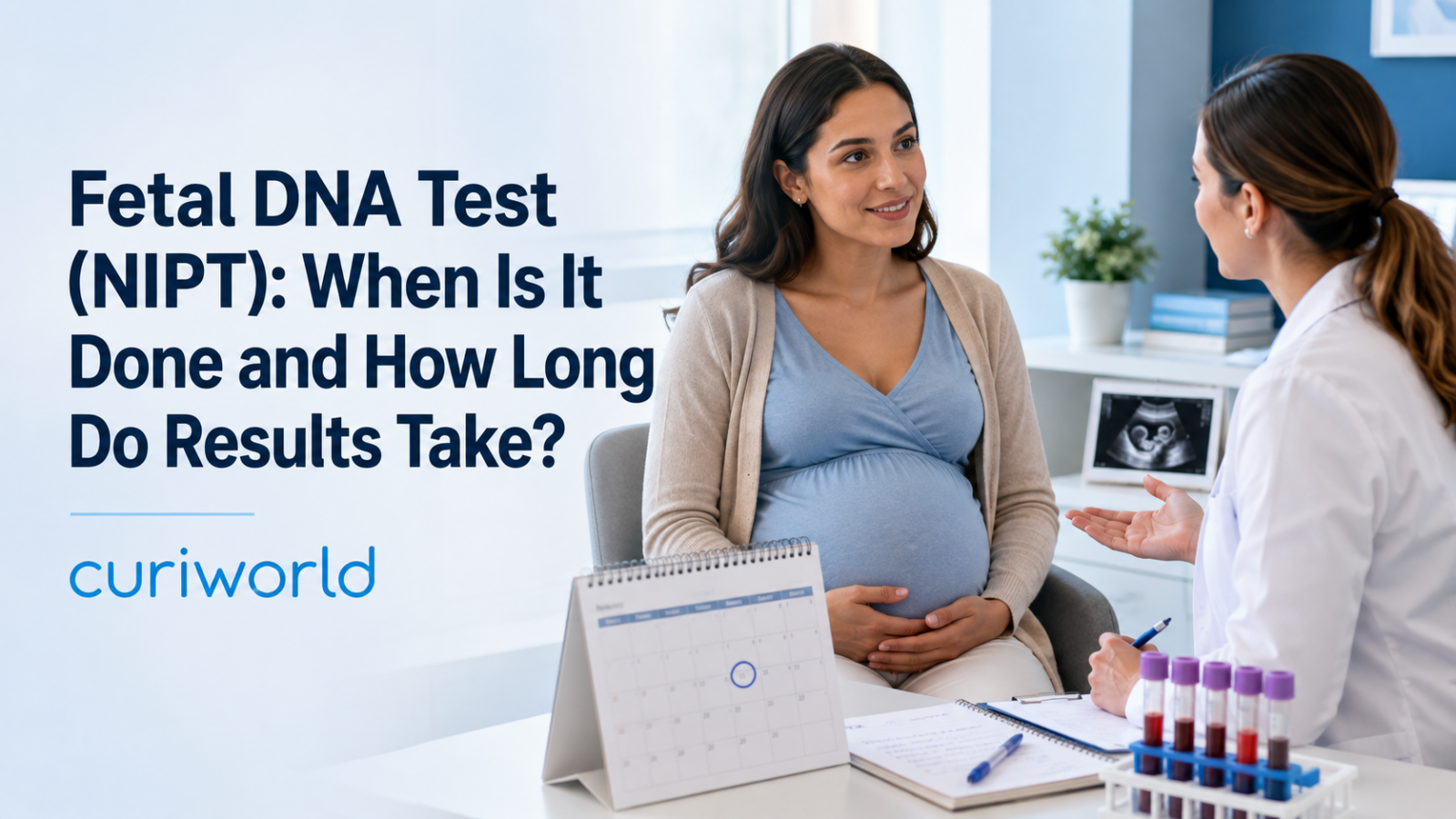
For many parents considering a fetal DNA test, the first questions are practical rather than technical: How early can NIPT be done, and how long will it take to get the result?
A widely used starting point is 10 weeks of pregnancy. According to the American College of Obstetricians and Gynecologists (ACOG), cell-free DNA screening can be performed starting at 10 weeks.
Results are often available in roughly one week, although turnaround times vary between laboratories and healthcare systems. In some settings, receiving the result may take up to about two weeks.
That means two dates matter: when the blood can reliably be collected and when the laboratory is likely to complete the analysis.
What Week Can a Fetal DNA Test Be Done?
Noninvasive prenatal testing, commonly called NIPT, cell-free DNA screening, or a fetal DNA test, can generally be performed from the 10th week of pregnancy onward.
The test uses a blood sample from the pregnant patient. The laboratory analyzes small fragments of cell-free DNA circulating in the bloodstream, including DNA originating primarily from the placenta.
For the full explanation of what the test screens for, what a high- or low-risk result means, and its main limitations, see how NIPT works.
Unlike amniocentesis or chorionic villus sampling (CVS), NIPT does not require a needle to enter the uterus.
The timing matters because there must be enough pregnancy-related cell-free DNA in the maternal blood for the laboratory to analyze the sample reliably.
Is 10 Weeks Exactly the Same for Every NIPT Test?
Not necessarily.
Ten weeks is a commonly used clinical starting point for cell-free DNA screening, and ACOG states that cfDNA testing can be performed from 10 weeks of pregnancy.
However, laboratories may have their own minimum gestational-age requirements and quality thresholds.
That means a patient should follow the instructions for the specific laboratory and test ordered rather than assuming that every commercial NIPT platform follows identical rules.
Why Is the 10th Week Commonly Used?

Cell-free DNA from the pregnancy can be detected earlier than 10 weeks, but detecting DNA is not the same as having enough of it for reliable clinical screening.
One of the factors laboratories consider is the fetal fraction—the proportion of cell-free DNA in the sample that comes from the pregnancy, primarily the placenta.
Earlier in pregnancy, this proportion may be too low for some samples to produce a reliable result.
Waiting until around 10 weeks therefore reduces the chance that the test is performed before enough pregnancy-related DNA is available for analysis.
This is why the 10-week mark has become a common clinical starting point for NIPT.
Does NIPT Have to Be Done Exactly at 10 Weeks?
No.
Ten weeks is generally the earliest commonly recommended starting point, not a narrow testing window.
A person does not lose the opportunity to have NIPT simply because they did not have the blood drawn during week 10.
Testing can be performed later in pregnancy as well, although the timing of prenatal screening should be discussed with the healthcare team because later results can affect when additional evaluation or diagnostic testing can be performed.
For many patients, NIPT is arranged during the first trimester as part of broader prenatal screening discussions.
Why Can Testing Too Early Increase the Chance of No Result?
NIPT needs enough pregnancy-related cell-free DNA in the blood sample for the laboratory to analyze it reliably.
The proportion of pregnancy-related DNA in the sample is often described as the fetal fraction, even though much of that DNA originates from the placenta.
Earlier in pregnancy, the amount may be too low for some testing platforms to generate a reliable result.
If the laboratory cannot obtain enough usable information, the report may be described as:
- no result,
- no call,
- nonreportable,
- or inconclusive.
A nonreportable result should not automatically be interpreted as either normal or abnormal.
The appropriate next step depends on gestational age, the reason for testing, the laboratory result and the broader pregnancy context.
Can a Fetal DNA Test Be Done Before 10 Weeks?
Some laboratories or individual testing platforms may advertise collection before the 10th week.
However, laboratory protocols are not identical, and earlier testing may increase the possibility that there is insufficient pregnancy-related cell-free DNA in the blood sample.
For a general patient-facing guideline, 10 weeks or later is the more established benchmark.
Patients should follow the timing recommended by their obstetric healthcare professional and the requirements of the specific laboratory performing the test rather than choosing an earlier date solely because a commercial test advertises one.
How Long Do Fetal DNA Test Results Take?
There is no universal turnaround time for every NIPT laboratory.
ACOG patient guidance states that cell-free DNA screening results take about one week.
Other healthcare systems advise patients that NIPT results may take up to approximately two weeks.
A realistic expectation is therefore:
around one week in many cases, with some results taking closer to two weeks depending on the laboratory and healthcare system.
The clinic performing the blood draw should be able to provide a more specific estimate for the laboratory it uses.
Turnaround time and medical interpretation are not the same thing.
A laboratory may finish processing the sample within several days, but the result may take longer to reach the patient because it first passes through the clinic, electronic health record or ordering healthcare professional.
So when a laboratory advertises a particular turnaround time, that usually refers to laboratory processing rather than a guarantee of the exact day the patient will receive the result.
Why Do NIPT Result Times Vary?
Two people can have their blood drawn on the same day and receive results on different dates.
Turnaround time may depend on several practical factors.
Sample Transportation
The blood sample may not be analyzed at the same clinic where it was collected.
Some samples are transported to a central or specialist genetic laboratory. The time required for collection, shipping, laboratory receipt, and processing can therefore affect the overall wait.
Laboratory Workload
Processing times can change depending on laboratory capacity and the number of samples being analyzed.
The quoted turnaround time may also refer to working days rather than calendar days, which can make weekends and holidays relevant.
The Day the Laboratory Receives the Sample
A laboratory may calculate its turnaround time from the day the sample arrives rather than from the day the blood was drawn.
This distinction can explain why a test advertised as taking a certain number of days appears to take longer from the patient’s perspective.
A Sample That Cannot Produce a Result
Occasionally, the first blood sample does not provide enough information for the laboratory to issue a result.
One possible reason is a low fetal fraction.
If another sample is required, the overall waiting period naturally becomes longer.
What Happens If There Is Not Enough Fetal DNA?
A result is not always available after the first blood draw.
Reports may use terms such as:
- low fetal fraction
- no result
- no call
- non-reportable result
- insufficient fetal DNA
These terms do not mean the screening result is negative.
They mean that the laboratory could not generate a sufficiently reliable result from that sample.
Depending on the circumstances, a healthcare professional may discuss repeating the blood test, reviewing ultrasound findings, genetic counseling, or considering diagnostic testing.
The appropriate next step depends on the individual pregnancy and the reason the laboratory could not report a result.
If NIPT Is Done at 10 Weeks, When Might the Result Arrive?
Consider a simple example.
If blood is drawn shortly after the pregnancy reaches 10 weeks and the laboratory’s usual turnaround time is approximately one week, the result may arrive around the 11th week.
If the service takes closer to two weeks, the result may arrive around the 12th week.
These are only examples, not guaranteed dates.
Shipping time, weekends, laboratory processing, and the need for a repeat sample can all change the timeline.
Does Getting NIPT Earlier Mean Getting Better Information?
Not necessarily.
The goal is not to perform the test at the earliest technically possible moment. The goal is to obtain a sample that can be analyzed reliably and at a time that fits appropriately into prenatal care.
Testing too early can create an avoidable problem if there is not enough pregnancy-related cell-free DNA to generate a result.
For many patients, waiting until the established testing window beginning around 10 weeks provides a more useful balance between early information and reliable sample analysis.
What Does NIPT Screen For?
Standard cell-free DNA screening is primarily used to estimate the chance of certain chromosome conditions, particularly:
- Down syndrome (trisomy 21)
- Edwards syndrome (trisomy 18)
- Patau syndrome (trisomy 13)
Some tests can offer additional screening, but exactly what is included depends on the laboratory and testing panel.
NIPT remains a screening test rather than a diagnostic test.
A high-risk result means the probability of a condition is increased; it does not confirm that the fetus has that condition.
Positive screening results may therefore be followed by genetic counseling and diagnostic testing such as CVS or amniocentesis.
Some NIPT reports may also include information about fetal sex, which is a separate question from screening for trisomies. Curiworld explains how accurate NIPT can be for fetal sex.
Does a Fast Result Mean the Test Is More Accurate?
No.
Turnaround time and screening performance are different issues.
A laboratory returning a result in five days is not automatically more accurate than one returning it in eight or ten days.
The clinically important questions are whether the test is appropriate for the pregnancy, what conditions it screens for, how the laboratory validates its testing, and how the result should be interpreted.
Speed alone should not determine which prenatal screening test is chosen.
What If My NIPT Result Is Taking Longer Than Expected?
A delayed result does not by itself mean that something is wrong with the pregnancy.
Turnaround times can vary because of:
- laboratory workload,
- sample transportation,
- quality-control checks,
- the need to repeat part of an analysis,
- administrative delays,
- or a sample that does not initially produce a reportable result.
If the expected reporting window has passed, the most useful next step is to contact the healthcare professional or laboratory that ordered the test rather than trying to interpret the delay itself.
The Practical Timeline
For someone planning a fetal DNA test, the timeline can be kept fairly simple:
Around 10 weeks: NIPT can generally begin.
Blood draw: A routine maternal blood sample is collected.
Laboratory analysis: Cell-free DNA is analyzed for the chromosome conditions included in the screening panel.
Around one week later: Many patients may receive their result.
Up to around two weeks: Some healthcare systems and laboratories may require longer.
If no result is obtained: A healthcare professional will discuss whether repeat testing or another form of evaluation is appropriate.
The exact timeline can differ, which is why the laboratory or clinic performing the test remains the best source for a specific turnaround estimate.
The Key Point
For most people asking when a fetal DNA test can be performed, 10 weeks of pregnancy is the most useful benchmark.
Results often take about one week, but waiting up to approximately two weeks is possible depending on the laboratory, transportation, processing system, and whether the first sample produces a reportable result.
Trying to reduce the answer to a single universal number can therefore be misleading.
The more useful questions to ask before testing are: What is this laboratory’s earliest accepted gestational age, and how does it calculate its result turnaround time?
Those two answers provide a much more realistic picture of when the test can be taken and when the result is likely to arrive.
This article provides general educational information and is not a substitute for individualized prenatal care, genetic counseling, diagnosis, or medical advice.
Sources
- American College of Obstetricians and Gynecologists (ACOG) — Prenatal Genetic Screening Tests
https://www.acog.org/womens-health/faqs/prenatal-genetic-screening-tests - Royal Berkshire NHS Foundation Trust — Non-Invasive Prenatal Testing (NIPT)
https://www.royalberkshire.nhs.uk/media/sd4ngfjz/non-invasive-prenatal-testing-nipt-r445.pdf






Join the discussion