Why Do Kids Whisper to Themselves? It May Be Private Speech
Kids may whisper or talk to themselves while playing, thinking, or solving problems. This private speech can support planning, focus, and self-regulation as language gradually becomes inner speech.
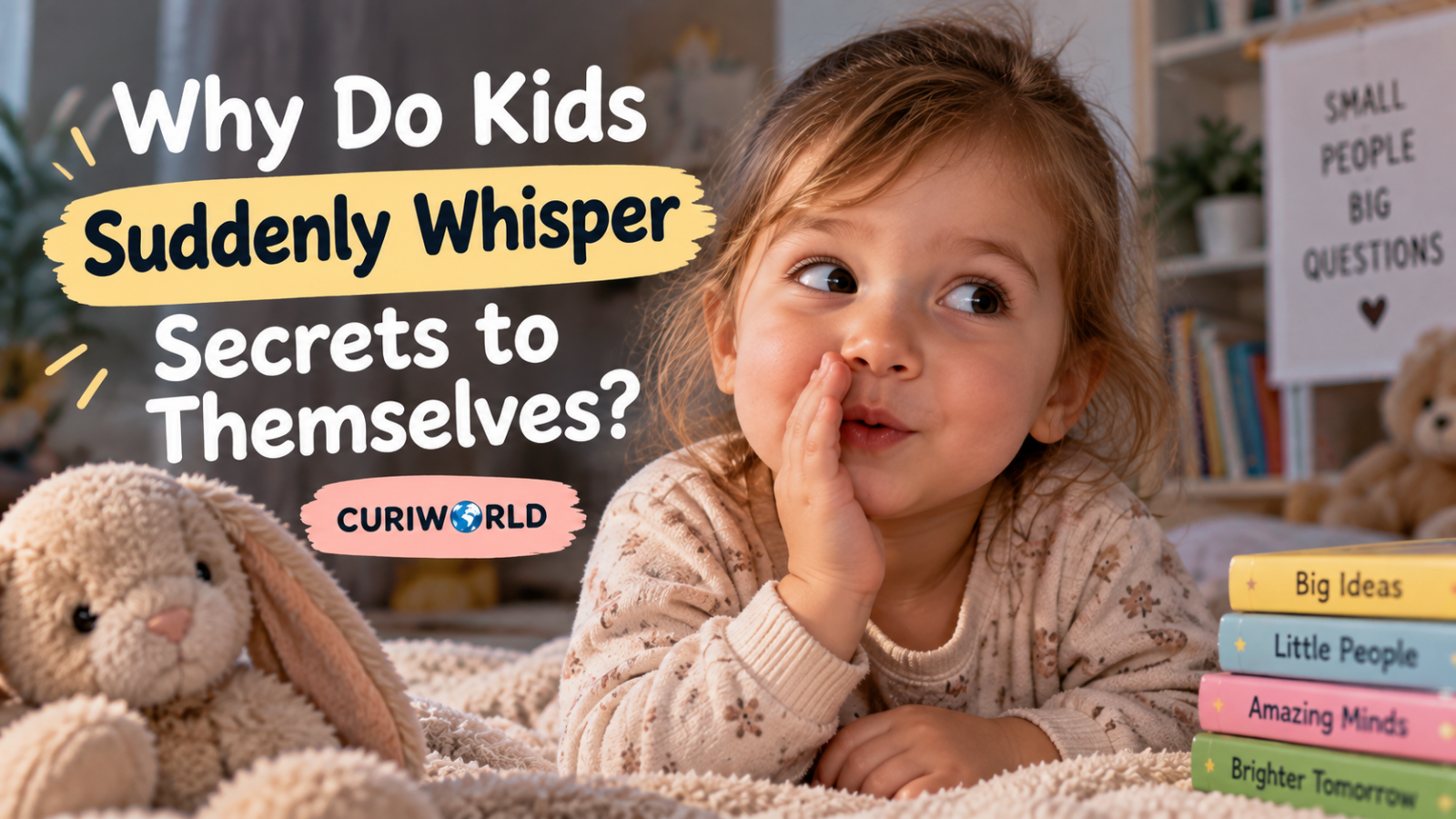
You walk past the playroom and hear your child whispering.
“Okay… this one goes here. No, not there. He has to hide first.”
Nobody else is in the room.
It can sound like a secret conversation, but in many young children, talking or whispering to themselves is something much more ordinary: they may be using language to organize their own thoughts.
Developmental psychologists call this private speech—speech that is spoken aloud but directed mainly toward the child rather than toward another person.
Far from being meaningless chatter, private speech can help children plan, remember, solve problems, guide play, manage frustration, and gradually develop the silent inner speech adults use every day.
Private Speech Is Different From Talking to Someone Else
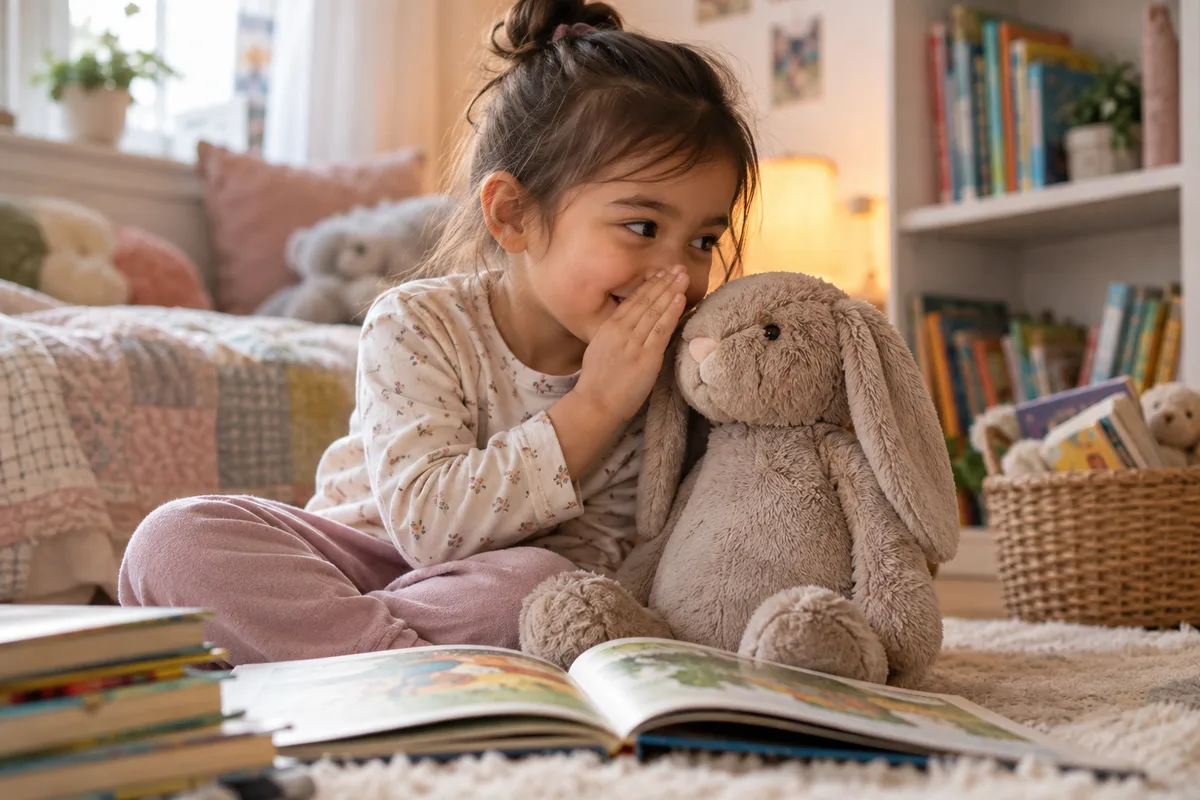
If a child says, “Mom, look at my tower,” the purpose is communication.
If the same child quietly says, “Big block first… then the little one,” while building alone, the purpose may be very different.
The second example is closer to private speech.
The child is not necessarily trying to tell anyone anything. The words are helping guide the activity.
Adults do versions of this too.
You might mutter:
“Keys, wallet, phone.”
Or:
“Don’t forget to send that email.”
Curiworld has explored the broader psychology of this behavior in why people talk to themselves. In young children, however, speaking thoughts aloud is especially interesting because language itself is still becoming a tool for thinking.
Why Do Children Talk to Themselves So Much?
One influential explanation comes from developmental psychologist Lev Vygotsky.
His idea was that children’s thinking develops partly through social interaction.
At first, adults guide children with spoken language:
“Put your shoes by the door.”
“Slow down.”
“Try the bigger piece first.”
Later, children begin using similar language on themselves.
A child working on a puzzle may say:
“This doesn’t fit.”
“Turn it around.”
“There.”
In that moment, language that once came from another person has become a way of guiding the child’s own behavior.
Research since Vygotsky has broadly supported the idea that private speech can play a role in self-regulation, planning, attention, and problem-solving.
The Whispering May Actually Be a Sign That the Speech Is Moving Inward
One of the most interesting parts of private speech is how it changes.
Young children may begin with fully audible self-talk.
Later, the speech can become quieter.
Sentences shorten.
Words may be whispered, muttered, or only partly pronounced.
Eventually, much of that verbal guidance can become silent inner speech.
This means a child whispering incomprehensible little phrases while working on something is not necessarily becoming more unusual.
In developmental terms, the opposite may be happening.
Research on private speech describes a general progression from obvious spoken self-talk toward quieter forms such as whispering and inaudible muttering, and eventually toward internal speech.
The ages are not rigid. Children develop differently, and even older children or adults may start talking aloud again when a task becomes difficult.
Difficult Tasks Can Bring Self-Talk Back Out
Watch a child doing something easy and they may remain completely silent.
Give them a puzzle that is just difficult enough, and suddenly the commentary starts.
“Wait.”
“That one goes there.”
“No, I need the blue one.”
This pattern matters.
Research has found that children often use more private speech when they are dealing with a challenging task that requires planning or attention.
Language becomes a temporary external tool.
Instead of holding every step silently in working memory, the child can put part of the plan into words.
That may be one reason adults also start muttering instructions when assembling furniture, navigating an unfamiliar place, or fixing something complicated.
The behavior does not disappear forever with age. We simply become better at keeping most of it inside our heads.
Play Is One of the Most Obvious Places to Hear It
Not every whispered conversation is a problem-solving instruction.
Sometimes children narrate elaborate imaginary worlds.
A stuffed animal has to go to school.
A toy dinosaur is angry.
A block becomes a restaurant.
One character tells another what to do.
Some of this is imaginative play rather than private speech in the strictest research definition.
But the two can overlap.
During pretend play, children are simultaneously:
- creating a story,
- assigning roles,
- remembering rules,
- deciding what happens next,
- practicing dialogue,
- and controlling their own actions.
Talking aloud can help hold that entire imaginary situation together.
What sounds like a child sharing “secrets” with themselves may therefore be a mixture of storytelling, rehearsal, role-play, and self-guidance.
Children Often Borrow Adult Language
Listen carefully and you may occasionally hear your own words coming back.
A child lining up toys might say:
“One at a time.”
Or:
“Careful, you’ll spill it.”
Or even:
“We’ve talked about this before.”
That is not necessarily imitation for entertainment.
Children absorb the language used around them.
Some of the phrases adults use to guide behavior can later appear in a child’s self-directed speech.
This is one of the reasons private speech is so interesting developmentally: social language can gradually become self-guidance.
A parent says, “Slow down.”
Later the child whispers, “Slow down.”
Eventually the instruction may happen silently.
Self-Talk Can Help With Emotion Too
Private speech is not limited to building towers and solving puzzles.
Children may also talk themselves through emotionally difficult moments.
A child might say:
“It’s okay.”
“I can do it.”
“Mom comes back after school.”
Or:
“Don’t be scared.”
These statements do not guarantee that the child suddenly feels calm.
But language can give structure to an emotion that might otherwise feel harder to manage.
Research on private speech suggests that children can use self-directed language not only for task planning but also for motivation and regulation.
The content matters.
“I can try again” and “I’m stupid” are both self-talk, but they are doing very different psychological work.
Why Does My Child Suddenly Stop When I Walk Into the Room?
Because private speech is private in function, even if it is audible.
A child may not be consciously hiding anything.
Your arrival simply changes the social situation.
The child who was directing their own play now has another person present. They may become self-conscious, switch to social conversation, or simply continue the activity silently.
As children get older, awareness of other people’s reactions increases too.
They may realize that talking aloud to themselves attracts attention, so the speech becomes quieter even while the internal dialogue continues.
That is another reason whispering can become more noticeable before self-talk largely disappears from view.
Should Parents Interrupt or Correct It?
Usually, ordinary private speech does not need correcting.
You do not need to tell a child:
“Stop talking to yourself.”
And you generally do not need to ask what every whispered sentence means.
If the child is playing independently, working through a task, or quietly narrating what they are doing, allowing the process to continue may be the simplest response.
Parents can also model useful problem-solving language without deliberately training self-talk.
For example:
“I can’t find the right piece. I’ll check the corners first.”
That makes a thinking process visible.
Children already do something similar when asking endless questions. Their developing language is not merely a way to communicate; it helps them build explanations about the world. Curiworld explores that pattern in what’s behind a child’s endless “why?” phase.
Talking to Yourself Is Not the Same as Having an Imaginary Friend
The behaviors can overlap, but they are not identical.
Private speech is directed toward oneself.
Imaginary play may involve talking to a character the child has invented.
Both can be ordinary parts of childhood.
The American Academy of Pediatrics notes that imaginary friends are common and can give children a way to practice communication, social roles, and perspective-taking.
A child having a conversation with an invisible dragon while playing is therefore not automatically displaying the same thing as a child whispering, “Blue one next,” while completing a puzzle.
Context tells you much more than the fact that speech occurred while nobody else was nearby.
When Is Self-Talk Worth Paying More Attention To?
Hearing a child whisper or talk to themselves, by itself, is usually not enough to indicate a problem.
Instead, look at the child’s overall functioning and the nature of the behavior.
It is reasonable to discuss the behavior with a pediatrician or appropriate child-development professional if it comes with broader concerns—for example, major changes in speech or social behavior, significant distress, declining functioning at school, persistent self-critical statements, or behavior that appears frightening or uncontrollable to the child.
The American Academy of Pediatrics gives similar advice around imaginary companions: the concern is not simply that a child talks to someone who is not visibly present, but whether the experience becomes threatening, persistently disruptive, or appears alongside other developmental or behavioral changes.
Likewise, frequent negative self-talk deserves more attention when it begins affecting relationships, schoolwork, sleep, eating, or the child’s emotional well-being.
The behavior should be understood in context rather than diagnosed from one overheard whisper.
Children Are Learning to Think With Language
A young child’s mind does not move instantly from spoken language to the silent internal monologue of adulthood.
There is a transition.
At first, language happens between people.
Then children increasingly use those same words to direct themselves.
Some of that thinking remains audible:
“Put this here.”
“Try again.”
“No, that’s wrong.”
Then it becomes quieter.
A whisper.
A mutter.
A movement of the lips.
Eventually, much of the conversation goes somewhere adults cannot hear at all.
So when you hear your child apparently sharing secrets with themselves in the next room, there may be no secret.
You may simply be hearing thought before it has learned to stay silent.
Sources
Frontiers in Developmental Psychology — Private Speech Among Children With Intellectual Disabilities: Literature Review and Developmental Background
Perspectives of the ASHA Special Interest Groups — Inner Speech and Executive Function in Children: Typical Development of Inner Speech
American Academy of Pediatrics / HealthyChildren.org — My Child Plays With an Imaginary Friend. Should I Be Concerned?







Join the discussion