Fetal DNA Test (NIPT): How It Works and What It Can Screen For
NIPT can screen for Down syndrome and other chromosome conditions from a maternal blood sample—but understanding what the result can and cannot prove is essential.
A fetal DNA test can estimate the chance that a pregnancy is affected by certain chromosome conditions from a simple blood sample, often from around 10 weeks of pregnancy. The test is commonly called NIPT, or noninvasive prenatal testing.
It is particularly useful for screening for common chromosomal conditions such as Down syndrome, Edwards syndrome, and Patau syndrome.
There is one distinction every parent should understand before interpreting the result: NIPT is a screening test, not a diagnostic test.
A high-risk result does not prove that the fetus has a chromosome condition, and a low-risk result cannot guarantee that every genetic or developmental condition has been ruled out.
What Is a Fetal DNA Test?
During pregnancy, small fragments of cell-free DNA circulate in the pregnant person’s bloodstream. Some of this genetic material comes from the pregnancy, primarily from the placenta.
NIPT analyzes these fragments to look for chromosome patterns associated with an increased or decreased chance of certain chromosomal conditions.
The phrase “fetal DNA test” is widely used, but it can be slightly misleading. The genetic material analyzed by the test largely comes from the placenta rather than directly from the fetus.
Because placental DNA usually reflects the fetus’s genetic makeup but does not always match it perfectly, false-positive and false-negative results are possible.
For this reason, medical organizations often use the term cell-free DNA screening, or cfDNA screening.
Timing matters as well; see when NIPT can be performed and how long results usually take.
Why Is It Called Cell-Free DNA Screening Instead of a Fetal DNA Test?
“Fetal DNA test” is a common everyday name for NIPT, but it is not technically the most precise description.
The pregnancy-related cell-free DNA circulating in maternal blood comes mainly from the placenta rather than directly from fetal blood.
In most pregnancies, placental DNA closely reflects the fetus’s chromosome pattern, which is why the test works so well as a screening tool.
But the placenta and fetus are not genetically identical in every pregnancy.
That distinction helps explain why NIPT can occasionally produce a false-positive or false-negative result and why an abnormal screening result may need confirmation with diagnostic testing.
For this reason, professional organizations commonly use the term cell-free DNA screening, or cfDNA screening.
How Is the Fetal DNA Test Done?
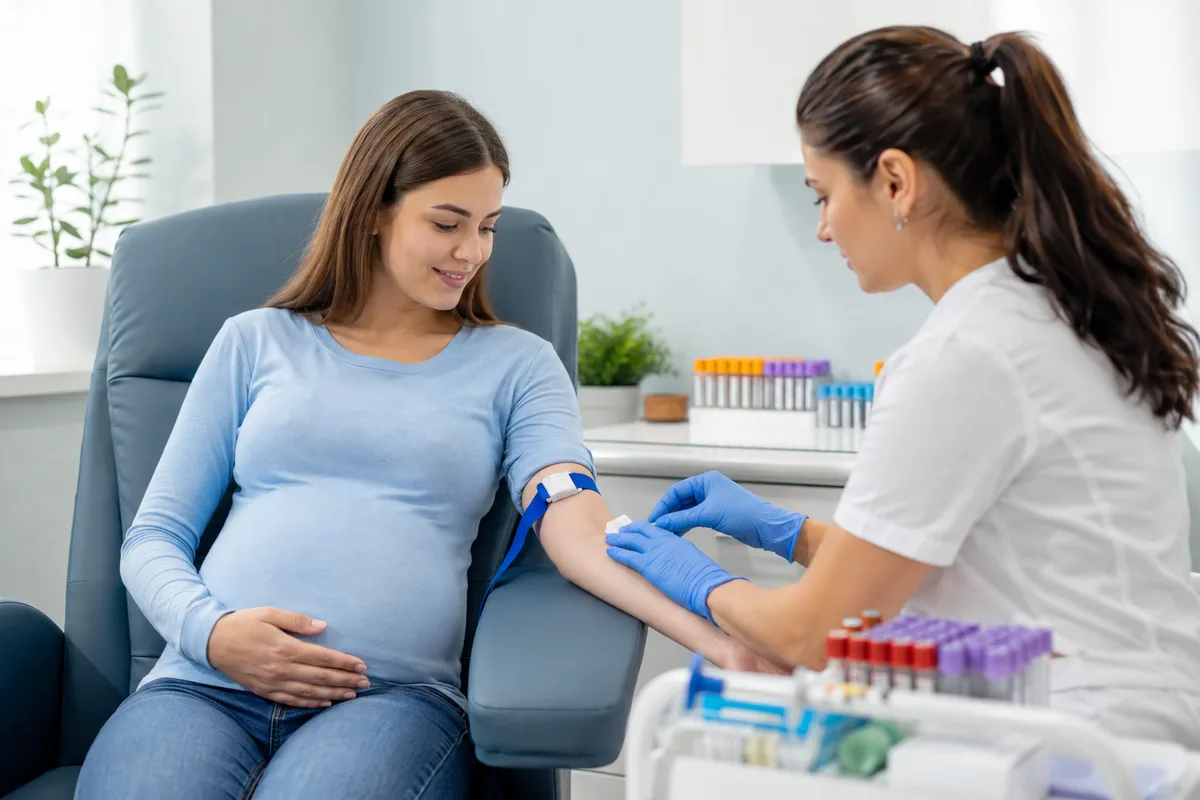
NIPT does not require a procedure inside the uterus.
The usual process is simple:
- A healthcare professional takes a blood sample from a vein in the pregnant person’s arm.
- The laboratory isolates and analyzes cell-free DNA circulating in the blood.
- The test evaluates chromosome patterns associated with the conditions included in the selected screening panel.
- A result is issued, usually describing the pregnancy as having a lower or higher chance of the conditions screened.
Because the test only requires a maternal blood sample, it does not carry the procedure-related pregnancy risks associated with invasive diagnostic procedures such as chorionic villus sampling or amniocentesis.
Cell-free DNA screening can generally be performed from around 10 weeks of pregnancy, although laboratory requirements may vary.
For the earliest testing window and typical result turnaround times, see when NIPT can be done and how long results usually take.
What Conditions Can NIPT Screen For?
The best-established use of fetal DNA screening is for three common chromosomal conditions:
| Condition | Chromosomal change | What NIPT estimates |
|---|---|---|
| Down syndrome | Trisomy 21 | Chance of an extra chromosome 21 |
| Edwards syndrome | Trisomy 18 | Chance of an extra chromosome 18 |
| Patau syndrome | Trisomy 13 | Chance of an extra chromosome 13 |
Current professional guidance considers cell-free DNA screening the most sensitive and specific screening method for these common fetal aneuploidies.
That does not make it a diagnostic test.
What NIPT Does Not Screen For
A low-risk NIPT result does not mean that every genetic, structural or developmental condition has been ruled out.
Standard cell-free DNA screening is primarily designed to assess the chance of selected chromosome abnormalities, especially:
- trisomy 21,
- trisomy 18,
- and trisomy 13.
Depending on the laboratory and the test ordered, additional screening may be offered for sex chromosome aneuploidies or other conditions.
However, broader does not automatically mean better.
Current SMFM guidance, endorsed by ACOG, does not recommend routine general-population cfDNA screening for microdeletion conditions or large genome-wide copy-number changes.
Patients who want information about a wider range of chromosomal copy-number variants may be better served by discussing diagnostic testing with their healthcare team or a genetic counselor.
NIPT also does not replace ultrasound, carrier screening or diagnostic procedures when those are clinically indicated.
Down Syndrome — Trisomy 21
Down syndrome occurs when there is an extra copy of chromosome 21.
NIPT is particularly effective at screening for trisomy 21 and is generally more accurate than older serum-based screening approaches.
A high-risk result, however, still represents an increased probability, not a confirmed diagnosis.
Diagnostic testing is required if parents and their healthcare team need to determine whether the fetus actually has trisomy 21.
Edwards Syndrome — Trisomy 18
Edwards syndrome is associated with an extra copy of chromosome 18.
Cell-free DNA screening can identify pregnancies with a higher probability of trisomy 18, but a positive screening result should not be interpreted as confirmation.
Depending on the pregnancy, follow-up may include genetic counseling, detailed ultrasound evaluation, and diagnostic testing.
Patau Syndrome — Trisomy 13
Patau syndrome occurs when there is an extra copy of chromosome 13.
It is another core condition commonly included in standard NIPT panels.
As with trisomy 21 and trisomy 18, the test estimates risk rather than establishing a diagnosis.
Can NIPT Screen for Other Chromosome Conditions?
Some laboratories offer expanded NIPT panels that include conditions beyond trisomies 21, 18, and 13.
A larger panel, however, does not automatically mean a more reliable test.
Sex Chromosome Aneuploidies
Some NIPT panels can screen for chromosome differences involving the X and Y chromosomes.
These may include conditions such as monosomy X and other sex chromosome aneuploidies.
Current professional recommendations treat sex chromosome screening differently from screening for trisomies 21, 18, and 13. It should generally be an informed, optional choice rather than something assumed to be necessary for every pregnancy.
Microdeletion Screening
Some expanded panels also offer screening for rare microdeletion syndromes, which occur when a small section of a chromosome is missing.
This is an important area where “more testing” should not automatically be interpreted as “better testing.”
Current Society for Maternal-Fetal Medicine guidance does not recommend routine population-wide cfDNA screening for microdeletion conditions.
Rare conditions can also have lower positive predictive values, meaning that a positive screening result may be more difficult to interpret reliably.
How Accurate Is NIPT?
NIPT is highly accurate as a screening test for common fetal trisomies, particularly trisomy 21.
But accuracy statistics can easily be misunderstood.
A test can have excellent sensitivity and specificity while still producing some false-positive or false-negative results.
Three concepts help explain why.
Sensitivity
Sensitivity describes how often a test correctly identifies pregnancies affected by the condition being screened.
Specificity
Specificity describes how often the test correctly identifies pregnancies that are not affected.
Positive Predictive Value
Positive predictive value, commonly called PPV, answers a slightly different question:
If the test result is positive, how likely is it that the pregnancy is actually affected?
PPV depends partly on how common the condition is in the population being tested and on the individual’s underlying probability before testing.
This means a laboratory result should never be interpreted only by looking at a percentage printed on a report.
Is NIPT a Diagnostic Test?
No.
This is the most important distinction in the entire subject.
NIPT is a screening test.
It estimates the likelihood of certain chromosomal conditions.
Diagnostic tests, by contrast, directly analyze fetal or placental cells to determine whether a chromosomal abnormality is actually present.
The two main prenatal diagnostic procedures are:
- Chorionic villus sampling (CVS)
- Amniocentesis
A positive NIPT result may therefore lead to a discussion about one of these diagnostic procedures.
Major professional guidelines recommend diagnostic confirmation before irreversible pregnancy decisions are made based on a positive cfDNA screening result.
What Does a High-Risk NIPT Result Mean?
A high-risk result means the screening test detected a DNA pattern associated with an increased chance of the chromosome condition being tested.
It does not mean:
“The baby definitely has the condition.”
The actual probability depends on several factors, including the particular condition, the test used, and the pregnancy’s underlying risk.
A healthcare professional may recommend:
- genetic counseling;
- a detailed ultrasound examination;
- chorionic villus sampling;
- amniocentesis;
- or another appropriate follow-up strategy.
The appropriate next step depends on the individual pregnancy.
What Does a Low-Risk Result Mean?
A low-risk result means that the conditions included in the screening panel are considered less likely.
That is reassuring, but it is not a guarantee that the fetus has no medical or genetic condition.
NIPT does not screen for every possible:
- chromosome abnormality;
- genetic disorder;
- single-gene condition;
- structural birth difference;
- developmental condition.
For this reason, routine prenatal appointments and recommended ultrasound examinations remain important after a low-risk NIPT result.
Why Can NIPT Produce a False Result?
The biology behind the test explains an important part of its limitations.
Most cfDNA analyzed during NIPT originates from the placenta.
For a deeper explanation of false-positive, false-negative and non-reportable results, see can NIPT be wrong?
Usually, placental and fetal chromosomes are the same. Occasionally, however, chromosome differences may be present in placental cells but not in fetal cells.
This phenomenon is called confined placental mosaicism.
Other factors can also influence or complicate NIPT results, including:
- low fetal fraction;
- testing too early;
- a vanishing twin;
- some maternal chromosome differences;
- certain maternal medical conditions;
- laboratory or technical factors.
This is one reason why a positive result should be confirmed rather than treated as definitive.
What Does “Low Fetal Fraction” Mean?
A laboratory needs enough pregnancy-related cell-free DNA in the blood sample to produce a reliable result.
If the proportion is too low, the laboratory may report:
- low fetal fraction;
- insufficient fetal DNA;
- no result;
- no call;
- non-reportable result.
Testing very early in pregnancy can sometimes contribute to a low fetal fraction, although many other factors may also influence it.
A non-reportable result should not automatically be interpreted as a negative result.
A healthcare professional may recommend another blood sample, additional ultrasound assessment, genetic counseling, or diagnostic testing depending on the circumstances.
Who Can Have NIPT?
NIPT was once associated mainly with pregnancies considered to have a higher risk of chromosome abnormalities.
That approach has changed.
Current professional recommendations support offering prenatal genetic screening options, including cfDNA screening for trisomies 21, 18, and 13, to obstetric patients regardless of maternal age or baseline risk.
The choice remains personal.
For a fuller look at who may consider screening, how age and baseline risk affect the discussion, and when diagnostic testing may be considered instead, see who should consider NIPT.
A pregnant person may choose:
- prenatal screening;
- diagnostic testing;
- or no prenatal genetic testing.
Good prenatal counseling should explain the benefits and limitations of each option before testing.
Can NIPT Be Used in Twin Pregnancies?
Cell-free DNA screening can also be used in some twin pregnancies.
Current guidance supports cfDNA screening as a first-line screening option for trisomy 21 in twin pregnancies and also supports its use for trisomies 18 and 13.
However, testing for some other chromosome conditions in multiple pregnancies may have less supporting evidence.
Twin pregnancies therefore require individualized interpretation by the healthcare team.
Does NIPT Replace Ultrasound?
No.
NIPT and ultrasound answer different questions.
NIPT estimates the probability of selected chromosome abnormalities.
Ultrasound can evaluate fetal anatomy, growth, development, placental location, amniotic fluid, and other features that a blood-based chromosome screening test cannot assess.
A normal NIPT result therefore does not eliminate the need for routine prenatal ultrasound examinations.
Current ACOG guidance recommends that all patients still be offered a second-trimester ultrasound for fetal structural abnormalities, ideally between 18 and 22 weeks, regardless of whether cfDNA screening was low risk.
NIPT vs. Amniocentesis: What Is the Difference?
The simplest distinction is:
NIPT screens for risk. Amniocentesis can provide a diagnosis.
NIPT requires a maternal blood sample and does not enter the uterus.
Amniocentesis involves obtaining amniotic fluid using a needle and can directly analyze fetal genetic material.
Because amniocentesis is a diagnostic procedure, it can answer questions that screening alone cannot.
The appropriate choice depends on the pregnancy, previous screening results, ultrasound findings, personal preferences, and medical advice.
Screening and Diagnosis Answer Different Questions
A screening result estimates probability.
A diagnostic test examines genetic material obtained through procedures such as chorionic villus sampling (CVS) or amniocentesis and can provide a much more definitive answer for the conditions being tested.
This distinction becomes especially important after:
- a high-risk NIPT result,
- certain abnormal ultrasound findings,
- or when a patient wants diagnostic rather than probabilistic information.
A screening result should not be treated as a confirmed fetal diagnosis.
What Can a Fetal DNA Test Really Tell You?
The term “fetal DNA test” can sound as though a single blood test can provide a complete genetic assessment of a baby.
That is not what NIPT does.
Its strength is more specific: it provides a highly informative estimate of the likelihood of selected chromosome conditions, particularly Down syndrome, Edwards syndrome, and Patau syndrome.
A low-risk result lowers the estimated probability of the conditions screened.
A high-risk result raises that probability but does not confirm a diagnosis.
Understanding that difference prevents both unnecessary reassurance and unnecessary alarm.
For anyone considering NIPT or interpreting a result, the most useful next step is to discuss the individual findings with an obstetric healthcare professional or genetic counselor.
This article is intended for general educational information and does not replace individualized prenatal care, genetic counseling, diagnosis, or medical advice.
More Questions About NIPT
For timing, see when NIPT can be done and how long results may take.
For eligibility and decision-making, see who should consider NIPT.
For result interpretation, see why NIPT can occasionally be wrong and what high- or low-risk results mean.
For fetal sex reporting, see how NIPT can estimate fetal chromosomal sex.
Sources
- Society for Maternal-Fetal Medicine (SMFM) — Consult Series #74: Cell-Free DNA Screening for Aneuploidies: Updated Guidance
https://publications.smfm.org/publications/620-society-for-maternal-fetal-medicine-consult-series-74cell/ - American College of Obstetricians and Gynecologists (ACOG) — Screening for Fetal Chromosomal Abnormalities
https://www.acog.org/clinical/clinical-guidance/practice-advisory/articles/2026/01/screening-for-fetal-chromosomal-abnormalities






Join the discussion