Can NIPT Be Wrong? What Positive and Negative Fetal DNA Results Mean
A positive NIPT result is not a diagnosis, and a negative result is not a guarantee. Here is how fetal DNA screening results should actually be interpreted.
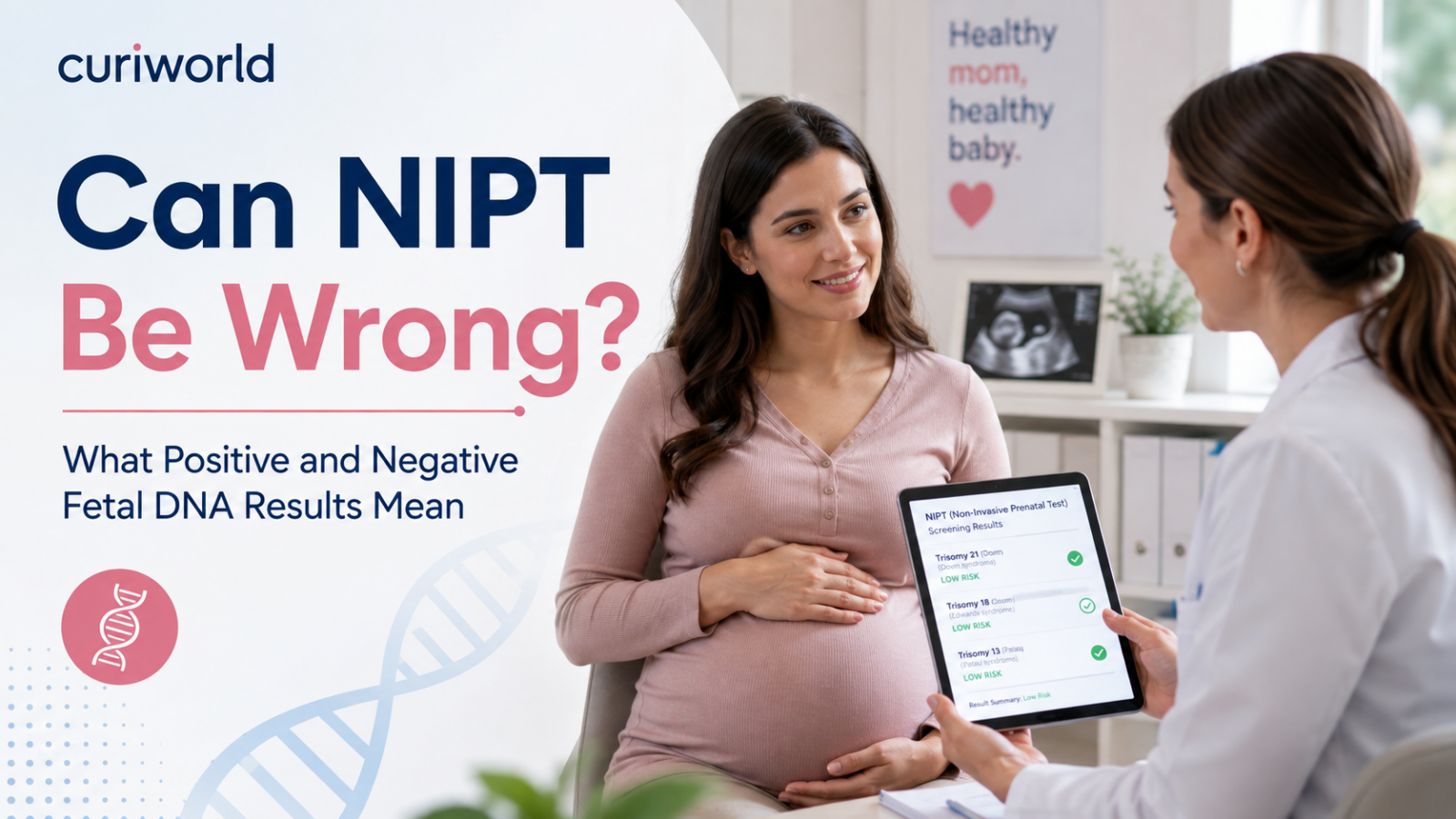
A fetal DNA test can be highly accurate and still be wrong.
That apparent contradiction is the key to understanding NIPT results.
Cell-free DNA screening, commonly called NIPT or a fetal DNA test, is one of the most sensitive and specific prenatal screening methods available for common chromosome conditions such as Down syndrome, Edwards syndrome, and Patau syndrome. But it remains a screening test—not a diagnostic test.
If you need the test basics before interpreting a result, start with our guide to how NIPT works and what it can screen for.
A positive or high-risk NIPT result means the chance of a chromosome condition is increased. It does not prove that the fetus has that condition.
A negative or low-risk result means the chance has been substantially reduced. It does not reduce the possibility to zero.
Those two distinctions are more important than any single accuracy percentage printed on a laboratory brochure.
Can a Fetal DNA Test Be Wrong?

Yes.
NIPT can produce both:
- false-positive results, where screening suggests an increased risk but diagnostic testing shows that the fetus does not have the condition;
- false-negative results, where screening indicates a low risk even though the fetus is affected.
These results are uncommon for the major trisomies compared with many older screening methods, particularly for trisomy 21, but they are possible.
The American College of Obstetricians and Gynecologists describes cell-free DNA as the most sensitive and specific screening test for the common fetal aneuploidies while emphasizing that false-positive and false-negative results can still occur.
This is why the word screening matters.
Whether the test is useful also depends on the pregnancy and the reason for screening; see who may consider NIPT and why.
Why Can False-Positive NIPT Results Happen?
One reason is that cfDNA screening analyzes DNA largely originating from the placenta.
The chromosome pattern in placental cells usually matches the fetus, but occasionally it does not.
Other possible contributors to unexpected cfDNA results can include:
- confined placental mosaicism,
- a vanished twin,
- maternal chromosome variation,
- some maternal medical conditions,
- low fetal fraction,
- and technical or laboratory factors.
Which explanation is relevant cannot be determined from the screening result alone.
That is one reason an abnormal cfDNA result may lead to genetic counseling, ultrasound evaluation and discussion of diagnostic testing.
What Does a Positive NIPT Result Mean?
A positive result may also be described on a laboratory report as:
- high risk;
- increased risk;
- screen positive;
- high probability;
- or another laboratory-specific term.
The wording can sound frighteningly definitive.
It is not.
A positive screening result means that the DNA pattern detected by the test is associated with an increased probability of the chromosome condition being screened.
For example, if NIPT returns a high-risk result for trisomy 21, the test has identified a pattern associated with Down syndrome.
It has not directly examined fetal cells and established a diagnosis.
That distinction is why ACOG recommends that a positive cfDNA screening result be followed by genetic counseling, detailed fetal evaluation, and an opportunity for diagnostic testing.
Why a “99% Accurate” Test Does Not Mean a Positive Result Is 99% Certain
This is one of the most important concepts in NIPT interpretation.
Test sensitivity or specificity is not the same thing as the probability that a particular positive result represents a truly affected pregnancy.
For an individual patient, the probability after a positive result is often described using the positive predictive value, or PPV.
PPV depends partly on how common the condition was in the tested population before screening.
That means the same screening technology can produce a different PPV in populations with different baseline risks.
This is why a laboratory’s headline accuracy figure should never be interpreted automatically as:
“There is a 99% chance the fetus has the condition.”
The actual meaning of a positive result depends on the condition screened, the test used and the patient’s individual context.
Does a Positive NIPT Result Mean the Baby Definitely Has Down Syndrome?
No.
A positive NIPT result for trisomy 21 does not automatically mean that the fetus has Down syndrome.
The same principle applies to positive screening results for:
- trisomy 18 — Edwards syndrome;
- trisomy 13 — Patau syndrome;
- and other chromosome findings included in a particular panel.
The probability that a positive screening result represents a truly affected pregnancy is often described by a concept called positive predictive value, or PPV.
PPV is not identical for every person or every condition.
It can vary according to:
- which chromosome condition is being screened;
- how common that condition is;
- the patient’s underlying probability before testing;
- maternal age;
- relevant ultrasound findings;
- and characteristics of the screening test itself.
This is one reason a statement such as “NIPT is 99% accurate” can be misleading when applied directly to an individual positive result.
Test sensitivity is not the same thing as the probability that one person’s positive result is a true positive.
What Is a False-Positive NIPT Result?
A false positive occurs when NIPT indicates an increased chance of a chromosome condition but subsequent diagnostic testing does not confirm that condition in the fetus.
This does not necessarily mean that the laboratory simply “made a mistake.”
The biology of NIPT itself can explain some discordant results.
Why Can NIPT Produce a False Positive?
One important fact is often missing from simplified explanations of fetal DNA testing:
Most pregnancy-related cell-free DNA analyzed by NIPT comes from the placenta.
It does not consist primarily of DNA taken directly from fetal cells.
Usually, the genetic pattern of the placenta reflects the fetus accurately. Occasionally, however, biological differences can occur.
Confined Placental Mosaicism
Sometimes a chromosome difference is present in some placental cells but not in the fetus.
This is known as confined placental mosaicism.
Because NIPT mainly analyzes DNA released from the placenta, the screening test may detect that chromosome signal even though diagnostic evaluation later shows that the fetus is unaffected.
This is one of the most important biological explanations for a false-positive cfDNA result.
A Vanishing Twin
Some pregnancies begin with more than one embryo, with one stopping development very early.
DNA from a vanished twin may remain in the maternal bloodstream for a period of time.
If that embryo had a chromosome abnormality, its DNA may potentially influence the cfDNA screening result.
Maternal Chromosome Differences
Most cell-free DNA circulating in the blood sample actually comes from the pregnant patient.
Pregnancy-related cfDNA represents only part of the total DNA being analyzed.
Certain maternal chromosome variations can therefore occasionally influence the patterns detected during screening.
Other Biological or Technical Factors
Rare biological circumstances and laboratory or sample-related issues can also contribute to unexpected findings.
This is why an unusual NIPT result needs clinical interpretation rather than being treated as a stand-alone diagnosis.
What Should Happen After a Positive Fetal DNA Test?
The next step should not be panic—and it should not be treating the result as final.
Current professional guidance recommends further evaluation.
This usually includes:
Genetic Counseling
A genetics professional or appropriate healthcare provider can explain what the specific result means, how reliable screening is for that condition, and what additional testing options are available.
Detailed Ultrasound Evaluation
Ultrasound may provide important additional information about fetal development and whether findings associated with the suspected chromosome condition are present.
However, ultrasound alone cannot necessarily confirm or exclude a chromosomal diagnosis.
Diagnostic Testing
A definitive answer may require a diagnostic procedure.
The two major prenatal diagnostic options are:
Chorionic villus sampling (CVS)
CVS collects placental tissue for genetic analysis and can generally be performed earlier in pregnancy.
Amniocentesis
Amniocentesis collects amniotic fluid containing fetal cells for genetic testing.
The choice between them depends on gestational age, the particular NIPT finding, ultrasound information, and individual clinical circumstances.
Why Isn’t NIPT Considered Diagnostic If It Is So Accurate?
Because accuracy and diagnosis are not the same thing.
NIPT looks for statistical patterns in cell-free DNA and estimates the probability that a chromosome abnormality is present.
Diagnostic tests directly analyze genetic material obtained through procedures such as CVS or amniocentesis.
That difference matters most when an important decision depends on the result.
A positive screening result should therefore be confirmed with diagnostic testing before irreversible pregnancy decisions are made.
What Does a Negative Fetal DNA Test Mean?
A negative result may also be reported as:
- low risk;
- screen negative;
- low probability;
- or another equivalent term.
A negative result means the test did not detect a DNA pattern indicating an increased risk for the conditions included in that screening panel.
For the conditions tested, that is reassuring.
ACOG states that a negative prenatal screening result substantially decreases the risk of the targeted chromosome condition.
But it does not guarantee that the fetus is unaffected.
A low-risk result is reassuring for the conditions screened, but it is not a universal genetic “all clear.”
NIPT does not evaluate every chromosome condition, single-gene disorder, birth defect or developmental condition.
Routine prenatal care and recommended ultrasound examinations remain important even after a low-risk cfDNA result.
Does a Negative NIPT Result Mean the Baby Is Completely Healthy?
No.
This is the opposite misconception from assuming that a positive result is a diagnosis.
A low-risk NIPT result tells you about the chromosome conditions that the specific test actually screened.
It does not provide a complete assessment of fetal health.
Standard NIPT does not rule out every:
- chromosome abnormality;
- genetic syndrome;
- single-gene disorder;
- structural birth difference;
- developmental condition;
- congenital anomaly.
A low-risk result for trisomy 21, for example, does not mean that every other possible genetic or developmental condition has been excluded.
Can NIPT Produce a False Negative?
Yes, although false-negative results for the common trisomies are uncommon.
A false negative occurs when the test reports a low risk even though the fetus is actually affected.
Possible explanations can again involve the biology of the placenta, the amount of pregnancy-related DNA in the sample, mosaicism, and other unusual circumstances.
This is why a low-risk NIPT result should not override important clinical findings.
If a later ultrasound reveals a significant fetal abnormality, diagnostic testing may still be considered even when earlier cfDNA screening was negative.
Does a Negative NIPT Mean Ultrasound Is No Longer Needed?
No.
NIPT and ultrasound examine different aspects of pregnancy.
NIPT mainly estimates the probability of selected chromosome abnormalities.
Ultrasound evaluates fetal anatomy and development.
ACOG recommends that pregnant patients still be offered a second-trimester ultrasound for structural fetal abnormalities, ideally between approximately 18 and 22 weeks.
Structural abnormalities can occur whether or not a chromosome abnormality is present.
A reassuring fetal DNA result therefore does not replace routine prenatal ultrasound care.
What Is a “No-Call” NIPT Result?
Not every NIPT result is simply positive or negative.
Sometimes the laboratory cannot produce a reliable result.
Reports may use terms such as:
- no call;
- non-reportable;
- inconclusive;
- insufficient fetal fraction;
- or test failure.
This is not the same as a negative result.
A no-call result means there was not enough reliable information to issue the usual screening interpretation.
One common reason is a low fetal fraction—the proportion of pregnancy-related cfDNA in the blood sample may not be sufficient for the laboratory’s analysis.
Current ACOG guidance notes that non-reportable cfDNA results are associated with an increased risk of fetal aneuploidy and should be followed by appropriate counseling and evaluation.
Depending on the pregnancy, the healthcare team may discuss:
- comprehensive ultrasound;
- genetic counseling;
- diagnostic testing;
- or, in selected circumstances, repeating cfDNA screening.
Positive, Negative and No-Call Results Are Three Different Things
The easiest way to interpret the terminology is:
Positive / high risk:
The probability of the screened condition is increased. It is not a diagnosis.
Negative / low risk:
The probability of the screened condition is substantially reduced. It is not a guarantee.
No call / non-reportable:
The laboratory could not produce a reliable screening result. It should not be interpreted as negative.
Keeping these categories separate prevents many of the most common misunderstandings around fetal DNA testing.
Can Two Laboratories Give Different NIPT Results?
Different laboratories may use different:
- analytical technologies;
- algorithms;
- fetal-fraction thresholds;
- quality-control standards;
- reporting terminology;
- and screening panels.
That does not mean people should automatically repeat NIPT at several laboratories until they receive the result they prefer.
Professional guidance generally advises against performing multiple screening approaches simultaneously simply to compare results.
If an NIPT result is positive or clinically concerning, the important question is usually not:
“Should I get another screening test?”
It is:
“Do I now need diagnostic testing?”
That question should be discussed with the healthcare team.
Why Accuracy Percentages Can Be Confusing
NIPT marketing frequently emphasizes very high percentages.
Those figures can be useful when they describe validated test performance, but they do not answer every question a patient may have.
Several measures may be involved:
Sensitivity asks how effectively a test identifies affected pregnancies.
Specificity asks how effectively it identifies pregnancies that are not affected.
Positive predictive value asks how likely a positive result is to represent a truly affected pregnancy.
Negative predictive value asks how likely a negative result is to represent an unaffected pregnancy for the screened condition.
These are different statistics.
This is why a test can have extremely high sensitivity while a particular positive result still requires confirmation.
Should You Be Worried After a Positive NIPT?
A positive result deserves prompt clinical follow-up, but it does not deserve an automatic assumption that the diagnosis is confirmed.
The most useful response is to determine:
- Which chromosome condition was flagged?
- How was the risk reported?
- Were there any relevant ultrasound findings?
- Was the sample quality adequate?
- What confirmatory diagnostic testing is available?
- Would genetic counseling help interpret the result?
A healthcare professional can then place the screening result into the context of the individual pregnancy.
The Most Important Rule for Reading a Fetal DNA Result
NIPT is exceptionally useful because it can screen for common chromosome conditions from a maternal blood sample with better performance than many traditional screening methods.
Its strength, however, does not change what kind of test it is.
A positive result raises the probability—it does not establish the diagnosis.
A negative result lowers the probability—it does not eliminate every possibility.
And a non-reportable result is neither positive nor negative.
That is why fetal DNA results are best interpreted as part of prenatal care rather than as isolated laboratory answers.
If NIPT returns a high-risk result, professional guidance supports genetic counseling, detailed evaluation, and diagnostic confirmation with CVS or amniocentesis where appropriate.
This article is intended for general educational information and does not replace individualized prenatal care, genetic counseling, diagnosis, or medical advice.






Join the discussion