Can NIPT Tell the Baby’s Sex? How Reliable Fetal DNA Results Are
NIPT can often reveal fetal sex from around 10 weeks and with high accuracy—but the result is not infallible, and fetal sex is only one part of the test.
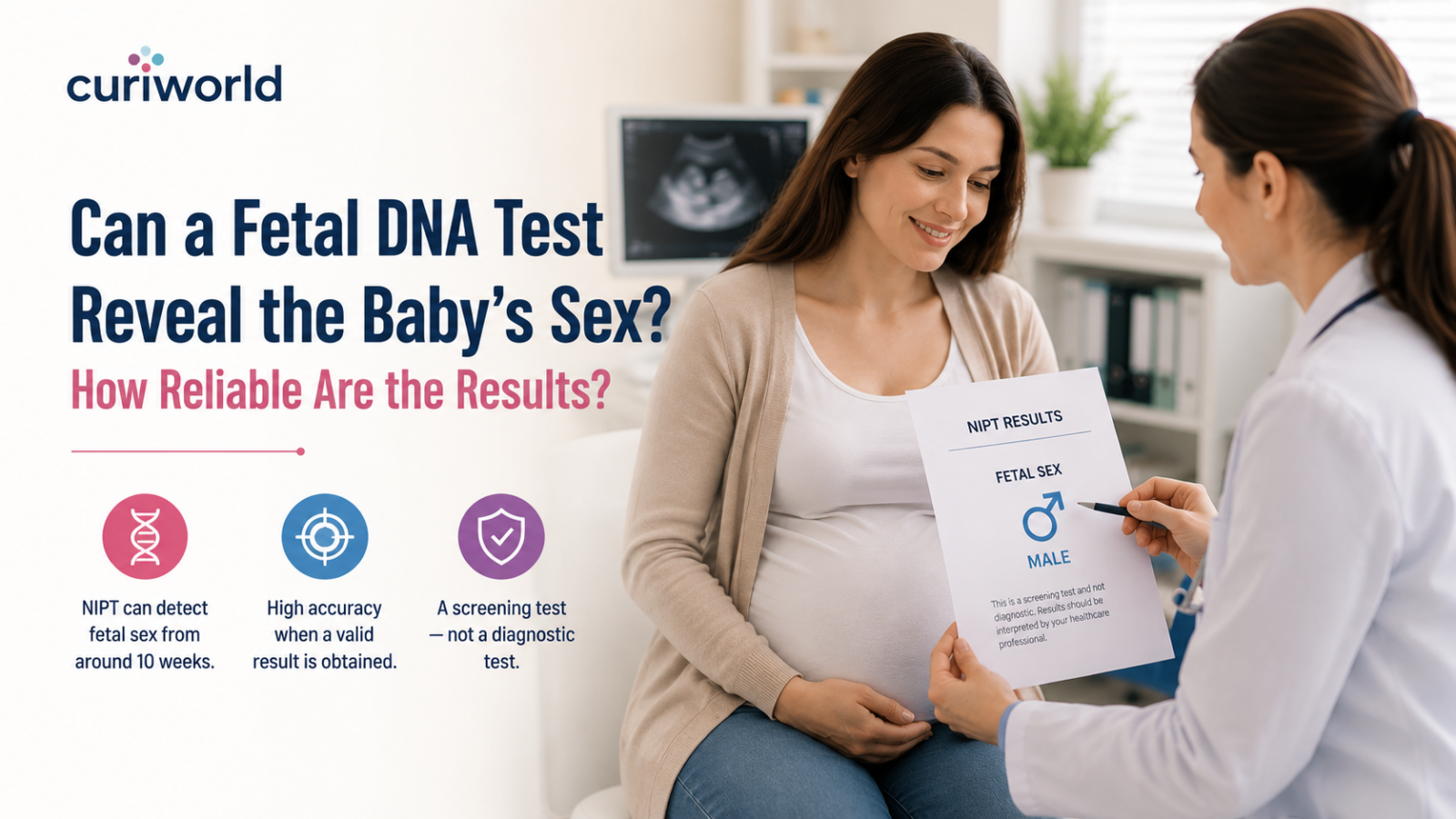
For many expectant parents, one of the most anticipated parts of a fetal DNA test is not the chromosome screening itself. It is seeing whether the report says the pregnancy is likely to be carrying a male or female fetus.
And in many cases, NIPT can provide information about fetal chromosomal sex from around 10 weeks of pregnancy.
The result can be highly accurate when the test produces a reportable result, but it is not infallible. Just as importantly, determining fetal sex is not the primary medical purpose of NIPT. Cell-free DNA testing was developed mainly to screen pregnancies for certain chromosomal conditions, particularly trisomy 21, trisomy 18, and trisomy 13.
Understanding that distinction makes the result much easier to interpret.
Can a Fetal DNA Test Tell the Baby’s Sex?
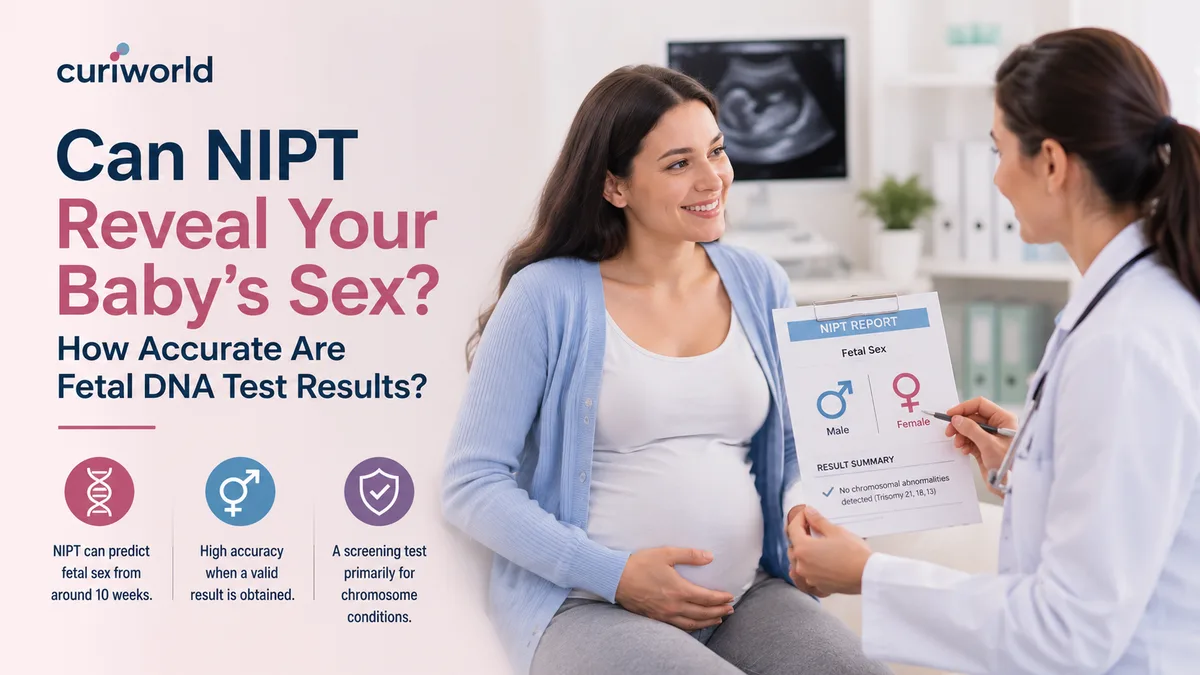
Yes. Many NIPT panels can provide information about fetal sex.
During pregnancy, fragments of cell-free DNA from the pregnancy circulate in the pregnant person’s bloodstream. Most of this pregnancy-related DNA originates from the placenta.
Laboratories can analyze these fragments and look for genetic material associated with the sex chromosomes.
In simplified terms, detecting Y-chromosome material usually indicates a male chromosomal pattern, while the absence of detectable Y-chromosome material in an adequately analyzed sample usually indicates a female chromosomal pattern.
The exact analytical method differs between laboratories and NIPT platforms.
This is why fetal sex may appear as an additional result on an NIPT report even though the same blood sample is primarily being analyzed for chromosome abnormalities.
For the broader picture first, our NIPT guide explains how fetal DNA screening works and what it can—and cannot—screen for.
It is more precise to describe this as information about fetal chromosomal sex rather than a complete prediction of every aspect of biological sex.
Most NIPT platforms infer this information from signals associated with the X and Y chromosomes.
That is usually consistent with fetal anatomy, but rare biological and technical situations can produce unexpected or discordant results.
When Can NIPT Tell the Baby’s Sex?
Cell-free DNA screening can generally be performed from around 10 weeks of pregnancy.
If the laboratory includes fetal sex reporting, information about chromosomal sex may therefore be available from the same NIPT sample.
This is earlier than fetal sex can usually be determined reliably through routine ultrasound.
However, not every laboratory uses identical testing protocols. Some have different minimum gestational ages, fetal-fraction requirements, reporting policies, or options for whether parents want fetal sex disclosed.
For that reason, 10 weeks should be viewed as the commonly used clinical starting point for NIPT rather than a guarantee that every laboratory will report fetal sex at exactly the same gestational age.
How Does NIPT Determine Fetal Sex?
NIPT does not look at fetal anatomy.
It looks at DNA.
The test analyzes cell-free DNA circulating in maternal blood and examines chromosome-related signals. Depending on the platform, the laboratory can evaluate DNA associated with the X and Y chromosomes.
The presence of sufficient Y-chromosome material generally supports a male fetal chromosomal pattern.
If no Y-chromosome material is detected and the sample passes the laboratory’s quality requirements, the result generally supports a female fetal chromosomal pattern.
That sounds straightforward, but there is an important biological detail behind the test.
The pregnancy-related DNA circulating in maternal blood comes primarily from the placenta rather than directly from fetal cells.
Usually, the placental chromosome pattern accurately reflects the fetus. Rare exceptions are one reason that NIPT results should never be described as literally incapable of being wrong.
How Accurate Is NIPT for Fetal Sex?
Fetal sex prediction using cell-free DNA is generally highly accurate when a valid, reportable result is obtained. In a large 2023 prospective study, fetal sex predicted by cfDNA matched confirmatory genetic information in all 14,486 euploid pregnancies evaluated for fetal sex. However, that study result should not be interpreted to mean that every NIPT result from every laboratory is universally 100% accurate.
Different laboratories use different technologies, reporting thresholds, quality controls, and sample requirements. Individual pregnancies can also present biological situations that complicate interpretation.
A more responsible way to describe the evidence is:
NIPT can predict fetal chromosomal sex with very high accuracy, but no individual result should be presented as universally error-proof.
A single universal percentage should be treated cautiously.
Accuracy can depend on:
- gestational age,
- fetal fraction,
- whether the pregnancy is singleton or multiple,
- the testing platform,
- laboratory quality thresholds,
- and unusual biological situations.
That is why the most useful accuracy information is the validated performance data for the specific laboratory and assay being used—not a percentage copied from a different commercial test.
Why Can an NIPT Sex Result Occasionally Be Wrong?
NIPT–ultrasound fetal sex discordance is uncommon, but it does occur. Published clinical reviews estimate that sex discordance is identified in roughly 1 in 1,500 to 2,000 pregnancies undergoing cfDNA screening. When it happens, the explanation may involve the sample, placenta, a vanished twin, maternal biological factors, or less commonly differences in fetal sex development.
Low Fetal Fraction
The laboratory needs enough pregnancy-related cell-free DNA in the blood sample to generate a reliable result.
The proportion of this DNA is known as the fetal fraction.
If the fetal fraction is too low, the laboratory may not be able to provide a reliable result at all. This is more likely to be an issue when testing is performed very early, although other maternal and pregnancy-related factors can also affect fetal fraction.
A responsible laboratory may report the sample as non-reportable rather than make a prediction without enough information.
Testing Very Early
NIPT is generally offered from around 10 weeks partly because pregnancy-related cfDNA needs to be present in sufficient quantity.
Testing outside a laboratory’s validated gestational-age window can increase uncertainty.
For the broader timing question—including when testing can begin and how long results may take—see when NIPT is done.
Getting the test as early as technically possible is therefore not necessarily better than getting it at the appropriate time.
A Vanishing Twin
A pregnancy may initially involve two embryos, with one stopping development very early.
DNA from a vanished twin can sometimes remain detectable in maternal circulation for a period of time.
If that twin had a different chromosomal sex from the continuing fetus, the cfDNA signal may complicate interpretation.
Placental Mosaicism
Because cfDNA largely reflects placental DNA, differences between placental and fetal chromosome patterns can occasionally produce unexpected results.
This phenomenon is known as confined placental mosaicism.
It is also one of the broader biological reasons why cfDNA screening is not treated as diagnostic testing.
Maternal Genetic Factors
Cell-free DNA testing analyzes a mixture of maternal and pregnancy-related DNA.
Certain maternal chromosome variations or other unusual biological circumstances can therefore sometimes affect the signals detected by the laboratory.
These situations are uncommon, but they demonstrate why an unexpected result deserves clinical evaluation rather than an assumption that either the laboratory or ultrasound must automatically be wrong.
Why Can NIPT and Ultrasound Occasionally Disagree About Fetal Sex?
A mismatch does not have one single explanation.
Possible reasons can include:
- low fetal fraction,
- laboratory or sample error,
- a vanished twin,
- placental genetic differences,
- sex chromosome variations,
- or differences between chromosomal findings and fetal anatomy.
Because several explanations are possible, an unexpected mismatch should not be diagnosed from an online article.
The healthcare team may review gestational age, ultrasound findings, the original laboratory report and whether further testing is appropriate.
What If NIPT and Ultrasound Show Different Sexes?
A discrepancy between NIPT and ultrasound should not be resolved by simply choosing whichever result seems more convincing.
Because cfDNA reflects mainly placental DNA while ultrasound evaluates fetal anatomy, a persistent mismatch deserves clinical review rather than assuming that one result must automatically be wrong.
The first step may be surprisingly simple: confirm that the correct report belongs to the correct patient and review the gestational age and quality of the ultrasound examination.
If the discrepancy remains, the healthcare team may review:
- the NIPT report;
- fetal fraction and laboratory quality information;
- pregnancy history;
- the possibility of a vanished twin;
- ultrasound findings;
- and whether additional genetic evaluation is appropriate.
In uncommon cases, discordance may also be associated with sex chromosome differences or differences in sexual development.
The significance cannot be determined from an online article or from the NIPT fetal-sex line alone.
A persistent discrepancy should therefore be discussed with the obstetric healthcare team and, when appropriate, a genetics professional.
Reporting Fetal Sex Is Not the Same as Screening for Sex Chromosome Conditions
These two parts of an NIPT report can sound similar but are not identical.
Reporting fetal chromosomal sex usually involves determining whether genetic material associated with the Y chromosome is detected.
Screening for sex chromosome aneuploidies evaluates whether there may be an atypical number of X or Y chromosomes.
Current SMFM guidance recommends that screening for sex chromosome aneuploidies be offered as an opt-in consideration with appropriate pretest counseling.
So a patient may encounter different options depending on what the laboratory reports and what they choose to have screened.
Fetal Sex Prediction and Sex Chromosome Screening Are Not the Same Thing
This distinction is easy to miss.
If an NIPT report says that Y-chromosome material was detected and predicts a male fetus, that is not the same test question as asking whether the fetus has the expected number of sex chromosomes.
Some expanded NIPT panels can also screen for sex chromosome aneuploidies such as:
- monosomy X;
- XXY;
- XXX;
- XYY.
These conditions involve differences in the number of X or Y chromosomes.
Their screening performance should not be assumed to be identical to the accuracy of simply predicting fetal sex.
Current SMFM guidance, endorsed by ACOG, recommends that cfDNA screening for trisomies 21, 18 and 13 be routinely available to all obstetrical patients. Screening for sex chromosome aneuploidies is treated differently and is recommended as an opt-in option after appropriate pretest counseling.
A high-risk sex chromosome result is still a screening result, not a diagnosis.
Is NIPT Mainly a Test to Find Out the Baby’s Sex?
No.
Fetal sex may be one of the most personally interesting pieces of information on the report, but it is not the main clinical purpose of NIPT.
Cell-free DNA screening is primarily used to estimate the chance of chromosomal conditions, particularly:
- Down syndrome — trisomy 21
- Edwards syndrome — trisomy 18
- Patau syndrome — trisomy 13
Some panels can also evaluate sex chromosomes and other chromosome findings.
This distinction matters because marketing sometimes makes NIPT appear similar to an early “gender test.”
That description understates what the test actually does.
NIPT is a medical prenatal screening test that may also provide fetal sex information, depending on the panel and the patient’s preference.
Does Every NIPT Test Reveal Fetal Sex?
No.
Whether fetal sex appears on the report depends on several factors:
- the laboratory;
- the NIPT platform;
- the selected panel;
- local policies or regulations;
- and whether the patient chooses to receive that information.
Some parents specifically request fetal sex information.
Others prefer not to know.
In some clinical settings, fetal sex information can be withheld while the chromosome screening itself is still performed.
Patients who want—or specifically do not want—to learn fetal sex should mention that preference before the test is ordered.
Does NIPT Determine Gender?
The words sex and gender are often used interchangeably in everyday pregnancy searches, which is why phrases such as “NIPT gender test” are common online.
Scientifically, NIPT provides information about chromosomal sex, based on genetic signals such as the presence or absence of Y-chromosome material.
It does not determine a child’s future gender identity.
For medical accuracy, “fetal sex” or “chromosomal sex” is therefore the more precise terminology.
Is NIPT More Reliable Than Ultrasound for Early Fetal Sex?
The two methods work in completely different ways.
NIPT analyzes DNA.
Ultrasound examines fetal anatomy.
NIPT can potentially provide fetal sex information from around 10 weeks, while ultrasound generally becomes useful for this purpose later.
Ultrasound accuracy also depends on factors such as gestational age, fetal position, image quality, and the experience of the person performing the examination.
Because NIPT analyzes chromosome-related DNA signals rather than fetal anatomy, it can provide highly accurate fetal sex information earlier in pregnancy when a valid sample is obtained. Ultrasound remains essential because it evaluates anatomy and development that NIPT cannot assess.
Can a Low-Risk NIPT Result Guarantee Everything Is Normal?
No.
A low-risk NIPT result means that the conditions included in the screening panel are considered less likely.
It does not prove that the fetus has no genetic, structural, or developmental condition.
Likewise, accurately predicting fetal sex does not tell you whether every chromosome is normal.
These are separate pieces of information.
NIPT should therefore remain part of prenatal care rather than being treated as a replacement for ultrasound examinations, clinical follow-up, or diagnostic testing when indicated.
How Much Should You Trust the Fetal Sex Result?
For most singleton pregnancies with an adequate, reportable sample, an NIPT fetal sex result is highly reliable. It is reasonable to trust the result, while remembering that rare biological and technical reasons for discordance exist.
If the NIPT fetal sex result later matches ultrasound findings, there is usually little reason for concern.
If the results do not match, the discrepancy deserves proper review rather than guesswork.
And if the NIPT report contains a high-risk finding involving the sex chromosomes, that is a different matter entirely: screening for a chromosome abnormality requires appropriate counseling and may need diagnostic confirmation.
The most important distinction is simple.
NIPT can often tell you the likely fetal chromosomal sex very early and with high accuracy. But its medical purpose goes far beyond that—it is first and foremost a prenatal chromosome screening test.
This article is intended for general educational information and does not replace individualized prenatal care, genetic counseling, diagnosis, or medical advice.
Sources
- Society for Maternal-Fetal Medicine — Consult Series #74: Cell-Free DNA Screening for Aneuploidies: Updated Guidance (2025)
- View the SMFM guidance
- Martin K, Dar P, MacPherson C, et al. — Performance of Prenatal cfDNA Screening for Sex Chromosomes — Genetics in Medicine (2023)
- View the PubMed record






Join the discussion