Braxton Hicks vs. Real Labor: What’s the Difference?
Braxton Hicks contractions are usually irregular, while true labor contractions tend to become stronger, longer and closer together over time. Pattern and progression matter more than how one contraction feels.
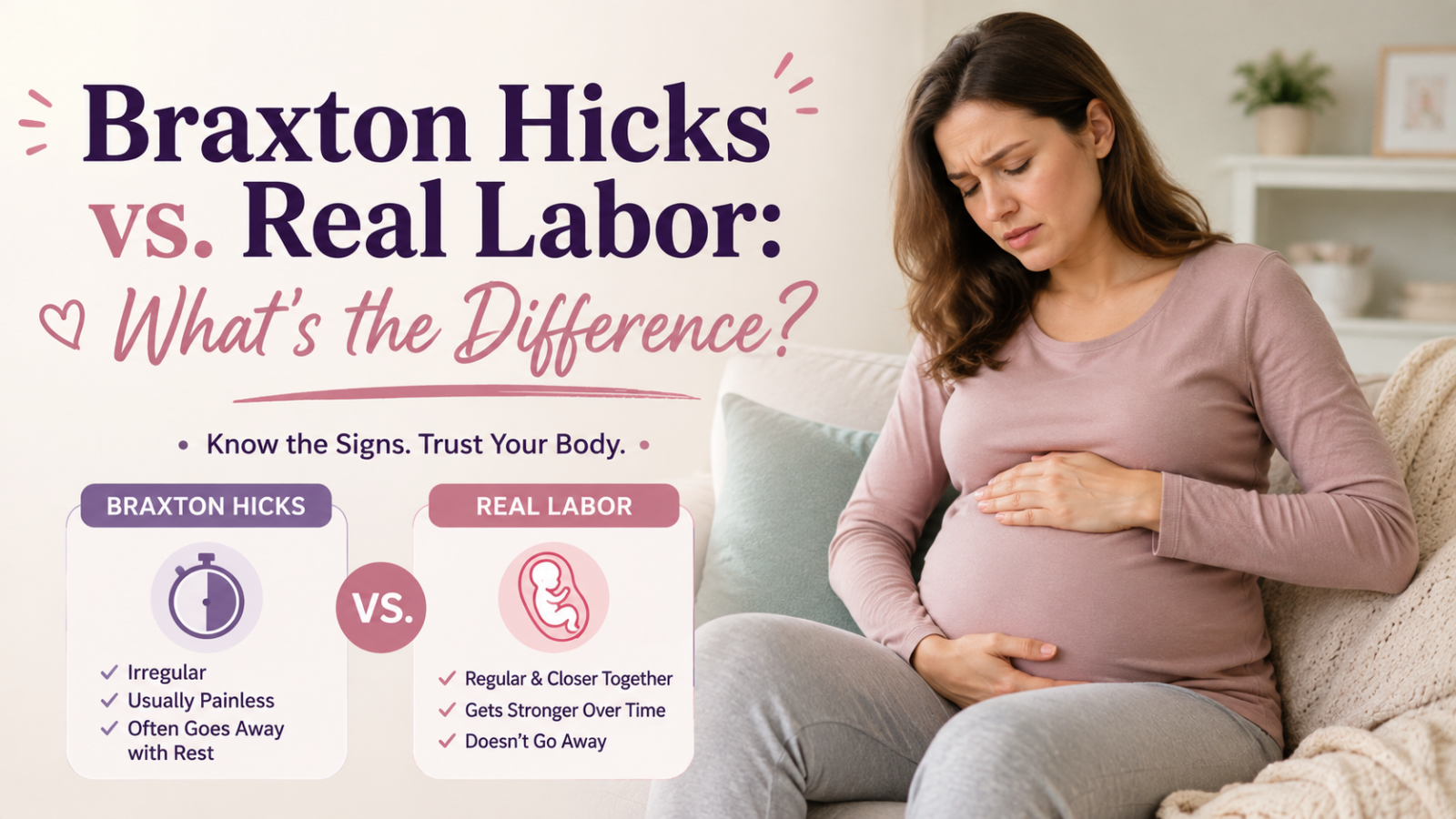
A tightening belly late in pregnancy can trigger one immediate question: Is this a Braxton Hicks contraction, or is labor actually starting?
The most useful clue is not how dramatic one contraction feels. It is what the contractions do over time.
Braxton Hicks contractions are usually irregular and do not develop into a steadily intensifying pattern. Real labor contractions tend to become more regular, stronger, longer, and closer together as labor progresses. They also tend to continue even after resting or changing position.
There is an important catch: no single symptom can always tell you with certainty. Braxton Hicks contractions can sometimes be uncomfortable or painful, while early labor may begin with relatively mild contractions. In some cases, a healthcare professional may need to examine the cervix to determine whether labor is actually progressing.
Braxton Hicks vs. Real Labor at a Glance
| Braxton Hicks | Real Labor |
|---|---|
| Usually irregular | Develops a more regular pattern |
| Do not steadily get closer together | Usually become closer together |
| Often stay similar in intensity | Tend to become progressively stronger |
| May ease with rest or a change of position | Usually continue despite rest or position changes |
| Do not cause progressive cervical dilation | Labor causes progressive changes in the cervix |
| Can be uncomfortable and sometimes painful | Often become increasingly difficult to ignore |
The pattern matters more than any single item in the table.
A contraction that hurts does not automatically mean labor has begun. Likewise, contractions that initially feel manageable do not rule out early labor.
For another common pregnancy change that can feel surprisingly intense, see why your sense of smell may seem stronger during pregnancy.
What Do Braxton Hicks Contractions Feel Like?

Braxton Hicks contractions are often described as practice contractions.
The uterus tightens and then relaxes, which may make the abdomen temporarily feel firm or hard. They can become more noticeable toward the end of pregnancy and may occur for weeks before true labor begins.
Some people experience little more than abdominal tightening. Others find Braxton Hicks distinctly uncomfortable.
What usually separates them from established labor is their lack of progression.
You might notice several contractions and then nothing for a while. They may appear at unpredictable intervals rather than following a consistent rhythm. Resting or changing position may also cause them to ease.
The absence of a clear progression is an important clue.
What Do Real Labor Contractions Feel Like?
Real labor contractions also involve tightening of the uterus, but their behavior usually changes over time.
Instead of appearing randomly and fading away, contractions tend to establish a pattern. As labor progresses, they generally become:
- more regular,
- closer together,
- longer-lasting,
- stronger,
- and increasingly difficult to ignore.
The American College of Obstetricians and Gynecologists (ACOG) explains that true labor contractions occur at regular intervals and become closer together with time. They also tend to continue regardless of whether you rest or move around.
The NHS guidance on signs that labor has begun similarly notes that contractions tend to become longer, stronger, and more frequent as labor progresses.
That progression is often more informative than asking whether the contractions are simply painful.
Pain Alone Is Not a Reliable Test
One common misconception about Braxton Hicks is that they are painless while real labor contractions hurt.
Reality is less tidy.
Braxton Hicks contractions can sometimes be uncomfortable or painful. At the same time, early labor does not necessarily begin with overwhelming pain.
That means the better question is not:
“Does this hurt?”
It is:
“Are these contractions developing a consistent pattern and becoming stronger, longer, or closer together?”
Following the trend over time can provide much more useful information.
A Simple Pattern Check
If you are near your due date, have mild contractions, and have no warning signs requiring immediate medical attention, timing the contractions can help you understand the pattern.
Note:
- when each contraction begins,
- how long it lasts,
- how much time passes before the next one,
- and whether the pattern changes over time.
You can also notice what happens after you rest, walk, or change position.
Braxton Hicks contractions may settle after these changes. True labor contractions generally continue and progressively establish a stronger pattern.
This is only a practical observation tool—not a diagnostic test.
If you are unsure whether labor has begun, contacting your obstetrician, midwife, maternity unit, or other pregnancy care provider is appropriate.
Other Signs That Labor May Be Starting
Contractions are not the only change that can occur as labor approaches.
Your “Show”
During pregnancy, mucus helps seal the cervix. As the cervix begins to change, some or all of this mucus plug may come away.
This may appear as sticky, jelly-like mucus that can be clear, pink, or slightly blood-streaked.
A show can mean the cervix is beginning to change, but it does not provide an exact countdown to birth. Labor may follow relatively soon or may still be some time away.
Backache or Pelvic Pressure
Some people notice aching in the lower back or a heavier sensation in the pelvis as labor approaches.
These symptoms alone do not prove labor has begun, but they may become more meaningful when they occur alongside increasingly regular contractions.
Your Water Breaking
The amniotic sac may rupture before or during labor.
Unlike the dramatic rush often shown in movies, water breaking does not always happen as one large gush. It can also appear as a slower trickle of fluid.
If you think your water has broken, contact your maternity care provider for instructions rather than waiting for contractions to become strong.
When Should You Call Your Maternity Care Team?
Individual instructions vary, so the plan provided by your own obstetrician, midwife, or maternity unit should take priority.
The NHS recommends contacting your maternity unit when you think you are in labor or your contractions are regular and occurring about every five minutes or more frequently.
You should also seek prompt professional advice if:
- your water breaks,
- you have vaginal bleeding,
- your baby is moving less than usual,
- you are less than 37 weeks pregnant and think labor may be starting,
- contractions are unusually frequent,
- or you are worried that something does not feel right.
If you have a strong urge to push and believe the baby may be coming immediately, seek emergency medical assistance.
Do not use an online contraction comparison to delay medical care when warning signs are present.
Can Braxton Hicks Suddenly Become Real Labor?
Braxton Hicks contractions do not necessarily “transform” into labor contractions in one clearly identifiable moment.
You may experience practice contractions for days or weeks and later begin having true labor contractions. Because the sensations can overlap, the change may feel gradual rather than obvious.
What changes is the pattern.
A series of occasional tightenings may eventually be replaced by contractions that repeatedly return, become stronger, last longer, and occur closer together.
That shift toward progression is much more meaningful than one unusually strong contraction.
What If You Still Cannot Tell the Difference?
Sometimes you simply cannot tell from the contractions alone.
Even someone who has given birth before may struggle to distinguish false labor from early true labor based only on sensation.
ACOG notes that sometimes the difference can only be determined by checking the cervix for changes associated with labor.
That is why contacting your healthcare team is appropriate when you are uncertain.
Online pregnancy information can help you recognize general patterns, but it cannot determine whether your cervix is changing or assess the individual circumstances of your pregnancy.
The Most Useful Difference to Remember
Braxton Hicks contractions usually come and go without building a consistent pattern.
Real labor usually progresses.
The contractions tend to organize themselves: stronger, longer, more regular, and closer together rather than simply appearing occasionally and then fading.
Still, labor does not follow an identical script for everyone. Pain intensity alone is not enough to identify it, and there is no need to wait until contractions perfectly match a textbook description before asking for advice.
If the pattern is changing, your water breaks, you experience bleeding or reduced fetal movement, you are having possible labor symptoms before 37 weeks, or you simply are not sure what is happening, contact your maternity care provider.
This article provides general educational information and is not a substitute for individualized prenatal care, diagnosis, or medical advice.








Join the discussion