Why Do Toddlers Throw Food on the Floor? What They’re Learning
Toddlers may throw food to explore cause and effect, test reactions, practice motor skills or signal that they're full. Here's how to understand the behavior and respond without turning meals into a battle.
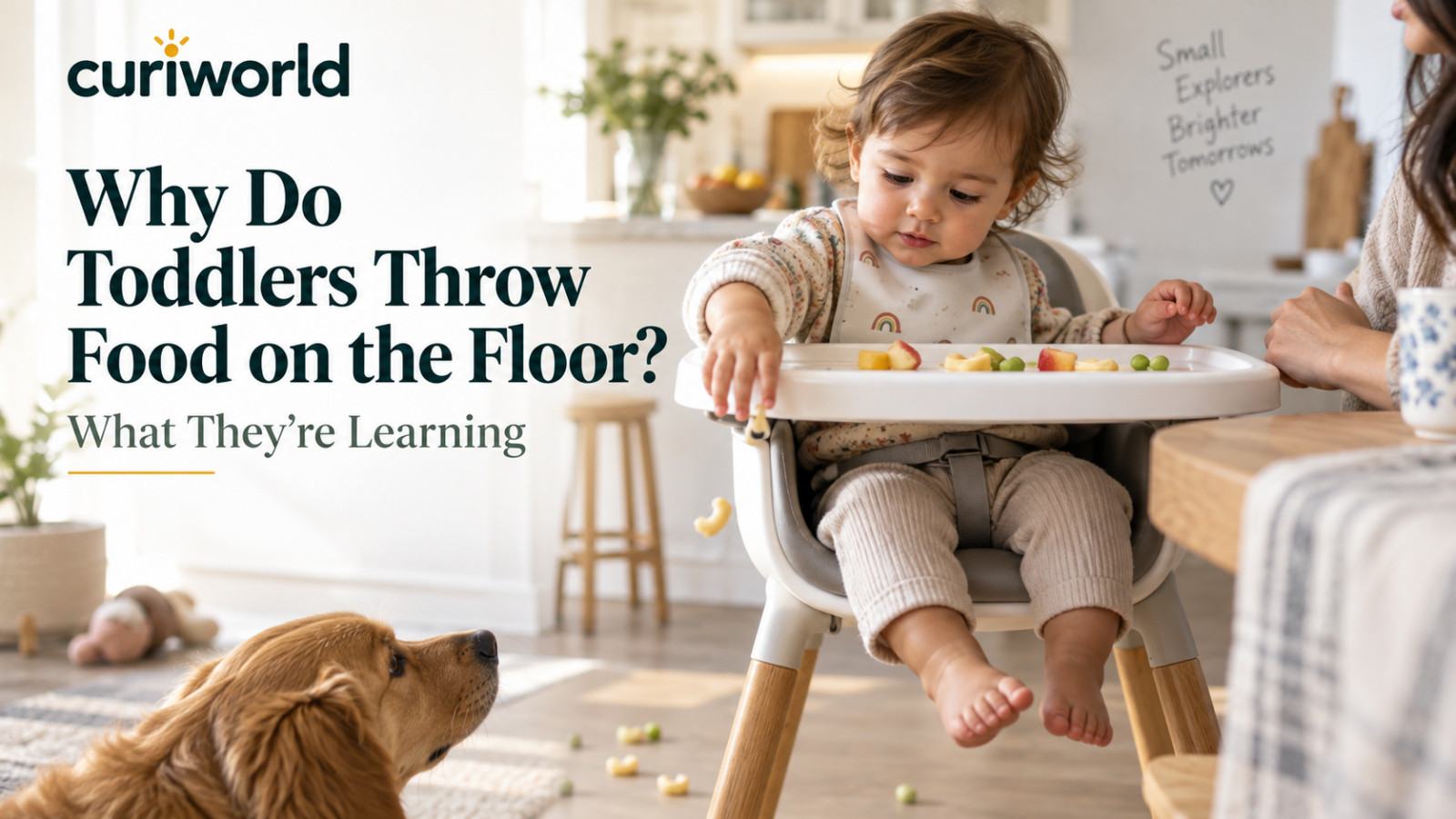
A toddler picks up a piece of banana, looks directly at you, stretches an arm over the side of the high chair—and drops it.
Then another piece.
Then the spoon.
At that point, it can feel less like lunch and more like a very specific experiment designed to test your patience.
But food throwing during the toddler years is often doing more than creating a mess.
Toddlers may drop or throw food because they are exploring cause and effect, practicing motor skills, testing what happens when they repeat an action, looking for a reaction, or simply signaling that they are finished eating.
The same behavior can mean different things at different meals. The useful part is learning to recognize which version you are seeing.
Sometimes the Floor Really Is Part of the Experiment
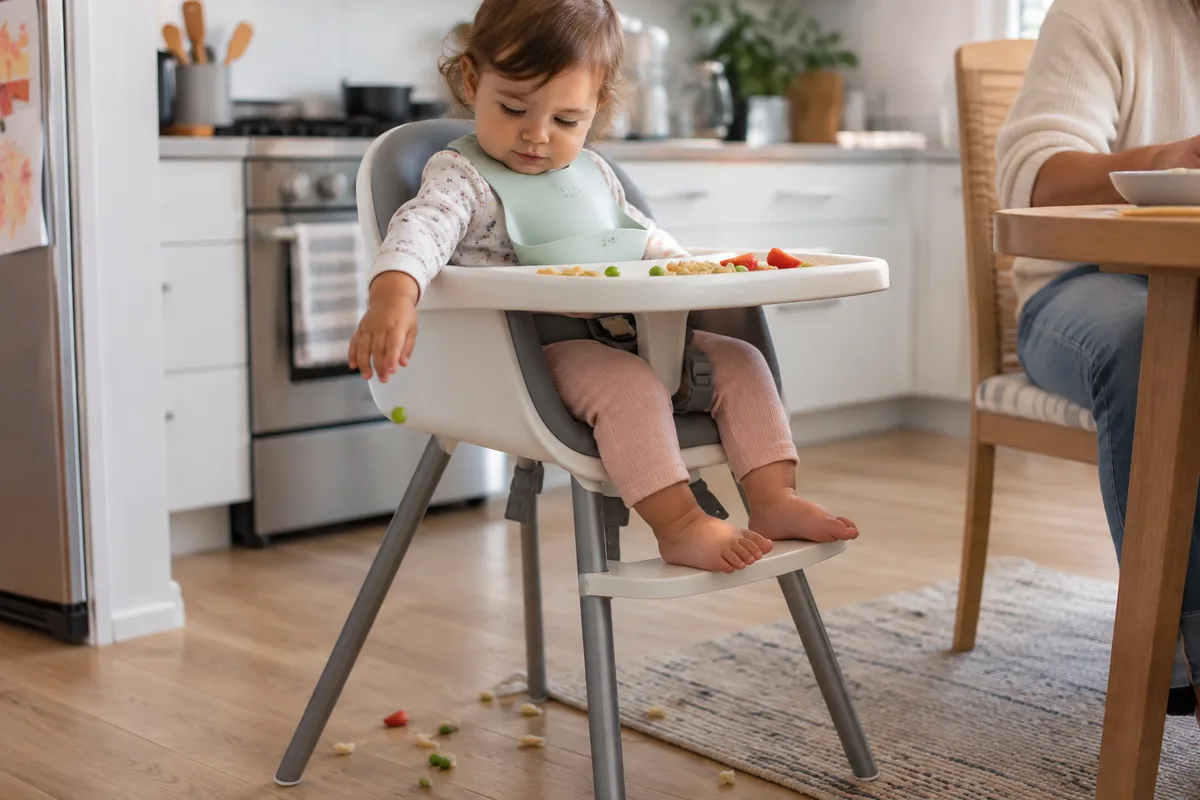
Young children learn by acting on things. They squeeze. Bang. Pour. Drop. Throw.
Then they watch what happens.
Food happens to be an excellent material for experimentation because every item behaves differently.
A blueberry rolls. Mashed potato sticks. A cracker breaks. Pasta bends. A spoon makes a noise.
Raising Children Network notes that messy eating and food play can help children learn about food, textures, and the physical world. Dropping an object teaches a very simple but important lesson:
When I let go, it falls.
Throwing adds another variable:
If I move my arm differently, the object goes somewhere else.
Adults already know these outcomes. A toddler is still building that knowledge through repetition.
That does not mean every thrown pea deserves applause. It simply explains why the behavior can be so fascinating to a young child.
The Reaction Can Become More Interesting Than the Food
There is another experiment happening at the table:
What will you do?
The toddler drops a piece of toast.
You say, “No, no, no!”
They smile.
They do it again.
Now the experiment is no longer only about gravity.
It is also social.
CDC parenting guidance points out that attention—including negative attention—can reinforce behavior. If throwing food reliably produces a dramatic facial expression, a loud voice, or an immediate scramble under the high chair, that reaction can become part of the game.
This is why an enormous reaction can sometimes keep a harmless behavior going longer than a calm response would.
A toddler does not need to be “manipulating” anyone in an adult sense.
They may simply have discovered a very dependable sequence:
Food goes down → parent reacts.
Predictable outcomes are interesting.
Food Throwing Can Also Mean “I’m Done”
This is one of the most useful distinctions for parents.
A toddler who throws food two minutes after sitting down may be experimenting.
A toddler who has eaten for ten or fifteen minutes, slowed down, started pushing food away, and then begins dropping it may simply be finished.
CDC lists behaviors such as pushing food away, closing the mouth, or turning the head away as possible signs of fullness in children 6–23 months old. Parents are encouraged to let children decide how much they eat rather than requiring them to finish everything served.
Food throwing is not officially a universal fullness cue.
But context matters.
If throwing consistently appears at the end of meals, it may be your toddler’s less-than-elegant way of communicating:
“I don’t want this anymore.” That is different from a child who is still actively eating between throws.
Watch What Happens Immediately Before the Food Flies
Instead of treating every throw the same way, look for the pattern.
If your toddler is still hungry
They may eat several bites, drop one, then continue eating.
That often looks more like experimentation or testing a reaction.
If your toddler is full
Eating slows.
They may turn away, push the plate, close their mouth, or start playing with everything instead of eating.
Throwing may appear near the end.
If your toddler wants attention
They may make eye contact before throwing and immediately look at your face afterward.
The response may be more rewarding than the dropped food.
If the portion is overwhelming
A large plate gives a toddler a large laboratory.
Sometimes offering a small amount and adding more as needed makes the meal easier to manage.
Raising Children Network specifically recommends placing only a few pieces within reach at a time when children are learning to feed themselves.
If the meal has gone on too long
Toddlers have limited attention spans.
CDC notes that meals for young children do not need to be long and may last roughly 10–15 minutes, or for as long as the child can stay engaged.
A child who has mentally left lunch may begin inventing activities with what remains on the tray.
Food Play Is Not the Same as Refusing to Eat
Parents understandably want food to go into the child rather than onto the floor.
But touching, squashing, smelling, licking, and moving food are also ways children become familiar with it.
This can be especially relevant with unfamiliar foods.
Raising Children Network notes that playing with food can help children learn about its shape, color, texture, and other properties, and that familiarity may make new foods less intimidating over time.
So there is a difference between: exploring food and turning the entire meal into a throwing game.
You can allow some sensory exploration without making “launch everything off the tray” the routine.
What Should You Do When Your Toddler Throws Food?
The response does not need to be dramatic.
Start with a short, calm boundary:
“Food stays on the table.”
Then show the alternative.
If your child is finished, you might teach: “All done?” and remove the plate.
If they do not want a particular food, give them a place to put it—a small “no thank you” section of the plate, for example—instead of throwing it.
The exact phrase matters less than consistency.
Toddlers learn patterns through repetition. If one day food throwing produces laughter, the next day shouting, and the next day five replacement portions, the rule is difficult to understand.
A simple, predictable response is easier to learn.
Try Serving Less Food at Once
A toddler does not need the entire serving on the tray immediately.
Start small.
A few pieces of pasta.
A couple of fruit slices.
A small portion of vegetables.
Then offer more if the child is still hungry.
This has several advantages.
There is less material available for throwing.
The plate may feel less visually overwhelming.
And less food is wasted if the child is already nearing fullness.
CDC also advises starting with small portions for young children and watching hunger and fullness cues rather than assuming how much they should eat.
Avoid Turning the Meal Into a Power Struggle
One of the quickest ways to make mealtime stressful is to turn every bite into a negotiation.
“Just one more.”
“You haven’t eaten enough.”
“If you eat this, you can have that.”
“Don’t throw it.”
“Take another bite.”
“Why aren’t you eating?”
Now the food is carrying a lot more emotional weight than lunch needs.
The American Academy of Pediatrics advises parents not to fixate on how much a toddler eats and to avoid turning meals into battles. Toddlers’ appetites can vary substantially from day to day.
The adult’s job is generally to provide appropriate food and a safe, predictable eating environment.
The child’s appetite still matters.
That same growing need for autonomy is part of why toddlers suddenly start saying “no” to almost everything.
At the table, the conflict often becomes:
Parent: “Eat.”
Toddler: “I decide.”
Neither side needs to win that battle.
Do Not Keep Replacing Every Thrown Item
A common pattern looks like this:
Toddler throws spoon.
Parent picks up spoon.
Toddler throws spoon again.
Parent picks it up again.
Repeat twelve times.
From the toddler’s perspective, you may have just invented a game.
If an item is repeatedly being thrown, it is reasonable to calmly remove it for the moment.
You can say:
“The spoon is staying with me because you’re throwing it.”
No lecture is required.
CDC guidance on toddler behavior emphasizes clear rules, consistency, and predictable follow-through.
What If the Toddler Laughs When You Say No?
The laugh can feel personal.
Usually, it is more useful not to interpret it as disrespect.
Toddlers are still learning social rules, impulse control, and cause-and-effect relationships.
Your reaction can also be stimulating.
A serious “food stays on the table” face may simply be interesting.
Keep your response boring.
Not cold.
Not angry.
Just predictable.
If throwing no longer creates a large social event, the behavior may become less rewarding.
When Should You End the Meal?
If the toddler is clearly no longer eating and repeatedly throwing or playing with everything, the meal may simply be finished.
You can say:
“It looks like you’re all done.”
Then remove the food calmly.
This works best when regular meals and snacks are offered throughout the day rather than making every meal feel like the child’s only chance to eat.
CDC recommends regular eating routines and notes that young children may eat very different amounts from one day to another.
The goal is not to punish the child by taking food away.
It is to recognize when eating has ended and the activity has become something else.
The Mess Is Annoying—But Self-Feeding Is a Skill
A toddler learning to eat independently is doing several jobs at once.
They are practicing:
- reaching,
- grasping,
- releasing,
- coordinating hand and mouth movements,
- using utensils,
- judging how much force to use,
- recognizing hunger and fullness,
- learning table routines,
- and figuring out what different foods feel like.
That process will not look tidy.
CDC specifically encourages children’s growing independence with feeding, while Raising Children Network describes mess as a normal part of learning to self-feed.
A clean floor is not the only measure of a successful meal.
When Food Throwing Deserves a Closer Look
Food throwing by itself is common and usually not enough to suggest a feeding or developmental problem.
What matters is the bigger picture.
Talk with your child’s pediatrician or an appropriate feeding professional if you are concerned about things such as:
- very limited food intake,
- difficulty chewing or swallowing,
- coughing or choking during meals,
- poor growth,
- persistent distress around eating,
- losing previously acquired feeding skills,
- or a very restricted diet that makes adequate nutrition difficult.
Those concerns are different from a toddler enthusiastically dropping broccoli to watch what happens.
If a child is growing, eating a reasonable range over time, and otherwise developing as expected, occasional food throwing usually belongs more to the messy-learning category than the medical one.
The Floor Phase Usually Has More Than One Meaning
A toddler throwing food is not necessarily saying:
“I hate dinner.”
And they are not necessarily trying to misbehave.
They might be asking, in toddler terms:
What happens if I drop this?
Will it bounce?
Will Dad pick it up?
Will Mom make that funny face again?
What happens if I say I’m finished without words?
Can I control what happens to this food?
That is what makes food throwing so frustrating—and developmentally interesting.
The best response usually combines two ideas:
Let toddlers learn. Give them clear limits.
Meals can be messy without becoming chaos.
And sometimes the most useful clue is not the piece of food on the floor.
It is what your toddler was trying to communicate right before it landed there.
Sources
Centers for Disease Control and Prevention — Tips for Mealtime Routines
Raising Children Network — Children Learning to Feed Themselves
Centers for Disease Control and Prevention — Signs Your Child Is Hungry or Full






Join the discussion