AI Voice Clones and Deepfakes: How to Verify a Suspicious Recording
A familiar voice is no longer proof of identity. Learn how to verify suspicious recordings without relying on your ears—or a single AI detector.
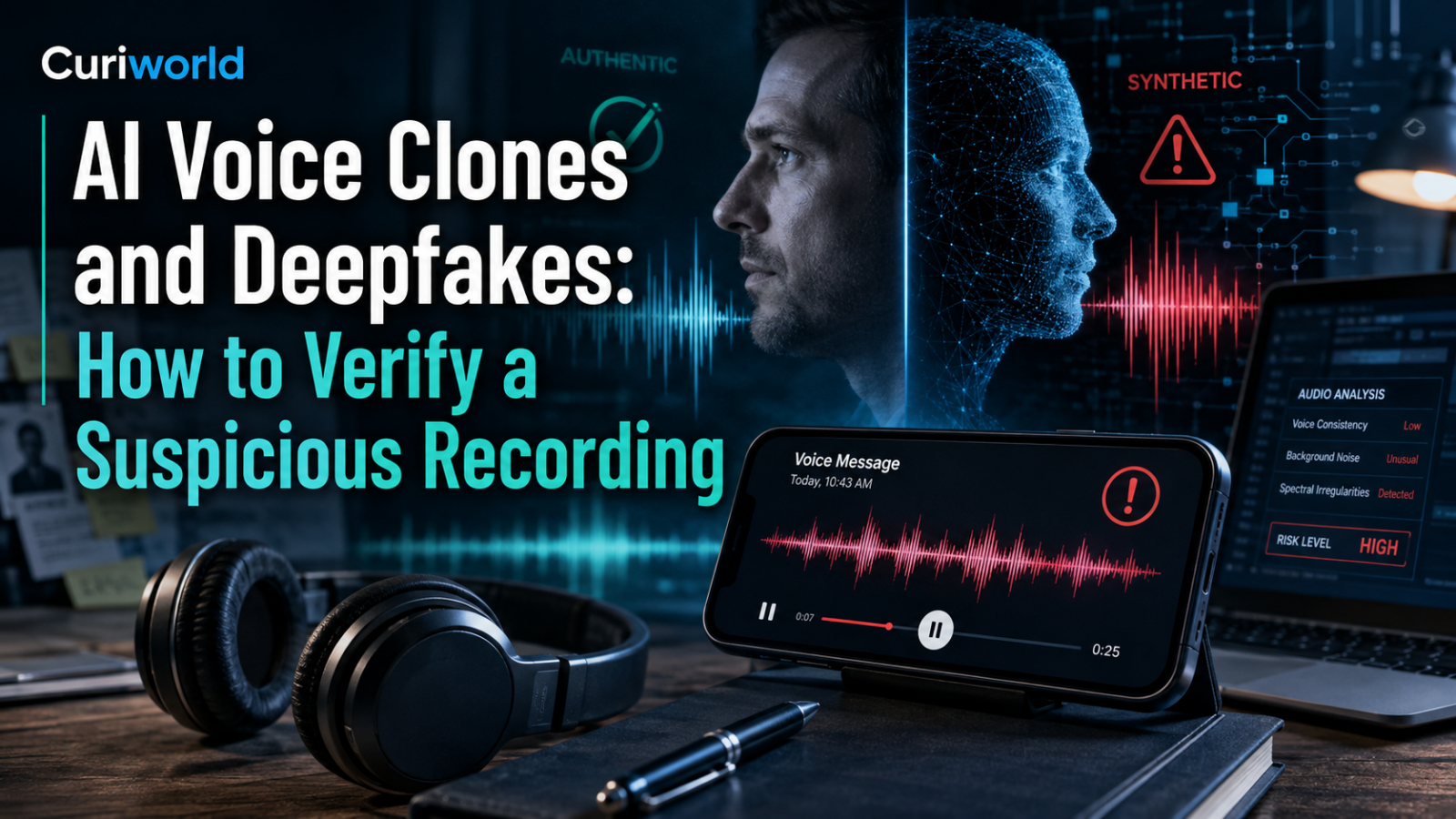
A familiar voice is no longer proof that a familiar person is speaking.
AI voice-cloning tools can reproduce recognizable elements of a person’s speech, while audio deepfakes can make someone appear to say words they never recorded. That creates a difficult situation when a voicemail, voice note, phone recording, or social media clip sounds convincing but something about it feels wrong.
The safest response is not to become an expert at detecting robotic voices.
It is to verify the recording independently.
Odd pauses, unusual pronunciation, strange background noise, or an unnatural rhythm can raise suspicion, but modern synthetic audio can sound remarkably convincing. A recording should therefore be judged by its source, context, and independent confirmation—not simply by whether the voice “sounds real.”
A Realistic Voice Does Not Prove the Recording Is Real
Older synthetic voices were often easy to notice. They sounded flat, mechanical, or obviously computer-generated.
That is becoming a poor assumption.
Modern voice-cloning systems can imitate characteristics such as tone, accent, pacing, and vocal identity closely enough to fool listeners, particularly when the recording is short or emotionally charged.
A scammer does not necessarily need to create a flawless ten-minute conversation. A short message such as:
“I’ve had an accident. Please call me.”
or:
“I need you to send this payment right now.”
may be enough to create urgency before the listener has time to question what they heard.
This is why the first question should not be:
“Does this sound fake?”
A better question is:
“Can I independently prove who created or sent this?”
That change in approach makes verification much more reliable.
Listen for Clues—but Treat Them Only as Clues
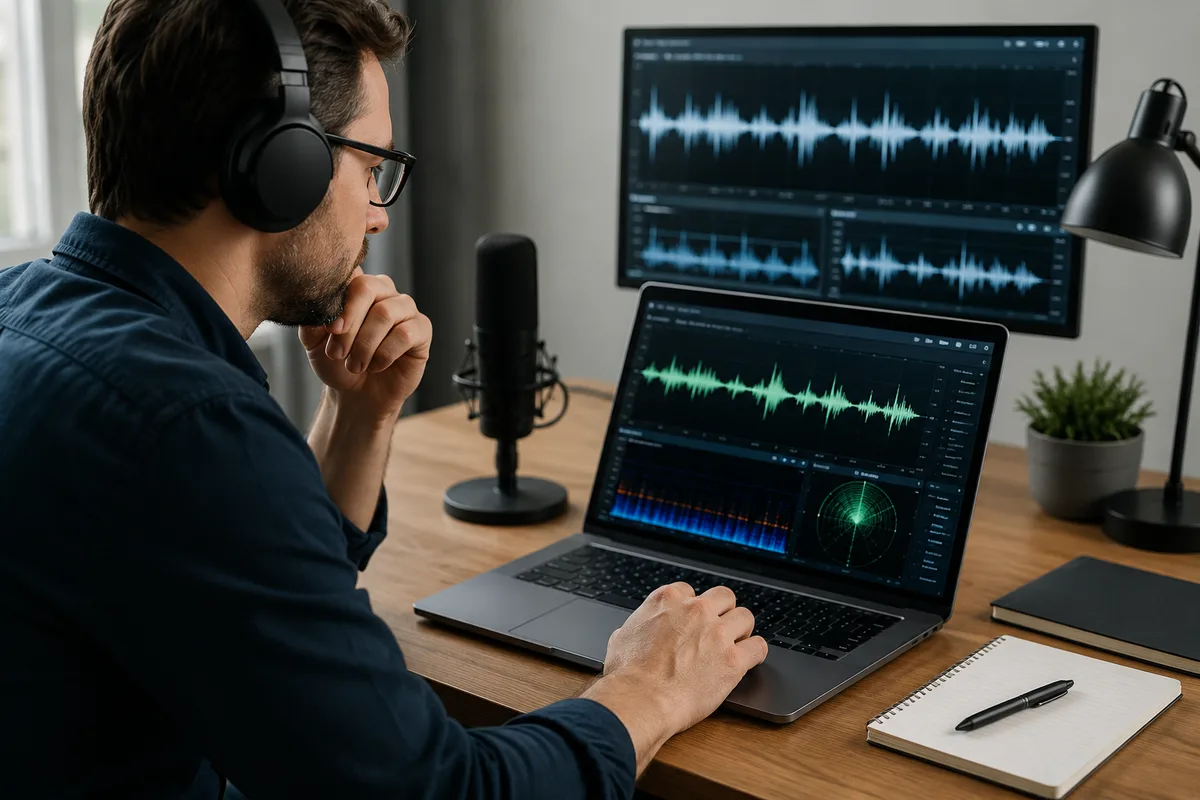
Synthetic audio can sometimes contain noticeable imperfections.
The FBI advises people evaluating potentially AI-generated content to pay attention to characteristics such as unnatural pauses, unusual inflections, abnormal phrasing, inconsistent background noise, or other irregularities.
Those details can be useful.
Imagine that someone you know normally speaks casually but suddenly sends a strangely formal voice message. Their pronunciation may sound right, yet the words do not resemble anything they would normally say.
Or perhaps the recording contains a background environment that does not fit the claimed situation.
Those mismatches deserve attention.
The problem is that none of them proves that the audio is synthetic.
Real recordings can contain strange pauses because of compression, poor reception, editing, stress, illness, or ordinary speech variation. At the same time, a sophisticated clone may contain few obvious artifacts.
Think of acoustic imperfections as warning signals, not a final verdict.
The Strongest Test Is an Independent Callback
Suppose you receive a voice message from a relative saying they have been arrested abroad and urgently need money.
Calling the number included in the suspicious message does not truly verify anything. You may simply be returning to the person who sent it.
Instead, contact the supposed speaker using information you already trusted before the suspicious recording arrived.
Call their normal phone number.
Message them through an established account.
Contact another family member who can reach them.
If the supposed caller represents a company, bank, government agency, or employer, find the organization’s contact information independently rather than using a phone number or link supplied with the recording.
The FBI specifically recommends independently identifying a phone number for the person or organization and using it to verify the communication.
This principle works because it separates two things a scammer wants you to treat as one:
the convincing voice and the person’s verified identity.
A voice can be copied.
An independently established communication channel is much harder to fake at the same time.
Use a Verification Question the Recording Cannot Answer for You
If direct contact is possible, confirm something that does not depend on recognizing the voice.
For a family member or close friend, that may mean asking about information naturally known between you.
For a workplace request, confirm through the company’s established approval process.
If a manager apparently sends an urgent audio message requesting a transfer, the correct verification may be a callback, a second authorized employee, or an internal approval system—not a debate over whether the manager’s voice sounds slightly unusual.
Some families also choose a private verification word for emergency situations.
The important part is that the verification method should not rely on information easily available from public social media accounts.
A birthday, pet name, hometown, employer, school, or family relationship may already be public.
The best verification is based on an independent channel or information that an impersonator would not reasonably possess.
Urgency Is Often More Important Than the Audio Quality
A suspicious recording may reveal more through what it asks you to do than through how it sounds.
Be especially cautious when the message combines identity impersonation with pressure.
Examples include an urgent demand for money, a request to purchase gift cards or cryptocurrency, instructions not to contact anyone else, a sudden request for passwords or authentication codes, a change in payment details, or pressure to act before you have time to verify the story.
The Federal Trade Commission has specifically warned about scammers using cloned voices in fake family emergencies.
The voice is the credibility mechanism.
The urgency is what pushes the victim toward action.
If a recording creates an artificial deadline—“send it now,” “don’t call anyone,” “I can’t explain”—that is a reason to slow the process down, not speed it up.
Check Where the Recording Came From
The audio file itself is only part of the evidence.
Consider its origin.
Was it sent from the person’s normal account?
Is the phone number familiar?
Was a new messaging account suddenly introduced?
Did the recording first appear on an anonymous social media account?
Is the clip being reposted without any link to the original source?
A recording of a celebrity, politician, executive, or public figure deserves particular caution when the only evidence for authenticity is a viral post repeating the clip.
Search for the original context.
If a recording supposedly came from an interview, speech, company announcement, podcast, livestream, or press conference, look for the complete material from the original publisher.
Short clips are easier to manipulate than full contexts.
They can also be misleading without involving AI at all. Ordinary editing, selective quotation, changes in playback speed, or removal of surrounding statements can alter how a genuine recording is understood.
That distinction matters:
Not every misleading recording is an AI deepfake.
Sometimes the audio is real and the context is false.
Compare the Claim, Not Just the Voice
Suppose a voice note supposedly from a company’s CEO announces a major acquisition.
You could spend ten minutes listening for tiny glitches.
There may be a better route.
Check the company’s official website.
Look at regulatory disclosures if applicable.
Check whether established news organizations or other primary sources independently confirm the announcement.
Verification becomes much stronger when you examine the underlying claim rather than trying to analyze sound alone.
The same principle applies to AI-generated text. Curiworld’s guide to checking whether an AI answer is actually correct makes a similar distinction: confident presentation is not evidence. What matters is whether the important claim can be independently supported.
A convincing voice deserves the same skepticism.
Can an AI Detector Tell You Whether the Voice Is Fake?
Audio-deepfake detection tools exist, and they may provide useful evidence.
They should not be treated as a truth machine.
Detection systems may analyze patterns in speech, acoustic signals, or other properties that differ between genuine and synthetic recordings. Other approaches attempt to verify the origin of audio through watermarking or authentication mechanisms.
The FTC has examined several of these approaches, including real-time detection, watermarking, authentication, and post-use evaluation.
But it also highlights an important limitation: there is no single solution that eliminates the problem.
Detection tools face an ongoing challenge. Voice-generation systems improve, detection systems adapt, and attempts can be made to alter recordings or remove indicators of synthetic origin.
A detector saying “likely AI-generated” can therefore be evidence worth investigating.
A detector saying “likely real” should not override major contextual warning signs.
The same caution applies to visual content. If the suspicious material is an image rather than a recording, see how to investigate whether an image was made by AI.
This is especially important when money, account access, personal safety, sensitive information, or someone’s reputation is involved.
A Practical Verification Routine
When a recording seems suspicious, use a process rather than intuition alone.
- Do not act immediately.
Urgency is exactly when verification matters most. - Preserve the original message or recording.
Avoid repeatedly editing, exporting, or converting the file if the incident may need further investigation. - Check the sender and source.
Look at the account, number, platform, original post, and surrounding context. - Contact the supposed speaker independently.
Use a phone number, account, website, or communication channel you already trust. - Verify the actual claim.
Confirm whether the emergency, payment request, announcement, or event described in the audio really occurred. - Compare language and context.
Notice unusual wording, requests, background sounds, timing, or behavior—but do not treat those clues as definitive proof. - Use detection tools only as supporting evidence.
Do not let a single automated result determine whether you send money, reveal credentials, or publicly accuse someone of creating a deepfake. - Escalate high-risk cases.
If the recording involves fraud, extortion, account compromise, threats, or significant financial loss, preserve the evidence and contact the relevant financial institution, platform, employer, or local cybercrime/law-enforcement authority.
This process may take slightly longer than simply trusting your ears.
That is the point.
The same source-verification principle applies to synthetic visuals. Here is how to tell whether an image may have been made by AI in 2026.
Be Careful Where You Upload Suspicious Audio
One overlooked verification risk is the detector itself.
Uploading a private recording to an unknown “AI voice detector” means giving that audio to another service.
That recording could contain names, confidential conversations, business information, health information, financial details, or someone’s biometric voice data.
Before uploading sensitive audio, check who operates the service, what its privacy policy says, whether files are retained, and whether submitted recordings may be used for training or other purposes.
For sensitive material, independent source verification may be both safer and more useful than sending the recording to several unknown websites.
What If the Recording Involves a Public Figure?
The same verification principles apply, but the source trail is often easier to investigate.
Suppose a dramatic recording appears online claiming to feature a politician, celebrity, scientist, business executive, or other public figure.
Before sharing it, search for:
the complete original recording;
the official account or organization associated with the speaker;
independent reporting from established sources;
and statements confirming or disputing the clip.
Be cautious with screenshots of headlines, cropped videos, anonymous reposts, and accounts that provide no original source.
A viral recording can accumulate thousands of shares before anyone establishes where it came from.
Popularity is evidence of reach.
It is not evidence of authenticity.
Why “I Know Their Voice” Is No Longer Enough
People naturally trust familiar voices.
That trust once functioned as a useful identity signal. If your parent, friend, manager, or colleague sounded like themselves on the phone, there was usually little reason to question whether the speaker was actually that person.
Voice cloning weakens that assumption.
This does not mean every unexpected voicemail should trigger a forensic investigation.
It means the level of verification should rise with the stakes.
A funny voice note from a friend requires almost none.
A message requesting a $10,000 transfer requires a great deal.
The more serious the requested action, the less weight you should place on the sound of the voice itself.
The Best Deepfake Detector May Be a Second Communication Channel
Audio analysis will continue to improve. So will synthetic audio.
That technological race makes ordinary verification habits surprisingly powerful.
A suspicious recording does not need to be scientifically proven fake before you refuse to act on it.
You only need to recognize that its authenticity has not yet been established.
Pause.
Find the person through a channel you already trust.
Verify the underlying story.
Check the original source.
Only then decide what the recording deserves to make you believe—or do.
As AI-generated voices become harder to distinguish by ear, the safest question is no longer:
“Does this sound like them?”
It is:
“What evidence do I have that this actually came from them?”
Sources
Federal Bureau of Investigation — Senior U.S. Officials Impersonated in Malicious Messaging Campaign
https://www.fbi.gov/investigate/cyber/alerts/2025/senior-us-officials-impersonated-in-malicious-messaging-campaign
Federal Trade Commission — Approaches to Address AI-Enabled Voice Cloning
https://www.ftc.gov/policy/advocacy-research/tech-at-ftc/2024/04/approaches-address-ai-enabled-voice-cloning








Join the discussion