Cities Stay Hot After Sunset: The Urban Heat Island Effect Explained
Cities can stay noticeably warmer long after sunset. The reason lies in how pavement, buildings, vegetation, and urban design store and release heat.
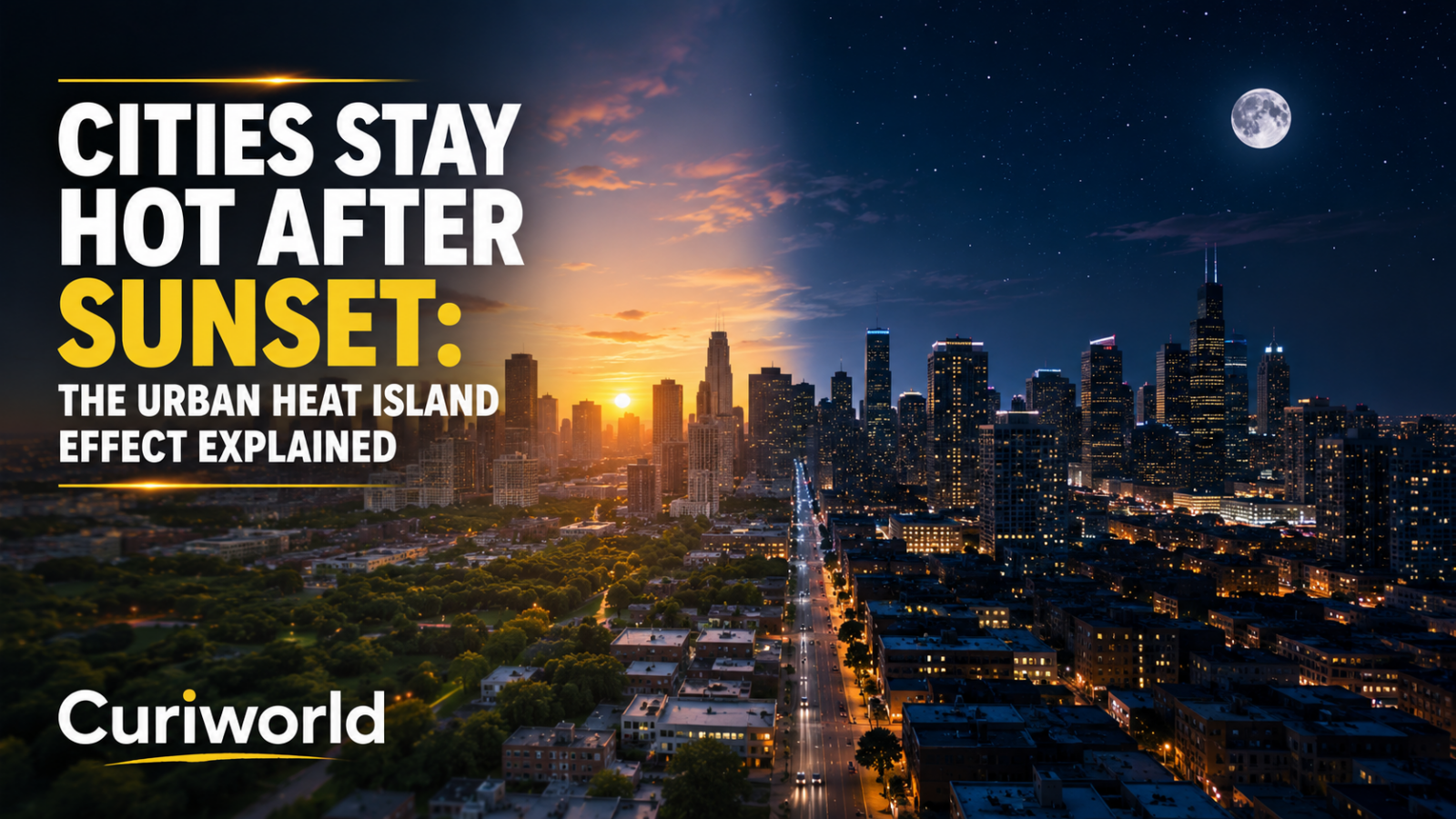
The Sun has disappeared. The sidewalk is in shadow. Traffic is thinning out. Yet the city still feels as if someone forgot to turn the heat off.
Drive a few miles beyond the dense urban center, and the evening can feel noticeably cooler.
That difference is one of the clearest expressions of the urban heat island effect: developed areas tend to remain warmer than their less-built surroundings because roads, roofs, buildings, reduced vegetation, urban geometry, and human activity change the way heat is absorbed, stored, and released.
The surprising part is that the contrast does not necessarily disappear after sunset.
In many cities, night is when the atmospheric heat island becomes especially noticeable.
Why Doesn’t a City Cool Down as Soon as the Sun Sets?
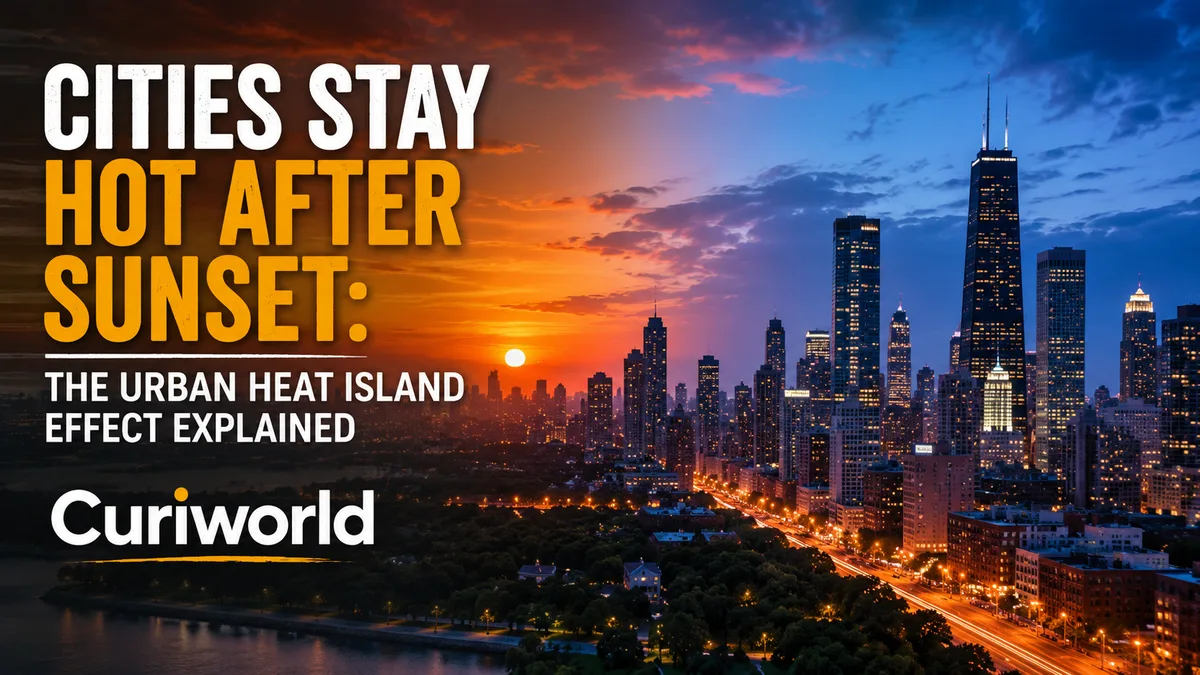
Sunset stops incoming solar heating, but it does not instantly remove the energy absorbed during the day.
Concrete, asphalt, brick, roofs, and other built surfaces can absorb solar energy for hours. After sunset, those materials begin releasing some of that stored energy back into their surroundings.
The city is effectively cooling from a large thermal reservoir.
Natural landscapes often behave differently.
Vegetated ground receives shade from trees and loses energy through evapotranspiration—the movement of water from soil and plants into the atmosphere. Moist surfaces can therefore use part of the incoming energy for evaporation instead of simply becoming hotter.
Replace vegetation with pavement and buildings, and that balance changes.
The result is not that concrete somehow “creates” heat. It is that a heavily built environment stores and exchanges energy differently from a greener landscape.
That difference becomes particularly obvious after the direct sunlight is gone.
The Urban Heat Island Can Become Stronger After Sunset
There are actually different ways to describe an urban heat island.
A surface heat island refers to differences in the temperatures of surfaces themselves—such as roofs, asphalt, grass, and soil.
An atmospheric heat island refers to differences in the air temperature above urban and surrounding areas.
That distinction matters because they do not necessarily peak at the same time.
Sunlit asphalt can become extremely hot during the afternoon, making surface-temperature differences especially dramatic during the day.
Air-temperature differences can tell a different story.
After sunset, less-developed areas may cool rapidly while densely built neighborhoods remain warm. The temperature gap between urban and surrounding air can therefore grow during the evening.
This is why the urban heat island effect is not simply a story about cities getting hotter in sunshine.
It is also a story about cities cooling more slowly.
In the United States, EPA summarizes typical heat-island differences as roughly 1–7°F warmer during the day and about 2–5°F warmer at night than nearby outlying areas.
Those numbers are broad ranges, not a rule for every city or every night. The magnitude depends on weather, urban form, vegetation, surface materials and how the comparison is measured.
Pavement and Buildings Act Like Heat Storage
Walk barefoot on dark pavement on a sunny day and its ability to absorb energy becomes obvious very quickly.
Urban areas contain enormous amounts of these heat-absorbing surfaces.
Roads.
Parking lots.
Sidewalks.
Roofs.
Building walls.
Concrete plazas.
During daylight hours, these materials receive solar radiation. How much they reflect or absorb depends on properties such as their color, composition, surface texture, and reflectivity.
Many conventional urban surfaces absorb a significant portion of the energy that reaches them.
Some of that energy later moves back into the surrounding air.
One parking lot does not create a citywide heat island. But multiply those surfaces across blocks, neighborhoods, highways, rooftops, commercial districts, and industrial zones, and the energy balance of an entire urban landscape can differ from that of the countryside around it.
Those differences can become extremely local, which helps explain why some neighborhoods are hotter than others.
Trees Cool Cities in More Than One Way
A tree is not simply an object casting a shadow.
Shade is important because it prevents some solar energy from reaching pavement, walls, people, and other surfaces in the first place.
Plants also cool through evapotranspiration.
Water taken up by vegetation eventually moves into the atmosphere, and that process consumes energy. Instead of all available solar energy becoming sensible heat that raises temperatures, some is involved in moving water through the environment.
That helps explain why a park can feel different from an exposed parking lot even when both are inside the same city.
It also means that urban heat is not necessarily distributed evenly.
Two neighborhoods separated by only a short distance can have noticeably different thermal environments depending on tree canopy, pavement, building density, shade, and access to green space.
An urban heat island is therefore not always one smooth dome of temperature covering an entire city.
A city can contain hot spots and cooler pockets within the larger heat island.
Tall Buildings Can Make It Harder for Heat to Escape
Cities do not just replace vegetation.
They change geometry.
In dense districts, tall buildings stand close together along relatively narrow streets. Urban climatologists often describe these spaces as urban canyons.
Their shape affects sunlight, shade, airflow, and the way thermal radiation moves between surfaces and the sky.
At night, an open rural surface has a relatively unobstructed view of the sky and can lose heat efficiently through radiation.
Inside a dense urban canyon, surrounding walls and structures can interfere with that process. Energy emitted from one surface may encounter another building rather than escaping as efficiently toward the open sky.
Buildings can also alter airflow.
Under some conditions, reduced ventilation can make it harder for accumulated heat to disperse.
This is one reason two areas within the same city may cool at very different rates after dark.
An open park and a tightly packed downtown street may have experienced the same sunset, but they do not have the same physical environment for losing heat afterward.
Cities Generate Heat of Their Own
Not all urban heat began as sunlight.
Cities contain millions of smaller heat sources.
Vehicles release waste heat.
Industrial activity can release heat.
Buildings consume energy.
Air-conditioning systems remove heat from indoor spaces and reject it outdoors.
That last example produces an interesting local paradox.
Air conditioning can make an apartment or office much more comfortable while transferring heat from inside the building to the outdoor environment. Across a dense district containing many cooling systems, that rejected heat can contribute to the urban thermal environment.
This human-generated energy is known as anthropogenic heat.
It is usually only one part of the urban heat island mechanism, but it helps explain why a functioning city continues generating heat even after solar input has ended.
Why Clear, Calm Nights Can Make the Difference More Obvious
Weather strongly influences how noticeable a heat island becomes.
Wind can mix air and transport heat away from a location.
Clouds can alter the exchange of radiation between the surface and atmosphere.
Under clear, relatively calm conditions, surrounding rural land may cool efficiently while the urban environment releases its stored heat more gradually.
The difference between the two can therefore become more pronounced.
This is also why the heat island effect does not have one fixed temperature value for every city or every night.
It varies with:
- weather;
- season;
- geography;
- city size and structure;
- vegetation;
- surface materials;
- building density;
- time of day;
- and the specific locations being compared.
According to the U.S. Environmental Protection Agency, U.S. urban areas are typically about 1–7°F warmer during the day and about 2–5°F warmer at night than outlying areas.
Those are broad typical differences, not a promise that every city will experience exactly the same temperature gap.
A Thermal Satellite Image Is Not the Same as the Air Temperature
Pictures of urban heat islands often show cities covered in dramatic reds, oranges, yellows, and blues.
These images can be extremely useful—but it helps to understand what they are showing.
Satellite instruments can measure or estimate land-surface temperature, revealing how hot roofs, roads, vegetation, bare ground, and other surfaces are.
That is not automatically the same as the air temperature reported by a weather station.
A dark roof can be much hotter than the air above it.
A shaded park may have a cooler surface.
Both observations matter, but surface heat and atmospheric heat should not be treated as interchangeable measurements.
This distinction helps explain something that otherwise seems contradictory:
The strongest surface temperature differences may occur in daylight, while the air-temperature heat island can become particularly important at night as rural surroundings cool faster.
Does the Urban Heat Island Cause Global Warming?
The urban heat island effect and global climate change are related to heat, but they are not the same phenomenon.
An urban heat island is primarily a local effect caused by changes to the land surface, city structure, vegetation, energy use, and other urban characteristics.
Global warming describes a long-term rise in Earth’s average temperature driven primarily by increasing greenhouse gases from human activities.
NASA specifically notes that scientists account for urban heat islands when analyzing global temperature trends. The localized warming of cities does not explain the observed global warming trend.
The two effects can, however, occur at the same time.
A warmer global climate can increase the background temperatures on which an urban heat island operates. During hot weather, residents of dense urban neighborhoods may therefore experience both a broader heat event and additional local warming associated with the built environment.
So the useful distinction is:
Climate change can make hot periods hotter or more frequent on a broad scale. Urban heat islands can make particular developed places hotter than their surroundings.
Why Warm Nights Matter
A hot afternoon is uncomfortable, but nighttime normally provides an opportunity for buildings, streets, and people to cool down.
Urban heat islands can reduce that relief.
If outdoor temperatures remain elevated overnight, buildings may retain more heat and cooling systems may need to operate longer.
The effect can be particularly noticeable during prolonged periods of extreme heat, when urban materials repeatedly absorb energy during the day without fully cooling before the next day begins.
This creates a kind of thermal carryover.
The city does cool after sunset.
It just may not cool as quickly or as far as nearby areas.
Can Cities Be Designed to Stay Cooler?
There is no single switch that removes an urban heat island, because the effect emerges from the structure of the city itself.
But cities can change some of the factors contributing to it.
Common strategies include increasing tree canopy and vegetation, preserving parks and open spaces, installing green roofs, using roofs designed to reflect more incoming solar energy, and developing pavement systems intended to reduce excessive heat absorption.
The effectiveness of each approach depends on climate, neighborhood design, water availability, maintenance, building type, and local conditions.
Urban planners also have to think beyond average city temperature.
Where cooling measures are placed matters.
A tree canopy concentrated in one neighborhood does not shade residents several miles away. Citywide averages can therefore hide large differences in heat exposure between individual streets and communities.
The most useful question is often not simply:
“How hot is this city?”
but:
“Which parts of this city stay hottest, especially at night?”
The City Is Still Releasing the Afternoon After Dark
A hot city street after sunset can feel mysterious because the obvious heat source—the Sun—is gone.
But the energy did not disappear with it.
Some of the afternoon is still stored in roads, walls, roofs, and other parts of the built environment. Dense urban geometry can slow heat loss. Reduced vegetation changes the way energy and water move through the landscape. Human activity adds additional heat.
Meanwhile, greener and less-developed surroundings may be cooling faster.
That difference creates one of the defining characteristics of the urban heat island.
So when a downtown neighborhood remains warm long after sunset, the city is not somehow continuing to receive sunlight.
It is still giving yesterday’s sunlight back.







Join the discussion