Why Do Children Create Imaginary Friends—and Is It Normal?
Imaginary friends are usually part of healthy pretend play. Here is what these invented companions may offer—and which signs deserve a closer look.
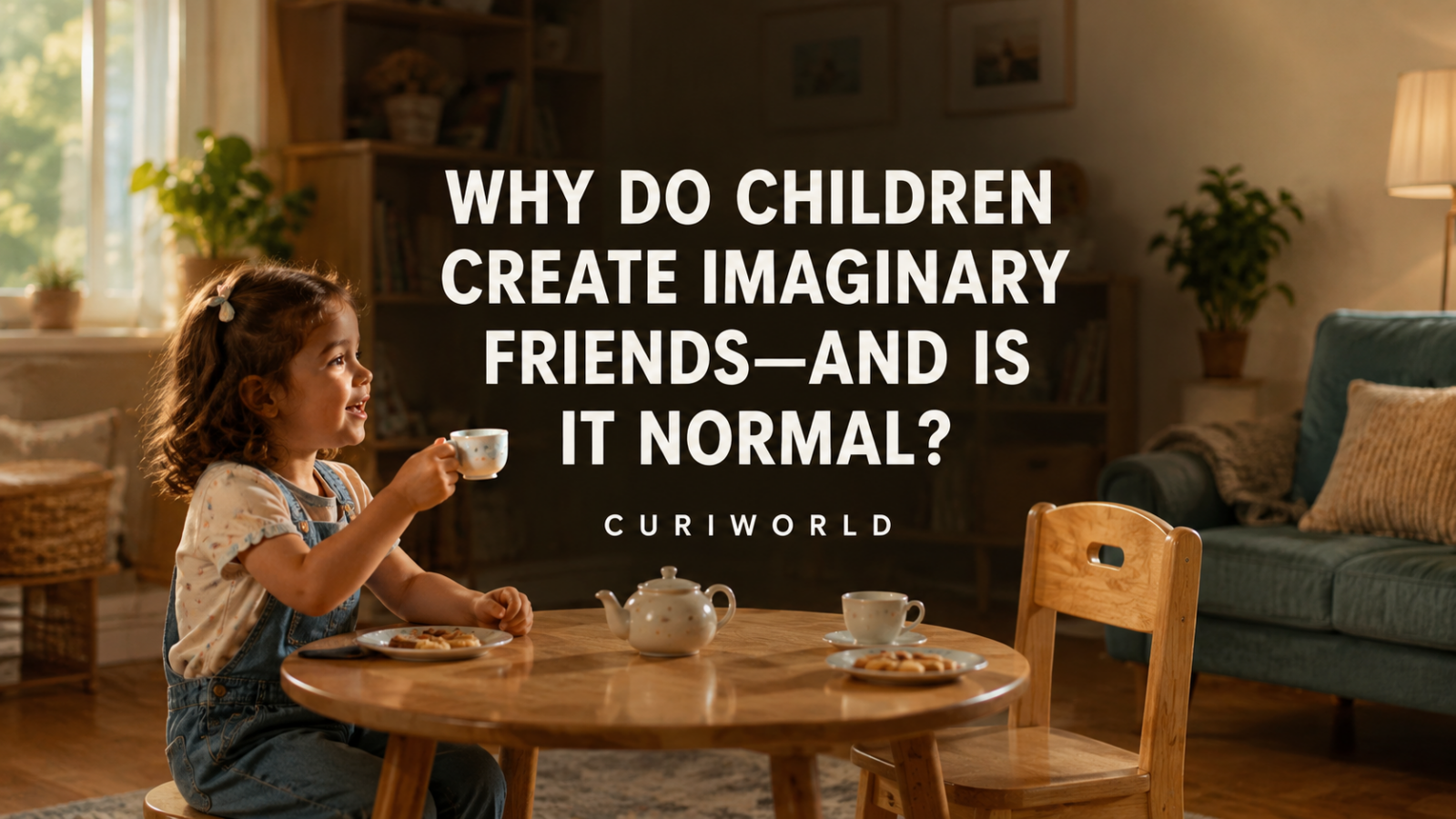
An extra place is set at the table. A child pauses because someone invisible is “sitting” on the stairs. A new family member has apparently arrived—and only one person in the house can see them.
For most children, having an imaginary friend is a normal form of pretend play. It does not automatically mean that a child is lonely, confused about reality or experiencing a mental-health problem. An invented companion can give a child a character to talk with, care for, argue with, comfort and include in stories.
What matters most is not whether the friend is invisible. The more useful questions are whether the experience feels safe and controllable to the child, and whether the child is otherwise developing and functioning comfortably.
What Counts as an Imaginary Friend?
An imaginary friend, sometimes called an imaginary companion, is a recurring character that a child treats as a social partner during play. The companion may be an invisible child, an animal, a fantasy creature or an ordinary doll or stuffed toy given a detailed personality and life of its own.
This is more elaborate than briefly pretending to be a superhero or talking to a toy once. An imaginary companion may have a name, preferences, moods, adventures and rules. Some visit for a few days; others return for months or change into entirely new characters.
Young children can become deeply absorbed in these relationships, but that does not necessarily mean they believe the companion exists in the same way as a parent, teacher or classmate. Many children understand that the character belongs to the world of play even while insisting that adults respect the story while it is happening.
Not every child creates an imaginary friend, either. Having one is not a developmental requirement, and not having one does not suggest a lack of imagination.
Why Do Children Invent Companions?

Children rarely announce a single reason. The friend may serve several purposes, and those purposes can change as the story develops.
- Practicing social situations: A child can take turns, negotiate, disagree, apologize or comfort someone within a situation they control. These invented conversations may provide a low-pressure space for trying out the patterns of relationships.
- Building stories: Imaginary companions give children recurring characters for adventures and conversations. The same growing mind that searches for explanations during the endless “why?” phase can also create surprisingly detailed fictional worlds.
- Exploring another point of view: Giving a character different wants, feelings and opinions asks the child to imagine a mind that is separate from their own. Researchers discuss this in relation to perspective-taking and theory of mind, although an imaginary friend should not be treated as proof that a child has superior social abilities.
- Experiencing some control: Adults make many of the decisions in a young child’s day. In imaginary play, the child decides who appears, what happens and how the story ends. This wish for influence fits with the growing independence also seen when toddlers begin saying “no” and testing everyday boundaries.
- Working with emotions: A companion may be brave when the child feels nervous, misbehave when the child is testing a rule or need comfort after a difficult day. Play can make feelings easier to approach indirectly.
- Providing companionship: An invented friend is always available for a game or conversation. That can be enjoyable, but it does not prove that the child lacks real friends or feels chronically lonely.
A companion may also appear simply because imaginative play is fun. Adults should be careful not to turn every invented detail into a hidden psychological message.
Does an Imaginary Friend Mean a Child Is Lonely?
Usually, no. Children with siblings, classmates and active social lives can have imaginary companions. A fictional friend can add another kind of play without replacing relationships with real people.
Loneliness can influence anyone’s desire for companionship, so it should not be ruled out when other signs are present. The imaginary friend alone, however, is not enough to support that conclusion. Pay attention to the child’s broader life: Do they enjoy interacting with family or other children? Can they participate in school and ordinary activities? Do they seem generally secure?
The same caution applies to claims about creativity, intelligence or empathy. Research has identified interesting associations between imaginary companions and aspects of cognitive or social development, but that does not prove that inventing a friend causes those abilities. It is a style of play, not a test score.
How Should Parents Respond?
A calm, curious response usually works best. If the child wants to share, simple questions such as “What is your friend’s name?” or “What do you like to do together?” invite the child to explain without taking control of the story.
Let the child remain the author. Adults do not need to supply the friend’s personality, speak for the character or insist on participating. Some children enjoy including a parent, while others prefer to keep parts of their pretend world private.
Recurring characters may also provide the familiarity children enjoy in favorite books. Just as children may love hearing the same story again and again, they may return to the same imaginary companion because the character makes play familiar while still allowing new adventures.
A few responses are particularly helpful:
- Show interest without conducting an interrogation.
- Avoid mocking, embarrassing or trying to prove that the friend is not real.
- Listen for feelings without assuming every statement is a literal disclosure.
- Keep ordinary household routines and safety rules in place.
- Continue offering real-world play, conversation and time with other children.
If the child says the imaginary friend is afraid of school, for example, that can open a gentle conversation: “Is there anything at school that feels scary or difficult to you?” The answer may reveal a real concern—or it may simply be part of the day’s story. Curiosity is more useful than immediate interpretation.
The Imaginary Friend Does Not Remove Real Responsibility
Children sometimes blame an invisible companion for spilled juice, broken toys or unfinished chores. This can be an experiment with storytelling, rules and adult reactions rather than a calculated attempt at deception.
There is no need to argue about whether the friend committed the offense. A parent can acknowledge the play while keeping the boundary clear: “Maybe Theo was part of the game, but the crayons still need to be picked up.”
The child does not have to abandon the story, and the adult does not have to abandon the rule.
When Do Children Outgrow Imaginary Friends?
Imaginary companions are especially associated with the preschool years, but there is no universal deadline for their disappearance. Some continue into the school years, while others vanish suddenly, return occasionally or are replaced by new characters.
Age by itself is less informative than the character of the experience. A child who knows the companion belongs to play, can stop the activity and continues to function well is in a different situation from a child who feels frightened, controlled or unable to escape the experience.
Parents also do not need to stage a farewell. The relationship often fades naturally as the child’s interests, friendships and ways of expressing ideas change.
When Is It Worth Talking to a Pediatrician?
An imaginary friend by itself is generally not a cause for concern. Professional advice becomes more appropriate when the experience is accompanied by distress, loss of control or significant changes elsewhere in the child’s life.
Consider discussing the situation with a pediatrician or qualified child-development professional if:
- the child seems frightened by the companion or says they cannot make the companion go away;
- the companion repeatedly threatens the child or encourages harm toward the child or other people;
- the experience consistently interferes with sleep, eating, school, relationships or ordinary family life;
- the child appears unable to distinguish pretend play from everyday reality outside the play situation;
- there are sudden, marked changes in behavior, communication, concentration, hygiene or social interaction;
- the child loses skills they previously had; or
- there are additional concerns involving speech, development or the child’s ability to connect with others.
These signs do not establish a diagnosis. They simply provide reasons to look at the child’s overall development rather than evaluating one imaginative behavior in isolation. A pediatrician can consider the full context and decide whether any further assessment is useful.
A Pretend Friend Can Serve a Real Purpose
An imaginary companion may be invisible, but the play surrounding that character can be meaningful. It can give a child room to create stories, rehearse relationships, experiment with control and approach feelings from a safer distance.
Parents do not need to encourage the friendship, dismiss it or decode every detail. A steadier approach is to remain interested, preserve real-world boundaries and watch the child’s overall well-being. When the experience is enjoyable, flexible and under the child’s control, the mysterious new friend at the dinner table is usually simply another resident of a busy imagination.








Join the discussion