Why Do Siblings Fight So Much?
Siblings can be best friends one moment and fierce rivals the next. Here’s what their arguments are really about—and when parents should step in.
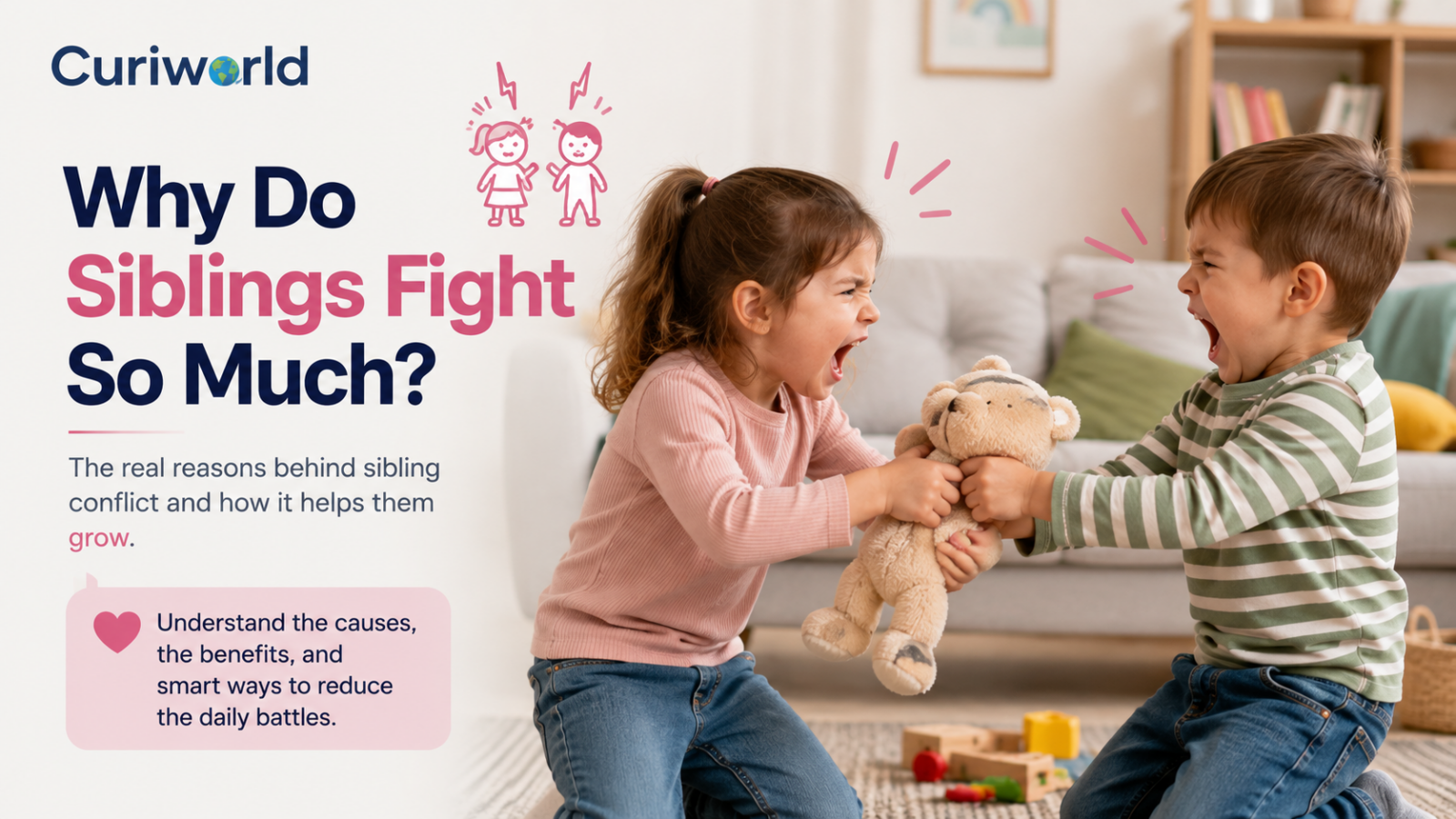
One minute, two siblings are laughing together. Five minutes later, they are arguing over who touched whose toy, who got the bigger piece, who gets to sit where, or who looked at whom “in a weird way.”
For parents, the frequency of these arguments can be exhausting. But sibling conflict does not automatically mean that children dislike each other or that something is wrong with the family.
Siblings occupy an unusual position in a child’s life. They can be playmates, competitors, allies, role models, irritants, confidants, and rivals—sometimes all before breakfast. Because they spend so much time together and often compete for the same spaces, objects, attention, and privileges, disagreement is almost inevitable.
The more useful question is not simply why siblings fight, but what those fights are actually about.
Siblings Share More Than a Home
Most childhood relationships come with natural breaks.
Friends go home. Classmates leave when school ends. Teammates separate after practice.
Siblings often do not.
They may share bedrooms, bathrooms, toys, devices, parents, meals, vacations, routines, and countless everyday decisions. That creates far more opportunities for friction.
A disagreement between friends over a toy might end when the playdate ends. Two siblings can argue about the toy, see each other again at dinner, disagree over the television, and start a completely different argument before bedtime.
This constant proximity matters.
Research on sibling relationships describes brothers and sisters as important participants in one another’s everyday development. Their interactions can be unusually frequent and emotionally intense, giving siblings many opportunities for both cooperation and conflict.
In other words, siblings may fight a lot partly because they interact a lot.
Many Sibling Fights Are Really About Scarce Resources
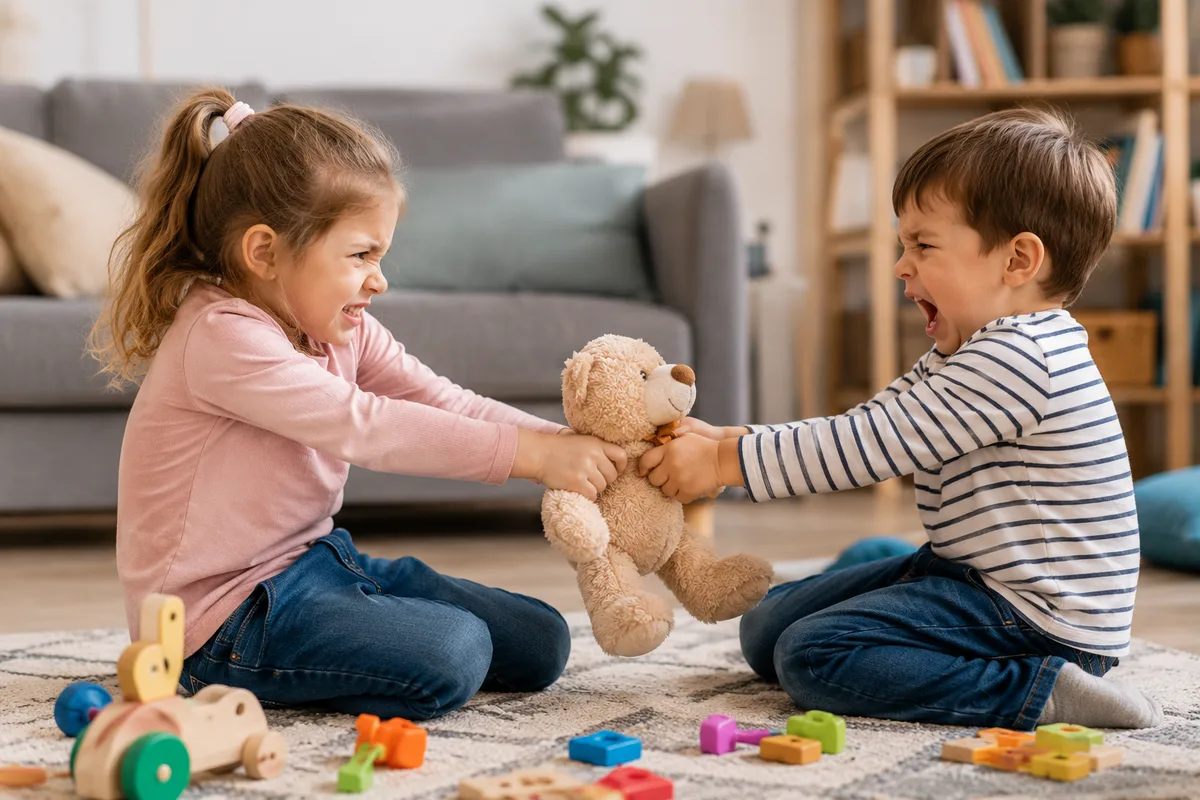
Children do not need to understand economics to recognize scarcity.
There is one favorite toy. One front seat. One last cookie. One parent currently available to help. One television. One bathroom when everyone needs to leave.
Even things that appear unlimited to adults can feel limited to children. Parental attention is a good example.
A child may not say, “I am worried that my sibling is getting more parental attention than I am.” Instead, the feeling may appear as:
“Why does she get to sit next to you?”
“You always help him first!”
“That’s not fair!”
The visible argument may be about a chair or a snack. The emotional issue underneath it may be attention, status, control, or fairness.
“Fair” Does Not Always Mean “Exactly the Same”
Sibling comparisons can make parenting surprisingly complicated.
One child gets a later bedtime because they are older. Another receives more help with homework because they need it. A younger child may have fewer chores. An older child may have more freedom.
From an adult perspective, these differences may be reasonable. From a child’s perspective, they can look like evidence that someone else is getting a better deal.
Research on sibling relationships has found that children’s perceptions of differential parental treatment can be connected with sibling relationship quality and adjustment.
This does not mean parents need to treat every child identically.
Children of different ages, personalities, abilities, and needs often require different things. A more realistic goal is understandable fairness: helping children see why a particular rule or decision may differ rather than expecting every sibling to receive precisely the same treatment.
Age Differences Can Create Built-In Conflict
Imagine a four-year-old and a nine-year-old sharing a play space.
The younger child sees an elaborate block structure and thinks, “That looks fun.”
The older child sees an hour of careful work.
One reaches toward it. The other panics.
Neither child necessarily intended to create a conflict. They simply understood the situation differently.
Developmental differences influence impulse control, perspective-taking, communication, patience, privacy expectations, and the ability to negotiate.
A toddler may grab. A preschooler may insist something is “mine.” A school-age child may argue about rules. A teenager may become furious because a younger sibling entered their room without permission.
The subject changes as children grow, but the basic tension often remains: two people with different needs must occupy the same family environment.
The American Academy of Pediatrics notes that temperament, developmental stage, and differences between children can all affect sibling relationships and conflict.
Siblings Know Exactly How to Annoy Each Other
There is another reason sibling arguments can escalate so quickly: familiarity.
Siblings often know one another extremely well.
They know which toy matters most. Which nickname is irritating. Which subject causes embarrassment. Which sound is unbearable. Which boundary gets the fastest reaction.
That knowledge can create closeness, but it also gives siblings an impressive collection of emotional buttons to push.
A conflict between unfamiliar children may require time to develop. Siblings already know the shortcut.
This is also why an argument that seems absurdly small to a parent may feel much larger to the children involved. The fight may include a history that began long before the current disagreement.
“Stop touching my stuff” may really mean, “You keep ignoring a boundary I have asked you to respect.”
Children Are Still Learning How to Handle Conflict
Adults sometimes expect children to solve disagreements using abilities they have not fully developed yet.
Good conflict resolution requires several skills at once: recognizing emotions, controlling impulses, understanding another person’s perspective, explaining what you want, listening, tolerating disappointment, negotiating, accepting compromise, and knowing when to walk away.
Those abilities develop gradually.
Sibling relationships provide an unusually frequent place to practice them.
Arguments can therefore have two very different outcomes. Repeated hostile or aggressive conflict can be harmful, but ordinary disagreements can also become opportunities to learn negotiation, perspective-taking, problem-solving, and repair.
That is one reason the goal does not have to be a household in which siblings never disagree.
A better goal is helping children learn what to do when disagreement happens.
The development of language and reasoning also changes how children argue. The same growing curiosity behind a child’s seemingly endless “why?” questions eventually gives children increasingly sophisticated ways to explain what they want, challenge rules, negotiate, and defend their point of view.
Sometimes that produces a thoughtful conversation.
Sometimes it produces a fifteen-minute courtroom argument about whose turn it was.
Stress Can Turn Tiny Problems Into Big Fights
Not every sibling fight is really about the sibling.
Children may be more reactive when they are tired, hungry, overstimulated, bored, rushed, disappointed, or stressed.
A child who peacefully shares on Saturday morning may become intensely territorial after a difficult school day.
That is why patterns matter.
Curiworld has previously explored why kids can behave differently at school and at home. Home and school place different demands on attention, emotion, routines, relationships, and self-control. A child who has spent hours managing classroom expectations may arrive home tired, hungry, or emotionally depleted.
Sibling conflict can easily become the place where that accumulated frustration appears.
If arguments consistently happen immediately after school, just before dinner, during screen transitions, or near bedtime, the trigger may not be mysterious sibling hatred.
The family may simply be reaching the same high-friction moment every day.
Changing the conditions around that moment can sometimes help more than repeatedly lecturing children after the fight has already begun.
Should Parents Stop Every Sibling Argument?
Usually, not every disagreement requires an immediate referee.
If children are safe and the conflict is manageable, giving them some space to negotiate can allow them to practice resolving disagreements themselves.
That does not mean ignoring everything.
Younger children generally need more direct guidance because their self-control and conflict-resolution abilities are still developing. Clear household boundaries are also important regardless of age.
Rules can be simple:
- No hitting.
- No threatening.
- No deliberately damaging another person’s belongings.
- Respect agreed privacy and personal space.
- Stop when someone is being hurt or frightened.
The American Academy of Pediatrics encourages parents to give children opportunities to work through ordinary disagreements while stepping in when necessary, particularly when physical or emotional well-being is at risk.
Parents can then act less like judges deciding who is the “bad child” and more like coaches helping both children describe what happened and find a workable solution.
Avoid Turning Every Conflict Into a Competition
Some well-intended responses can accidentally intensify rivalry.
“Why can’t you be patient like your sister?”
“Your brother never complains about this.”
“She always finishes her chores before you.”
Comparisons may seem motivating, but they also give siblings another reason to measure themselves against each other.
It is usually more useful to address the behavior itself.
Instead of saying, “Your brother shares better than you,” try, “He was using that. Ask before taking it.”
Instead of, “Why are you always the one starting fights?” try, “I want to understand what happened before the yelling started.”
The difference is small in wording but large in meaning. One response creates a sibling ranking. The other focuses on a specific behavior that can change.
Give Children Some Territory of Their Own
Sharing is an important skill.
So is having boundaries.
Children do not necessarily need to share every possession, every activity, or every minute of their time simply because they are siblings.
A few clearly personal belongings can reduce repeated battles. Older children may need privacy. Younger children may need help understanding that a sibling’s ongoing project should not automatically become communal property.
One-on-one time with parents can help for similar reasons.
Children who regularly receive individual attention may feel less pressure to compete for every available moment of it. The American Academy of Pediatrics also recommends making space for individual time with each child alongside activities the family does together.
It does not have to involve elaborate outings.
A bedtime conversation, a short walk, cooking together, reading together, or running an errand can create a small period in which a child is not competing with siblings for attention.
When Sibling Fighting Is More Than Ordinary Rivalry
Frequent arguments are common, but “siblings fight” should never become an excuse to dismiss behavior that is genuinely harmful.
Pay closer attention when conflict repeatedly involves physical injury, threats, fear, humiliation, deliberate cruelty, destruction of belongings, one child consistently dominating another, or a child actively avoiding situations because of a sibling.
A large power difference also matters.
Conflict between children who can defend themselves and negotiate relatively equally is different from repeated aggression in which one child is consistently unable to protect themselves.
When sibling conflict is severe, persistent, frightening, or affecting a child’s everyday well-being, discussing the situation with a pediatrician or qualified child or family mental-health professional may be appropriate.
Fighting and Loving Each Other Can Coexist
Sibling relationships are rarely simple.
The child screaming “I never want to play with you again!” may be building a blanket fort with the same sibling an hour later.
That contradiction is not necessarily strange.
Siblings can experience affection, jealousy, admiration, irritation, loyalty, competition, and closeness within the same relationship. Conflict does not erase attachment, and closeness does not eliminate conflict.
The important question is therefore not whether siblings ever fight.
It is what happens around the fighting.
Do they gradually learn to negotiate? Can they repair the relationship afterward? Are boundaries respected? Does each child feel safe? Can parents guide disagreements without constantly turning them into competitions?
A completely conflict-free childhood may be unrealistic. A home where children slowly become better at handling conflict is a much more useful goal.
Sibling fights may begin over toys, snacks, attention, privacy, or whose turn it is. Beneath those everyday battles, children are also learning something larger: how to live with another person who has their own needs, feelings, boundaries, and opinions.
That lesson extends far beyond the bedroom they currently have to share.
Sources
1. American Academy of Pediatrics — Sibling Relationships: How to Help Your Kids Build Healthy Bonds
https://www.healthychildren.org/English/family-life/family-dynamics/Pages/Sibling-Synergy.aspx
2. McHale, S. M., Updegraff, K. A., & Whiteman, S. D. — Sibling Relationships and Influences in Childhood and Adolescence — Journal of Marriage and Family
https://pubmed.ncbi.nlm.nih.gov/24653527/








Join the discussion