Why Do Babies Rub Their Eyes When They’re Tired?
Eye rubbing is a common tired sign in babies, especially alongside yawning, heavy eyelids and reduced interest in play. Persistent rubbing with redness or discharge can mean something different.
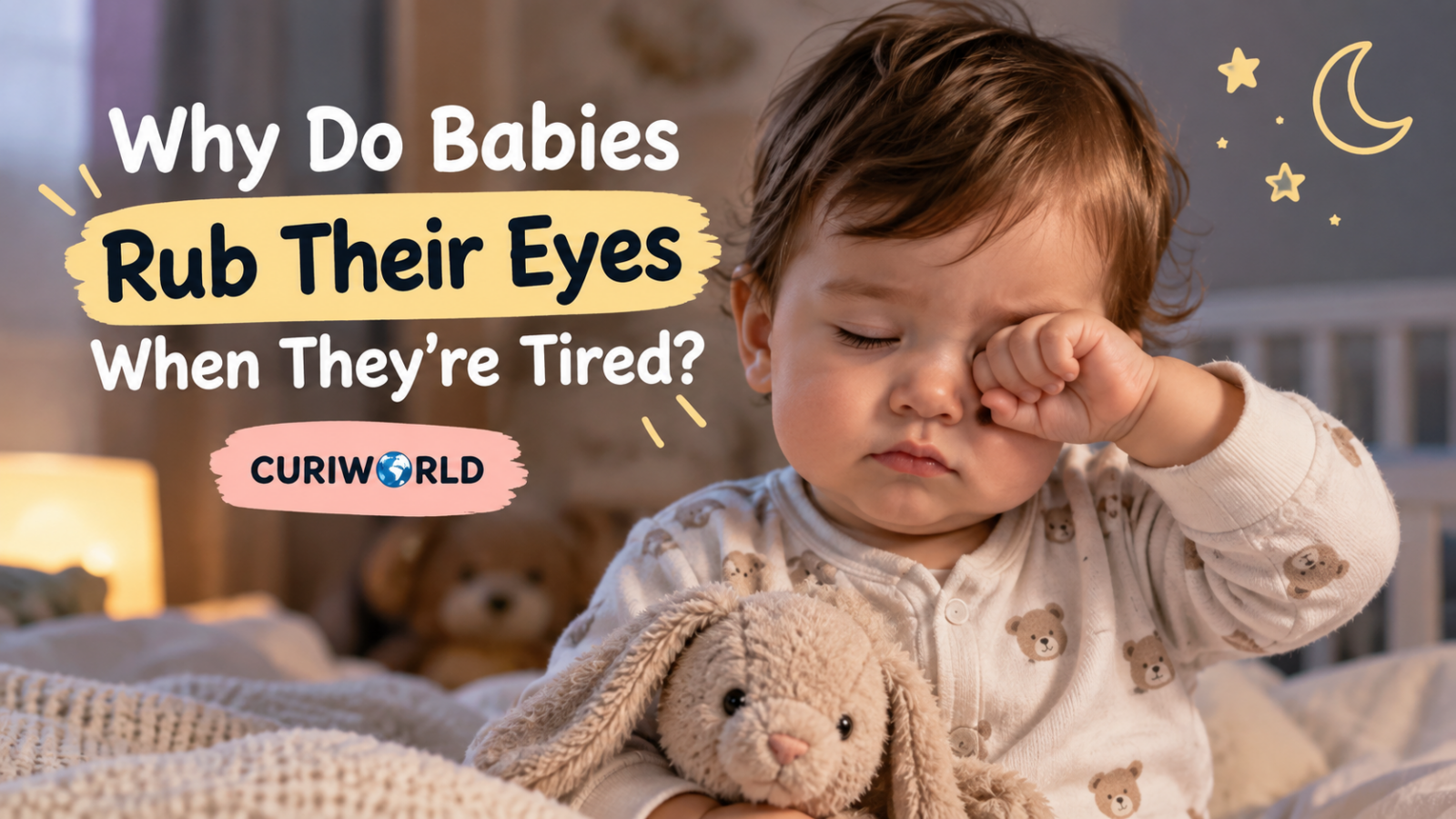
A baby who was happily looking around ten minutes ago suddenly starts rubbing both eyes, turning away, and getting fussy.
Parents quickly learn what often comes next: sleep.
Eye rubbing is a common tired sign in babies, especially when it appears alongside yawning, heavy eyelids, reduced interest in play, fussiness, or looking away. What is less certain is the exact biological reason babies rub their eyes when tired. Pediatric guidance recognizes the behavior as a sleep cue, but there is no good evidence for one simple explanation that applies to every baby.
The most useful question is therefore not “What secret mechanism does eye rubbing activate?” but “What else is happening when my baby rubs their eyes?”
Eye Rubbing Is One of Several Baby Tired Signs
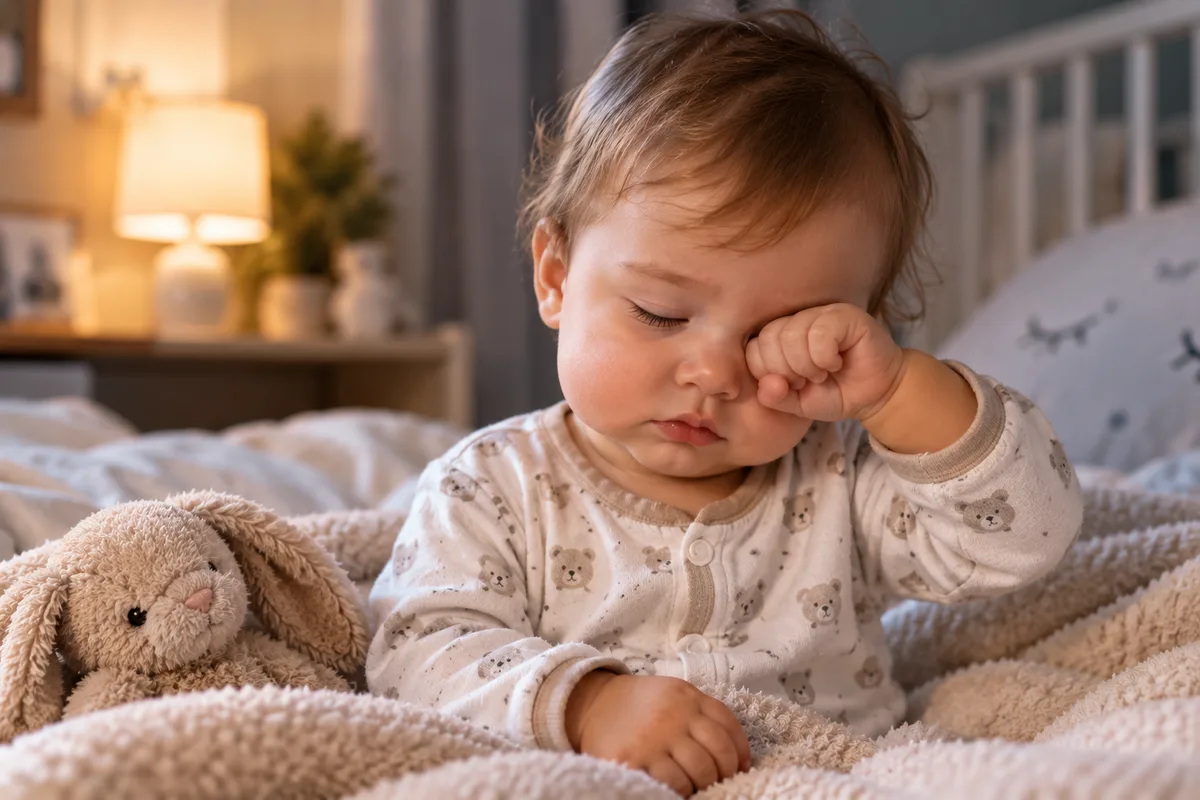
Babies rarely announce that they are sleepy with one perfectly reliable signal.
Instead, tiredness tends to appear as a pattern of changing behavior.
Depending on age and temperament, a tired baby might:
- rub their eyes,
- yawn,
- develop heavy or fluttering eyelids,
- stare into space,
- lose interest in toys or faces,
- turn their head away,
- become quieter,
- fuss,
- or make increasingly jerky movements.
The NHS describes drowsy babies as having glazed or heavy-lidded eyes and fewer body movements. Raising Children Network specifically includes eye rubbing among tired signs in babies.
That means eye rubbing can be useful information—but it should be read together with the rest of the baby’s behavior.
Why Do Tired Babies Rub Their Eyes?
The safest answer is: we know it is associated with tiredness, but the exact reason is not fully established.
It is tempting to create a neat explanation.
You may see claims that rubbing automatically lubricates tired eyes, that it switches off visual stimulation, or that pressure around the eyes directly makes babies sleepy.
Those explanations sound plausible, but they go further than the evidence supports.
What we can say more confidently is that tiredness changes how babies interact with the world.
As sleep pressure increases, babies often become less interested in stimulation. Their eyelids become heavier, visual attention changes, and they may start using repetitive movements while settling.
Eye rubbing happens within that larger behavioral transition.
For some babies, it may also become a familiar self-soothing action through repetition: tiredness arrives, the hands move toward the face, and the behavior becomes part of the baby’s usual pre-sleep pattern.
That does not mean every baby will do it.
Some Babies Barely Rub Their Eyes at All
Parents sometimes worry when their baby does not show the same “sleep cues” described online.
There is no requirement that every tired baby rub their eyes.
One baby may yawn repeatedly.
Another becomes unusually quiet.
Another starts looking away from faces.
Another becomes vocal and irritable before showing any obvious sleepy behavior.
Sleep cues also change as babies grow.
That is why learning your own baby’s pattern is usually more useful than relying on a universal checklist.
Eye Rubbing Can Be an Early Cue—or a Late One
Timing matters.
A baby who rubs their eyes once and then remains cheerful and alert may not be ready for sleep at all.
But if eye rubbing appears after a period of wakefulness together with yawning, disengagement, or drooping eyelids, it becomes a much stronger clue.
Some babies become increasingly fussy if tiredness progresses.
Raising Children Network notes that overtired babies can become harder to settle, which is one reason caregivers are often encouraged to notice earlier changes in behavior rather than waiting for intense crying.
This does not mean you have to rush a baby to bed after the first eye rub.
It means the eye rub can be one piece of a larger pattern.
Does Eye Rubbing Mean the Baby Is Overtired?
Not necessarily.
This is another place where parenting advice often becomes too rigid.
Eye rubbing does not automatically mean a baby has already become overtired.
It may simply be a tired cue.
To judge the situation, look at what follows.
If your baby is rubbing their eyes but remains calm, responsive, and easy to settle, there is little reason to interpret the behavior as evidence that something has already gone wrong.
If rubbing is accompanied by escalating crying, arching, frantic movements, or difficulty settling after a long period awake, tiredness may have progressed further.
The behavior makes more sense in context than on a stopwatch.
Why Does My Baby Rub Their Eyes While Feeding?
Sometimes the timing overlaps.
A feed may happen close to a nap or bedtime, so a baby who becomes sleepy while nursing or bottle-feeding may start touching or rubbing the face and eyes.
That does not automatically mean feeding is irritating the eyes.
Again, look for the surrounding pattern.
A relaxed baby who is slowing down, developing heavy eyelids, and rubbing both eyes near the end of a feed may simply be getting sleepy.
A baby who suddenly rubs one eye repeatedly while the eye becomes red or watery deserves a different interpretation.
When Eye Rubbing Might Not Be About Sleep
Not every eye rub is a sleep cue.
Babies can touch their eyes because something feels uncomfortable.
Possible sources of irritation can include a loose eyelash, dry or irritated skin around the eye, tears, environmental irritants, or another eye problem.
The difference is often in the pattern.
Sleep-related rubbing is more likely to appear around naps or bedtime and alongside other tired behaviors.
Irritation-related rubbing may happen repeatedly while the baby is otherwise alert and may occur with visible eye symptoms.
Pay more attention if you also notice:
- persistent redness,
- swelling,
- significant watering,
- sticky or unusual discharge,
- one eye being rubbed much more than the other,
- apparent sensitivity to light,
- difficulty opening the eye,
- or obvious discomfort.
A baby cannot explain that an eye feels scratchy or painful, so persistent rubbing plus visible eye changes deserves more attention than ordinary bedtime rubbing.
What About Watery or Sticky Eyes?
Young babies can develop watery or sticky eyes for reasons unrelated to tiredness.
For example, tear drainage is still developing in infancy, and some babies have a blocked tear duct that causes tears or mucus to collect.
That does not mean every watery eye is a blocked duct, and parents should not diagnose the cause from appearance alone.
The practical distinction is simpler:
Eye rubbing that predictably appears with sleepiness is usually a behavioral cue. Eye rubbing that appears throughout the day with persistent redness, swelling, discharge, or discomfort should be discussed with a healthcare professional.
Should You Stop a Baby From Rubbing Their Eyes?
Occasional gentle eye rubbing before sleep usually does not need to be treated as a problem.
You can redirect the hands gently if rubbing becomes vigorous, especially if the baby’s nails are sharp enough to scratch the skin.
Keeping fingernails trimmed can reduce accidental scratches around the face.
Avoid putting eye drops, herbal preparations, or home remedies into a baby’s eyes unless they have been recommended for that child by a qualified healthcare professional.
If something seems to be irritating the eye, the goal should be finding the cause rather than simply stopping the hand movement.
Eye Rubbing Is More Useful as a Pattern Than a Rule
The same principle applies to many baby behaviors.
Babies are constantly adjusting to light, movement, sound, fatigue, hunger, and stimulation. Their developing sensory systems can make ordinary things surprisingly compelling—one reason babies can become fascinated by ceiling fans, lights, and moving shadows.
Sleep cues work the same way: they are behaviors to interpret, not rigid commands.
If your baby usually rubs their eyes, turns away, and becomes quiet before a nap, you may eventually recognize that combination almost instantly.
Another baby may have an entirely different pattern.
The goal is not to teach every parent one universal “correct” signal.
It is to notice what tiredness consistently looks like in your baby.
When Should You Ask a Doctor About Frequent Eye Rubbing?
Ordinary eye rubbing around sleep time is common.
Consider discussing it with your pediatrician or another appropriate healthcare professional if the rubbing is persistent when your baby is fully awake or if it comes with significant eye redness, swelling, discharge, apparent pain, injury, or unusual sensitivity to light.
Seek prompt medical advice if an eye injury or chemical exposure is suspected.
The important point is not how many times a baby touches their eyes.
It is whether the behavior fits an ordinary sleepy pattern or appears together with signs that the eye itself may be uncomfortable.
The Bottom Line
Babies often rub their eyes when tired, and the behavior is widely recognized as a normal sleep cue.
But it is not a perfect sleep detector, and science does not support reducing it to one simple biological trick.
Watch the whole baby.
Eye rubbing plus yawning, heavy eyelids, reduced engagement, and the usual timing before sleep strongly suggests tiredness.
Eye rubbing that is persistent, one-sided, or accompanied by redness, swelling, discharge, or obvious discomfort deserves a closer look.
That distinction is more useful than trying to decode every eye rub on its own.
Sources
NHS — Understanding Your Baby
Raising Children Network — Baby Cues: How to Know What Babies Want







Join the discussion