Why Do Toddlers Say “No” to Everything?
Why do toddlers say “no” to almost everything? Discover how independence, emotions, language development and the need for control shape this common toddler phase.
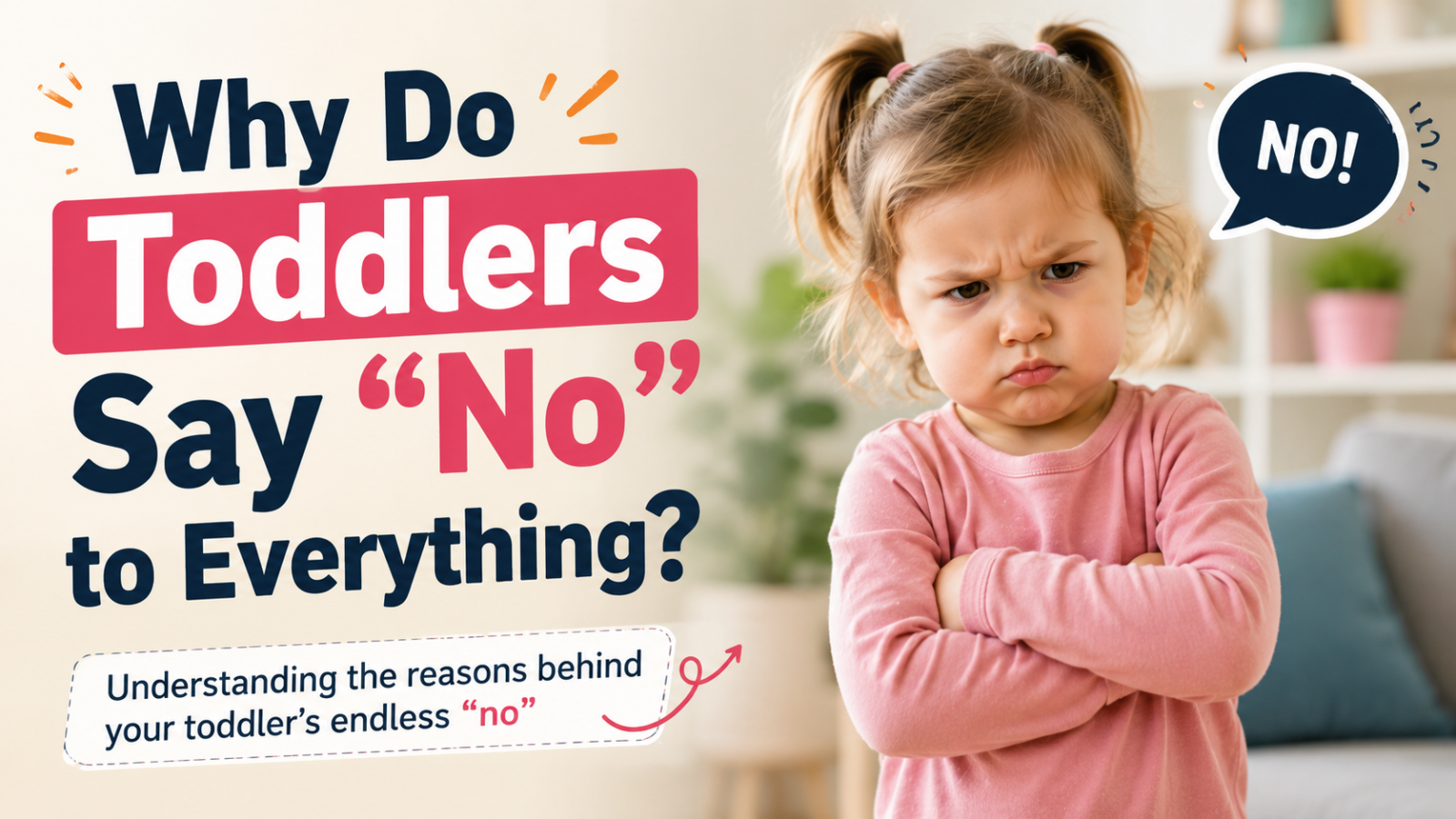
You ask your toddler to put on shoes.
“No.”
Would you like the blue cup?
“No.”
Do you want to go outside?
“No.”
Would you like the snack they were asking for thirty seconds ago?
Somehow, the answer is still “no.”
For many toddlers, this sudden enthusiasm for refusal is not simply bad behavior. Saying “no” is one of the easiest and most powerful ways a young child can express something they are only beginning to discover: I am a separate person, and I can have an opinion about what happens to me.
That does not make the tenth refusal of the morning any less exhausting. But understanding what is happening underneath the word can make toddler resistance much easier to respond to.
“No” Is One of a Toddler’s First Tools for Independence

During toddlerhood, children become increasingly aware that they are separate from the adults caring for them.
They can walk toward something they want. They can move away from something they dislike. They can choose a toy, demand a particular cup, try to dress themselves and protest when someone interrupts their plan.
Their independence is expanding quickly.
Their ability to manage that independence is not.
The American Academy of Pediatrics notes that two-year-olds commonly test limits while still developing control over their actions, impulses and emotions. ZERO TO THREE similarly describes the period beginning around 18 months as one in which children increasingly recognize that they have thoughts and feelings of their own.
“No” fits perfectly into that developmental moment.
It is short.
It is easy to remember.
It gets an immediate reaction.
And most importantly, it gives the toddler a way to influence what happens next.
A child who cannot explain, “I understand that we need to leave the playground, but I am enjoying myself and strongly object to this transition” has a much more efficient option:
“No!”
A Toddler’s “No” Does Not Always Mean the Same Thing
Adults tend to hear refusal as a simple message: I will not do what you asked.
For toddlers, the meaning can be much broader.
“No” might mean:
- I want to do it myself.
- I do not want to stop what I am doing.
- I want to make the decision.
- I need more time.
- I do not like this change.
- I am frustrated.
- I do not understand what is happening next.
- I want to see whether this rule is really a rule.
- I know this word gets a reaction.
That distinction matters.
A toddler refusing shoes because they want to put them on independently is dealing with a different problem from a toddler refusing shoes because leaving the house means ending an enjoyable activity.
The spoken answer may be identical.
The reason behind it is not.
Why Does the “No” Phase Seem So Intense?
Toddler development creates an unusual combination.
Children become capable of wanting more control before they become consistently capable of handling frustration, waiting patiently, shifting plans or regulating strong emotions.
Imagine gaining a dramatic amount of independence without yet having the emotional tools to manage disappointment.
That is everyday toddlerhood.
A two-year-old may know exactly which shirt they want but struggle when it is in the laundry.
They may insist on pouring their own drink but become furious when the cup is too heavy.
They may happily play at the park but have little ability to accept that playtime has ended simply because an adult says so.
These are not necessarily calculated attempts to create conflict.
Often, the child has a real preference and a very limited set of tools for coping when reality does not match it.
Sometimes “No” Is Really About a Transition
Think about when refusals happen most often.
Getting dressed.
Leaving the playground.
Going into the car seat.
Ending screen time.
Taking a bath.
Cleaning up toys.
Going to bed.
Many classic toddler battles involve moving from one activity to another.
Transitions remove control.
The toddler is doing one thing, and someone else announces that it is time to do something different.
For adults, this may seem ordinary. For a young child absorbed in the present moment, it can feel abrupt.
Simple warnings can help make the change more predictable.
Instead of suddenly announcing, “We’re leaving now,” a parent might say:
“Two more turns on the slide, then we’re going home.”
The limit has not changed. The child simply has more information about what is coming.
Give Choices Where Choices Actually Exist
One of the most useful responses to constant refusal is surprisingly simple: give the toddler some control without handing over control of the entire situation.
For example:
“Do you want the red pajamas or the blue pajamas?”
“Would you like to walk to the bathroom or should I carry you?”
“Do you want to put your shoes on first or your coat?”
Each option leads toward the necessary outcome, but the child gets to make a meaningful decision.
There is an important catch.
Do not present something as a choice when it is not one.
“Time for bed, okay?”
sounds polite to an adult.
To a toddler, it may sound like a genuine yes-or-no question.
If bedtime is not optional, clearer language can prevent an unnecessary argument:
“It’s bedtime. Would you like to choose the first book?”
The boundary belongs to the adult.
The choice inside the boundary belongs to the child.
That small distinction can make everyday routines much smoother.
Acknowledge the Feeling Without Removing Every Limit
Parents sometimes worry that recognizing a toddler’s frustration means giving in.
It does not.
You can understand the feeling and still keep the boundary.
“I know you want to stay at the playground. You’re having fun. It’s time to go home now.”
Both parts can be true.
The toddler is disappointed.
The family is still leaving.
This approach also gives children words for emotions they cannot yet describe very well themselves.
Over time, “NO!” can gradually become something more specific:
“I want another turn.”
“I’m mad.”
“I don’t want to go.”
Language does not eliminate frustration, but it gives children more ways to communicate it.
As children become more verbal, their communication changes in other interesting ways too. Curiworld has explored the next famous phase in what’s behind a child’s endless “Why?” phase.
Avoid Turning Every Refusal Into a Power Struggle
Not every preference needs to become a test of authority.
Sometimes the yellow spoon really is just as good as the green spoon.
Sometimes wearing the dinosaur shirt instead of the striped shirt changes absolutely nothing.
Before enforcing a limit, it can help to ask:
Does this actually matter?
Safety matters.
Health-related routines can matter.
Leaving the house when the family needs to leave matters.
Whether toast is cut into triangles or squares probably does not.
Saving firm boundaries for situations where boundaries genuinely matter gives toddlers more harmless opportunities to exercise independence.
It also reduces the number of battles everyone has to fight.
Keep Instructions Short
Adults often respond to resistance by explaining more.
Toddlers do not necessarily benefit from a longer argument.
A frustrated child may have even less capacity than usual to follow a detailed explanation.
Instead of:
“We already talked about this, and you know that if we don’t leave right now we’re going to be late, and Mommy already told you that…”
try:
“It’s time to go. Do you want to carry the bear or the truck?”
Clear.
Predictable.
Limited choice.
No debate disguised as a lecture.
Why Is My Toddler Worse With Me Than With Other People?
A parent may hear something particularly confusing from a babysitter, grandparent or caregiver:
“They were perfect all day.”
Then the parent arrives and the refusals begin.
The American Academy of Pediatrics notes that toddlers can behave differently with caregivers and may test limits more readily with parents.
More broadly, behavior is highly sensitive to context. Expectations, routines, relationships, fatigue and the environment can all change how a child behaves.
Curiworld explores this broader pattern in why children can behave differently at school and at home.
That does not mean every difficult behavior at home should be dismissed as normal.
It does mean one setting does not always reveal the entire picture.
Does Saying “No” Mean a Toddler Is Spoiled?
Not by itself.
Frequent refusal is common during a stage when independence is expanding faster than emotional self-control.
Temperament also matters.
Some toddlers adapt relatively easily when plans change. Others respond strongly to transitions, unexpected events or limits.
Parenting still matters, of course. Children benefit from clear, consistent and reasonable boundaries.
But a toddler saying “no” repeatedly is not, on its own, evidence of poor parenting or a difficult personality.
Development can look surprisingly dramatic while it is happening.
When Does the Constant “No” Stop?
There is no birthday when toddlers suddenly retire the word.
For many children, refusal becomes less universal as language, emotional regulation and flexibility improve.
A child who once communicated almost every disagreement with “no” gradually gains alternatives:
“I don’t like it.”
“Can I do it?”
“After this?”
“I want the other one.”
“Why?”
The goal is not to create a child who never disagrees.
Healthy development includes preferences, opinions and growing independence.
The bigger change is that children gradually become better able to communicate what they want, tolerate disappointment and understand which boundaries are negotiable and which are not.
When Is It Worth Asking for Professional Guidance?
Frequent “no” responses by themselves are usually much less informative than the overall pattern of a child’s development and behavior.
It may be worth discussing concerns with a pediatrician or qualified child-development professional if defiant behavior is consistently interfering with everyday functioning, relationships, play, exploration or learning.
The same applies when parents have broader concerns about communication, emotional development or significant changes in behavior.
A professional can look at the whole child rather than interpreting one behavior in isolation.
“No” Is Annoying — but It Is Also a Milestone of Sorts
A toddler who has discovered “no” has discovered something bigger than a word.
They have discovered that they can disagree.
They can prefer one thing over another.
They can try to influence what happens.
They can be a participant rather than simply a passenger in everyday life.
The difficult part is that this new sense of independence arrives long before adult-level patience, reasoning or emotional control.
That gap creates the classic toddler contradiction:
“I want to do everything myself.”
and
“I am furious that doing everything myself is difficult.”
So the next time “no” appears for the fifteenth time before breakfast, it may help to hear the message hiding underneath it.
Sometimes your toddler is not really saying:
“I refuse to cooperate.”
They may simply be practicing a much newer idea:
“I have a say.”
Sources
American Academy of Pediatrics — Emotional Development: 2 Year Olds — HealthyChildren.org
View source
ZERO TO THREE — Coping with Defiance: Birth to Three Years
View source








Join the discussion