When Kids Behave Differently at School and at Home: What’s Going On?
A child can be calm at school and fall apart at home—or do the exact opposite. The difference often reveals how environment shapes behavior.
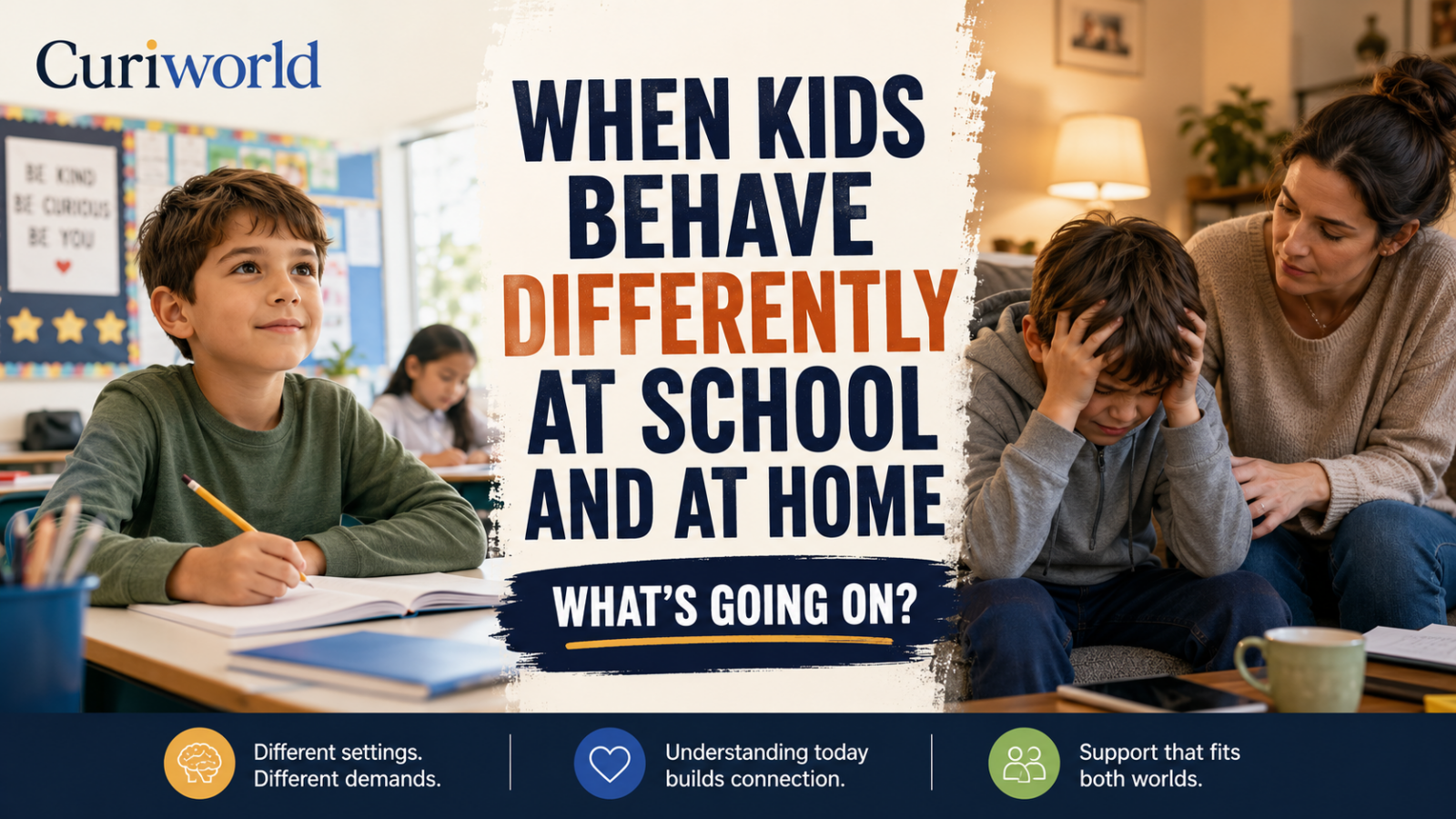
The teacher describes a child who follows directions, waits patiently, finishes assignments, and rarely causes trouble.
Then the same child gets home and falls apart over the wrong snack.
Or the opposite happens: a child who is relaxed and cooperative with family struggles to sit still, follow classroom rules, manage frustration, or get along with classmates at school.
It can leave adults wondering which version is the “real” child.
Usually, that is the wrong question.
Children can genuinely behave differently in different environments. Home and school ask different things of them, provide different amounts of structure and stimulation, involve different relationships, and place different demands on attention, emotion, independence, and self-control.
The difference is information—not automatically evidence that someone is missing the problem, exaggerating it, or doing something wrong.
A Child’s Behavior Is Not Fixed Across Every Setting
Adults change behavior depending on context all the time.
Someone may be quiet during a work meeting and animated with close friends. A person who handles a stressful day calmly in public may become irritable when they finally get home.
Children are also responsive to their surroundings, but their self-regulation skills are still developing.
Research comparing parent and teacher reports confirms that differences between settings are common enough to matter.
One study involving 1,292 children identified several distinct patterns: some showed few conduct difficulties anywhere, some showed more difficulties mainly at home, some mainly at school, and a smaller group showed high levels across both environments.
That does not mean every disagreement between a parent and teacher represents a true behavioral difference. Adults can interpret the same behavior differently too.
But it does demonstrate something important:
“I never see that behavior” does not necessarily mean “that behavior never happens.”
Both the parent and teacher may be accurately describing the child they see.
School Is Usually More Structured Than Home

One major difference is predictability.
Schools often organize children’s days around repeated routines.
Arrival happens at a certain time.
There is a place to sit.
Activities have beginnings and endings.
Adults announce transitions.
Classroom rules tend to be repeated.
Lunch, recess, lessons, and dismissal follow recognizable patterns.
For some children, that structure makes self-regulation easier.
They know what happens next and what is expected of them.
Home can be more flexible.
A child may have several choices, interact differently with siblings and parents, negotiate routines, move between activities more freely, and experience less external structure.
That does not make home poorly managed.
It simply means the behavioral demands are different.
A child who appears highly organized at school may rely more heavily on external routines than anyone realizes.
Remove those routines, and the effort required to organize behavior can become more visible.
Sibling dynamics can add another layer at home; see why brothers and sisters fight so often.
Some Children Hold It Together Until They Get Home
Parents sometimes describe a frustrating pattern:
“The teacher says everything was fine, but the minute we walk through the door, everything explodes.”
Crying.
Arguing.
Irritability.
Refusing simple requests.
Fighting with siblings.
Becoming upset over something that normally seems insignificant.
This is sometimes described online as “after-school restraint collapse.” The phrase is popular and intuitive, but it is not a formal medical or psychological diagnosis.
The underlying idea, however, is reasonable.
A school day can require hours of attention, transitions, social negotiation, following instructions, managing impulses, handling noise, completing work, and adapting to other people’s expectations.
Doing all of that requires effort.
A child who manages successfully during the school day may still arrive home tired, hungry, overstimulated, or emotionally depleted.
Home may also be the place where the child feels safest expressing emotions that were contained earlier.
That does not mean children deliberately save their worst behavior for their parents.
Sometimes they have simply reached the point where the resources they were using to regulate themselves are running low.
Feeling Safe Can Sometimes Look Like Worse Behavior
This idea is easy to misunderstand.
People sometimes say, “Children behave worst with the people they feel safest with.”
That can be true in some situations, but it should not become a universal explanation for every difficult behavior.
A child may express frustration more freely around a trusted caregiver because the relationship feels secure.
But behavior at home can also be influenced by fatigue, sibling conflict, family routines, expectations, hunger, transitions, screen limits, homework, or dozens of other ordinary factors.
“Your child feels safe with you” can therefore be part of an explanation.
It should not automatically end the investigation.
A useful response is curiosity:
What happens before the difficult behavior?
When does it usually begin?
What seems to make it better or worse?
Patterns often reveal more than labels do.
School Can Also Be the Harder Environment
The pattern can run in the opposite direction.
A child may function beautifully at home and struggle substantially at school.
That makes sense when you consider what a classroom demands.
At home, a child may have more one-on-one adult attention, fewer competing voices, familiar routines, access to preferred activities, greater freedom of movement, and fewer social demands.
School introduces an entirely different environment.
A child may need to:
follow group instructions;
ignore distractions;
wait for attention;
work beside other children;
move between tasks on schedule;
cope with mistakes publicly;
remember multi-step instructions;
manage disappointment;
interpret social cues;
and continue working on activities they did not choose.
A difficulty that barely appears at home can become much more visible under those conditions.
For example, trouble sustaining attention may be difficult to notice during an interesting one-on-one activity but obvious during a long classroom task.
Social anxiety may be minimal at home but significant around peers.
Sensory sensitivity may be manageable in a quiet bedroom and much harder in a crowded cafeteria.
The environment can reveal demands that simply do not exist elsewhere.
The Relationship Is Different Too
A teacher and a parent occupy very different roles in a child’s life.
A classroom teacher may be responsible for 20 or 30 children simultaneously.
Instructions often need to apply to the entire group.
Parents usually interact with far fewer children at once and have years of detailed knowledge about their child’s habits, preferences, triggers, and communication style.
Children also have different histories with each adult.
They may negotiate more with parents because negotiation has worked before.
They may comply quickly with a teacher because classroom expectations are highly predictable.
Or they may challenge a teacher while cooperating with a parent because the school relationship feels more difficult.
None of these possibilities means one adult is necessarily more competent than the other.
Relationships are part of the behavioral environment.
Peers Can Change Everything
One element parents rarely get to observe directly is the child’s full peer environment.
Friendships, exclusion, competition, teasing, embarrassment, group status, and social pressure can all influence behavior at school.
A child who seems calm at home may become reactive around certain classmates.
Another may spend significant energy trying to fit in and appear unusually quiet at school.
A third may imitate behavior that is rewarded by peers.
Research into home-school behavior differences has found that context matters and that some difficulties can be much more visible in one setting than another.
That makes questions about peers valuable when school behavior suddenly changes.
Instead of asking only:
“Why won’t my child behave?”
it may be more informative to ask:
“What tends to be happening around my child when this behavior occurs?”
Different Rules Produce Different Behavior
Children learn surprisingly specific patterns.
They may know that jumping on furniture is forbidden at school but tolerated in the playroom.
They may speak differently to a teacher than to a sibling.
They may clean up immediately after an activity in preschool because everyone does it together, yet resist cleaning their bedroom at home.
This is not necessarily hypocrisy or manipulation.
Learning when a behavior is appropriate is part of development.
Children gradually learn that different environments have different expectations.
The challenge appears when the expectations are unclear, inconsistent, beyond the child’s current abilities, or substantially different between settings.
That is why exchanging information between parents and teachers can be more productive than debating whose description is correct.
Parent and Teacher Reports Do Not Have to Match Perfectly
Suppose a parent says:
“My child cannot sit still.”
The teacher replies:
“I don’t see that at all.”
There are several possible explanations.
The child may truly behave differently.
The situations being compared may not be equivalent.
The teacher may be describing structured classroom periods while the parent is thinking about evenings after a long day.
One adult may also interpret a behavior differently from another.
This is one reason child assessments often gather information from multiple settings rather than treating one observer as the definitive source.
The American Academy of Pediatrics notes this explicitly in guidance surrounding ADHD evaluation: information about behavior across different environments matters, and children may not act the same way at home and school.
That does not mean a home-school behavior difference implies ADHD.
Quite the opposite.
It means one setting alone often provides an incomplete picture.
Look for Patterns Before Looking for Labels
When adults notice a strong difference, tracking the pattern can be more useful than immediately searching for a diagnosis.
Consider:
Time: Does the behavior happen first thing in the morning, after lunch, after school, during homework, or near bedtime?
Task: Does it appear during reading, transitions, chores, group work, unstructured play, or difficult assignments?
People: Does it happen with every adult and child or only particular people?
Environment: Is the setting loud, crowded, highly structured, unpredictable, or overstimulating?
Physical needs: Is the child tired, hungry, thirsty, ill, or in need of movement?
Expectations: Is the child being asked to do something developmentally difficult?
Afterward: What usually happens immediately after the behavior?
A short pattern log can sometimes reveal that what seemed random is remarkably predictable.
Perhaps every major argument happens within 20 minutes of arriving home.
Perhaps classroom difficulties occur mainly during independent writing.
Perhaps behavior changes dramatically when a particular peer is present.
Those details give parents and teachers something concrete to work with.
Avoid Turning Home and School Into Opposing Teams
One of the least helpful outcomes is:
“He never does that at home.”
versus:
“Well, he does it constantly here.”
Both statements can be true.
A better conversation compares conditions.
A parent might ask:
“What was happening right before it started?”
“Does it happen during particular subjects or transitions?”
“What seems to help?”
A teacher can ask similar questions about home:
“What does homework look like?”
“How does she respond when plans change?”
“Does this happen on weekends?”
The goal is not to determine which adult has correctly identified the child’s personality.
The goal is to identify the circumstances in which the child succeeds and the circumstances in which something becomes difficult.
Sometimes the most useful clue is not the problem behavior.
It is the environment where the problem doesn’t happen.
If a child can manage a skill in one setting, adults can examine what that environment provides and whether some of those supports can be recreated elsewhere.
When Is the Difference Worth Discussing With a Professional?
Different behavior across settings is not automatically a warning sign.
Children have difficult afternoons, stressful school weeks, friendship problems, developmental phases, and bad days just as adults do.
The question becomes more important when behavior is persistent, intense, worsening, or interfering significantly with everyday life.
It is reasonable to discuss concerns with a pediatrician or qualified child-development or mental-health professional when difficulties substantially affect learning, friendships, family life, sleep, school attendance, safety, or a child’s ability to participate in ordinary activities.
Sudden major behavior changes also deserve attention, particularly when adults cannot identify an obvious explanation.
Professional evaluation should consider the whole picture rather than diagnosing a child from one behavior observed in one place.
Information from both school and home can therefore be extremely valuable.
The Two Versions of Your Child May Both Be Real
A child who behaves differently at school and at home is not necessarily pretending in either place.
Different environments reveal different abilities, stresses, relationships, expectations, and needs.
The quiet student may be using enormous effort to manage a demanding school day.
The relaxed child at home may struggle when faced with noise, peers, group instructions, or sustained academic tasks.
The child who follows classroom routines perfectly may find a less-structured evening unexpectedly difficult.
Instead of asking which behavior represents the child’s “true personality,” look at the difference itself.
What does one environment provide that the other does not?
That question can turn a confusing contradiction into useful information—and give parents and teachers a much better place to start.
Sources
De Los Reyes et al. / Family Life Project — Child Conduct Problems across Home and School Contexts: A Person-Centered Approach
https://pmc.ncbi.nlm.nih.gov/articles/PMC5926240/
American Academy of Pediatrics — Diagnosing ADHD in Children: Guidelines & Information for Parents
https://www.healthychildren.org/English/health-issues/conditions/adhd/Pages/Diagnosing-ADHD-in-Children-Guidelines-Information-for-Parents.aspx








Join the discussion