How Babies Learn to Recognize Familiar Faces and Voices
Babies can become familiar with a parent's voice before birth, then gradually connect faces, sounds, touch and repeated interactions into recognition after birth.
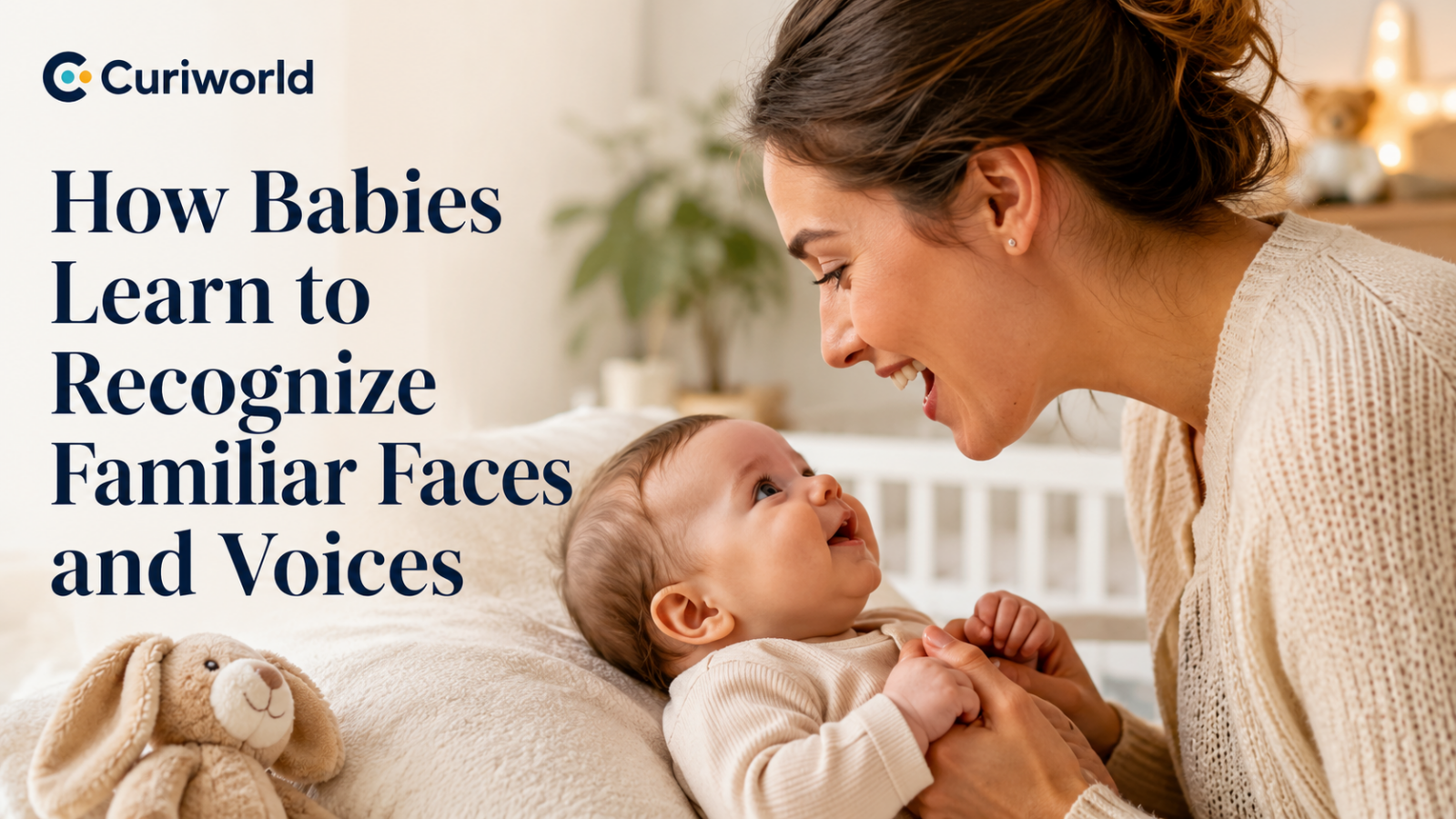
A newborn has only just arrived, yet a familiar voice can already seem to matter.
A few weeks later, the same baby may become noticeably more alert when a parent enters the room, turn toward a familiar voice, or study a caregiver’s face differently from a stranger’s.
This ability does not appear all at once.
Babies gradually learn who people are by combining voice, face, smell, movement, touch, timing, and repeated interaction. And one part of that process may begin even before birth.
A Familiar Voice Can Come First
For a baby’s developing brain, voices have one major advantage over faces:
They can be experienced before birth.
During late pregnancy, sound from outside the womb reaches the fetus in a filtered form. The mother’s voice is especially prominent because it is heard both through the surrounding environment and through vibrations transmitted through her body.
The sound is not as crisp as speech heard after birth. Higher-frequency details are reduced, while rhythm, pitch, and intonation remain more available.
That repeated exposure matters.
Research has long shown that newborns respond differently to their mother’s voice than to unfamiliar female voices. More recent brain-imaging work also shows stronger neural tracking of maternal speech in young infants.
So when a newborn seems calmer or more attentive after hearing a familiar caregiver speak, the reaction may have a surprisingly long history.
The baby has already had months of exposure to some of the sound patterns in that voice.
Faces Have to Be Learned After Birth
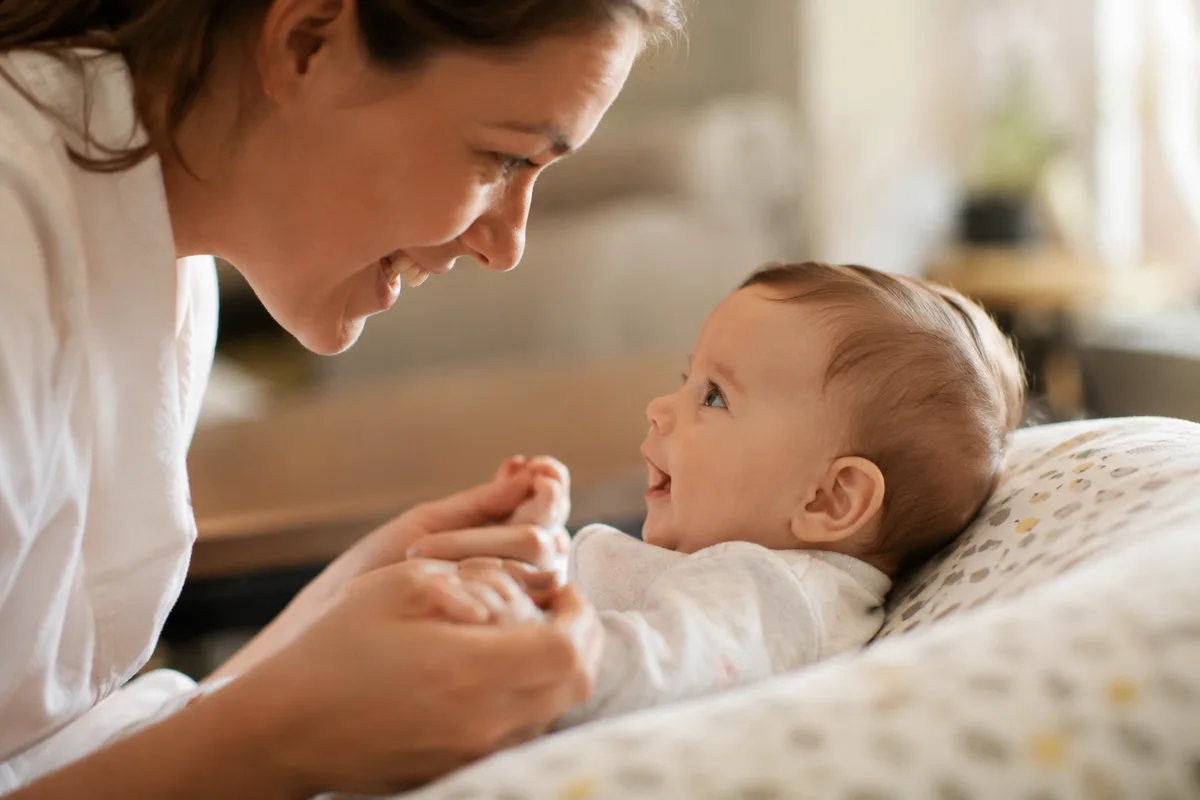
Faces are different.
A fetus cannot see a parent’s face before birth, so visual familiarity has to develop after delivery.
Newborn vision is also still immature. Babies initially see best at relatively close distances, which happens to be roughly where a caregiver’s face often appears during feeding, holding, and talking.
That creates repeated learning opportunities.
The baby repeatedly encounters the same combinations:
A face appears.
A familiar voice speaks.
The person picks the baby up.
Feeding happens.
Warmth, touch, movement, and comfort follow.
Over time, those separate sensations begin to form a more stable representation of a familiar person.
Recognition is therefore not simply a matter of memorizing someone’s photograph.
It develops through repeated, multisensory experience.
Visual attention develops alongside those familiar connections, which is one reason babies can become fascinated by ceiling fans and lights.
Talking May Actually Help Babies Learn Faces
One of the most interesting findings in early face research is that voice and face learning interact.
Experiments with newborns have found that babies can become better at recognizing a face when that person has previously spoken to them.
In other words, hearing someone may help make that person’s face more memorable.
This makes sense from the baby’s perspective.
A silent face is just one visual pattern among many.
A talking face provides synchronized information: mouth movements, eye contact, facial expression, and sound all occur together.
That combination gives the developing brain more clues that these signals belong to the same person.
What Does “Recognize” Mean for a Baby?
It is tempting to imagine recognition as the baby consciously thinking:
“That’s Mom.”
Scientists cannot measure infant recognition that way.
Instead, researchers look for measurable differences in behavior or brain activity.
For example, a baby may:
- look longer at one face than another
- turn toward a familiar voice
- change sucking behavior in response to a voice
- show different heart-rate responses
- display different patterns of brain activity
- become calmer or more attentive
These responses suggest that the infant distinguishes familiar from unfamiliar information.
They do not necessarily mean that a newborn experiences identity in the same rich, conscious way an older child or adult does.
Recognition itself develops.
Babies Learn Through Repetition
Familiarity is built through repeated exposure.
Every ordinary interaction contributes information.
A caregiver says the same kinds of phrases.
Their face appears from familiar angles.
Their voice has a characteristic rhythm.
They hold the baby in particular ways.
Their expressions change while they speak.
None of those experiences needs to be taught deliberately.
Babies are constantly collecting patterns from the people around them.
That is why ordinary daily interaction—feeding, talking, smiling, carrying, changing diapers—provides enormous amounts of learning without requiring special exercises.
Why Do Babies Sometimes Stare at Strangers?
Recognizing familiar people does not mean babies will always look at them the longest.
Sometimes something unfamiliar attracts more attention precisely because it is new.
Developmental researchers use this phenomenon frequently.
A baby may initially prefer something familiar, but in another situation may spend more time looking at a novel face because it contains new information.
So if your baby studies a stranger intensely, it does not mean they have forgotten you.
Attention and recognition are not the same thing.
A familiar caregiver may be easier to identify while an unfamiliar face is temporarily more interesting to inspect.
When Do Babies Start Recognizing Parents?
There is no single day when recognition suddenly switches on.
Different components emerge on different timelines.
At birth: Babies can already respond to familiar auditory information, particularly the maternal voice, because of prenatal exposure.
During the first weeks: Repeated face-to-face interaction provides rapid experience with caregivers’ faces.
By the first few months: Visual focusing, tracking, social attention, and face processing become increasingly sophisticated.
Across the first year: Babies become much better at identifying people across changes in angle, expression, distance, hairstyle, and context.
The process is continuous rather than a single milestone.
And babies do not all show familiarity in exactly the same way.
Why Can Grandma’s Voice Be Familiar Too?
The mother’s voice has a unique prenatal advantage, but babies can quickly learn other familiar voices after birth.
A father, grandparent, sibling, or other caregiver who regularly talks to the baby provides repeated auditory experience.
Eventually, the baby learns characteristic features of that person’s speech.
These include more than the words themselves.
Voices contain identity information in:
- pitch
- rhythm
- accent
- speaking speed
- intonation
- timbre
- pronunciation patterns
Adults recognize familiar people from surprisingly little voice information.
Infants gradually develop their own version of this ability.
Faces and Voices Eventually Become Linked
One of the larger developmental achievements is learning that a particular face and a particular voice belong to the same person.
Imagine hearing your partner speak from another room.
You do not need to see them to know who it is.
When they enter the room, their voice and face immediately belong to one identity in your mind.
Babies have to build those connections.
Repeated social interaction gives them synchronized information over and over again: the same face moves while the same voice speaks.
By several months of age, infants already show impressive abilities to connect certain kinds of voices and faces.
That multisensory learning eventually contributes to the effortless person recognition adults take for granted.
Does a Baby Need Constant Face-to-Face Stimulation?
No.
Babies benefit from responsive human interaction, but parents do not need to turn every waking minute into a developmental exercise.
Ordinary life supplies a huge amount of sensory information.
Talking while changing clothes, making eye contact during feeding, smiling back when the baby looks at you, singing, carrying the baby through the house, and responding to sounds all provide learning opportunities.
A baby also needs time to sleep, look around, move, and quietly process the environment.
Development is not a competition to provide the maximum possible amount of stimulation.
Familiarity Becomes More Than a Face
What begins as repeated sensory information gradually becomes something much richer.
A baby’s earliest recognition of a caregiver may depend on voice, face, smell, touch, and routine appearing together again and again.
With experience, those signals become connected.
The familiar voice can identify someone who is out of sight.
The face can remain recognizable even when the person is silent.
Eventually, a familiar person is no longer just a collection of sensory features.
They become someone the baby knows.
And remarkably, part of that learning can begin before the baby has ever seen a face at all.
Sources
Neural Tracking of the Maternal Voice in the Infant Brain — Journal of Neuroscience / PMC







Join the discussion