Why Do Children Love Hearing the Same Story Again and Again?
Why do children ask for the same story again and again? Familiar stories can help with prediction, participation, word learning, and comforting reading routines.
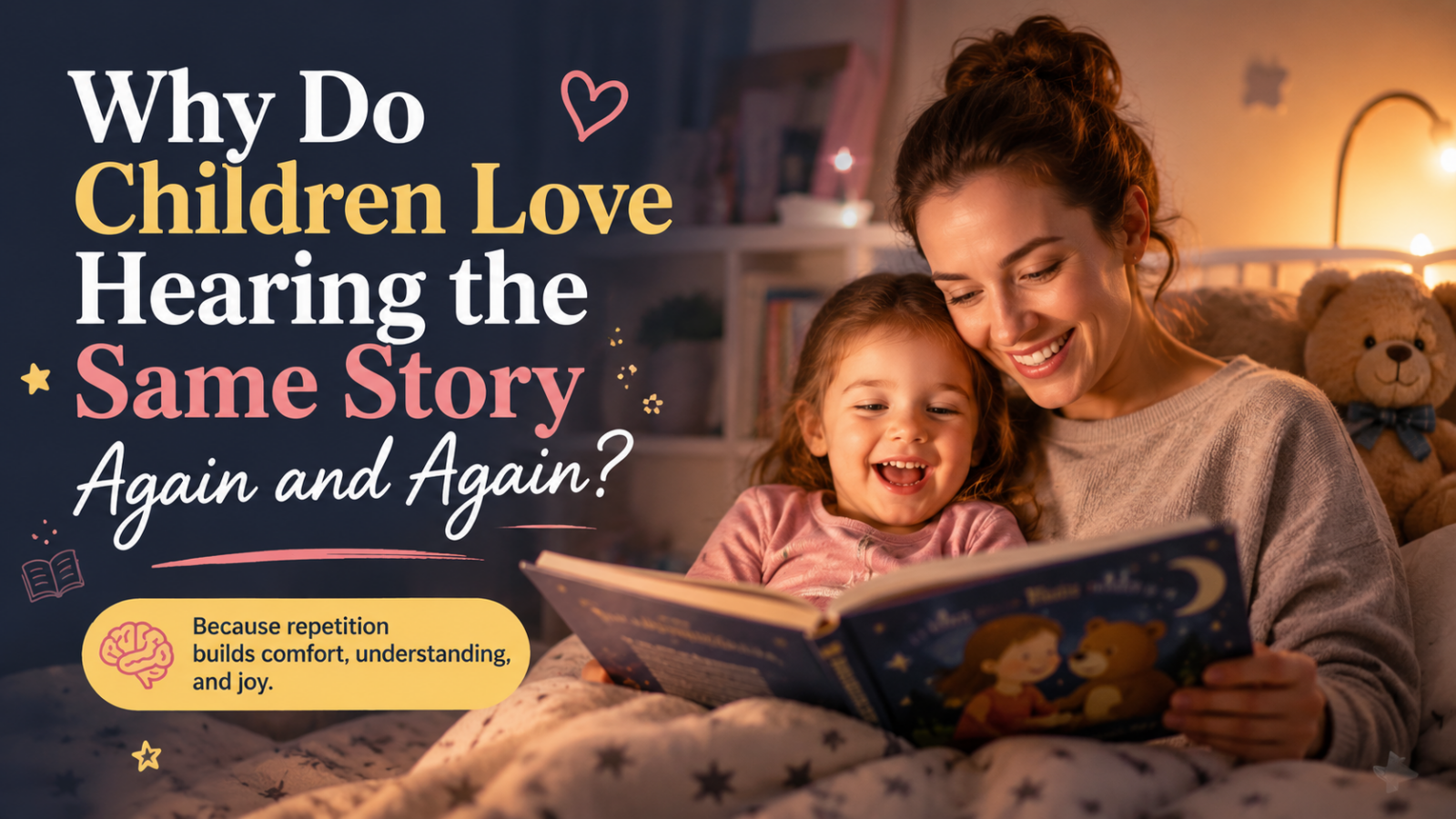
You finish the last page, close the book, and hear the request you already knew was coming:
“Again.”
Perhaps you have read the same story every night for a week. Your child knows where the funny part is, remembers what happens on the next page, and may even correct you if you skip a sentence. To an adult, the mystery is gone. To a young child, that may be exactly why the story is so appealing.
Children often enjoy repeated stories because familiarity changes the experience. A book that was once new becomes predictable enough to participate in, remember, explore, and enjoy in greater detail. Repetition can also help young children learn new words and turn shared reading into a comforting routine with a parent or caregiver.
So the twentieth reading is not necessarily the same experience as the first.
Knowing What Happens Next Can Be Part of the Fun
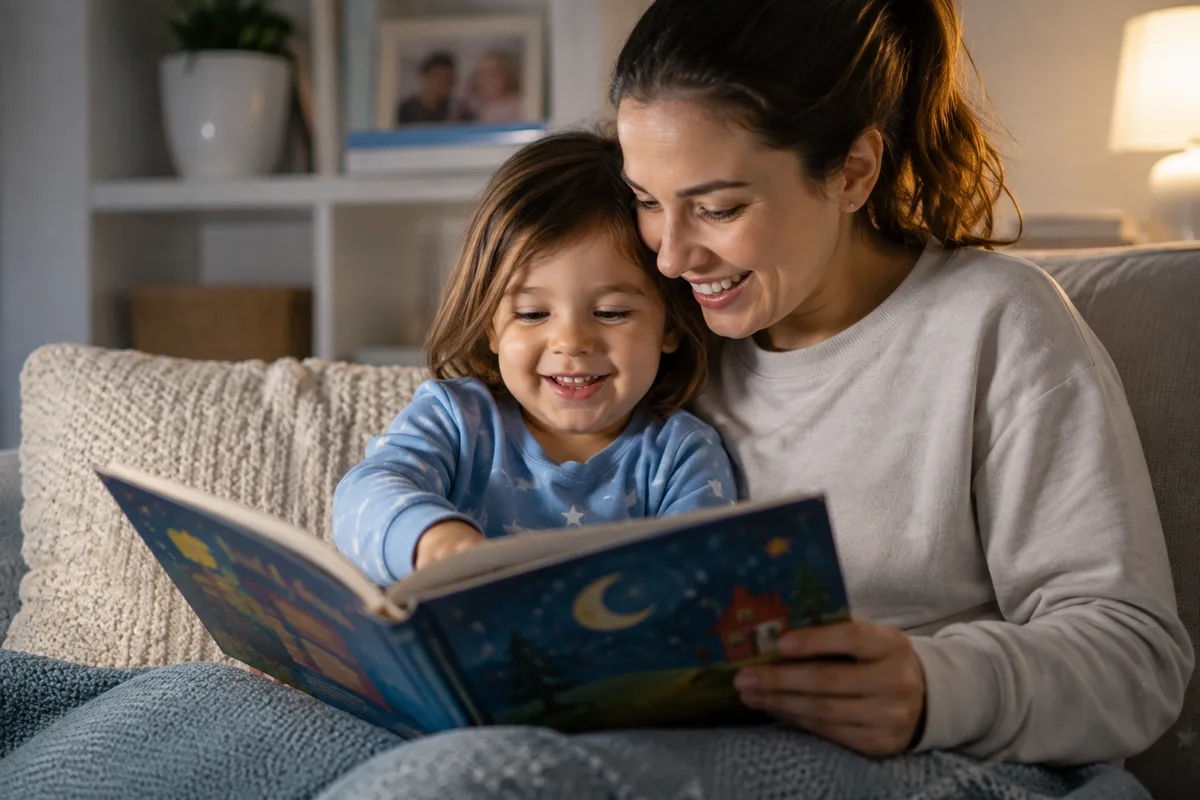
Adults often associate entertainment with novelty. We want a new movie, a different episode, or a book whose ending we do not already know.
Young children do not always experience stories that way.
Once a story becomes familiar, a child can anticipate what is coming. They know which character will appear, which page contains the surprise, and which phrase comes before the funny sound.
That predictability does not automatically make the story boring. It can make the child more involved.
Instead of spending all their attention trying to understand what is happening, they can begin anticipating it.
The wolf is about to appear.
The bear is going to fall.
The character is about to say that familiar line.
For a preschooler, successfully predicting the next moment can be satisfying. The child is no longer simply receiving the story. They know the story.
Research into repeated storybook reading offers an interesting clue here. Familiar story contexts may help children anticipate what comes next and direct more attention toward words, pictures, and details. In one experiment involving 3-year-old children, those who repeatedly heard the same stories learned and retained new word-object associations better than children who encountered the same new words across different stories.
Familiarity, in other words, can create room for learning.
The Second Reading Is Not Really the Same as the First
Think about the first time you watch a complicated movie.
Much of your attention goes toward answering basic questions:
Who is this person?
What is happening?
Why did they go there?
What is the problem?
Watch the movie again and your attention changes. You notice a small expression, a background detail, a line that suddenly makes more sense, or a clue you missed completely.
Something similar can happen during repeated story reading.
During an early reading, a child may concentrate mostly on following the basic sequence of events. Once the plot becomes familiar, other details become easier to notice.
A child might suddenly point to a tiny animal hidden in an illustration.
They may ask what an unfamiliar object is.
They may notice that two words rhyme.
They may connect something in the story to an experience from yesterday.
They may start wondering why a character behaved a certain way.
The pages have not changed.
The child’s relationship with those pages has.
This connects with another familiar childhood behavior: repeatedly asking questions while building an understanding of the world. Curiworld explores that process in What’s Behind a Child’s Endless “Why?” Phase?.
In both situations, learning is rarely a one-pass process.
Repetition Can Help New Words Stick
One of the clearest benefits of rereading is language learning.
A child may hear an unfamiliar word during the first reading without fully understanding or remembering it. On the next reading, the word appears in the same sentence, alongside the same illustration and within the same sequence of events.
That stable context can make the word easier to learn.
A study by Jessica Horst, Kelly Parsons, and Natasha Bryan tested this idea with 3-year-old children. The children encountered novel words in specially created storybooks. Some repeatedly heard the same stories, while others heard different stories containing the same target words.
Importantly, the children were exposed to the new words the same number of times.
The difference was the story context.
Children who repeatedly heard the same stories performed better at recalling and retaining the new word-object associations.
That distinction matters. Repetition was doing more than simply increasing the number of times a word was heard. Hearing it again inside a familiar narrative appeared to make learning easier.
It helps explain why the book you could now recite from memory may still contain useful work for your child.
Familiar Stories Let Children Become Participants
There is another transformation that often happens after enough repetitions.
The child begins taking over.
They finish sentences.
They make the sound effect before you do.
They point to the correct picture before you turn the page.
They announce what the character is about to do.
And, sometimes, they become surprisingly strict editors.
Skip a familiar line and you may immediately hear:
“That’s not what it says!”
This is a different kind of reading experience from quietly listening to an unfamiliar book.
The child now has enough memory of the story to participate. Even before being able to read printed words independently, they can retell portions of the narrative, recognize patterns, recall sequences, and connect language with pictures and events.
That sense of mastery can be enjoyable in its own right.
A story that once belonged mostly to the adult reader gradually becomes something the child can help perform.
A Favorite Book Can Also Become a Comforting Routine
Sometimes children are asking for more than the story itself.
They may also be asking for the experience around it.
The same chair.
The same blanket.
The same person reading.
The same funny voice used for one character.
The same ending before the lights go out.
The American Academy of Pediatrics describes shared reading as a positive, language-rich interaction that can support early relationships as well as cognitive, language, literacy, and social-emotional development.
Shared reading can also become part of a predictable family routine, particularly around bedtime.
That does not mean one particular story has a special psychological power.
It means the repeated reading experience can become associated with a familiar period of closeness and attention.
For a child, “Read this one again” may partly mean:
“I know this.”
“I like doing this with you.”
“I know what happens when we do this.”
The book and the routine can become difficult to separate.
Is Reading the Same Book Every Night a Problem?
Usually, there is no need to turn a favorite book into a battle over variety.
Repeated reading and reading widely do different things.
Familiar books provide repetition, prediction, participation, and repeated encounters with language. New books introduce unfamiliar words, characters, ideas, illustrations, situations, and story structures.
Children can benefit from both.
You also do not have to choose between them.
If a child insists on one favorite bedtime story, try adding variety rather than removing the favorite. Read a new book first and finish with the familiar one, or rotate new stories during the day while keeping the bedtime favorite.
A child’s bookshelf does not need to operate like a school syllabus.
Reading together is more valuable when it remains something the child actually wants to do.
How to Make the Tenth Reading More Interesting
You do not need to invent an educational activity every time you open a favorite book. Sometimes enjoying the story together is enough.
But once a child knows the book well, the familiarity creates easy opportunities for interaction.
Pause before a phrase they already know and see whether they finish it.
Ask what they think happens on the next page.
Let them retell a familiar scene in their own words.
Point to an interesting detail in the illustration that you have never discussed.
Ask why a character might be happy, frightened, angry, or surprised.
Connect an event in the book to something the child has experienced.
You can also let the child become the storyteller and “read” the book back to you using pictures and memory.
The goal is not to quiz them after every page.
Too many questions can turn a favorite bedtime story into homework.
The advantage of familiarity is that conversation can emerge naturally because the child no longer has to devote all their attention to discovering the plot.
Why Doesn’t the Child Get Bored?
The simplest answer may be that children and adults are getting different things from the repetition.
The adult already understands the vocabulary, plot, humor, characters, sequence, illustrations, and emotional meaning. After several readings, there may be very little left for the adult to decode.
The child is still developing many of those abilities.
A familiar story can therefore remain interesting long after it feels completely exhausted to the person reading it aloud.
The child may also enjoy the anticipation itself. Knowing where the funny moment happens does not necessarily make it less funny. In fact, waiting for it can become part of the pleasure.
Adults are not entirely different. We rewatch favorite movies, replay songs, revisit familiar places, and reread books even though we already know what happens.
Knowing an experience is not always a reason to abandon it.
Sometimes it is the reason we return.
The Story Stays the Same, but the Child Does Not
A beloved children’s book may contain only a few hundred words, yet the experience surrounding those words can change every time it is read.
First, the child discovers the story.
Then they recognize it.
Then they predict it.
Then they remember parts of it.
Then they notice details.
Then they begin telling parts of it themselves.
That is why “Again!” does not necessarily mean a child needs more entertainment.
Sometimes it means the story has become familiar enough for the child to do more with it.
So if you are opening the same dog-eared book for what feels like the hundredth time, remember: the pages may be repeating themselves.
Your child probably is not.





Join the discussion