Carry-On Liquids Rules Explained: What Actually Counts as a Liquid?
Airport liquid rules cover more than drinks. Gels, creams, pastes, sprays and many spreadable foods can count as liquids, so knowing what security considers a liquid can prevent surprises at the checkpoint.
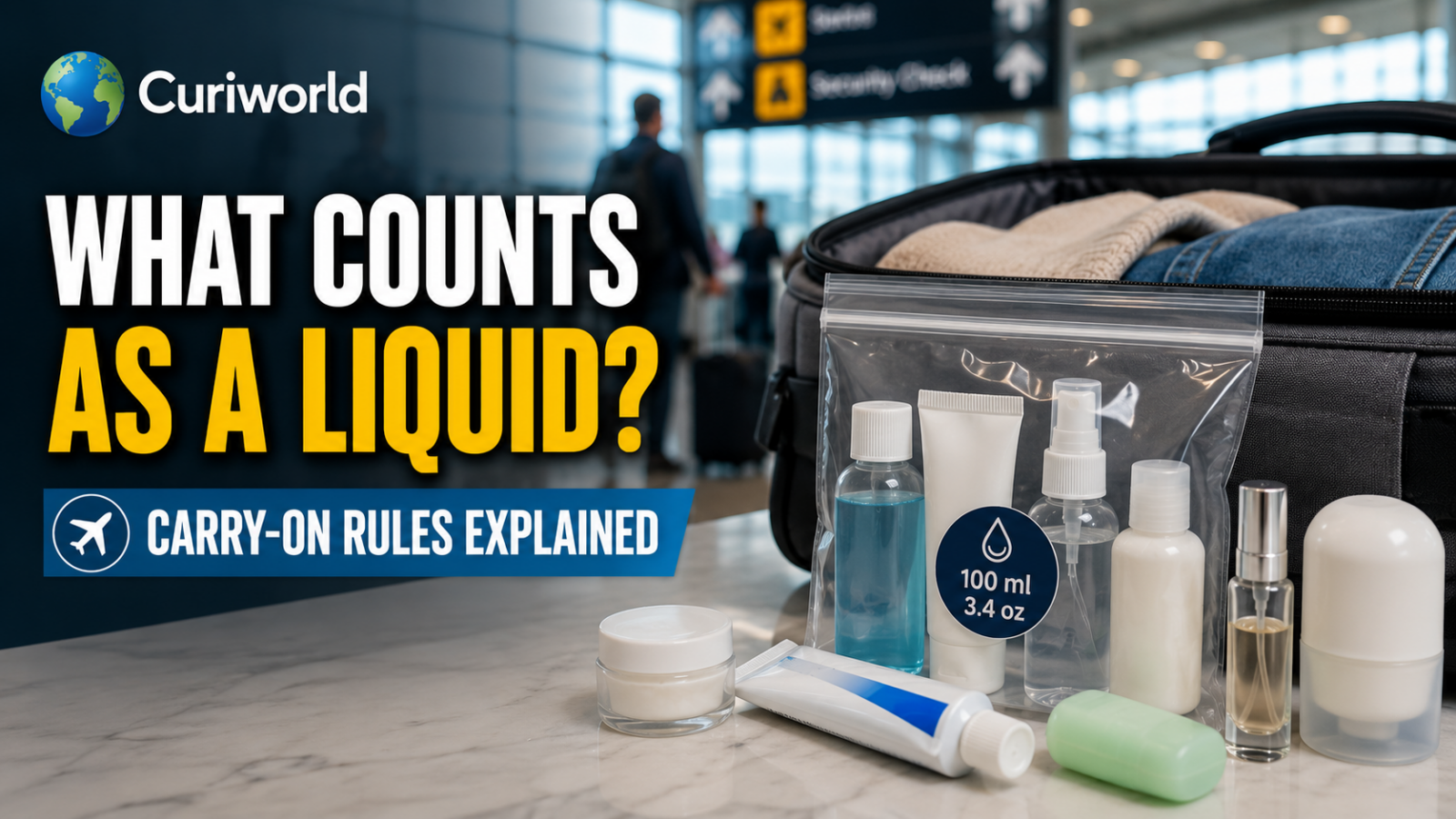
You remembered to leave the large water bottle at home.
Then airport security stops your bag because of toothpaste.
Or mascara. Or yogurt. Or the jar of honey you did not think of as a “liquid” at all.
That is where carry-on liquid rules become confusing.
At airport security, “liquid” can mean much more than something you would pour into a glass. Gels, creams, pastes, sprays and many spreadable or semi-liquid foods can fall under the same restrictions.
The exact limits also depend on where you are flying from. Security technology is changing, and not every airport now applies identical rules.
So instead of memorizing a few toiletries, it is more useful to understand what security considers a liquid in the first place.
What Counts as a Liquid at Airport Security?
The simplest answer is broader than most travelers expect.
Airport security rules can treat all of the following as liquids or similar substances:
- drinks, including water;
- gels;
- creams and lotions;
- oils;
- perfumes;
- sprays and aerosols;
- pastes;
- liquid or semi-liquid foods;
- and other products with a similar consistency.
That means an item does not have to splash like water to be covered by liquid restrictions.
Toothpaste is a good example.
Nobody drinks toothpaste, but it is a paste. It therefore falls within liquid restrictions at airports applying the standard 100 ml rule.
The same logic explains several other items that regularly surprise travelers.
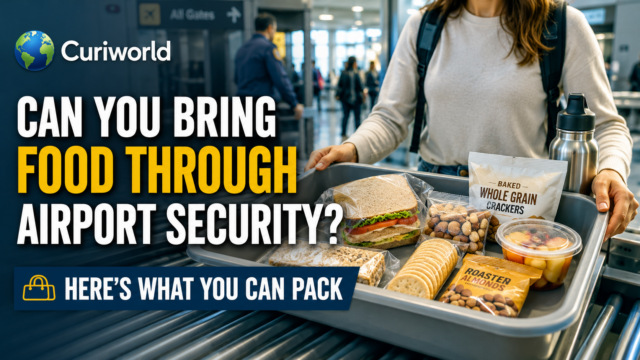
Food is where the liquid-versus-solid distinction can become especially confusing. Curiworld has a separate guide to what food you can actually bring through airport security.
Toothpaste, Mascara and Lip Gloss Count Too
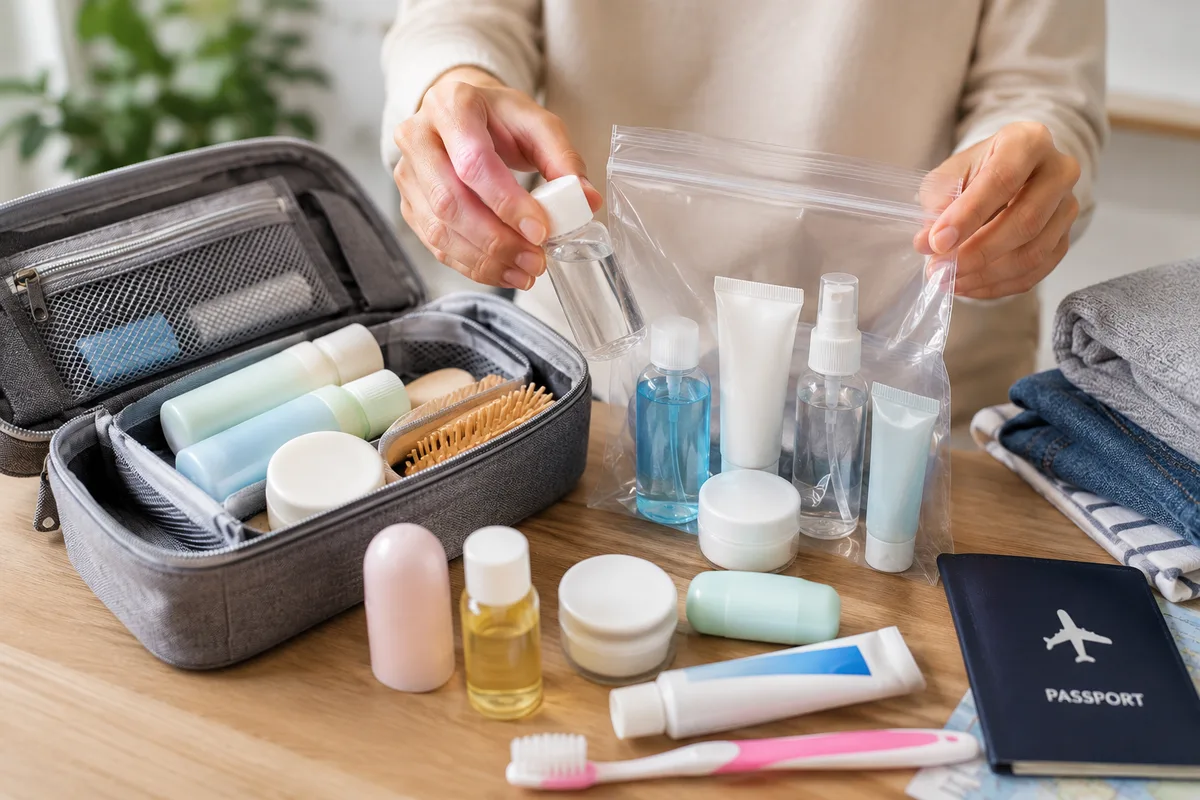
Your toiletry bag is where the definition of “liquid” becomes particularly important.
Products commonly treated as liquids, gels, pastes or similar substances can include:
- toothpaste;
- shampoo;
- conditioner;
- shower gel;
- liquid foundation;
- mascara;
- lip gloss;
- perfume;
- face cream;
- moisturizer;
- sunscreen;
- shaving foam;
- hairspray;
- spray deodorant;
- and contact lens solution.
A solid product can be different.
For example, a genuinely solid toiletry does not automatically become a liquid simply because it is used in the bathroom.
The useful question is not “Is this a cosmetic?”
Ask:
“What is its consistency?”
If it is liquid, creamy, gel-like, paste-like, spreadable or sprayable, check the liquid rules that apply at your departure airport.
Food Can Count as a Liquid
This is one of the stranger parts of airport security.
A sandwich may be treated as solid food while the spread you planned to put on it can fall under liquid restrictions.
Current UK security guidance, for example, specifically includes liquid or semi-liquid foods such as:
- soup;
- jam;
- honey;
- and syrups.
Similar logic can apply to other creamy, spreadable or gel-like foods depending on the security system and airport.
This is why “But it’s food” is not enough to determine whether something belongs with your liquids.
If you are unsure about food specifically, Curiworld’s guide to bringing food through airport security explains the difference between solid food, semi-liquid food and destination customs rules in more detail.
What Is the TSA 3-1-1 Liquids Rule?
For standard TSA screening in the United States, carry-on liquids, gels and aerosols generally follow the 3-1-1 rule.
The basic idea is:
3 — each container can hold no more than 3.4 ounces (100 ml).
1 — the containers must fit inside one quart-size clear plastic zip-top bag.
1 — each passenger is allowed one liquids bag.
The size of the container matters.
A 200 ml bottle containing only 50 ml of shampoo does not become a 50 ml container simply because it is almost empty.
If the standard limit is 100 ml, use a container with a maximum capacity of 100 ml or less.
That small detail can prevent an unpleasant surprise at the checkpoint.
Does the 100 ml Rule Apply at Every Airport?
No.
This is one of the most important things to understand about current carry-on liquid rules.
Airport security technology is changing, and some airports now use scanners that can support different procedures.
Current UK government guidance explicitly says liquid rules depend on the airport.
At most UK airports, liquids still cannot pass through security in containers larger than 100 ml, even when the container is only partly full.
However, some airports may allow liquids in containers holding up to 2 litres.
Some airports may also no longer require passengers to place liquids in a separate transparent bag.
That creates an unusual situation: something permitted on your outbound journey may be handled differently at the airport you use on the way home.
Always check:
- your departure airport;
- any connecting airport where you will pass through security again;
- and your return airport.
Do not assume the procedure you experienced on your last flight is now universal.
Does the Bottle Have to Be Full to Count?
No.
Container capacity matters under a standard 100 ml system.
Imagine you have a 250 ml shampoo bottle with only a tiny amount left inside.
The bottle is still designed to hold 250 ml.
Where the 100 ml container rule applies, being almost empty does not solve the problem.
Transfer the amount you need into a properly sized travel container instead.
This is also why buying a few reusable travel-size bottles can be more practical than carrying nearly empty full-size toiletries.
What About an Empty Water Bottle?
An empty bottle is fundamentally different from a bottle containing water.
At airports applying liquid-volume restrictions, travelers commonly take an empty reusable bottle through security and fill it afterward where facilities are available.
This can be useful on long travel days and reduces the need to buy another disposable bottle after screening.
The key word is empty.
If your departure airport limits liquids and the bottle still contains water when you reach screening, you may need to empty it before proceeding.
Check airport-specific instructions when in doubt.
Are Medicines Exempt From the Normal Liquid Limit?
Essential liquid medicines can have exemptions from standard carry-on liquid restrictions.
But the details depend on the country and security authority.
For example, current UK rules permit essential liquid medicines in containers larger than 100 ml. Proof such as a prescription or doctor’s letter may be required when the medication is liquid and the container exceeds 100 ml.
Security staff may also need to inspect or open the container.
Do not pour prescription medicine into an unmarked travel bottle merely to make your toiletry bag look tidier.
Keep medically necessary items appropriately identified and check the official requirements for your departure airport before traveling.
If your medication is subject to additional legal controls, destination-country rules can create separate requirements as well.
Baby Milk and Baby Food Can Have Special Rules
Parents should not assume that the normal toiletry limit automatically applies to everything needed to feed a baby.
Security systems can provide exceptions for baby milk, breast milk, sterilized water and baby food.
Current UK guidance, for example, permits enough baby food, baby milk and sterilized water for the journey, subject to its specific conditions and security screening.
These items may need to be presented separately or inspected.
Because rules and quantities can differ between security authorities, check the official baby-food guidance for your departure airport before traveling.
This is especially important if you need more than the ordinary liquid allowance.
What About Duty-Free Liquids?
Duty-free purchases can have their own security arrangements.
At UK airports, for example, qualifying liquids bought at an airport or aboard an aircraft can be taken through security when they remain sealed in the required security bag with the receipt visible inside.
Connections make this more important.
You may buy a large perfume bottle after security at one airport and then encounter another security checkpoint during your journey.
Do not automatically open or discard the security packaging if you still have a transfer ahead.
Check the rules for the airports through which you will connect.
Do Liquids Always Need a Clear Plastic Bag?
Not anymore at every airport.
Under the familiar system, passengers place qualifying containers in a single transparent, resealable liquids bag.
TSA’s standard 3-1-1 procedure in the United States still uses a quart-size clear bag.
But airport procedures elsewhere can differ.
Current UK guidance says travelers may need to place liquids in a separate transparent bag and specifically notes that this is not required at every airport.
Where a UK airport does require the traditional bag, the current guidance specifies a single transparent resealable bag holding no more than one litre, approximately 20 cm by 20 cm.
Again, the airport matters.
Do not throw away your travel liquids bag simply because one modern scanner allowed everything to remain inside your carry-on.
Your next airport may use different procedures.
What Happens During a Connecting Flight?
Connections are where liquid rules can become especially frustrating.
Suppose your first airport allows a larger container because it uses newer security equipment.
You then connect through another airport where you must pass security again and the traditional 100 ml restriction applies.
The second checkpoint follows its own rules.
Your first airport’s permission does not necessarily override them.
This is why travelers with connecting flights should check every airport where security screening may occur—not only the airport where the journey begins.
If you are planning how much time to leave for check-in and screening, Curiworld’s guide to how early you should get to the airport explains how security, baggage and airport size affect the timing calculation.
A Simple Way to Pack Carry-On Liquids
You do not need to turn packing toiletries into a science project.
Before leaving home:
1. Check your departure airport’s current liquid rules.
Do not rely solely on what happened the last time you flew.
2. Check connection and return airports too.
Their procedures may be different.
3. Separate obvious liquids, gels, creams, sprays and pastes.
Include items such as toothpaste and mascara that are easy to overlook.
4. Check container capacity.
Where a 100 ml limit applies, a half-empty oversized bottle can still be a problem.
5. Keep exemptions accessible.
Baby food, essential medicines and special dietary liquids may require separate screening.
6. Pack uncertain items where you can reach them.
If security needs another look, you do not want to unpack your entire carry-on at the checkpoint.
A few minutes of preparation at home is easier than repacking your bag while a security line waits behind you.
The Rule Is About Consistency, Not Just Drinks
The most useful thing to remember about carry-on liquids is that airport security uses a much broader definition than everyday conversation.
Water is obvious.
Toothpaste is less obvious.
Mascara, moisturizer, honey, jam, shaving foam and contact lens solution may be even easier to forget.
So when packing, stop asking only:
“Is this a liquid?”
Ask:
“Is this liquid, gel-like, creamy, spreadable, paste-like or sprayable?”
Then check the current rules for the airport where you will actually pass through security.
For many airports, 100 ml remains the familiar limit. But technology and procedures are changing, and some airports now permit different quantities or no longer require the traditional transparent bag.
The smartest packing rule is therefore not to memorize one number forever.
Know what counts as a liquid—and check the airport before you fly.



Join the discussion