Can You Bring a Power Bank on a Plane? Carry-On and Checked Bag Rules
Power banks are generally allowed on planes, but lithium-battery safety rules usually require them to stay in carry-on baggage. Capacity limits and airline rules can also affect what you can bring.
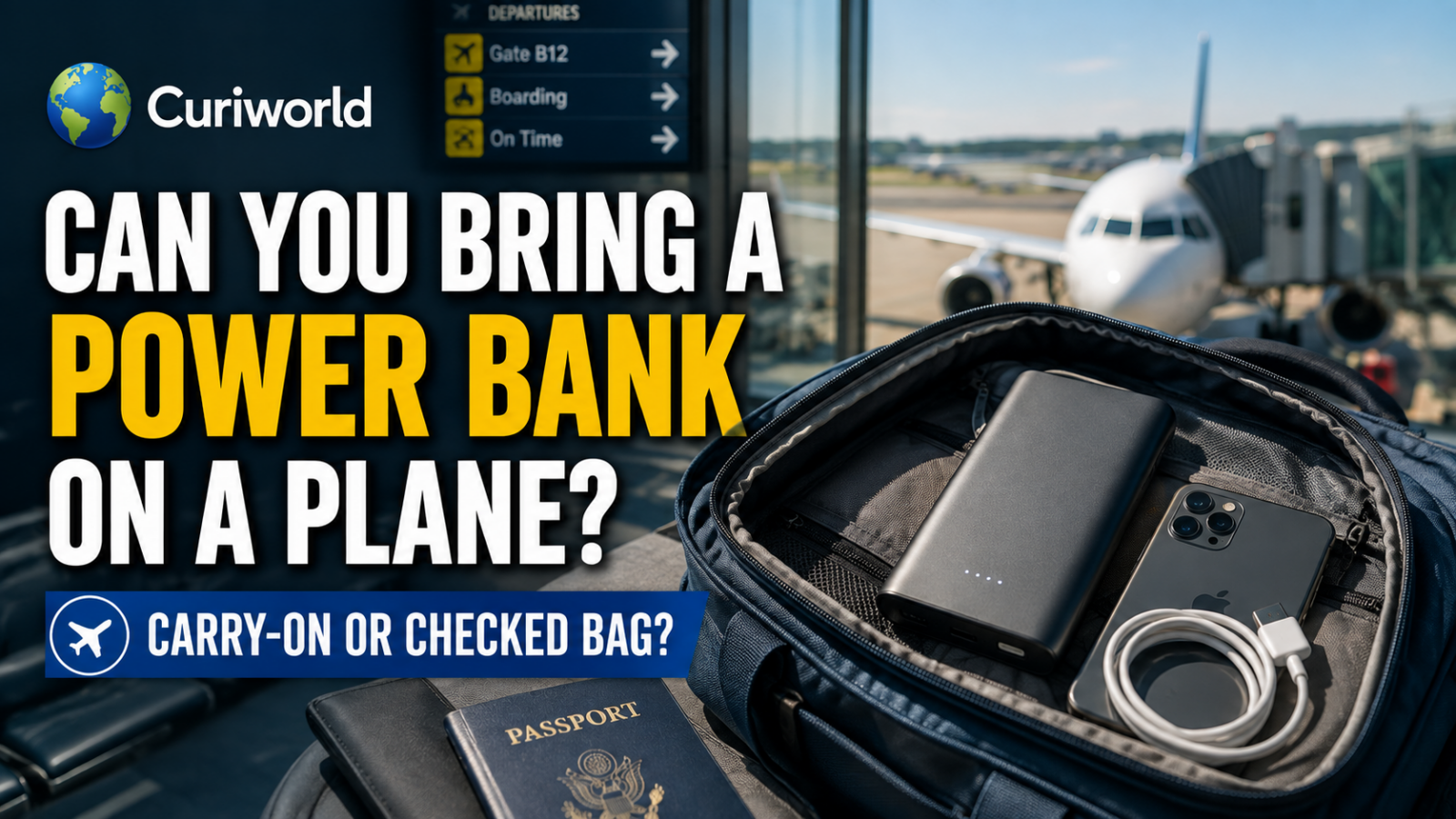
Your phone is at 18%, the airport outlets are occupied, and your power bank suddenly feels like the most useful thing in your bag.
Then comes the question: Can you actually bring a power bank on a plane?
Usually, yes—but where you pack it matters.
Power banks contain lithium batteries, which means they are subject to aviation safety rules. Under current U.S. aviation rules, a typical personal power bank can travel with you in the aircraft cabin if it stays within the permitted battery limits.
The important part is easy to remember:
Power banks belong in your carry-on baggage, not your checked suitcase.
There are also watt-hour limits, airline-specific restrictions and a few packing details worth checking before you leave for the airport.
The Short Answer: Carry-On Yes, Checked Bag No
For most ordinary power banks, the basic rule is:
- Carry-on baggage: Yes, subject to battery capacity and airline rules.
- Checked baggage: No.
- 0–100 Wh: Generally allowed in carry-on baggage.
- 101–160 Wh: May be allowed with airline approval, generally limited to two larger spare batteries.
- Over 160 Wh: Not permitted on passenger aircraft under the standard FAA passenger rules.
Why the difference between carry-on and checked baggage?
A power bank is treated as a spare lithium-ion battery rather than simply another electronic accessory.
Lithium batteries can overheat or enter a dangerous condition known as thermal runaway. Keeping spare batteries in the cabin means a problem such as overheating, smoke or fire can be noticed and addressed more quickly than if it develops inside the cargo hold.
That is why moving your power bank from your carry-on to your checked suitcase is not a harmless packing shortcut.
Why Power Banks Cannot Go in Checked Baggage
It is easy to think of a power bank as just another gadget.
A phone, laptop or camera has a battery installed inside the device. A power bank is essentially a rechargeable battery designed to supply electricity to other devices.
Aviation rules therefore treat it as a spare battery.
The FAA states that spare lithium-ion batteries—including power banks and portable chargers—must be carried in the aircraft cabin and cannot be placed in checked baggage.
There is a practical safety reason for this.
Lithium-ion batteries can overheat because of damage, manufacturing defects, short circuits or other problems. In rare cases, this can lead to thermal runaway, where the battery rapidly generates heat and may smoke or catch fire.
Cabin crew are trained to respond to lithium-battery incidents.
A battery buried inside checked luggage is much less accessible.
What Does 100 Wh Mean?
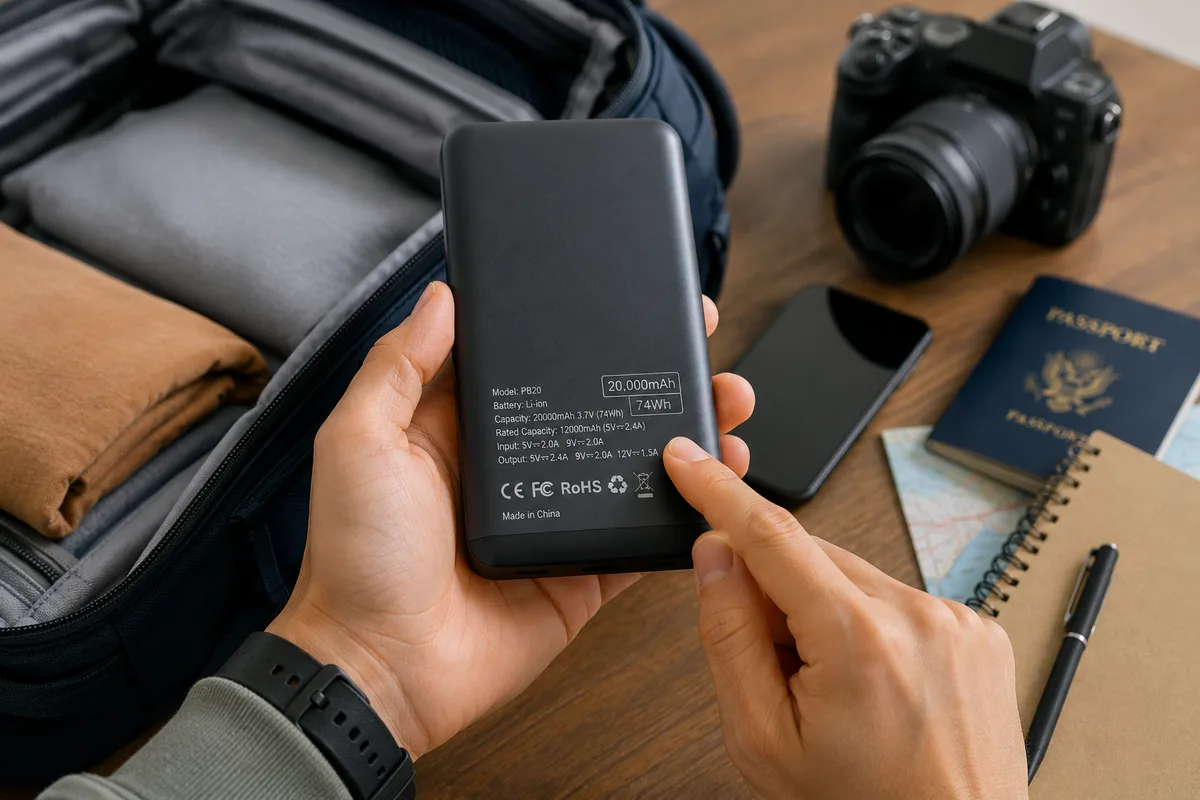
Power-bank rules are normally based on watt-hours (Wh) rather than the mAh number shoppers often use when comparing portable chargers.
For lithium-ion batteries under current FAA rules:
0–100 Wh: generally permitted in carry-on baggage.
101–160 Wh: airline approval is required.
Above 160 Wh: prohibited on passenger aircraft under the ordinary passenger exception.
Fortunately, many everyday phone power banks fall below 100 Wh.
But you should check rather than guess—especially with very large-capacity models.
Look at the specifications printed on the power bank itself. Many manufacturers list the watt-hour rating directly.
How Do You Convert mAh to Wh?
Power banks are often advertised as:
10,000 mAh
20,000 mAh
30,000 mAh
But airline restrictions are usually expressed in watt-hours.
To calculate watt-hours, you need both the battery capacity and voltage.
The formula is:
Wh = (mAh ÷ 1,000) × V
For example, imagine a power bank is rated:
20,000 mAh at 3.7 V
The calculation is:
20,000 ÷ 1,000 = 20 Ah
Then:
20 × 3.7 = 74 Wh
That would put the example battery below the FAA’s 100 Wh threshold.
But do not automatically assume every 20,000 mAh power bank has exactly the same Wh rating. Battery specifications and nominal voltage matter.
Check the label on your actual device.
What About a 10,000 mAh Power Bank?
Most conventional 10,000 mAh phone power banks are comfortably below 100 Wh when based on common lithium-cell voltages.
That generally puts them within the ordinary carry-on allowance under FAA rules.
The same is true for many conventional 20,000 mAh models.
However, capacity printed in mAh alone is not the legal limit used by the FAA.
The Wh rating is what matters.
This distinction becomes increasingly important with large power banks, laptop chargers and portable power stations.
If the Wh rating is printed on the device, use it rather than estimating from marketing claims.
Can You Bring a 30,000 mAh Power Bank?
Possibly—but this is where checking the actual specifications becomes much more important.
A 30,000 mAh rating by itself does not provide the complete answer because watt-hours depend on voltage.
Some high-capacity power banks may still fall at or below 100 Wh. Others may cross the threshold requiring airline approval.
Do not decide based on physical size either.
Two batteries that look similar can have different energy capacities.
Check for a label showing:
- battery capacity;
- nominal voltage;
- and preferably the Wh rating.
If you cannot determine the battery’s rating, check with your airline before traveling.
What Happens Between 101 Wh and 160 Wh?
This range has an extra restriction.
Under FAA guidance, passengers may carry up to two larger spare lithium-ion batteries rated above 100 Wh and no more than 160 Wh with airline approval.
Power banks fall within the spare-battery rules.
So a 120 Wh power bank should not simply be placed into your backpack on the assumption that carry-on automatically makes it acceptable.
Contact the airline first.
Airlines can also impose restrictions that are stricter than the general regulatory allowance.
That makes checking the carrier particularly important whenever your battery exceeds 100 Wh.
What About Power Banks Over 160 Wh?
This is where the ordinary passenger allowance ends.
Lithium-ion power banks exceeding 160 Wh are not permitted on passenger aircraft under standard FAA passenger rules.
This is particularly relevant to very large portable batteries and power stations designed to run laptops, camping equipment or other higher-power devices for long periods.
A product being sold as “portable” does not automatically make it suitable for air travel.
If your battery resembles a small power station rather than a pocket-sized phone charger, check its Wh rating before you even consider packing it.
Can You Put a Power Bank in Your Personal Item?
Generally, yes, provided the power bank itself complies with the applicable battery and airline rules.
A backpack, handbag or other permitted personal item kept in the cabin can be a practical place for it.
In fact, keeping the power bank somewhere accessible is preferable to burying it underneath everything else.
The FAA recommends protecting spare batteries from damage and short circuits.
Do not leave a power bank loose in a bag where its terminals or connectors can come into contact with metal objects such as keys or coins.
A protective pouch or suitable case is a simple solution.
What If Your Carry-On Gets Gate-Checked?
This catches travelers surprisingly often.
You correctly put the power bank in your carry-on.
The flight is full.
At the gate, the airline tells you the bag has to go into the cargo hold.
Remove the power bank before handing over the bag.
FAA guidance specifically requires spare lithium batteries and power banks to be removed when a carry-on is checked at the gate or planeside.
Keep the power bank with you in the cabin.
This is a good reason not to bury portable chargers at the bottom of your suitcase-style carry-on.
Pack them somewhere you can reach quickly.
How Should You Pack a Power Bank Safely?
Getting the bag right is only part of the rule.
The battery should also be protected against damage and short circuits.
Practical precautions include:
- keeping the power bank in a protective pouch or case;
- preventing exposed terminals from contacting metal objects;
- keeping it away from loose keys, coins and other conductive items;
- protecting it from crushing or puncture;
- and making sure it is not damaged, swollen or overheating.
Do not travel with a power bank that has started bulging, leaking, overheating or showing obvious physical damage.
The FAA warns that damaged or recalled lithium batteries that may spark or generate dangerous heat must not be carried aboard an aircraft unless they have been made safe under applicable requirements.
A swollen battery is not something to “use one last time” on vacation.
Can You Use a Power Bank During the Flight?
This is where airline-specific rules become especially important.
Being allowed to carry a power bank does not necessarily mean an airline will let you use or recharge it whenever you want during the flight.
Individual carriers can impose stricter requirements concerning storage, use and charging.
Some airlines have tightened their policies on portable batteries.
So before a flight—particularly an international one—check the airline’s current rules for:
carrying, storing, using and charging power banks onboard.
Follow cabin-crew instructions even if you have used the same power bank without a problem on another airline.
Do International Flights Have the Same Rules?
The carry-on-only principle for spare lithium batteries is widely used in international aviation, but travelers should not assume every airline and jurisdiction applies exactly the same operational limits.
Airlines may set stricter:
- quantity limits;
- capacity limits;
- approval procedures;
- storage requirements;
- or onboard-use restrictions.
This matters particularly when your itinerary involves several airlines.
The rule that matters at the airport is not simply what your first airline allows. You need your power bank to comply with the requirements that apply throughout the journey.
For international trips, check every operating carrier when necessary.
Is a Power Bank Treated Like Your Phone?
Not quite.
This distinction explains a lot of the confusion.
A smartphone contains an installed battery.
A power bank is treated as a spare lithium battery or portable recharger.
Battery-powered electronic devices can have different checked-baggage provisions when the battery is installed in the device and the device is completely switched off and protected.
Power banks do not receive that same treatment.
They belong in carry-on baggage.
So do not reason that “my phone can travel, therefore my power bank can go anywhere my phone can.”
They belong to different packing categories.
Airport Security Is Only Part of the Check
Travelers often search for “TSA power bank rules,” but security screening is only one part of the answer.
Battery transportation is also governed by aviation dangerous-goods requirements, and airlines can have their own restrictions.
That is why the safest pre-flight check is:
battery rating → aviation rule → airline rule
If you are preparing the rest of your carry-on too, our guide to carry-on liquids rules explains what counts as a liquid and why items such as toothpaste, gels and creams can be treated differently at security.
And if you are bringing snacks for the journey, see our guide to bringing food through airport security.
A 30-Second Power Bank Check Before You Leave
Before heading to the airport, look at the power bank and answer these questions:
Is it in my carry-on?
It should not be in checked baggage.
What is its Wh rating?
At or below 100 Wh is the ordinary FAA carry-on range.
Is it between 101 and 160 Wh?
Contact the airline for approval and applicable quantity restrictions.
Is it over 160 Wh?
It is outside the standard passenger allowance.
Is the battery damaged or swollen?
Do not bring a potentially unsafe lithium battery aboard.
Is it protected in my bag?
Keep it away from situations that could cause damage or a short circuit.
Could my carry-on be gate-checked?
Keep the power bank accessible so you can remove it before surrendering the bag.
Finally, check your airline’s current policy.
That last step matters because airlines may impose stricter limits than the general rules.
The Bottom Line
Yes, you can usually bring a power bank on a plane—but put it in your carry-on, not your checked bag.
For U.S. passenger flights, the FAA generally allows lithium-ion power banks up to 100 Wh in carry-on baggage. Batteries from 101 to 160 Wh require airline approval, with a limit of two larger spare batteries per passenger. Power banks exceeding 160 Wh are not permitted under the standard passenger allowance.
If your carry-on is unexpectedly gate-checked, remove the power bank and keep it with you in the cabin.
And never ignore the condition of the battery itself.
A damaged, swollen or recalled power bank can be a safety risk regardless of its capacity.
The easiest habit is also the safest:
Check the Wh rating, pack the power bank in your carry-on, protect it from damage and check your airline’s current rules before flying.






Join the discussion