What Happens to Your Checked Bag During a Long Layover?
During a long layover, your checked bag often stays inside the airline baggage system and continues to your next flight. Whether you must collect it depends on your itinerary, airport and customs rules.
You land after the first leg of a long trip, but your next flight is eight, twelve, or even eighteen hours away. You can leave the gate, eat, explore the terminal, perhaps even spend the night in a hotel.
But where is your suitcase?
In many connecting itineraries, your checked bag remains in the airline and airport baggage system and is transferred to your onward flight without you seeing it during the layover. A long connection does not automatically mean your suitcase will appear at baggage claim.
What happens depends mainly on where your bag was tagged, whether your flights are on one itinerary, whether the connection is treated as a stopover, and the customs rules at the transfer airport.
The easiest clue is often already in your hand: your baggage receipt.
First, Check the Destination on Your Baggage Tag
When you check a suitcase at your departure airport, the airline attaches a routing tag containing airport codes.
Suppose you are flying:
New York → London → Rome
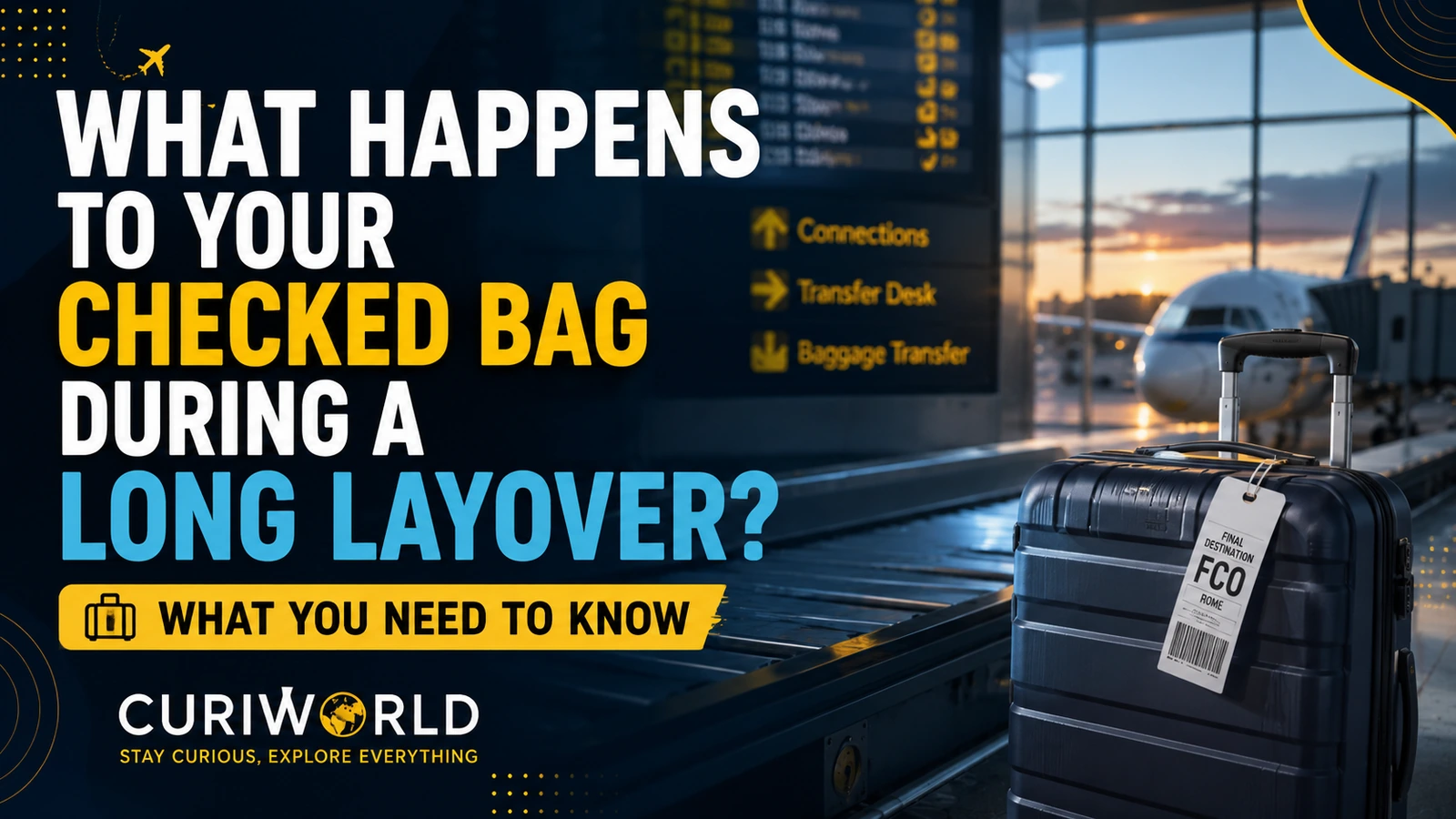
If your baggage receipt shows FCO, the airport code for Rome Fiumicino, the airline has generally checked the bag through to Rome.
You normally would not collect it in London.
If the tag ends at LHR, however, your bag is scheduled to be delivered in London, meaning you will usually need to collect it before continuing.
This is why asking, “Do I need my bag during the layover?” is less useful than asking:
“Is my bag checked through to my final destination?”
The answer can change the entire connection.
What Happens to the Bag While You Wait?
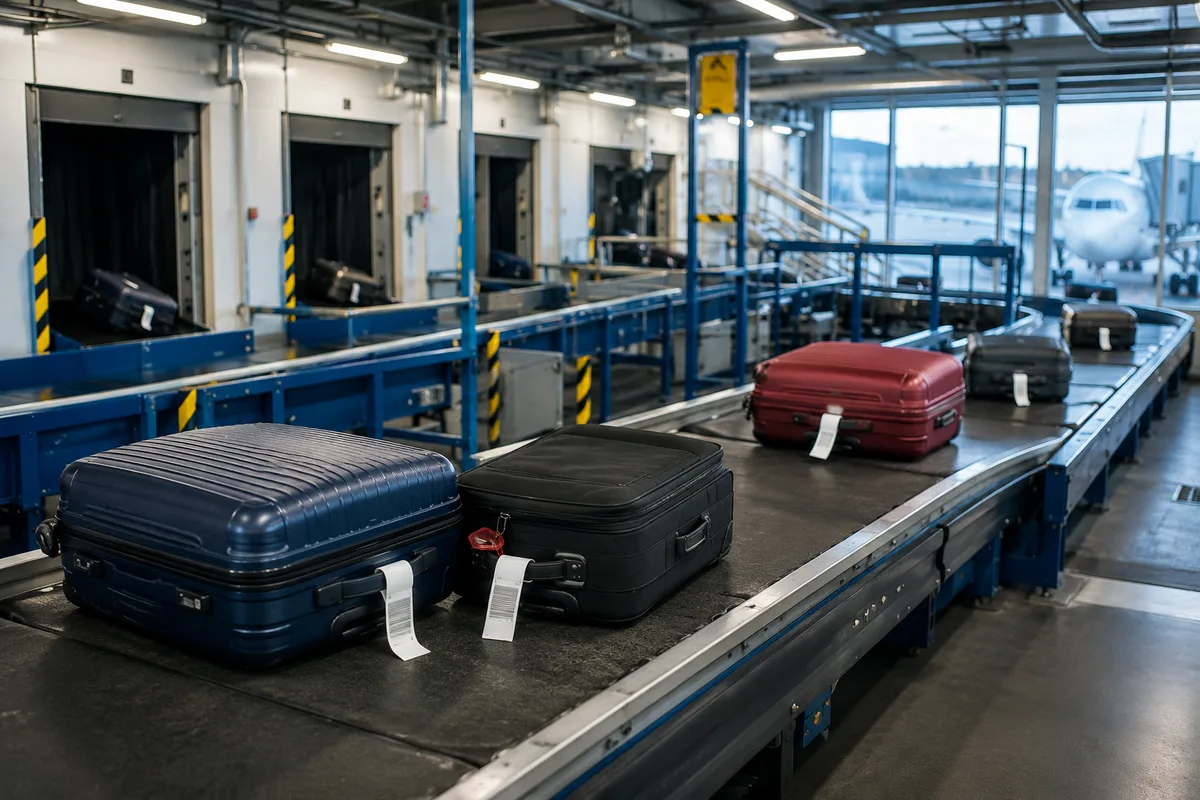
If your suitcase is checked through, you generally do not need to do anything with it during the connection.
After being unloaded from your first aircraft, it enters the airport’s transfer-baggage process. The baggage handling system and ground staff route it according to its tag and onward flight.
On a short connection, that may mean moving relatively quickly toward the next aircraft.
On a much longer connection, the bag may need to wait within the airport’s baggage-handling operation before it is prepared for the next flight.
The exact process differs among airports and airlines. Large international hubs handle enormous numbers of connecting bags and may use automated sorting, tracking and storage systems alongside ground-handling teams.
For you, however, the practical result is simple:
If the bag has been accepted through to your final destination, you usually do not collect it merely because you have several hours between flights.
Does an 8-, 12-, or 20-Hour Layover Change Anything?
Not necessarily.
There is no universal rule saying:
“If your layover exceeds X hours, you must collect your bag.”
Airline policies, airport procedures and the structure of the ticket matter more than the number of hours alone.
A 12-hour connection could still involve automatic baggage transfer.
Another itinerary with a three-hour connection could require you to collect and recheck your bag.
The difference may be that the first journey was sold as a protected connection on one ticket, while the second was built from two independent bookings.
That is why connection length alone is a poor way to predict what happens to checked luggage.
One Ticket Usually Makes Baggage Transfer Simpler
If all flights were sold as one connected itinerary, the airline will often check your baggage through to the final destination when the airlines involved have the necessary baggage arrangements.
For example:
Paris → Dubai → Bangkok
might be issued as one itinerary even though you change aircraft in Dubai.
If your baggage tag says BKK, you generally leave the suitcase with the airline throughout the connection and collect it in Bangkok.
You might spend hours walking around the airport while your suitcase remains inside the baggage system.
There are exceptions, so the tag still matters more than assumptions.
Separate Tickets Can Change Everything
Now imagine that you purchased:
Flight 1: Paris → Dubai
and separately purchased:
Flight 2: Dubai → Bangkok
Perhaps the combination was cheaper.
From your perspective, it may look like one journey.
From the airlines’ perspective, it may be two unrelated trips.
In that situation, your first airline may check the suitcase only to Dubai. You would then need to:
- enter the arrivals process;
- collect your suitcase;
- pass any required immigration or customs procedures;
- go to the next airline’s check-in or bag-drop area;
- check the suitcase again;
- and pass through security for the next flight.
This type of itinerary is often called a self-transfer.
Curiworld’s guide to using AI to find cheaper flights explains why apparently cheap combinations involving separate tickets, baggage rechecks and self-transfers can carry hidden costs and connection risks.
A low fare can become much less attractive once baggage, immigration and missed-connection risk enter the calculation.
Changing Airlines Does Not Automatically Mean Collecting Your Bag
Another common assumption is that changing airlines always means retrieving your suitcase.
It does not.
Airlines can have interline baggage agreements that allow a suitcase to be checked across multiple carriers on a connected itinerary.
For example, your first flight might be operated by Airline A and your second by Airline B while both flights remain part of the same ticket.
Your bag may still be tagged to the final airport.
But this is not guaranteed simply because the flights appear together in a search result.
The safest approach is to check the bag tag when you hand over your suitcase and ask the check-in agent where you will next see it.
U.S. Connections Can Work Differently After an International Arrival
For many travelers arriving in the United States from overseas, the first U.S. airport is also where U.S. Customs and Border Protection processing takes place.
Under the standard process, travelers may need to collect their checked baggage, bring it through customs and then return it to the airline for the connecting flight. A baggage tag showing the final destination does not always remove that requirement.
However, this is not universal on every route.
Travelers departing from a U.S. CBP Preclearance airport complete immigration, customs and agriculture inspection before boarding the U.S.-bound flight. After arrival in the United States, they can generally proceed as domestic-arriving passengers and continue to a connecting flight without going through CBP again.
There is also a newer exception on selected routes. CBP’s International Remote Baggage Screening program allows eligible checked baggage from participating foreign airports to be screened remotely before arrival. On those routes, passengers can continue to their connecting flights without retrieving and rechecking their bags unless CBP specifically refers the baggage for further inspection.
These exceptions are route-specific.
So if you are connecting in the United States after an international flight, do not rely only on a general rule or on what happened during a previous trip. Check the instructions for your actual flight, departure airport and connecting airport, and follow the directions given by the airline and CBP.
Quick Guide for U.S. Connections
| Arrival type | What usually happens to checked baggage |
|---|---|
| Standard international arrival into the U.S. | You may need to collect the bag for customs and recheck it |
| Arrival from a CBP Preclearance airport | You generally arrive as a precleared passenger and can continue without normal U.S. arrival clearance |
| Eligible International Remote Baggage Screening route | The bag may continue to the connecting flight without being reclaimed unless CBP refers it |
| Separate ticket or self-transfer | Airline and baggage arrangements may require collection and rechecking regardless of customs procedure |
Always follow the instructions for the specific itinerary because airline, airport and CBP procedures can differ by route.
What About an Overnight Layover?
Overnight connections create the most uncertainty because passengers often assume the airline will return their luggage so they can take it to a hotel.
That is not necessarily what happens.
If your bag has been checked through to the next destination, you may not have access to it overnight.
That means you should not assume you can retrieve pajamas, toiletries, medication, a change of clothes, or anything else you packed in the checked suitcase.
For an overnight connection, keep the essentials you expect to need in your carry-on, subject to airport security and airline baggage rules.
Useful items may include:
- basic toiletries;
- necessary medication;
- travel documents;
- electronics you need;
- charging cables;
- a change of underwear or clothing;
- and anything essential for the next morning.
This is useful even when everything goes according to plan. It becomes even more valuable if the next flight is delayed or your checked luggage does not arrive when expected.
Can You Ask the Airline to Give You the Bag During the Layover?
Sometimes travelers deliberately want their suitcase during a long connection.
Do not assume this will be possible simply because you have plenty of time.
The answer depends on how the itinerary and baggage have been ticketed and on airline and airport procedures.
If you know before departure that you need the suitcase at the connecting city, ask the airline before the bag is checked.
Once the suitcase has been tagged into a through journey, retrieving it during an intermediate connection may not be a simple matter.
This is especially relevant if the connection is intentionally being used as a short visit to a city rather than simply time spent inside the airport.
Leaving the Airport Does Not Necessarily Change Your Bag’s Route
Suppose you have a ten-hour layover and decide to leave the airport for a few hours.
If your suitcase has already been checked through, leaving the terminal does not automatically mean the airline must return it to you.
Your movements and your bag’s routing are separate processes.
You may pass immigration, enter the city, return to the airport and continue your journey while the checked suitcase remains in the airline’s transfer system.
Of course, whether you are allowed to leave the airport depends on immigration and visa rules for the country you are entering.
Never assume that having a boarding pass for another flight automatically gives you permission to enter the country during a layover.
What If the Connecting Flight Is Delayed?
If your onward flight is delayed by several hours, the bag will normally remain under the airline’s control if it has already been checked through.
A delay does not usually send the suitcase to baggage claim automatically.
If the disruption becomes more serious and the airline rebooks you onto another flight, baggage staff may need to redirect your luggage to the new service.
That is one reason modern bag tags and baggage-tracking systems are so important: the bag’s journey must be matched to the passenger’s updated itinerary.
When a connection changes significantly, check the airline app or speak with airline staff rather than assuming your suitcase has followed the same plan.
What If You Miss the Connection?
This is where having one ticket rather than separate tickets becomes especially important.
On a protected itinerary, the airline may rebook you after a disruption and arrange for your checked luggage to follow the revised journey.
With separately booked flights, responsibility becomes more complicated.
If your first flight arrives too late for you to collect the suitcase, complete arrival procedures and check in for an independently booked second flight, the second airline may treat you as a passenger who simply missed check-in.
That is another reason self-transfer itineraries need significantly more connection time than ordinary protected connections.
The Baggage Receipt Can Answer the Question Before You Fly
There is a useful habit that takes only a few seconds:
Look at your baggage receipt before walking away from the check-in desk.
Check the airport code printed as the baggage destination.
If you do not recognize it, ask.
A simple question can prevent hours of uncertainty:
“Is this checked all the way to my final destination, or do I collect it during the connection?”
Ask again if:
- the itinerary uses separate tickets;
- you change airlines;
- the layover is overnight;
- you change airports;
- you enter a country during the connection;
- or your itinerary changes after a cancellation or delay.
Do not rely solely on what happened during a previous trip. Different airlines, countries and tickets can produce different baggage procedures.
Do You Have to Pick Up Your Checked Bag During a Layover?
Not always.
On many through-ticket connections, checked baggage remains inside the airline and airport baggage system and is transferred automatically to the onward flight.
You are more likely to need to collect and recheck it when:
- the baggage tag ends at the connecting airport,
- you are traveling on separate tickets or making a self-transfer,
- customs procedures require baggage collection,
- you change airports,
- or the airline cannot check the bag through.
U.S. international connections deserve special attention because the standard customs process may require baggage collection at the first U.S. airport. However, travelers arriving from CBP Preclearance locations and passengers on eligible International Remote Baggage Screening routes may follow a different process.
The length of the layover by itself does not determine what happens to the suitcase.
Long Layover Does Not Mean Baggage Claim
The most useful takeaway is surprisingly simple.
Your suitcase does not come back to you just because the layover is long.
If it has been checked through to your final destination, the airline and airport normally remain responsible for transferring it until the next flight. If the baggage tag ends at the connecting airport, you will need to collect it.
Separate tickets, self-transfers, airport changes and customs procedures can all change the process.
So before wondering where your suitcase will spend the next twelve hours, look at the three-letter airport code on the baggage receipt.
It may already tell you exactly where you will see your bag again.
Sources
Sources
U.S. Customs and Border Protection — Checking Baggage Through to a Final Destination
U.S. Customs and Border Protection — What Is Preclearance?
U.S. Customs and Border Protection — International Remote Baggage Screening Initiative








Join the discussion