Why Do Airlines Ask You to Turn On Airplane Mode? What Your Phone Is Actually Doing
Why do airlines ask you to use airplane mode? Here’s what your phone actually turns off, whether signals can affect aircraft, and why Wi-Fi can still work in flight.
The cabin doors close, the safety demonstration begins, and the same request comes over the speakers:
Put your phone in airplane mode.
Most passengers do it without thinking. Others quietly wonder whether leaving one phone connected to a cellular network could really interfere with a modern commercial aircraft.
The answer is more nuanced than the familiar warning suggests.
Airplane mode mainly stops your phone from using its normal cellular connection while airborne. The rule exists to control radio transmissions, reduce the possibility of interference and keep airborne phones from trying to interact with terrestrial cellular networks in ways those networks were not designed for.
It does not mean one forgotten phone is expected to make an airplane fall out of the sky.
What Airplane Mode Actually Does
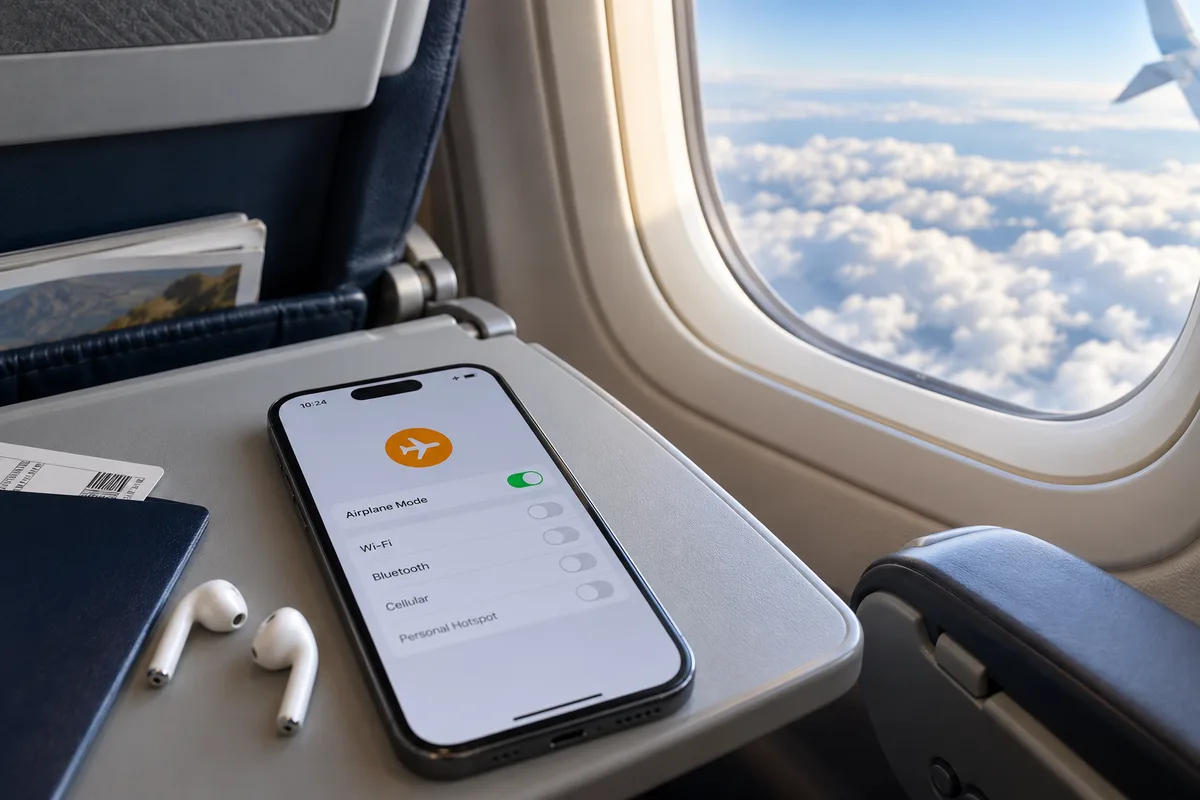
Your phone contains several separate wireless systems.
Depending on the model and operating system, these can include:
- cellular service;
- Wi-Fi;
- Bluetooth;
- GPS/GNSS reception;
- NFC;
- and other short-range wireless functions.
Airplane mode does not necessarily disable all of them permanently.
Its most important effect for flying is disabling the phone’s cellular radio.
On many devices, Wi-Fi and Bluetooth may initially switch off or remain available depending on previous settings. You can often turn them back on while airplane mode remains active—provided the airline allows their use.
That is why you can be in airplane mode and still connect to the aircraft’s Wi-Fi or use Bluetooth headphones.
GPS is different again. Your phone primarily receives positioning signals from satellites rather than transmitting a signal back to them, so location functions may still work in airplane mode depending on the device and app.
Curiworld’s guide to whether GPS works without an internet connection explains why satellite positioning and mobile data are not the same thing.
Why Airlines Care About Cellular Transmission
A phone that is not in airplane mode continues behaving like a phone.
It tries to communicate with cellular infrastructure.
On the ground, that is exactly what it is supposed to do. Your phone finds nearby cells, exchanges radio signals with the network and moves between cells as you travel.
Inside an aircraft moving hundreds of miles per hour and thousands of feet above the ground, the situation is very different.
The phone may detect multiple ground stations from altitude and repeatedly attempt to connect as the aircraft moves.
In the United States, the Federal Communications Commission’s rules prohibit ordinary airborne operation of cellular telephones. The FAA also tells passengers that phones and other portable electronic devices should be used in airplane mode or with cellular service disabled during flight.
So there are really two issues that often get blended together:
aircraft safety and interference, which falls within aviation regulation;
and airborne cellular-network use, which also involves telecommunications regulation.
Can Your Phone Actually Interfere With an Airplane?
Electronic devices produce radio-frequency energy.
Aircraft also depend on electronic systems for communication, navigation, surveillance and other critical functions.
That creates an obvious safety principle: equipment brought into the cabin should not be allowed to create harmful interference with aircraft systems.
Modern commercial aircraft are designed and tested with electromagnetic interference in mind, and regulators have spent years studying the use of portable electronic devices onboard.
The FAA concluded years ago that airlines could safely expand the use of many portable electronics during all phases of flight when aircraft had been shown to tolerate their emissions.
That is why you no longer have to switch off your tablet simply because the plane is taking off.
But cellular transmission remains treated differently.
Airplane mode offers a simple, standardized way for hundreds of passengers to disable the cellular function without requiring everyone to turn off their phone completely.
So Would One Phone Left On Crash the Plane?
That is not a useful way to understand the rule.
Modern aviation safety rarely depends on waiting until something has been proven likely to cause a catastrophe.
Instead, unnecessary risks are removed wherever practical.
A single phone accidentally left out of airplane mode is not generally expected to cause an aircraft to suddenly lose control. Commercial airplanes operate in environments full of radio-frequency signals, and aircraft systems are designed with electromagnetic compatibility in mind.
But that does not mean airlines should encourage hundreds of passengers to operate uncontrolled cellular transmitters throughout every flight.
The rule removes an unnecessary variable.
In aviation, that is reason enough.
And regardless of the technical debate, passengers are expected to follow crew instructions.
Why Is In-Flight Wi-Fi Allowed Then?
This is probably the most obvious contradiction.
If radio transmissions are the concern, why can an airline sell you Wi-Fi at 35,000 feet?
Because airplane Wi-Fi is not the same thing as letting every phone connect directly to terrestrial cellular towers.
The aircraft has an installed communications system designed for that purpose. Your phone connects over Wi-Fi to equipment onboard the aircraft, and that system handles the connection beyond the plane through approved technology such as satellite links or air-to-ground networks.
The FAA explicitly allows passengers to use Wi-Fi when the aircraft has an installed Wi-Fi system and the airline permits it.
That is why the normal sequence is:
Airplane mode ON → cellular connection OFF → Wi-Fi manually ON.
No contradiction is required.
The type of wireless connection matters.
What About Bluetooth Headphones?
Bluetooth uses short-range, relatively low-power radio communication.
Modern airlines commonly permit Bluetooth headphones and similar accessories, although the airline’s instructions always take priority.
This is also why switching on airplane mode does not necessarily mean your earbuds suddenly become useless.
Current smartphones can usually keep Bluetooth enabled—or allow you to turn it back on—while cellular connectivity remains disabled.
The exact behavior varies slightly between devices and operating systems.
Why Does Your Phone Sometimes Lose Battery Faster Without Airplane Mode?
A phone uses energy trying to maintain a cellular connection.
If coverage is weak or unavailable, the cellular system may have to work harder while searching for a usable network.
That can contribute to battery drain.
The effect is not unique to airplanes. It can happen anywhere cellular reception is poor.
Curiworld’s explanation of why a phone can get warm even when you are not actively using it covers how weak cellular conditions and background activity can continue using power even with the screen off.
Airplane mode removes the cellular-search problem entirely.
So even if the crew were not asking for it, airplane mode could still help preserve battery during a long flight.
Is the 5G–Airplane Interference Issue the Same Thing?
Not exactly.
You may remember headlines about 5G signals interfering with aircraft radio altimeters.
Radio altimeters measure an aircraft’s height above the ground and can feed information to important aircraft systems, particularly during approach and landing.
The aviation industry’s 5G concern involved powerful ground-based C-band wireless networks operating in spectrum near frequencies used by radio altimeters.
That led to aircraft modifications, operational restrictions and extensive coordination between regulators and telecommunications companies.
The FAA continued updating radio-altimeter interference requirements in 2026.
That is a real aviation spectrum issue.
But it should not be simplified into:
“Your 5G phone will interfere with the airplane’s altimeter.”
These are different technical situations.
Why Do Rules Differ Between Airlines and Countries?
Because portable-electronics rules are not identical worldwide.
In the United States, FAA guidance and FCC telecommunications regulations shape how cellular devices are used during flight.
European aviation rules similarly require operators to ensure that portable electronic devices do not adversely affect aircraft equipment, but the exact procedures can depend on the aircraft and operator.
Some aircraft can also provide approved onboard mobile connectivity through specially installed systems.
That is why you should follow the announcement on the aircraft you are actually flying rather than assuming the rules from another airline or country apply everywhere.
Do You Need to Turn Airplane Mode Off After Landing?
Once the airline allows normal cellular service again, turning airplane mode off lets your phone reconnect to available ground networks.
It may take a moment to register with a carrier.
If your phone shows signal bars but cannot actually place calls or use mobile data, the bars alone do not necessarily mean the phone has successfully registered with a network. Curiworld explains that distinction in why a phone can show signal bars but still say “No Service”.
For international flights, remember that reconnecting can also trigger roaming depending on your carrier and plan.
The Real Reason Airplane Mode Still Exists
Airplane mode is not based on the idea that every smartphone is a tiny threat capable of bringing down an aircraft.
It is a practical way of controlling wireless transmitters in an environment where communication and navigation systems matter enormously.
When you switch it on, the key change is that your phone stops trying to use its normal cellular network.
Wi-Fi and Bluetooth can often still be used when permitted. GPS reception may continue. Your downloaded movies, music, games, camera and offline apps keep working normally.
So the next time the cabin crew asks you to tap the little airplane icon, you are not turning your smartphone into a completely radio-silent brick.
You are mostly telling one particular part of it:
Stop trying to behave like a cellular phone until we’re back on the ground.
Sources
Federal Aviation Administration — Flying Safe: Electronics on Board
eCFR — 47 CFR § 22.925: Prohibition on Airborne Operation of Cellular Telephones
Apple Support — Use Airplane Mode on iPhone and Other Apple Devices







Join the discussion