Why Do Airplane Windows Have Tiny Holes?
That tiny hole in an airplane window is not a defect. It helps manage pressure between the window panes and can also reduce condensation during flight.
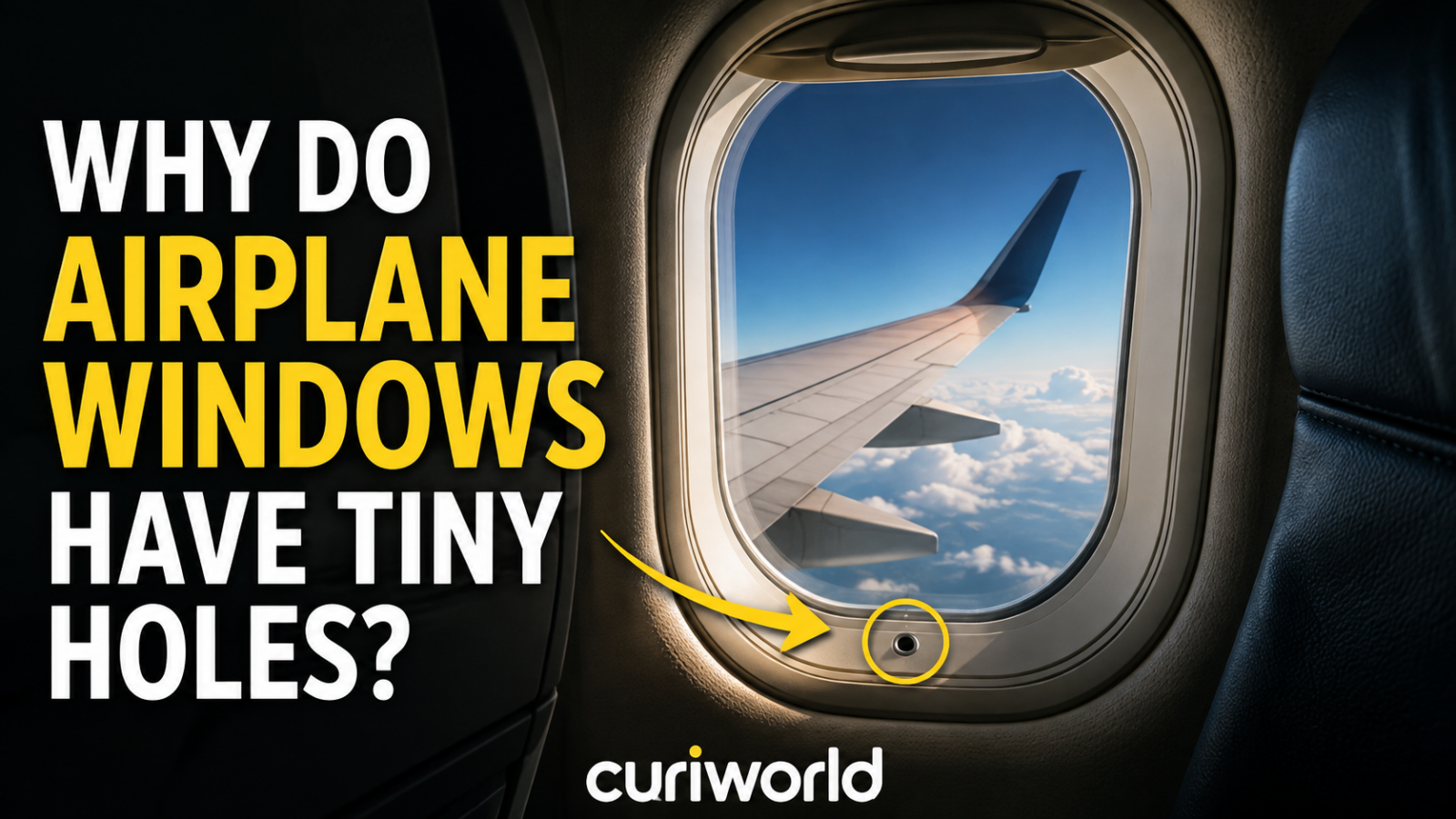
That tiny hole near the bottom of an airplane window can look slightly alarming. After all, a hole is probably the last thing anyone expects to see in a window while flying thousands of feet above the ground.
But it is not damage, and it does not expose the cabin directly to the outside air.
The opening is commonly called a breather hole or bleed hole, and it plays an important role in controlling pressure inside the multilayer window assembly. It also helps reduce moisture and condensation between the panes.
The clever part is that such a small feature helps the entire window system handle one of the biggest engineering challenges of high-altitude flight: the difference between cabin pressure and the much lower atmospheric pressure outside.
Airplane Windows Are Not Made From a Single Pane
Passenger aircraft windows may look simple from your seat, but they are built from several transparent layers.
The exact construction varies between aircraft models, but conventional passenger windows typically include structural panes designed to withstand pressure loads along with an interior protective layer closer to the passenger.
That inner surface—the one passengers can normally touch—is often called a scratch pane. It helps protect the more important structural components behind it from scratches, accidental impacts, cleaning equipment, and everyday cabin wear.
The tiny hole you see is usually located in one of the inner structural layers, not through the entire window assembly.
So it is not an open passage from the cabin to the atmosphere.
What Does the Tiny Hole Actually Do?
Its main job is to help equalize pressure between parts of the window assembly.
As an aircraft climbs, atmospheric pressure outside the plane decreases. The cabin remains pressurized so passengers and crew can breathe comfortably.
Cabin pressure affects more than the window structure. It also changes the sensory environment inside the aircraft; see why food can taste different on an airplane.
This creates a significant pressure difference between the inside and outside of the aircraft.
The window system must withstand that difference just like the rest of the pressurized fuselage.
The breather hole allows cabin pressure to reach the small space between the structural panes. This helps keep the pressure on both sides of one of those panes relatively similar under normal conditions.
As a result, the outer structural pane is designed to carry most of the pressure difference between the cabin and the outside atmosphere.
That arrangement makes the forces acting on the window more predictable and manageable.
The cabin environment affects more than the window itself; it can even help explain why food tastes different on an airplane.
Why Is the Outer Pane Supposed to Take the Pressure?

Aircraft designers do not simply try to make every component as thick as possible. They control how loads move through a structure.
The outer pane is positioned and designed to withstand the normal pressure differential during flight. The breather hole helps prevent the space between the panes from becoming an isolated pocket with its own changing pressure.
This means the pressure load is concentrated where the window has been engineered to handle it.
There is also an important safety advantage.
Passenger-aircraft windows use redundant structural elements so that the system is not dependent on one transparent layer alone. If the primary pressure-bearing pane were damaged, another structural pane is designed to provide backup protection under specified conditions.
This kind of redundancy is common throughout aviation engineering. Instead of assuming that a component can never fail, critical systems are designed with the possibility of failure in mind.
Does Air Escape Through the Hole?
Not directly outside.
This is probably the biggest misconception about airplane window holes.
The hole connects the cabin side of the window assembly with the space between its panes. Another structural layer still separates that space from the atmosphere outside the aircraft.
In other words, it is not like drilling a hole through a household window and leaving it open.
Cabin air can move through the small opening into the window assembly, but it does not simply rush out of the airplane through it.
The aircraft’s pressurization system controls cabin pressure as a whole. The tiny breather hole only manages a very small volume of air trapped within the window structure.
Why Is the Hole So Small?
It does not need to be large.
Pressure changes during an aircraft’s climb and descent occur gradually enough that a very small opening can allow the air between the panes to adjust.
The hole is not responsible for pressurizing or depressurizing the cabin. It only needs to equalize pressure within a relatively tiny enclosed area inside the window.
That is why something only a few millimeters across can perform an important engineering function.
Small details often matter enormously in aircraft design.
The Hole Also Helps Reduce Condensation
Pressure control is the main purpose, but the breather hole has another benefit: moisture management.
The air outside an aircraft at cruising altitude can be extremely cold, while the cabin is kept at a comfortable temperature. That creates a major temperature difference across the window.
Warm cabin air can contain moisture. When moisture encounters sufficiently cold surfaces, condensation can form.
The breather hole allows limited air circulation within the window assembly and helps reduce moisture accumulation between the structural panes.
Passengers may still occasionally notice fogging, small ice crystals, or moisture around a window, particularly under certain temperature and humidity conditions. That does not necessarily mean anything is wrong.
The goal is not to make condensation physically impossible. It is to help control the conditions inside the multilayer window assembly.
Why Not Just Use One Very Thick Window?
At first glance, one extremely thick piece of transparent material might seem simpler.
Aircraft engineering, however, values redundancy as much as raw strength.
Airliner windows experience thousands of cycles of changing pressure over their service lives. Every flight involves pressurization during climb and depressurization during descent.
They must also tolerate temperature changes, vibration, structural loads, and long-term material fatigue.
Using multiple structural layers provides another level of protection if one component develops a problem.
Certification standards for pressurized aircraft therefore require window systems to account for pressure loads, repeated pressurization cycles, temperature effects, and certain failure conditions.
A multilayer design provides engineers with more ways to control those forces while maintaining an acceptable level of safety.
Why Are Airplane Windows Rounded?
The pressure-management system also helps explain another familiar feature of modern aircraft: rounded passenger windows.
Early pressurized airliners helped demonstrate the importance of avoiding sharp corners in areas exposed to repeated structural stress.
Sharp corners can concentrate stress more intensely than smooth curves. Modern aircraft windows therefore use rounded shapes that distribute loads more evenly around the surrounding structure.
The tiny breather hole and the rounded window may look like unrelated details, but both reflect the same engineering philosophy: control how pressure and structural forces move through the aircraft.
Is the Tiny Hole a Safety Concern?
Under normal circumstances, no.
If you notice a small, precisely manufactured opening near the lower part of a passenger window, it is generally an intentional part of the window design.
A random crack, major scratch, loose panel, unusual deformation, or obvious structural damage would be a different matter and should always be brought to the attention of cabin crew.
But the small circular breather hole itself is not a sign that the aircraft window is leaking.
It is there because engineers want it there.
A Tiny Detail Doing an Important Job
Airplane cabins can make complex engineering look surprisingly ordinary.
You sit beside a transparent window, watch the clouds pass, and may never notice that the surface beside you is actually part of a carefully engineered pressure system.
The tiny hole helps regulate pressure between the window’s layers, allows the outer structural pane to carry the intended load, and helps manage condensation caused by dramatic temperature differences.
It is a good example of how aviation engineering often works: some of the most important solutions are almost invisible.
And the next time you notice that tiny opening during a flight, you will know that it is not a flaw in the window.
It is part of what makes the window work.
Sources
National Research Council Canada — Investigation of Aircraft Window Failures and Passenger Window Construction
https://nrc-publications.canada.ca/eng/view/ft/?id=7cc41956-c95b-4a42-a311-260af0e60045
U.S. Electronic Code of Federal Regulations — 14 CFR § 25.775, Windshields and Windows
https://www.ecfr.gov/current/title-14/chapter-I/subchapter-C/part-25/subpart-D/section-25.775








Join the discussion