Why Do People Throw Rice at Weddings? What the Tradition Means
Throwing rice at newlyweds is more than a festive send-off. The custom connects grain with prosperity, fertility and good fortune—and its history is more complex than one origin story.
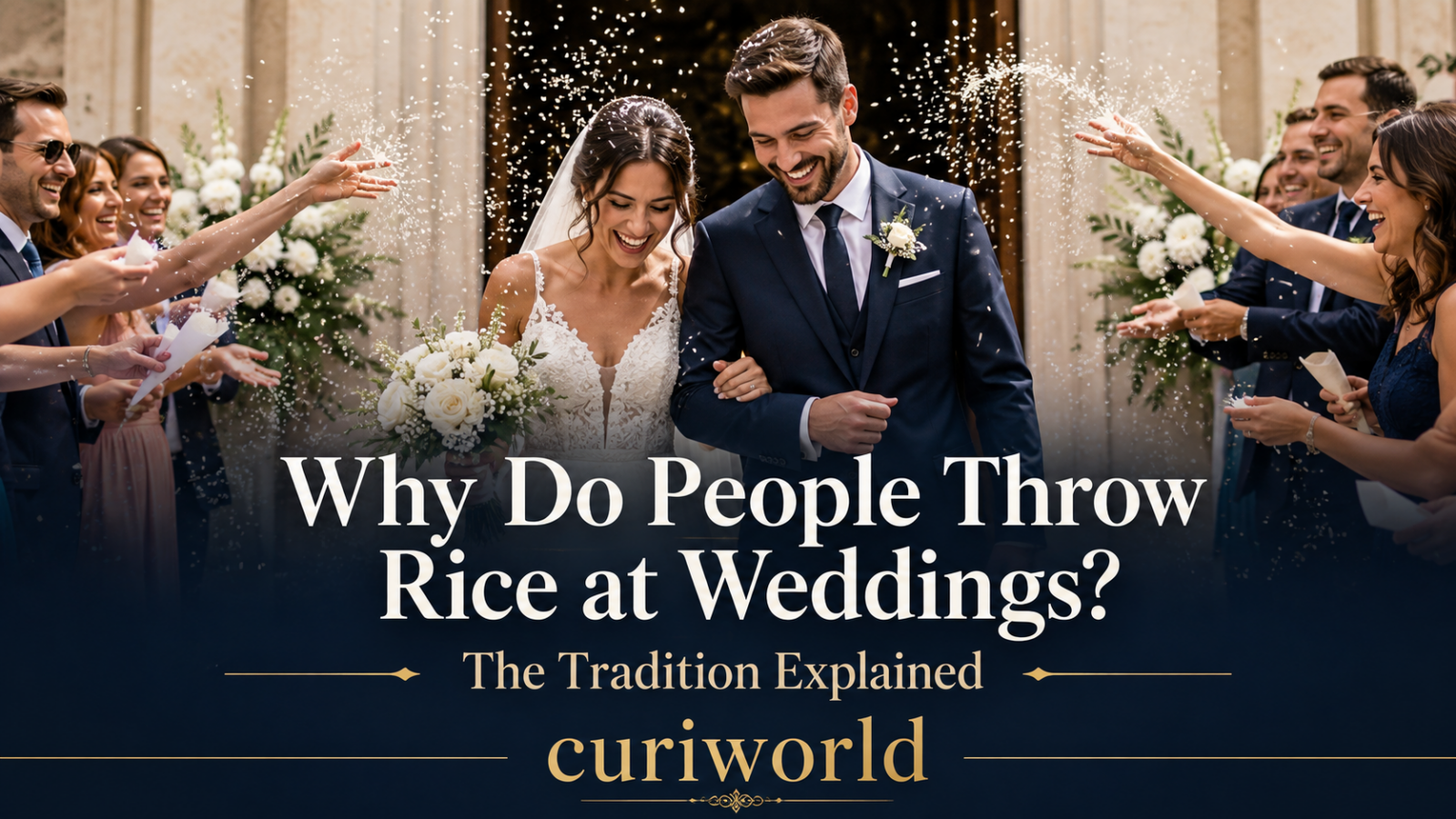
A newly married couple steps out of the ceremony, guests raise their hands, and a shower of rice fills the air. It looks playful now, but the gesture was never meant to be random.
Traditionally, throwing rice at newlyweds is a symbolic way of wishing them prosperity, fertility, abundance, and good fortune. The deeper history is more complicated, however. Rice is only one version of a much wider family of wedding customs in which grains, seeds, food, or other small objects are scattered over or around a couple.
That distinction matters because there probably was not one single moment when someone “invented” the wedding rice toss.
What Does Throwing Rice at a Wedding Mean?
At its simplest, the rice toss is a blessing made visible.
Grain has long represented food, harvest, survival, and the ability of a household to provide for itself. Scattering it over newlyweds turned those ideas into a physical wish: may the marriage be fruitful, may the household have plenty, and may the couple enter married life with good fortune.
Historically, “fruitfulness” could refer quite directly to having children. That is why fertility appears so often in explanations of the custom. Modern couples and guests, of course, do not have to attach that literal meaning to it. Today, the gesture is often understood more broadly as a wish for a happy and prosperous future.
That shift is normal for traditions. People can keep performing a ritual long after its original symbolism has softened, broadened, or been forgotten.
The Tradition Is Older Than the Rice Toss We Recognize Today
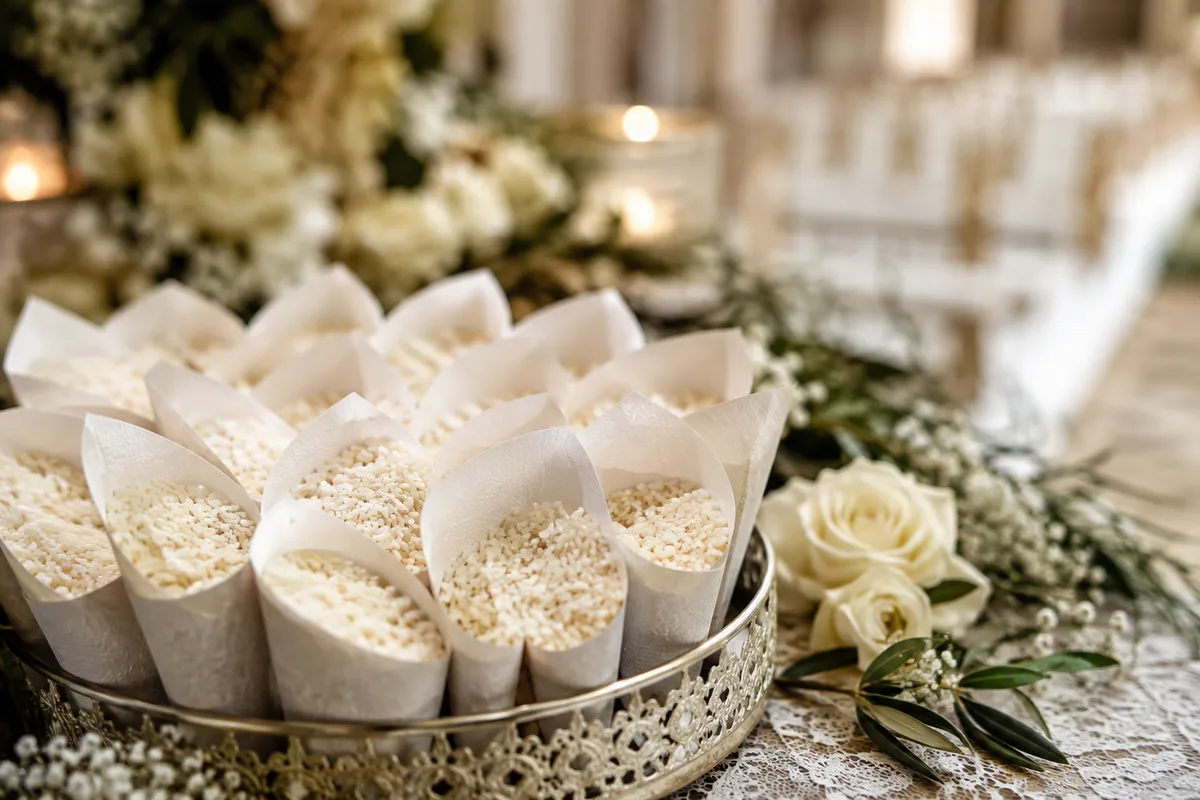
The history becomes more interesting once rice is separated from the larger idea of throwing grain.
Some retellings try to trace the modern custom to one ancient civilization or one specific place. Historical evidence is not neat enough to support such a simple origin story.
What can be documented is that scattering grain has appeared in different marriage and ceremonial traditions. In his 1896 study The Popular Religion and Folk-Lore of Northern India, William Crooke described rice being scattered in several Indian marriage rites. The same work also recorded an English practice of casting wheat over a bride and connected it with the later custom of throwing rice over newlyweds.
That does not prove that every modern wedding rice toss descended directly from one Indian or British ritual. Customs can develop independently, travel between communities, combine with other practices, and acquire new meanings over long periods.
It is therefore more accurate to see the familiar rice toss as part of a much older pattern: using grain symbolically during an important transition in life.
Why Rice?
Rice makes symbolic sense for a simple reason: it is food, but it is also seed.
A handful contains many individual grains, making it an intuitive image of plenty. In societies where harvests directly affected household security, grain could represent something far more significant than decoration. It meant nourishment, stored food, continuity, and the possibility of another crop.
Rice could therefore carry several ideas at once. It might suggest abundance in the home, future growth, prosperity, fertility, or good fortune.
But the exact meaning has never been identical everywhere.
Historical rice-scattering customs have also been connected with blessing, protection, luck, and other ritual purposes. Treating every culture’s use of rice as though it meant precisely the same thing would flatten very different traditions into one convenient story.
That is one reason the familiar explanation—“people throw rice because it symbolizes fertility”—is broadly useful but incomplete.
Did Rice Replace Wheat at Western Weddings?
In some historical British accounts, wheat appears before rice.
Crooke’s nineteenth-century folklore study refers to an English practice of casting wheat on a bride before discussing the custom of throwing rice over a newly married couple.
This suggests that the important element was not always rice itself. Grain was the symbolic object.
That distinction helps explain why the tradition can survive even when the material changes. The physical act—showering newlyweds with something associated with blessing or abundance—can remain recognizable while the object being thrown evolves.
Modern rice tossing is therefore better understood as one form of a larger grain tradition rather than a completely isolated wedding invention.
Cultural habits often work this way. The history behind why some countries drive on the left has nothing to do with weddings, but it illustrates the same broader principle: once a practice becomes socially familiar, it can persist long after the circumstances that originally shaped it have changed.
Does Throwing Rice at Weddings Hurt Birds?
No. The famous claim that uncooked wedding rice swells inside birds and causes their stomachs to rupture is a myth.
The Cornell Lab of Ornithology explains that many birds naturally eat rice and can digest it. Rice therefore does not make birds “explode,” despite the surprisingly persistent story.
That does not mean every wedding venue will allow a rice toss.
Loose grains can make smooth surfaces slippery, create additional cleanup, and potentially attract rodents. A church, hotel, garden, or event venue may therefore restrict rice for practical reasons rather than because it is poisonous to birds.
Anyone planning a wedding toss should check the venue’s policy before buying bags of rice for the guests.
Why Do Some Couples Use Petals, Confetti, or Bubbles Instead?
Wedding exits have become increasingly customizable, so rice is no longer the automatic choice.
Flower petals create a softer visual effect. Bubbles leave no scattered grain behind. Some couples choose dried leaves or venue-approved biodegradable materials, while others skip the toss entirely.
These alternatives do not necessarily carry the old agricultural symbolism of grain.
What they preserve is something else: the social function of the moment.
Everyone participates at once.
For a few seconds, the couple walks through something created collectively by the people who came to celebrate them. What once represented fertility or an abundant harvest can now function simply as a joyful send-off.
The object changes. The shared gesture survives.
Why Do Traditions Like This Last So Long?
Most people who throw rice at a modern wedding are not consciously reenacting an old agricultural ritual.
They are taking part in something recognizable.
A gesture appears at weddings, photographs preserve it, films repeat it, families remember it, and another generation encounters it as something people simply “do” when a couple gets married.
Repetition gives customs a kind of cultural momentum.
The same process can make everyday conventions feel almost inevitable even when other societies do things differently. Curiworld’s look at why European and American date formats differ shows another example: a habit repeated for generations can feel completely natural without most people knowing exactly how it developed.
Wedding rice is particularly adaptable because its symbolism is easy to reinterpret.
A wish for fertility can become a wish for abundance.
Abundance can become prosperity.
Prosperity can simply become good luck.
The ritual remains recognizable while its meaning becomes more flexible.
A Small Gesture With a Long Cultural Life
People throw rice at weddings because grain has long been associated with ideas people naturally want to attach to a new marriage: growth, plenty, prosperity, fertility, and good fortune.
The modern rice toss should not be reduced to a single, perfectly documented origin story. Grain-scattering rituals have appeared in different cultures, and historical evidence shows that wheat as well as rice has been used in marriage customs.
Over time, the shower of white rice became one especially recognizable version of a much broader tradition.
And despite the persistent rumor, the reason some weddings avoid rice is not that it makes birds explode.
The custom has changed because weddings change.
The wish behind it is much older: may the couple begin their new life with plenty ahead of them.
Sources
William Crooke — The Popular Religion and Folk-Lore of Northern India, Vol. 2 — Project Gutenberg
View source
Cornell Lab of Ornithology — “I’m getting married. Is it true that rice causes birds’ stomachs to explode?”
View source







Join the discussion