Why Do People Knock on Wood for Good Luck? Where the Tradition Came From
Why do we knock on wood after saying something lucky? The familiar superstition has several origin stories—but its real history is less certain than you might think.
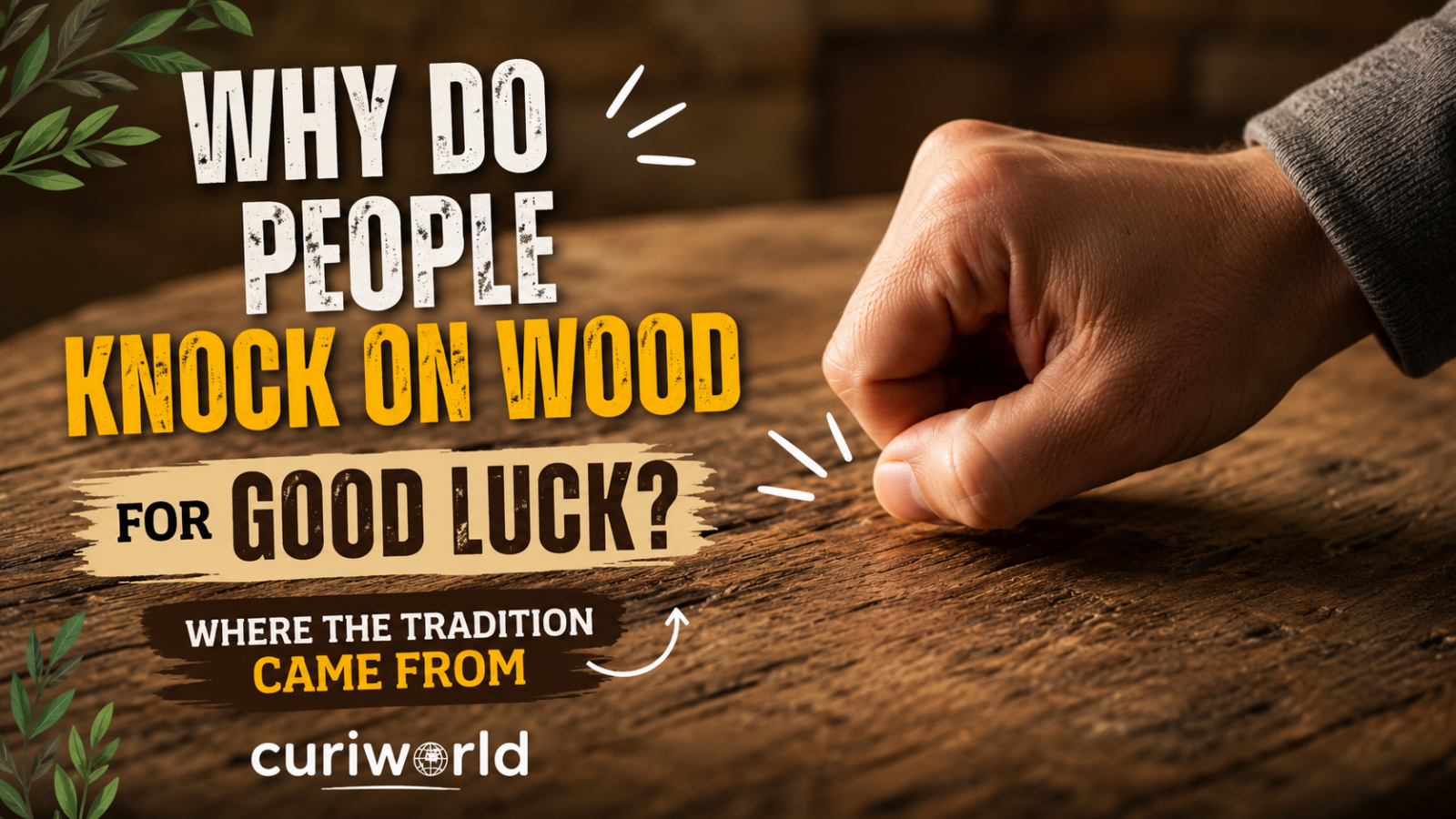
“I’ve never missed a flight.”
Knock on wood.
“Our car has never broken down.”
Knock on wood.
It is a tiny ritual performed almost automatically: say something fortunate, realize you may have tempted fate, then reach for the nearest wooden table, door, desk, or chair.
But why wood?
The familiar explanation is that the custom comes from ancient people who believed spirits lived inside trees. It is a great story. The problem is that the history is far less certain.
Nobody can confidently identify a single origin for knocking on wood. Several explanations have been proposed, from sacred trees and Christianity to nineteenth-century children’s games. The written trail of the modern English expression is surprisingly recent, which makes the idea of an uninterrupted ancient ritual difficult to prove.
That uncertainty is actually what makes the tradition more interesting.
What Does “Knock on Wood” Actually Mean?
People usually knock on wood after saying something positive that they do not want to “jinx.”
Imagine someone saying:
“I haven’t been sick all year.”
A moment later, they tap a wooden desk.
The gesture is supposed to prevent the statement from attracting bad luck.
It can also appear after a hopeful prediction:
“The weather should stay perfect for the wedding—knock on wood.”
In Britain, the equivalent expression is commonly “touch wood,” while “knock on wood” is particularly familiar in North American English.
The exact action varies. Some people tap once. Others knock several times. Some simply say the phrase without touching anything.
The underlying idea remains remarkably consistent: do something small to avoid tempting fate.
Did the Tradition Come From Ancient Tree Spirits?
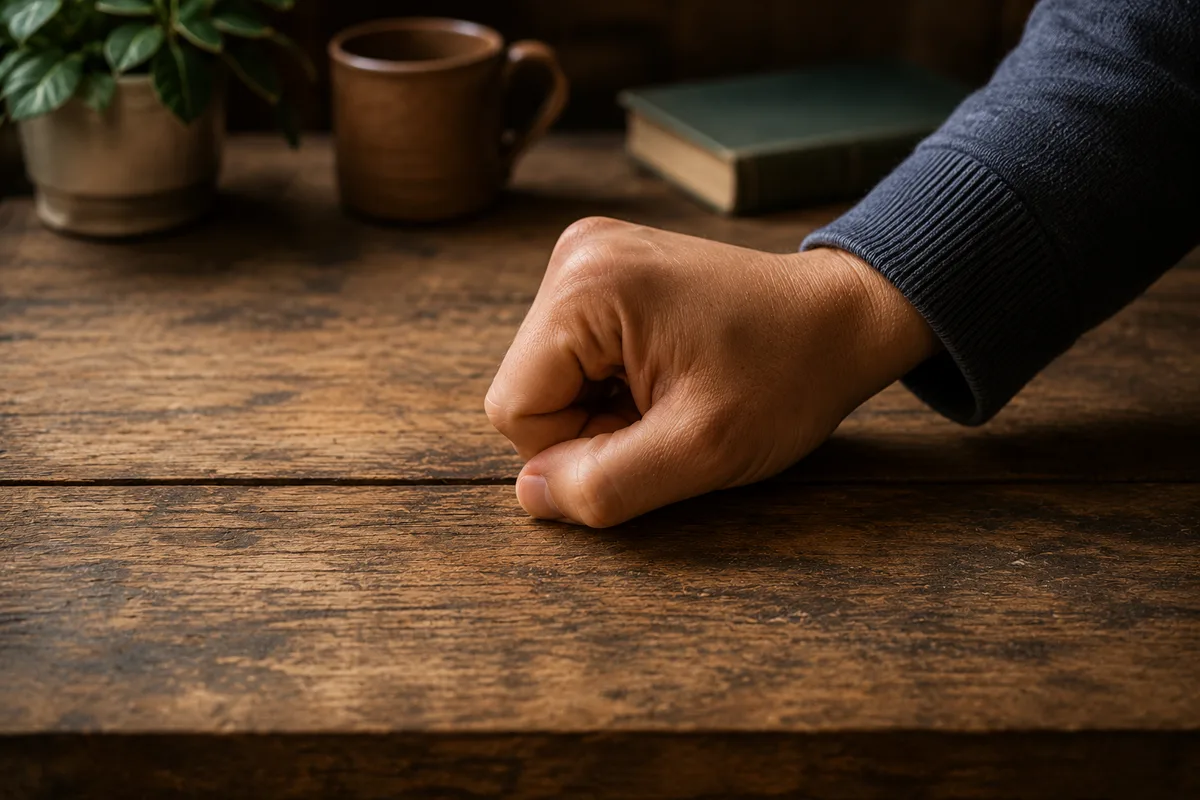
This is probably the most famous origin story.
According to one version, pre-Christian European cultures regarded certain trees as sacred or believed supernatural beings inhabited them. Touching or knocking on a tree supposedly allowed a person to seek protection, acknowledge those spirits, or prevent hostile forces from interfering with their good fortune.
Oak, ash, holly, and hawthorn are among the trees that appear in later explanations of the custom.
It sounds plausible because trees genuinely did carry religious and symbolic importance in many historical cultures.
But there is a large gap between those facts and proving that people today knock on a kitchen table because of a specific ancient ritual.
Historical treatments of the phrase repeatedly point out that the actual origin remains unknown. The tree-spirit explanation is a theory, not a documented chain connecting an ancient practice directly to the modern expression.
That distinction matters.
A tradition can resemble an ancient belief without necessarily descending directly from it.
What About the Wood of the Christian Cross?
Another explanation connects the practice with Christianity.
In this interpretation, touching wood symbolically invokes the wood of the cross on which Jesus was crucified. Contact with wood therefore became associated with protection or divine favor.
Again, the symbolism makes intuitive sense.
But evidence establishing this as the origin of the modern superstition is limited.
The Christian-cross theory and the pagan-tree theory share the same problem: both provide appealing explanations for why wood might be considered protective, but neither gives historians an uninterrupted record showing how the modern phrase developed.
That leaves room for a much more recent possibility.
Could “Touch Wood” Have Started as a Children’s Game?
One of the more intriguing theories moves the story away from ancient temples and sacred forests and into the playground.
British folklorist Steve Roud has connected the custom with nineteenth-century children’s chasing games sometimes known as Tiggy Touchwood or similar names.
The basic idea was simple.
A child being chased could become temporarily safe by touching wood.
A tree, wooden fence, door, or other wooden object effectively became a safe zone.
That connection is striking:
Touch wood → become safe.
It is easy to see how such an idea could eventually develop into:
Touch wood → remain safe from bad luck.
This theory has an advantage over some of the ancient explanations because related children’s games are historically documented.
But it should not be treated as the final solved answer either. Historians and folklorists still do not have enough evidence to declare one origin definitively correct.
The safest conclusion is less dramatic but more accurate:
The modern superstition probably developed from older ideas about protection, luck, and wood, but its precise path into everyday language remains uncertain.
The Phrase May Be Younger Than People Assume
The ancient-origin stories can make knocking on wood sound like a ritual that has been performed continuously for thousands of years.
The English-language evidence is much more recent.
Language researcher Michael Quinion notes that the familiar British expression “touch wood” appears relatively late in written records, while the American “knock on wood” is documented around the beginning of the twentieth century.
That does not prove nobody performed a similar gesture earlier.
Oral customs can exist long before someone writes them down.
But it does mean we should be cautious about confidently tracing the exact modern ritual all the way back to ancient Celts, Germanic peoples, or early Christians.
Sometimes a custom feels ancient simply because nobody remembers learning it.
Your parents did it.
Their parents did it.
Your friends understand it.
Eventually, a habit becomes culturally invisible.
Why Do We Say “Knock on Wood” in America but “Touch Wood” in Britain?
The distinction is mostly linguistic rather than philosophical.
British English generally favors “touch wood.”
American English generally favors “knock on wood.”
Both serve the same basic purpose: protecting good fortune or undoing the feeling that someone has tempted fate by speaking too confidently.
This is another example of how everyday conventions can develop differently while serving essentially the same function.
Similar cultural divergence appears in things as ordinary as timekeeping. Curiworld’s look at why countries use different clock conventions shows how something that feels completely natural in one place can feel unusual somewhere else.
The wording changes.
The superstition survives.
Does Knocking on Wood Actually Make People Feel Better?
This is where psychology adds another layer to the story.
A superstition does not need to physically change the future to affect the person performing it.
Psychologist Giora Keinan examined the relationship between stress, desire for control, and superstitious behavior in a study involving 108 participants. The interviews included questions designed to elicit a “knock on wood” response.
The results supported a relationship between stress, desire for control, and greater use of superstitious behavior.
That helps explain why rituals such as knocking on wood can be so persistent.
Uncertainty is uncomfortable.
You cannot guarantee that your flight will be on time.
You cannot guarantee that your healthy streak will continue.
You cannot guarantee that tomorrow’s important meeting will go perfectly.
But you can knock on the desk.
The action creates a tiny sense that something has been done.
That does not mean the ritual changes probability. It means rituals can change how people emotionally respond to uncertainty.
Why Does Saying Something Good Feel Like “Tempting Fate”?
There is another strange feature of the superstition.
The ritual usually appears after speaking.
Thinking “I have been lucky lately” may feel harmless.
Saying it out loud can suddenly feel dangerous.
That reflects an old and widespread human discomfort with excessive confidence about an uncertain future.
If you declare that something bad “never” happens to you, you have made a prediction about events you cannot control.
Then something in your mind whispers:
You probably should not have said that.
Knock on wood becomes the correction.
It is essentially an anti-jinx ritual.
The person has symbolically taken back a statement that sounded too confident.
Do You Have to Knock Three Times?
No universal rule requires exactly three knocks.
Different families and communities perform the superstition differently.
Some people knock twice.
Some three times.
Some merely touch the wooden object.
Others say “knock on wood” without moving at all.
And when there is no wood nearby, people sometimes jokingly knock on their own heads.
That variation is exactly what we should expect from folklore.
Unlike a formal ceremony with written instructions, folk customs spread through families, friends, communities, language, and imitation.
People learn the behavior because they see other people doing it.
The details mutate along the way.
Why Has Such a Strange Tradition Survived?
Because it is almost effortless.
Knocking on wood costs nothing.
It takes about a second.
Everyone around you usually understands what it means.
And it offers a small psychological response to something humans have never been especially comfortable with:
uncertainty.
That combination makes the ritual unusually durable.
A person does not even need to sincerely believe that wood controls luck.
Someone can laugh while doing it and still feel oddly uncomfortable about skipping the knock.
That is how cultural habits can survive after literal belief begins to fade.
They become reflexes.
The Real Story Is More Interesting Than the Myth
So where did knocking on wood come from?
There is no single proven answer.
Sacred-tree beliefs may have influenced later explanations. Christian symbolism produced another possible interpretation. Nineteenth-century children’s games offer a more recent and historically grounded theory. Written evidence for the familiar English phrases appears surprisingly late.
What we can say confidently is what the ritual became:
a quick way of protecting a hopeful statement from bad luck.
And psychology helps explain why a gesture with no demonstrated ability to control future events can still feel satisfying. When the future is uncertain, even a tiny ritual can make uncertainty feel slightly more manageable.
That may be why, centuries after humans began attaching meaning to lucky objects and protective gestures, you can still hear someone confidently say:
“Nothing has gone wrong yet.”
Then immediately reach for the nearest table.
Just in case.
Sources
HISTORY — Why Do People Knock on Wood for Luck?
View source
Giora Keinan / Tel Aviv University — The Effects of Stress and Desire for Control on Superstitious Behavior
View research record







Join the discussion