Why Are Women’s Pockets So Small? The Strange History Behind Clothing Pockets
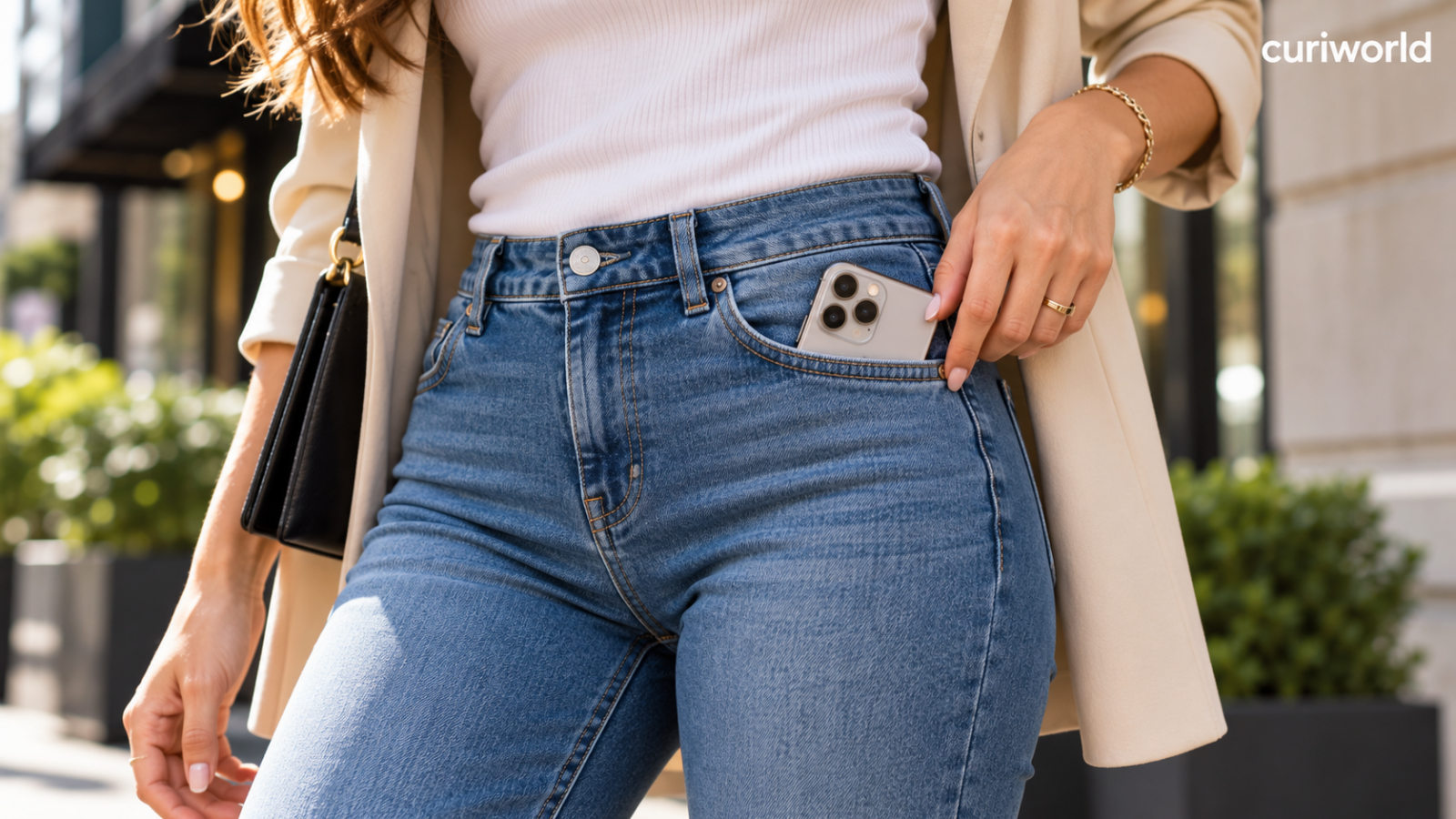
Try fitting a smartphone into the front pocket of many women’s jeans and you immediately notice the problem: half the phone sticks out, the pocket barely reaches your fingers, or there is no real pocket at all.
It is easy to assume women’s clothing has always been designed this way. It hasn’t.
Centuries ago, women often carried surprisingly large pockets—some big enough to hold money, keys, sewing tools, food and other everyday possessions. The modern pocket gap developed gradually as clothing styles changed, pockets moved, and handbags became a more visible part of fashion.
So why are women’s pockets so small today? The answer begins with a type of pocket most people would no longer recognize.
Women Once Had Much Bigger Pockets
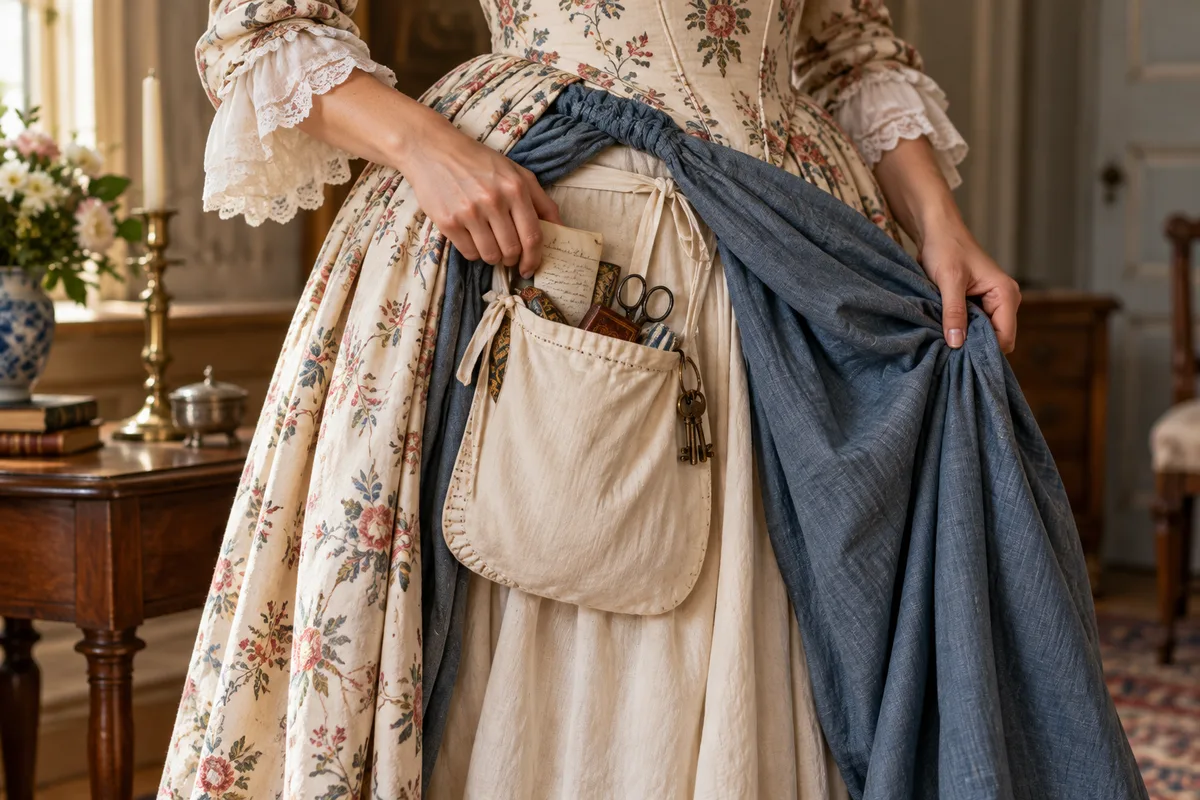
In Europe, women commonly wore tie-on pockets from around the 17th century onward.
These were not sewn into a dress. They were separate fabric pouches tied around the waist and worn underneath skirts or petticoats. Slits in the outer clothing allowed women to reach through and access them.
And they could be huge by modern standards.
The Victoria and Albert Museum notes that many surviving examples are roughly 40 centimeters long and 30 centimeters wide.
Women used them to carry practical possessions such as money, keys, spectacles, scissors, sewing equipment and personal papers. They could be worn individually or in pairs and moved from one outfit to another.
In other words, the idea that women historically had no useful pockets is wrong.
For some women, the opposite was true: their hidden pockets provided considerably more storage than the front pockets in many modern jeans.
Men’s and Women’s Pockets Developed Differently
The important historical difference was not simply that men had pockets and women did not.
Their pockets were built differently.
Men’s coats, jackets, waistcoats and breeches increasingly incorporated pockets directly into the garment. Women often relied on detachable pockets hidden beneath their clothing.
That distinction mattered because women’s pockets depended on the shape of the clothing worn over them.
When skirts were full and voluminous, there was plenty of space to hide a large pouch underneath without changing the visible silhouette.
But fashion did not stay that way.
Slimmer Dresses Changed the Pocket
By the early 19th century, fashionable women’s clothing had moved toward narrower silhouettes.
Suddenly, hiding a large fabric pouch underneath a dress became much harder.
The Museum at the Fashion Institute of Technology explains that the narrower silhouettes of the period could no longer easily conceal the large pockets worn beneath earlier skirts.
A different solution became fashionable: the reticule.
Reticules were small handbags typically carried by hand or on the wrist. Instead of keeping belongings inside a large hidden pocket, women could carry some of those possessions outside the garment.
This was an important turning point in the history of pockets.
But it does not mean handbags simply appeared one day and replaced them.
Did Handbags Kill Women’s Pockets?
This is one of the most popular versions of the story online—and it is too simple.
There is no convincing historical evidence of a handbag-industry conspiracy to eliminate women’s pockets.
Pockets and bags existed alongside one another for long periods.
The V&A points out that women could use different types of pockets and bags at the same time. The transition was gradual, influenced by changing silhouettes, social habits and clothing design rather than one coordinated decision to remove pockets.
Handbags did, however, provide another place to carry personal belongings.
Once carrying a separate bag became normal, clothing no longer had to provide all of a wearer’s storage itself.
That helped create a fashion system in which a woman could be expected to carry a purse while the garment prioritized silhouette over storage.
Modern Women’s Pockets Really Are Smaller
The difference between men’s and women’s pockets is not just a running joke.
In 2018, data publication The Pudding measured front pockets in 80 pairs of jeans from 20 popular U.S. brands.
The jeans were selected with 32-inch waist measurements so the comparison was not simply between larger men’s clothing and smaller women’s clothing.
The result was striking.
On average, the women’s front pockets in the sample were 48% shorter and 6.5% narrower than the men’s.
The researchers also tested whether common objects would fit. Only about 40% of the women’s front pockets they measured could completely hold one of the smartphones used in the comparison.
There is an important limitation: this was a specific sample measured in 2018, not every pair of jeans on the market today.
Still, it demonstrates that the pocket gap can be measured rather than dismissed as perception.
Why Are Women’s Pockets Still So Small Today?
History explains how the difference developed, but modern clothing design helps explain why it continues.
One reason is silhouette.
A functional pocket is not just the opening visible from the outside. There is a pocket bag made from fabric inside the garment.
In loose-fitting trousers, there is usually plenty of room for that fabric.
In tight jeans, fitted pants or body-hugging dresses, a deep pocket can create visible lines or additional bulk beneath the fabric. Designers may therefore use a shallower pocket to preserve the intended shape of the garment.
That is a design choice rather than a technical impossibility.
There are plenty of women’s pants, dresses and jackets with large functional pockets. The difference is which feature the garment prioritizes.
Some designs prioritize storage.
Others prioritize a particular silhouette.
Then Why Do Fake Pockets Exist?
Fake pockets may be even more frustrating than tiny ones.
But they make sense when you separate the appearance of a pocket from its practical function.
Pocket openings, flaps and welt details can visually break up a garment or create the appearance associated with tailored clothing. A designer can preserve that look without placing a full pocket bag underneath.
That is how you end up with a jacket that appears to have two pockets but gives you nowhere to put your hands.
There is one useful distinction, though.
Not every pocket that looks sealed is fake.
Some real pockets on new jackets, coats and trousers are temporarily stitched closed with loose thread so they keep their shape during manufacturing, shipping and retail display. If there is a genuine pocket bag behind the opening, the temporary stitching can usually be removed carefully.
A purely decorative pocket has nowhere to store anything even after the stitching is opened.
Pockets Were Also About Independence
The history becomes more interesting when pockets are viewed as more than pieces of fabric.
Fashion historian Barbara Burman examined the relationship between pockets, possessions, money and gender in her research on 19th-century Britain. Pockets gave people direct physical access to the things they needed during everyday life.
That could mean money.
Keys.
Work tools.
Letters.
Personal objects.
For women wearing large hidden tie-on pockets, this created a private and portable space for belongings that stayed close to the body.
That is one reason historians have become interested in pockets as evidence about everyday life rather than treating them as insignificant clothing details.
You can see the academic record for Burman’s research through the University of Southampton.
What About the Tiny Pocket Inside Jeans?
That little pocket inside the front pocket of classic jeans belongs to a completely different story.
It was originally created as a watch pocket for carrying a pocket watch in early riveted jeans.
Its tiny size therefore has nothing to do with the historical reduction of women’s pockets.
Curiworld explores that separate piece of clothing history in Why Do Jeans Have That Tiny Pocket? The Real Story Behind It.
It is a good example of the opposite phenomenon: instead of a useful feature disappearing as lifestyles changed, the pocket survived long after its original purpose became outdated.
So, Why Are Women’s Pockets Smaller?
There was no single moment when someone decided women should have tiny pockets.
The difference developed gradually.
Women once wore large detachable pockets beneath full skirts. Men’s pockets became integrated into clothing in a different way. As women’s fashion moved toward slimmer silhouettes, large hidden pockets became harder to accommodate. Small handbags became increasingly practical and fashionable, while clothing design placed greater emphasis on the shape of the garment itself.
Modern fashion inherited part of that history.
Today, the depth of a pocket still depends on the priorities of an individual garment—its fit, construction, silhouette and intended use.
That also means small pockets are not inevitable.
Perhaps the strangest part of the entire story is that demanding bigger pockets is not really asking fashion to invent something new.
Women had remarkably practical pockets centuries ago.








Join the discussion