Why Do Babies Put Everything in Their Mouth?
Babies explore the world with more than their eyes and hands. Discover why mouthing objects is a normal part of early development—and when parents should be cautious.
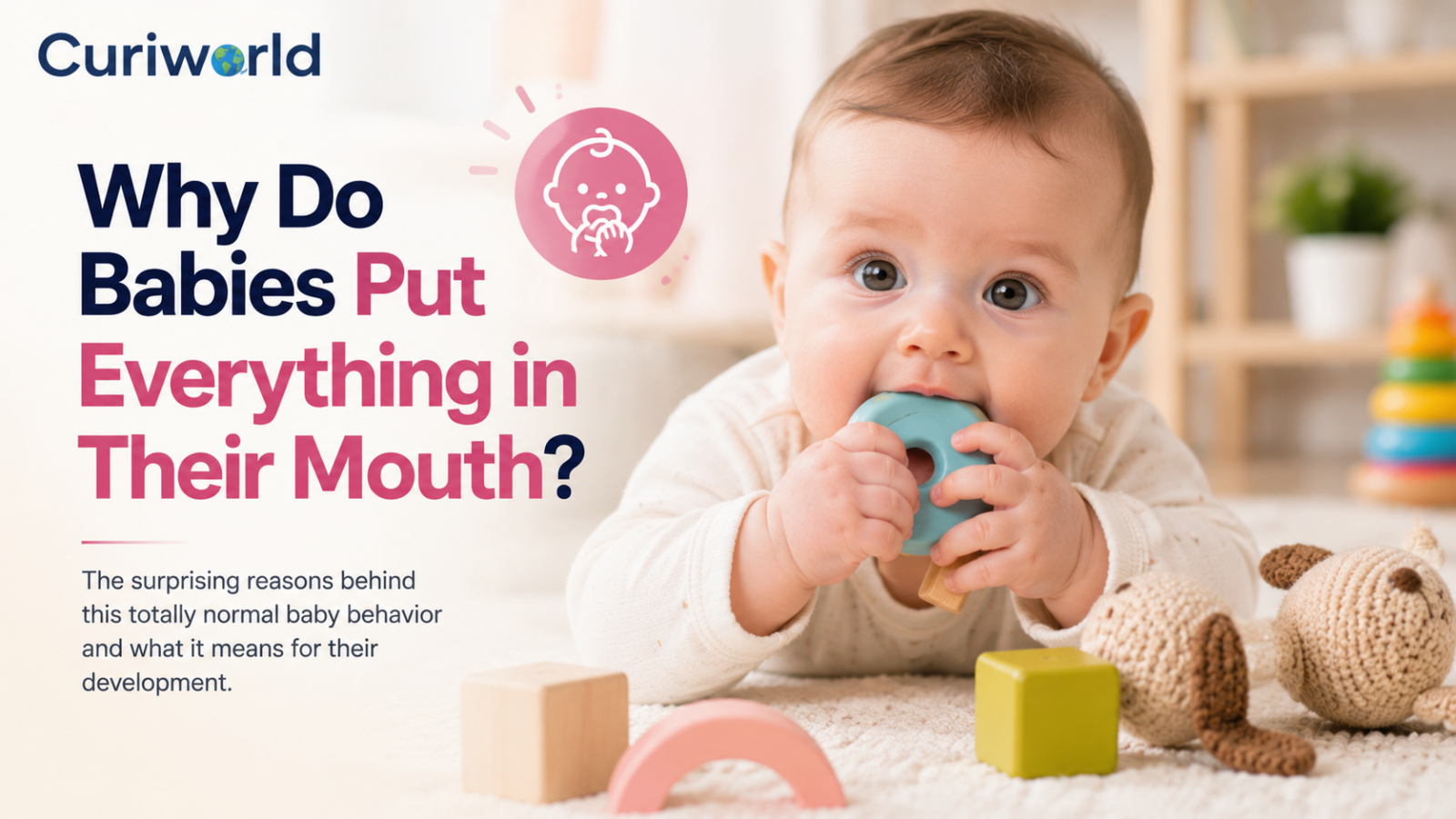
Give a baby a toy, a spoon, a clean sock, or almost anything else they can grab, and there is a good chance it will head straight toward their mouth.
To adults, the habit can look random—or slightly alarming. To a baby, however, mouthing objects is one of the simplest ways to investigate a world they are only beginning to understand.
Babies do not put everything in their mouths simply because they are hungry or teething. Mouthing is also part of early sensory exploration. As babies become better at reaching, grabbing, and holding objects, the mouth becomes another tool for discovering what those objects are like.
A Baby’s Mouth Is Part of Their Exploration System
Adults can inspect an unfamiliar object without touching it very much. We can look at its shape, recognize the material, guess whether it is hard or soft, and use years of experience to decide what it probably does.
Babies do not have that background knowledge yet.
Almost everything is new.
A toy block, a wooden spoon, a blanket corner, and a silicone teether may all be completely different experiences to a baby. Touching, squeezing, shaking, dropping, and mouthing these objects provide different kinds of information.
The American Academy of Pediatrics notes that babies can begin exploring the world with their mouths at around 3 months of age. This is one reason increased hand-to-mouth activity should not automatically be interpreted as a sign that a tooth is about to appear.
For a young baby, putting something in the mouth can simply mean:
“What is this?”
They cannot ask the question yet, so they investigate it physically.
Why Does Everything Go Straight From the Hand to the Mouth?
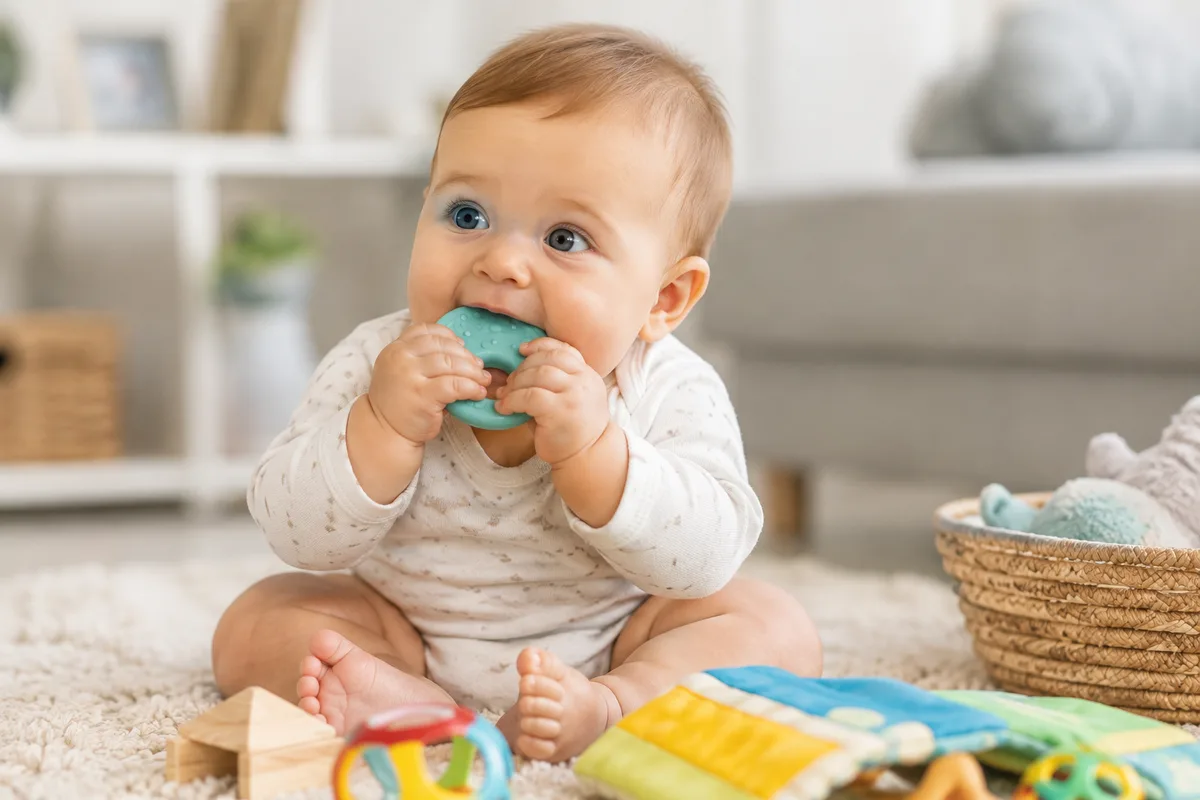
During the first months of life, babies gradually become more capable of controlling their hands.
At first, many movements are accidental. Later, babies begin deliberately reaching for objects, grasping them, turning them, and transferring them from one position to another.
Once an object reaches the hand, bringing it toward the face and mouth becomes part of that growing coordination.
That creates a familiar sequence:
See something.
Reach for it.
Grab it.
Bring it closer.
Put it in the mouth.
The behavior may look repetitive from an adult perspective, but repetition matters when you are learning how your own body works.
A baby who repeatedly grabs and mouths objects is practicing much more than chewing. They are coordinating vision, arm movement, hand control, and oral exploration at the same time.
It Is Not Always About Teething
Teething gets blamed for almost everything a baby does with their mouth.
Sometimes it does play a role. Babies who are teething may want to chew more because pressure can feel soothing on tender gums.
But mouthing commonly begins before the first tooth appears.
The American Academy of Pediatrics notes that babies may start exploring with their mouths and producing more saliva at around 3 months, while the first tooth commonly appears closer to 6 months, although timing varies considerably from baby to baby.
So a baby who suddenly seems determined to chew a toy at 3 or 4 months is not necessarily getting a tooth immediately.
The simplest explanation may be that the baby has discovered a new way to explore.
Babies Are Running Tiny Experiments
There is something surprisingly scientific about infant play.
A baby does not know that a rubber toy bends while a wooden block does not. They do not automatically understand that a spoon is smooth, a washcloth is soft, or a teether has a textured surface.
Those differences have to be discovered.
Babies experiment by:
- touching objects
- gripping them
- turning them over
- banging them
- dropping them
- shaking them
- and, very often, putting them in their mouths
This is part of a much larger pattern of early curiosity.
The same developing brain that becomes fascinated by texture can also become captivated by movement, contrast, and light. That is why seemingly ordinary household features can hold a baby’s attention for surprisingly long periods. Curiworld’s guide to why babies love ceiling fans and lights explores another side of this early sensory curiosity.
What looks ordinary to an adult is not ordinary to someone seeing, touching, and tasting the world for the first time.
Why Do Babies Mouth Things That Obviously Are Not Food?
Because “obviously not food” is an adult category.
You already know that a remote control, toy ring, shirt sleeve, and stuffed animal are not edible.
A baby is still learning the differences between objects.
That does not mean the baby literally expects every object to be food. Rather, their mouth is being used as an investigative tool before they have enough experience to classify the world the way an older child or adult does.
Over time, this changes.
As vision, hand control, memory, language, and understanding develop, babies gain many more ways to examine objects. Mouthing does not need to do as much of the exploratory work.
Should Parents Stop Babies From Putting Things in Their Mouth?
Normal mouthing does not need to be discouraged altogether.
What matters is controlling what is available to be mouthed.
Babies cannot judge whether an object is safe. Adults have to do that part for them.
A safe exploration area should be regularly checked for small objects, broken toy pieces, and anything else that could become a choking or ingestion hazard.
The Centers for Disease Control and Prevention recommends paying close attention to what young children put in their mouths and supervising them closely while they are eating. Choking risk depends partly on an object or food’s size, shape, texture, and consistency.
For everyday play, choose items designed for the baby’s age and inspect toys regularly for damage or loose pieces.
The goal is not to prevent exploration.
It is to make exploration safer.
Does Everything Need to Be Sterilized Constantly?
Babies mouthing toys can understandably make parents think about cleanliness.
Items designed to go into a baby’s mouth should be cleaned according to their care instructions, and obviously dirty objects should not be handed back for more chewing.
But trying to control every object becomes increasingly difficult once a baby can roll, crawl, reach farther, and eventually move independently.
The more practical approach is to keep the baby’s immediate environment reasonably clean while paying especially close attention to hazards.
A dusty toy may be unpleasant.
A small detachable object that can block the airway is a much more urgent concern.
That distinction helps parents focus their attention where it matters most.
When Does Mouthing Objects Usually Become Less Intense?
There is no single birthday when babies suddenly stop putting things in their mouths.
Development is gradual.
As babies grow, they become better at examining objects with their eyes and hands. They also learn what familiar objects are for.
A cup eventually becomes something to drink from.
A brush becomes something used on hair.
A toy phone may eventually be held to the ear instead of immediately chewed.
This shift reflects a broader change: objects are no longer only collections of interesting shapes and textures. They begin to acquire names, purposes, and meanings.
Mouthing can still continue during teething or ordinary play, but it becomes only one of many ways a child interacts with the environment.
When Should You Be More Cautious?
Ordinary mouthing is common in infancy, but the objects available to a baby matter enormously.
Seek appropriate medical help if you believe a baby has swallowed or inhaled something dangerous, is choking, or develops difficulty breathing.
Parents who are concerned about their baby’s feeding, swallowing, development, or unusual oral behavior should also discuss those concerns with their pediatric healthcare professional rather than trying to interpret one behavior in isolation.
This article provides general educational information and is not a substitute for individualized medical care.
Putting Everything in the Mouth Is Really About Learning
From an adult point of view, the behavior can seem simple:
Baby finds object. Baby eats object.
From the baby’s point of view, much more is happening.
They are reaching, grasping, coordinating movement, testing textures, discovering unfamiliar objects, and learning what their body can do.
Slowly, those repeated little experiments help build a mental map of the world around them.
So when a safe toy travels from the floor to a baby’s hand and immediately into their mouth, it is not necessarily a strange habit that needs to be stopped.
For a developing baby, it may simply be research.






Join the discussion