Babies Love Ceiling Fans and Lights — Is That Normal?
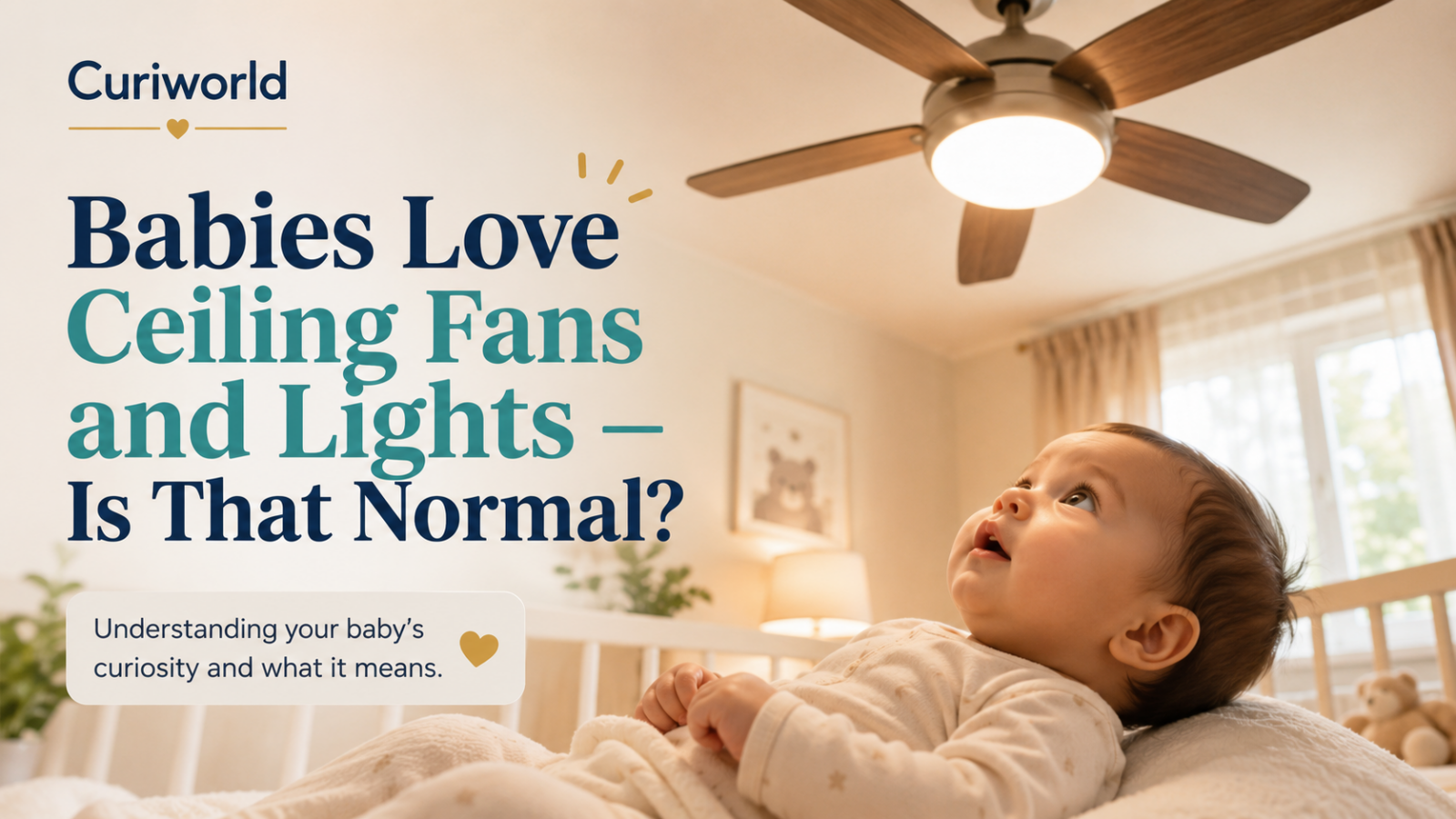
Ceiling fans and lights combine movement, contrast and simple patterns—exactly the kind of visual information a young baby's developing eyes notice easily.
You are holding your baby, talking, smiling, and doing your best impression of the most interesting person in the room.
Your baby looks straight past you.
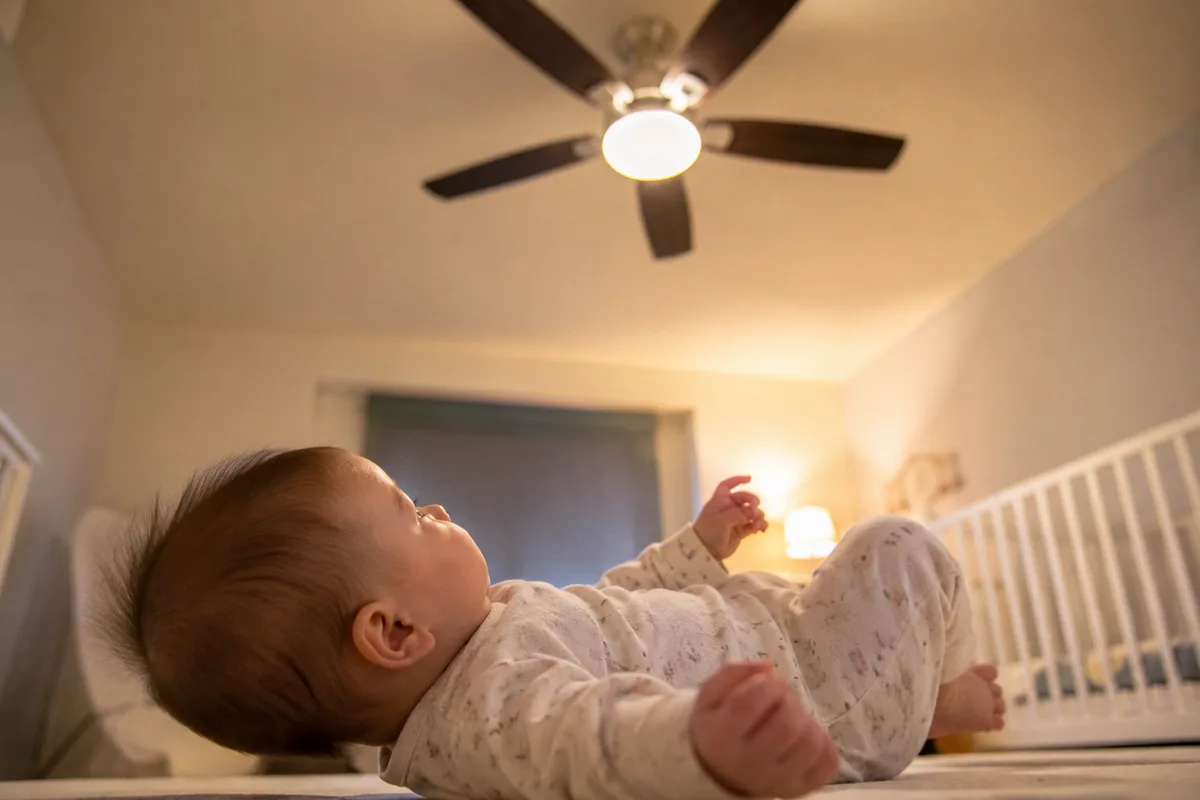
At the ceiling fan.
For several minutes.
Lights, ceiling fans, window blinds, shadows, and other ordinary household objects can become strangely fascinating to young babies. In most cases, this is a normal part of early visual development rather than a sign that anything is wrong.
The reason is simple: young babies are especially sensitive to movement, contrast, brightness, and simple visual patterns.
Why Is a Ceiling Fan So Interesting to a Baby?
A ceiling fan has several features that are almost perfectly designed to capture an infant’s developing visual attention.
It usually has:
- strong contrast against the ceiling
- large, simple shapes
- predictable movement
- repeating patterns
- changing shadows
- a central circular shape
Even adults notice movement automatically. For a baby whose visual system is still learning how to track and interpret the world, a large rotating object can be especially compelling.
Research on infant attention shows that moving and changing visual stimuli can attract attention from very early in life.
That does not mean babies understand what a ceiling fan is.
They are responding to visual properties that their developing brain finds easy and interesting to process.
That same drive to explore also helps explain why babies put almost everything in their mouths.
Babies Do Not See the World the Way Adults Do
A newborn’s eyesight is still immature.
According to the American Academy of Pediatrics, newborns can see light, shapes, faces, and movement, but distant vision is blurry.
They see most clearly at roughly 8 to 12 inches (20 to 30 centimeters)—about the distance between a baby’s face and a parent’s face during feeding.
During the first months, visual abilities develop quickly.
By around 3 months, babies generally become better at focusing on nearby objects and following moving objects with their eyes.
By around 4 months, they can distinguish more colors and shades and may show particular interest in circular patterns.
So something as ordinary as a spinning fan can provide exactly the kind of visual information their brain is currently learning to process.
Why Do Babies Stare at Lights?
Lights offer another powerful visual signal: contrast.
A bright lamp against a darker ceiling or wall creates an obvious difference in brightness.
Young infants tend to respond strongly to high-contrast visual information because fine detail and subtle color differences are harder for their immature visual system to distinguish.
This is also why black-and-white toys and high-contrast cards are commonly marketed for young babies.
The light itself is not necessarily the only interesting part.
A baby may actually be studying:
- the bright area around the bulb
- the darker fixture around it
- shadows on the ceiling
- reflections
- movement caused by people passing nearby
- the boundary between bright and dark areas
What looks like “staring at a lamp” to an adult may be a much richer visual experience for an infant.
Why Can a Baby Watch the Same Thing for So Long?
Adults quickly stop paying attention to predictable objects.
Babies are encountering many of those objects for the first time.
A ceiling fan turning repeatedly may seem boring to you, but your baby’s brain is still learning basic relationships such as:
It moves. It keeps moving. It disappears behind another blade. It returns. The shadow changes.
Infant attention is part of how babies gather information about their surroundings.
Studies of early visual development show that babies’ patterns of attention change dramatically during the first months and years of life as visual acuity and attentional control improve.
Simply watching something is one of the ways babies learn.
Does Staring at a Ceiling Fan Mean a Baby Prefers Objects to People?
Not necessarily.
Babies can be fascinated by a fan one moment and intensely interested in a parent’s face the next.
The American Academy of Pediatrics notes that even very young babies show an interest in human faces. Social attention also becomes increasingly obvious during the first months.
A single behavior—such as frequently watching a ceiling fan—should not be interpreted in isolation as evidence of a developmental condition.
Development is evaluated using patterns of abilities and behavior over time, not whether a baby happens to enjoy one particular object.
Is It Normal at 2 or 3 Months?
Yes, fascination with moving and high-contrast objects can be particularly understandable during this period.
Around 2 months, babies increasingly watch faces and begin following moving objects more effectively.
By 3 months, visual tracking and focusing continue to improve.
That means a ceiling fan can become even more interesting as the baby’s ability to follow movement becomes more sophisticated.
You may also notice your baby becoming fascinated with:
- mobiles
- curtains moving in the air
- tree branches outside a window
- your hair
- shadows
- striped clothing
- ceiling lights
- their own hands
These interests usually shift as new visual, motor, and social skills develop.
Should You Stop a Baby From Watching the Ceiling Fan?
There is generally no reason to interrupt ordinary visual exploration simply because a baby enjoys watching a fan.
You can still offer plenty of other age-appropriate stimulation:
- talk face-to-face
- slowly move toys for the baby to follow
- use high-contrast pictures
- give supervised tummy time
- move around the room so the baby sees different views
- let them watch everyday activity
Young babies do not need constant entertainment.
Quietly observing the room is also part of experiencing their environment.
When Is It Worth Mentioning to a Pediatrician?
Interest in fans or lights by itself is usually not the concern.
Pay more attention to the baby’s overall visual behavior and development.
The American Academy of Pediatrics recommends discussing vision concerns with a doctor if, for example, a baby around 3 months does not appear able to make steady eye contact or follow a moving object.
Persistent eye misalignment also deserves attention. Occasional wandering or crossing can happen in young newborns, but regular inward crossing or outward drifting after about 4 months should be discussed with the child’s doctor.
Other reasons to seek professional advice include situations where a baby:
- seems unable to see objects or faces
- does not respond visually to movement as expected for their age
- consistently uses one eye differently from the other
- develops unusual or repetitive eye movements
- loses a visual skill they previously had
Those are very different situations from a healthy baby who simply seems obsessed with watching a ceiling fan spin.
The Ceiling Fan Is Basically a Giant Baby Mobile
Adults see an appliance.
A young baby sees movement, contrast, repetition, shape, and changing light.
That combination explains why ceiling fans, lamps, windows, and shadows can compete surprisingly well with expensive baby toys.
As vision develops, babies gradually become interested in more complex objects, faces, colors, textures, and eventually things they can reach, grab, and explore themselves.
So if your baby occasionally ignores everyone in the room to stare happily at a spinning fan, the explanation is usually much simpler than it looks.
Their developing visual system has found something fascinating to study.







Join the discussion