Why Slow Travel Is Growing—and What Staying Longer Really Changes
Slow travel is less about taking a very long vacation than reducing unnecessary movement. Discover why longer stays are gaining attention and how slowing down can improve a trip.
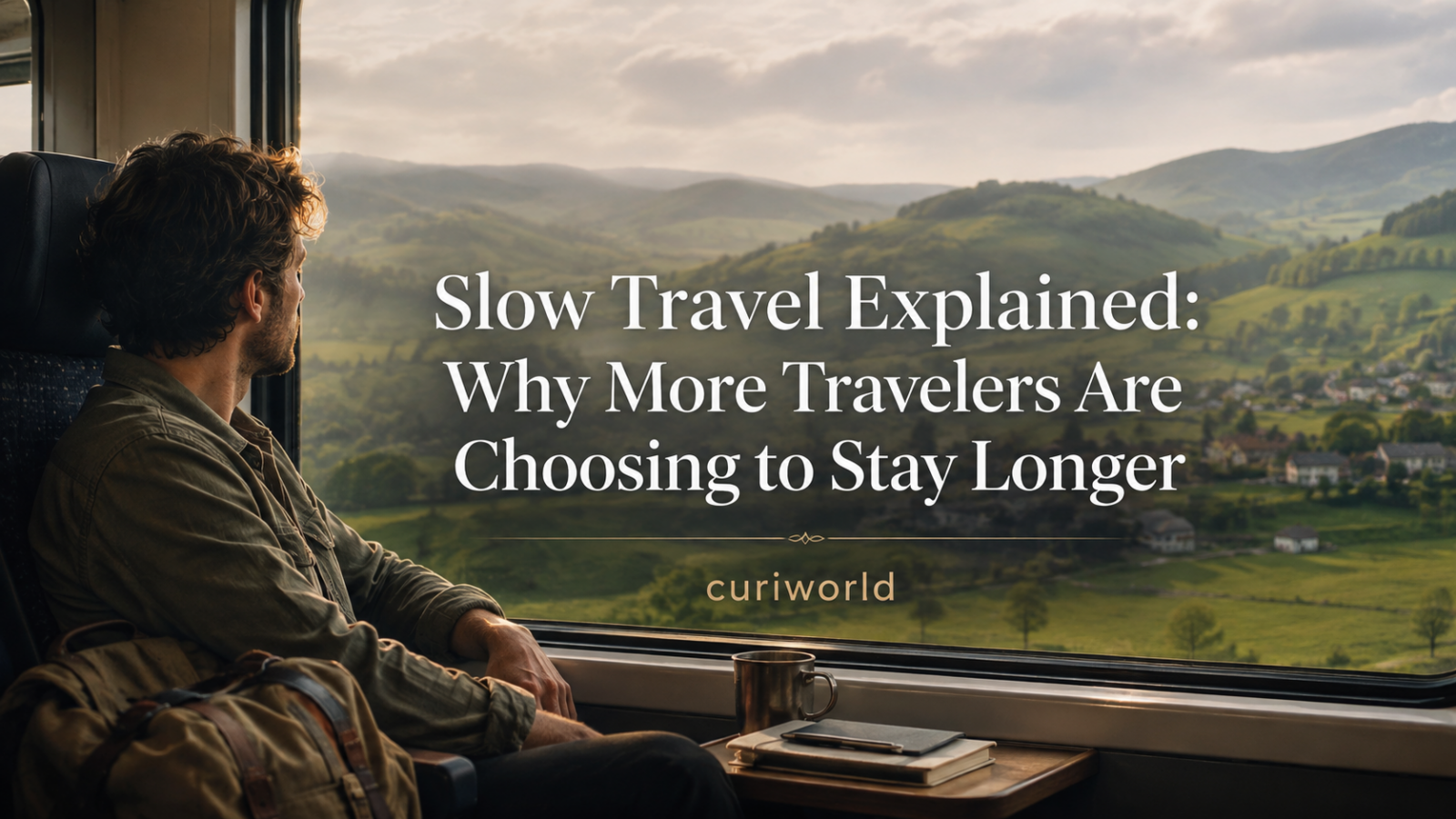
A vacation does not become slow simply because it lasts two weeks. You can spend 14 days changing hotels, catching early flights, checking arrival times, and racing through a list of landmarks. You can also spend five days in one neighborhood and experience a destination at a noticeably different pace.
That distinction is the heart of slow travel. It is less about moving at a literal crawl than about reducing unnecessary movement: fewer bases, more time in each place, greater flexibility, and enough breathing room to notice what happens between the headline attractions.
Interest in that approach is rising. The European Travel Commission’s 2026 Long-Haul Travel Barometer found that interest in slow travel among surveyed travelers considering Europe increased from 22% in 2025 to 26% in 2026.
What Does Slow Travel Actually Mean?
Slow travel has no universal rule requiring a minimum number of nights in one destination.
Academic research generally treats it as a broader way of thinking about travel: deliberately reducing speed and distance, valuing the journey as part of the experience, spending more time engaging with a place, and often choosing walking, cycling, rail, or other forms of ground transportation when practical.
More recent tourism research describes slow tourism through ideas such as flexible planning, stronger engagement with local communities, local consumption, richer destination experiences, and greater attention to the present moment.
That makes slow travel different from simply booking a long vacation.
A traveler who rents an apartment for three weeks but spends every day rushing between distant attractions may be staying longer without traveling slowly. Someone who takes a six-night trip, uses one town as a base, explores mostly on foot, and leaves part of the schedule open may be much closer to the idea.
The Idea of “Slow” Started Long Before the Current Travel Trend
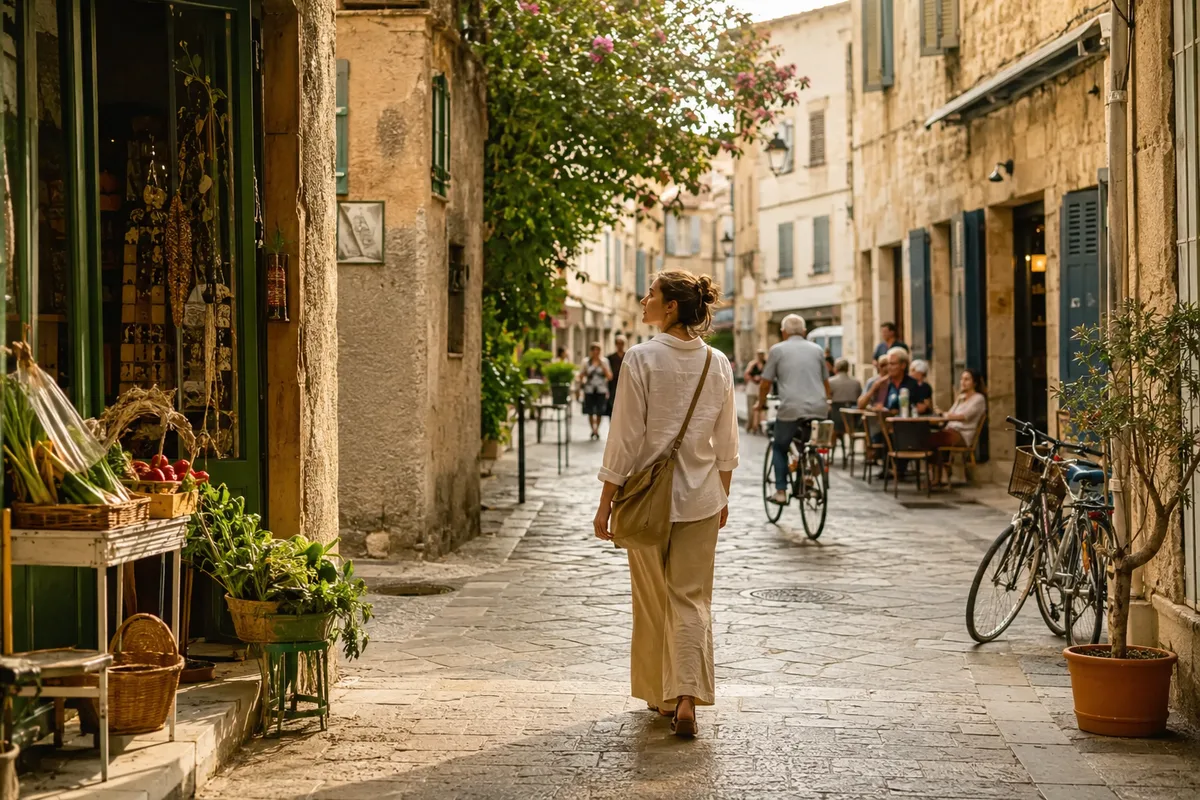
The language comes partly from the wider Slow Movement.
Slow Food traces its beginnings to Italy in 1986, when opposition to the opening of a fast-food restaurant near Rome’s Spanish Steps became a symbolic protest against homogenization and the loss of local traditions. Slow Food became an international movement in 1989.
Those ideas—local identity, time, quality, place, and resistance to constant acceleration—later appeared in discussions of tourism. By the early 2010s, researchers were already developing frameworks for slow travel and examining its relationship with transportation, climate change, and the tourist experience.
So the current popularity of slow travel is new in scale, not in principle.
Why Are More Travelers Interested in Staying Longer?
There is no single explanation, and the entire travel market is not moving in one direction.
Still, several changes help explain why longer, less fragmented trips have become more appealing.
Constant Movement Has a Hidden Cost
Changing destinations takes more time than the journey shown on a timetable.
There is packing, checking out, reaching the station or airport, waiting, traveling, finding the next accommodation, checking in, unpacking, and learning another transport system. On a tightly scheduled trip, a two-hour journey can consume much of a day.
Slow travel tries to reduce those transition days.
Staying in one place for longer also changes what becomes possible. A neighborhood market does not have to compete with a museum, three landmarks, a day tour, and a dinner reservation for space on the same afternoon. Ordinary experiences have time to become part of the trip rather than interruptions to the itinerary.
Travelers Are Showing More Interest in Experience-Led Trips
The European Travel Commission’s 2026 research found culture and heritage at the top of the activity preferences of long-haul travelers interested in Europe, followed by culinary experiences, city life, natural landscapes, and slow travel. The same report recorded a four-percentage-point increase in interest in slow travel from the previous year.
There is also evidence that longer trips did not begin with the 2026 trend cycle. Visa’s analysis of international travel patterns found that travelers from 70% of the countries and territories it studied had a higher average trip length in 2023 than in 2019. For roughly one in four origin markets, the increase was at least one full day.
That does not mean everyone is abandoning short trips. Current travel research still shows strong demand for shorter, flexible breaks alongside longer vacations.
Slow travel is better understood as a growing preference within a diverse travel market—not the replacement for every other kind of vacation.
What Changes When You Choose Fewer Stops?
The easiest way to see the difference is to compare the decisions behind the itinerary.
| Packed itinerary | Slow-travel approach |
|---|---|
| Several cities in a week | One main base, perhaps with nearby day trips |
| Attractions scheduled back-to-back | A few priorities with unscheduled time |
| Frequent hotel changes | Longer stay in the same accommodation |
| Transport chosen mainly for speed | Walking, rail, bus, or cycling when practical |
| Every meal planned as an attraction | Time for markets, neighborhood cafés, and repeat visits |
| Success measured by places covered | Success measured by the quality of the experience |
None of these choices has to be absolute. A flight can still be part of a slow trip. A famous attraction is not somehow incompatible with meaningful travel. Moving slowly does not require rejecting popular places or pretending that ordinary tourist experiences are inferior.
The real change is the amount of pressure placed on each day.
A slower itinerary can be especially useful when you are traveling alone for the first time. For destination ideas, see Curiworld’s first-time solo travel destinations.
Is Slow Travel Cheaper?
Sometimes. Not automatically.
Fewer intercity transfers can reduce spending on flights, train tickets, taxis, baggage fees, and repeated arrival-day expenses. Longer accommodation bookings may also qualify for weekly or monthly rates, while access to a kitchen can reduce restaurant spending.
If you are planning a first trip alone, staying longer in one easy-to-navigate destination can also reduce the pressure to keep moving. See 12 solo travel destinations for first-time travelers.
But a longer stay creates more accommodation nights and more days of daily expenses. Remaining for three weeks in an expensive capital can easily cost more than taking a compact seven-day trip.
Slow travel therefore works better as a budget structure than as a guaranteed money-saving strategy.
Instead of asking only, “How much does this hotel cost per night?” consider the total cost of movement: transportation between destinations, airport transfers, luggage charges, short-stay accommodation premiums, and the time lost repeatedly relocating.
For some trips, staying put is cheaper. For others, the reward is not a lower bill but a less fragmented experience.
Is Slow Travel More Sustainable?
It can be, but the details matter.
Transportation is crucial. Choosing a train over a short flight, walking instead of taking repeated car journeys, or traveling a shorter overall distance can substantially change the environmental profile of a trip. Slow-travel research has long treated mobility choices as one of the concept’s central elements.
Longer stays can also improve the relationship between the impact of reaching a destination and the amount of time spent there. Tourism sustainability frameworks increasingly consider length of stay when assessing the economic and environmental effects of visitor activity.
But “slow” should not be used as an automatic green label.
Flying thousands of miles for repeated extended trips does not become low-carbon simply because each visit lasts longer. Nor does staying longer guarantee that spending benefits local communities. Accommodation ownership, transportation, consumption patterns, seasonality, and the behavior of visitors all matter.
The more useful question is not Is this slow travel? but Which parts of this trip reduce unnecessary movement and keep more value in the place being visited?
Slow Travel Does Not Require a Month Away
The association between slow travel and digital nomads can make the idea seem inaccessible to anyone with limited vacation time.
It does not have to be.
A normal one-week trip can be redesigned around slower principles. Instead of trying to fit Paris, Brussels, Amsterdam, and Cologne into seven nights, for example, a traveler could choose one city or region and explore it at several scales: neighborhood, city, nearby town, countryside.
The number of vacation days has not changed. The ratio of experiencing to relocating has.
A practical slow-travel plan can be built around five decisions:
- Choose one strong base. Look beyond attractions. A useful base has groceries, places to eat, public transportation, walkable streets, and enough nearby options to make several days interesting.
- Limit the fixed itinerary. Choose a small number of experiences that genuinely matter rather than filling every morning and afternoon before arrival.
- Leave deliberate blank space. Unscheduled time allows for weather changes, local recommendations, a return visit to somewhere you liked, or simply a slower day.
- Reduce unnecessary transfers. A scenic train or regional bus can become part of the trip rather than dead time between destinations, especially when the alternative requires airport transfers and long waits.
- Spend beyond the tourism bubble. Local markets, independent restaurants, neighborhood businesses, guides, craftspeople, and locally operated experiences can distribute spending more widely—but “local” should be chosen thoughtfully rather than treated as a guarantee of authenticity.
The Best Slow-Travel Destination May Not Be the Most Famous One
Slow travel changes how destinations are evaluated.
A city with the longest list of landmarks is not necessarily the best place to stay for two weeks. Walkability, public transportation, nearby towns, access to nature, food markets, neighborhood life, and reasonable accommodation can matter more.
This also makes secondary cities and regional bases more interesting.
Instead of sleeping in a different town every night, a traveler can stay somewhere well connected and explore outward. The result is sometimes called a hub-and-spoke approach: one temporary home, several optional excursions.
The advantage is not merely convenience. Returning to the same streets changes your relationship with them. By the fourth or fifth day, navigation requires less attention. You recognize the route to the station. You know where to buy breakfast. A destination begins to feel less like a sequence of instructions.
That ordinary familiarity is difficult to schedule, which may be exactly why it appeals to slow travelers.
Slow Travel Is Not the Right Choice for Every Trip
There are perfectly good reasons to move quickly.
Someone traveling internationally for the first time may value seeing several major cities while the opportunity is available. A traveler with four vacation days cannot manufacture unlimited time. Family commitments, accessibility requirements, cost, visa limits, transport networks, and personal interests can all favor a faster itinerary.
Slow travel should not become another rule for doing tourism “correctly.”
Its most useful idea is much simpler: more movement does not necessarily produce more experience.
If changing destinations adds real value, move. If it is there only because another city can technically fit into the schedule, staying another night may produce the more memorable trip.
The Real Luxury May Be Having Less to Complete
Travel has become remarkably efficient. Routes can be optimized in seconds, reservations stacked into digital calendars, and famous places fitted into increasingly compressed itineraries.
Slow travel questions whether maximum efficiency is actually the point of leaving home.
The growing interest in longer stays suggests that at least some travelers are reconsidering what makes a trip feel valuable. The attraction is not simply spending more days away. It is creating enough time for a place to become more than a collection of highlights.
Sometimes that means taking the train instead of flying. Sometimes it means booking seven nights instead of four. And sometimes the most meaningful change is simply deleting one destination from the itinerary.
Sources
OECD — Measuring and Monitoring the Sustainability of Tourism at Regional Level in Spain: Indicator Framework and Compilation Guide
OECD report
Janet E. Dickinson, Les M. Lumsdon & Derek Robbins — Slow Travel: Issues for Tourism and Climate Change — Journal of Sustainable Tourism
Journal article








Join the discussion