Solo Travel Is Booming: 12 Places Perfect for Your First Trip Alone
Your first solo trip should feel exciting, not overwhelming. These 12 destinations combine easy transport, rewarding experiences, and beginner-friendly travel logistics.
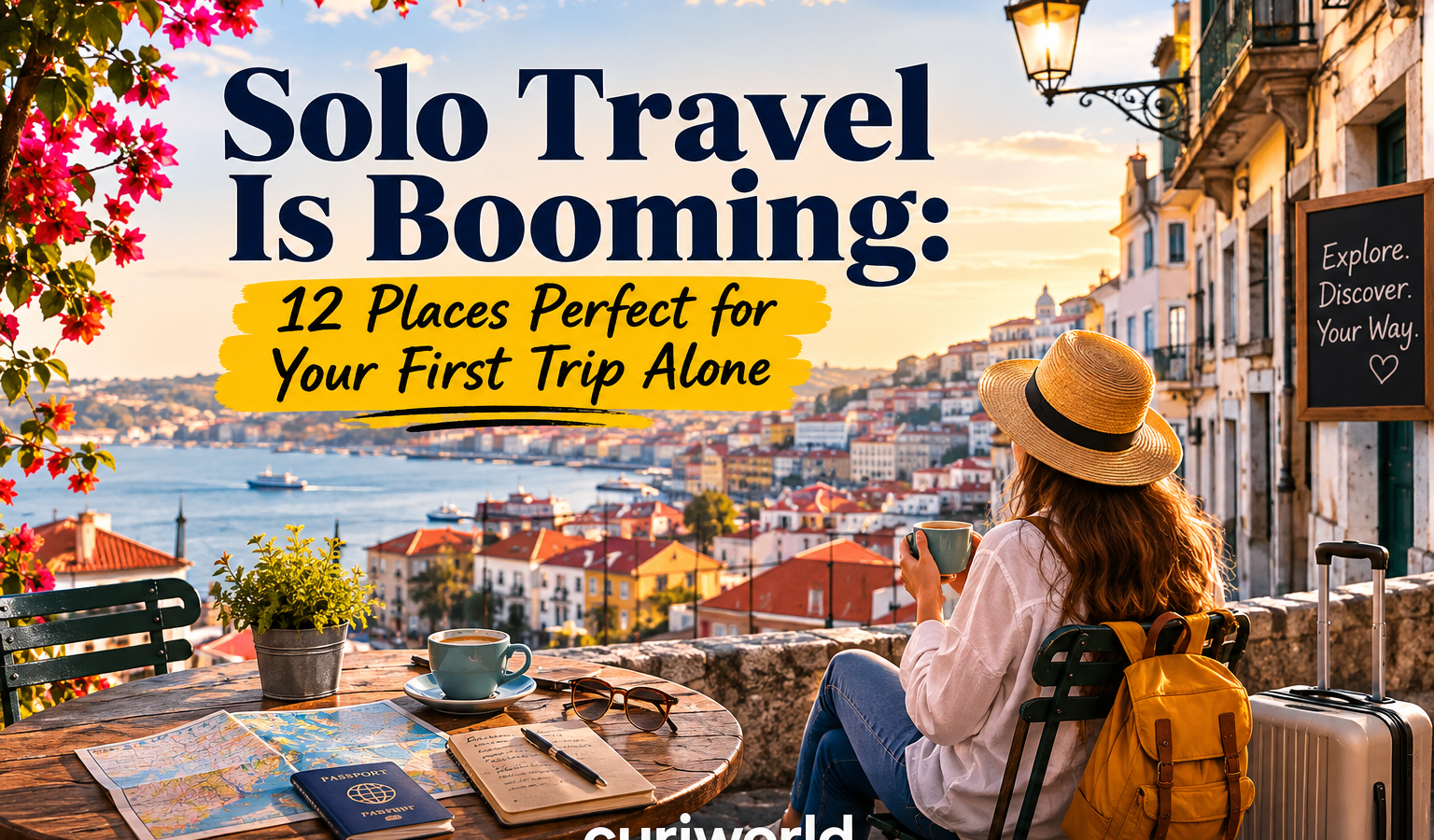
The hardest part of a first solo trip is rarely the moment you realize you are alone. It is carrying every small decision yourself: finding the train from the airport, choosing where to eat, figuring out the ticket machine, changing plans when it rains, and deciding whether you want company that evening—or absolutely none.
More travelers are deciding that the freedom is worth it. A 2026 Mastercard Travel Trendline survey conducted with The Harris Poll across 11 countries found that 39% of international travelers had already taken a trip alone, while another 35% said they would consider doing so. Seven in ten international leisure travelers were also interested in solo experiences that create opportunities to meet like-minded people.
Hostelworld’s 2025 State of Solo Travel report points in a similar direction within its own traveler community: freedom and spontaneity ranked among the strongest attractions of traveling alone, and 63% of first-time solo travelers surveyed said they intended to take more solo trips.
For a first trip alone, however, popularity is not enough. The better question is: Where will traveling by yourself feel easiest to manage?
What Makes a Destination Good for a First Solo Trip?
A destination can be spectacular and still be a difficult introduction to solo travel. A remote road trip, island-hopping itinerary, or city that practically requires a scooter might be unforgettable on trip number five but unnecessarily complicated on trip number one.
For this list, a strong first-time destination needs several things working in its favor:
- A reasonably straightforward way to get from the airport or station into the city
- Public transportation or a compact center that reduces dependence on a car
- Plenty to do without needing a companion
- Restaurants, cafés, markets, museums, neighborhoods, or tours where being alone does not become the focus of the experience
- Enough structure to make an unplanned day enjoyable
- Opportunities to meet people without making socializing compulsory
- Manageable consequences when you miss a train, choose the wrong street, or change your mind
That is why this is not a ranking of the world’s safest cities. Safety varies by neighborhood, time, current events, individual circumstances, and the precautions a traveler takes. Instead, these are places where the everyday logistics of traveling alone can be relatively forgiving.
If you would rather explore one place more deeply instead of moving between several cities, see why slow travel is growing and what longer stays really change.
What Is the Easiest Type of Destination for a First Solo Trip?
For a first solo trip, the easiest destination is usually not the most adventurous one.
A beginner-friendly place tends to have:
- simple airport or train connections,
- reliable public transportation,
- walkable central neighborhoods,
- plenty of activities that work well alone,
- accommodation in well-connected areas,
- and enough infrastructure that a small mistake does not derail the entire trip.
That is why compact cities and well-connected urban destinations often work better for a first solo trip than remote islands, complicated road trips or itineraries that require frequent transfers.
The goal is not to remove every challenge.
It is to make the logistics simple enough that you can focus on learning whether you actually enjoy traveling alone.
Which Solo Destination Is Best for You?
| If You Want… | Prioritize… |
|---|---|
| The easiest logistics | Compact cities with strong public transport |
| A social experience | Hostels, walking tours and active traveler communities |
| Quiet independence | Safe, walkable neighborhoods with cafés, museums and parks |
| A lower-stress first trip | One city rather than a multi-stop itinerary |
| Easy day trips | Cities with strong rail or regional transport |
| Less language friction | Destinations where visitor infrastructure is easy to navigate |
How Long Should Your First Solo Trip Be?
There is no perfect length, but a first solo trip usually becomes easier when the itinerary is simple.
A short trip of three to five nights can be enough to test the experience without committing to a long journey.
A week gives you more time to settle into a routine, recover from an awkward first day and explore without rushing.
The more important question is not the number of days.
It is how often you move.
For a first trip alone, spending five nights in one well-connected city is often easier than trying to visit three cities in the same amount of time.
1. Dublin, Ireland — Best for a Gentle First Step
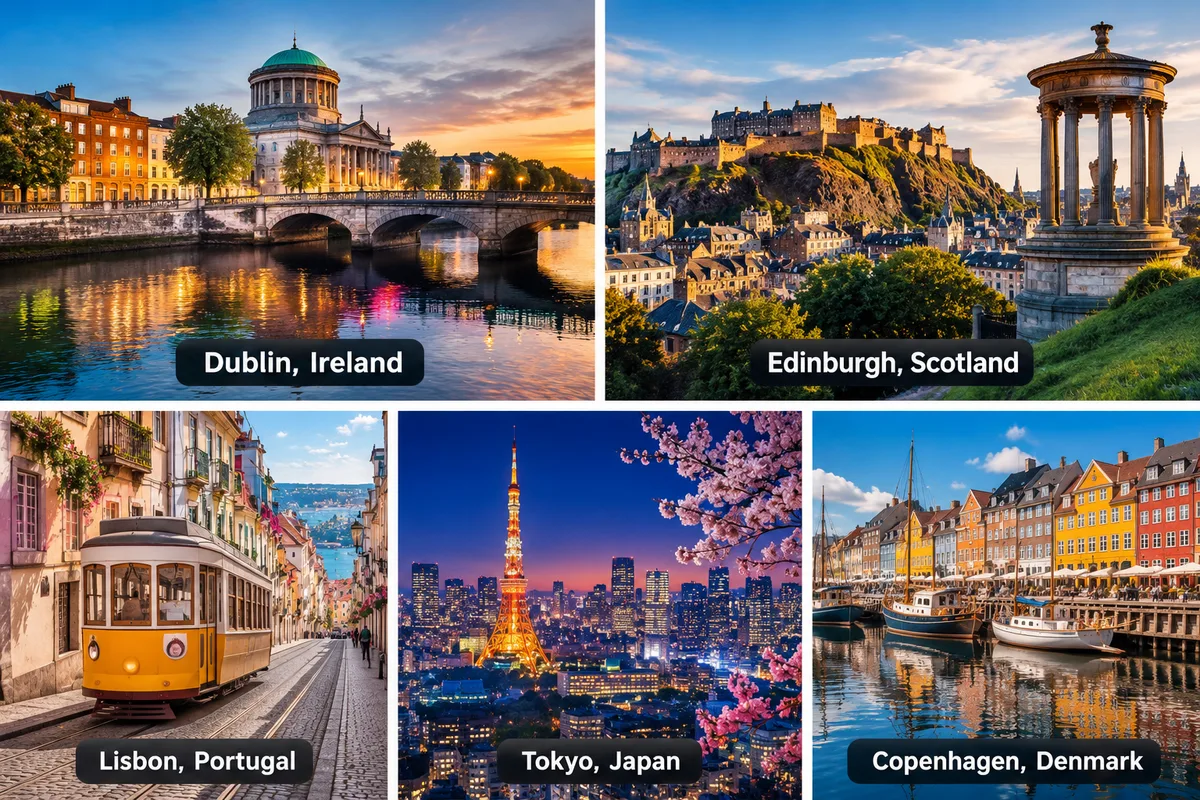
Dublin works particularly well when the psychological hurdle of traveling alone feels bigger than the logistical one. Its central area is compact enough to explore substantially on foot, while Dublin Bus, the Luas tram system, and DART trains make it easy to go farther.
There is enough history, live music, architecture, museums, and neighborhood wandering to fill a short trip without constructing an elaborate itinerary. An English-speaking environment can also remove one layer of uncertainty for many international travelers.
For a first solo trip, that simplicity matters. You can arrive, understand the basic geography fairly quickly, and spend more energy enjoying the city than solving transportation puzzles.
The catch: Dublin is not automatically a budget destination, particularly when accommodation demand is high. Check lodging prices before assuming a cheap flight means a cheap trip.
2. Edinburgh, Scotland — Best for Exploring Mostly on Foot
Edinburgh rewards wandering. Much of what gives the city its character—medieval lanes, Georgian streets, viewpoints, museums, cafés, and historic landmarks—is concentrated within a manageable central area.
It is an especially appealing choice if your ideal solo day involves having one planned attraction and allowing the rest of the afternoon to unfold around it. That style of travel removes the pressure to constantly invent entertainment for yourself.
The city’s buses and trams are useful when your feet need a break, but many first-time visitors can see a surprising amount simply by walking.
The catch: Edinburgh is hillier than a map suggests, and cobbled streets can make heavy luggage irritating. Major festival periods can also transform both crowds and accommodation prices.
3. Lisbon, Portugal — Best for Solo Travelers Who Want Social Energy
Lisbon combines the pleasures of an atmospheric old city with transportation that makes arrival less intimidating. The airport connects directly to the Metro network, and contactless payment options make public transportation relatively straightforward for visitors.
The city also lends itself naturally to solo days. Viewpoints, tiled streets, markets, museums, bakeries, waterfront walks, and short excursions provide structure without demanding a rigid schedule.
Travelers who want company can join a walking tour, food experience, hostel event, or day trip. Those who prefer their own space can spend an entire day moving between neighborhoods at their own pace.
The catch: those beautiful hills are real. Staying reasonably close to a Metro station can matter more than choosing the prettiest-looking street on a booking site.
4. Madrid, Spain — Best for Filling a Day Without Overplanning
Madrid is useful for a first solo trip because it gives you choices without forcing complicated logistics. Its extensive public transportation network makes it practical to move between major cultural areas, neighborhoods, parks, and transport hubs without hiring a car.
The Prado Museum, Reina Sofía, Retiro Park, food markets, café terraces, and neighborhood streets are all experiences that work perfectly well with one person.
Madrid also teaches one of the most enjoyable parts of solo travel: doing something simply because you want to do it, without negotiating the schedule with anyone else.
Want to spend three hours in a museum? Fine. Prefer to abandon the museum and sit in a park instead? Also fine.
The catch: Madrid runs later than many visitors expect. Adjusting your meal and evening rhythm can make the city feel much more natural.
5. Copenhagen, Denmark — Best for Travelers Who Hate Transportation Stress
Copenhagen makes urban movement unusually easy to understand. Its compact layout, Metro system, buses, trains, cycling infrastructure, and highly walkable central areas reduce many of the small logistical frustrations that can make a first solo trip feel tiring.
For a nervous first-time solo traveler, this matters more than it sounds.
Every routine task that becomes predictable—getting back to the hotel, reaching a museum, changing neighborhoods—leaves more mental space for enjoying the trip.
You do not need to rent a bicycle just because Copenhagen is famous for them. Walking and public transportation are perfectly valid ways to experience the city.
The catch: convenience comes at a price. Accommodation, meals, and everyday spending can add up quickly, so Copenhagen rewards a realistic budget.
6. Vienna, Austria — Best for Travelers Who Like Structure
Vienna is a strong match for people who want independence without chaos. The city’s U-Bahn, trams, buses, and suburban trains make it straightforward to build days around museums, palaces, markets, parks, and different neighborhoods.
Solo travel also fits Vienna’s cultural rhythm surprisingly well. Spending an hour in a museum, sitting over coffee, attending a concert, or walking through a park does not require a companion to feel complete.
That makes Vienna particularly comfortable for travelers who enjoy being alone but do not necessarily want to feel isolated.
The catch: travelers hoping to make spontaneous new friends every evening may find Vienna less immediately social than some hostel-centered destinations. Depending on your personality, that may be either an advantage or a drawback.
7. Ljubljana, Slovenia — Best for Keeping Things Small
Not everyone wants their first solo arrival to be in a city of ten million people.
Ljubljana offers almost the opposite experience. Slovenia’s capital has a compact center with a large pedestrian area, making it relatively easy to understand the city’s layout quickly.
That scale can be liberating.
You can learn the basic geography in a short time, return to places you liked without crossing half the city, and spend less time wondering whether an attraction will consume most of the afternoon just to reach it.
Ljubljana can also work as a base for seeing more of Slovenia once your confidence grows.
The catch: international flight options are more limited than in Europe’s largest capitals, so reaching Ljubljana may require a connection depending on where you begin.
8. Tokyo, Japan — Best for Discovering That “Big” Does Not Mean Unmanageable
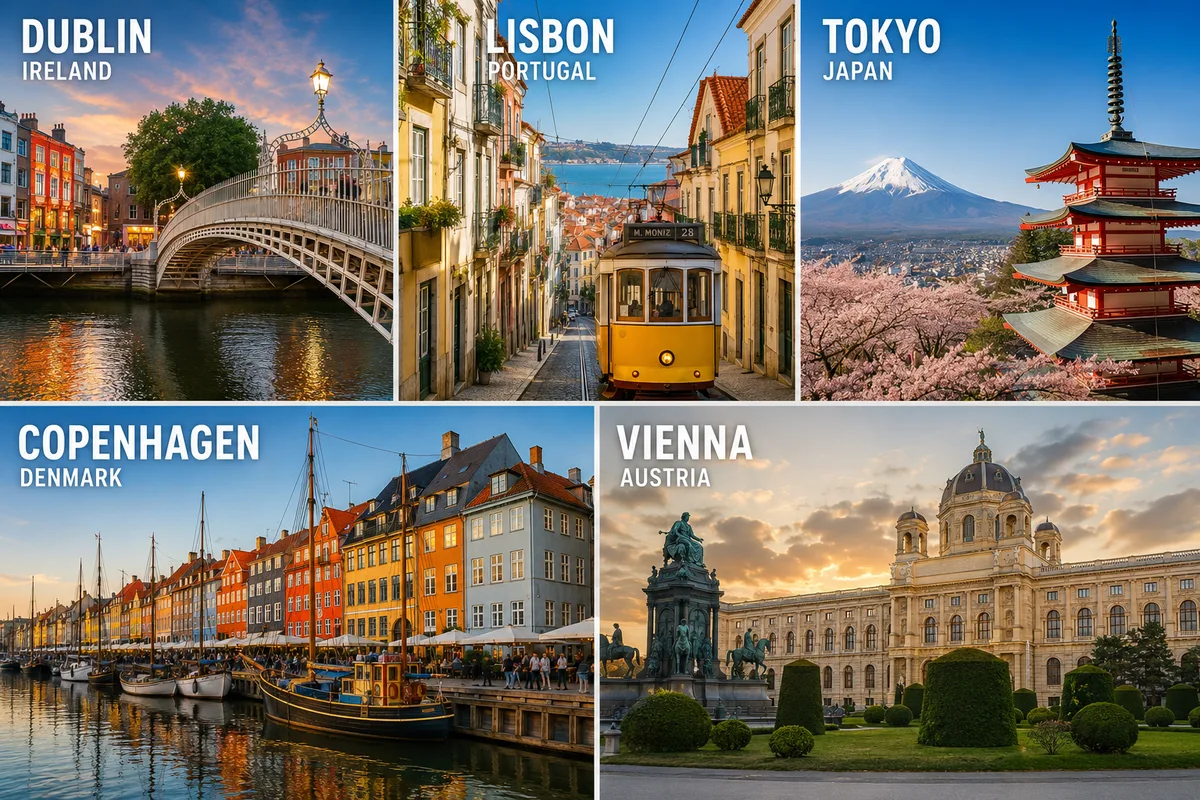
Tokyo looks intimidating on a map. On the ground, its transportation system can make an enormous city surprisingly usable once you stop trying to understand all of it at once.
The better first-timer strategy is to think in neighborhoods rather than trying to “do Tokyo.”
Choose two or three areas for a day and let the trains handle the distance between them.
Museums, gardens, observation decks, shopping streets, ramen counters, cafés, shrines, bookstores, and long neighborhood walks give solo travelers an enormous number of activities that require no group.
Japan’s well-developed rail networks, increasingly multilingual signage, and rechargeable transit cards also reduce some of the practical barriers first-time visitors may expect.
The catch: Tokyo’s system is logical but vast. Learn your route before the morning rush, and pay attention to the time of the last train when staying out late.
9. Singapore — Best for a First Solo Trip to Asia
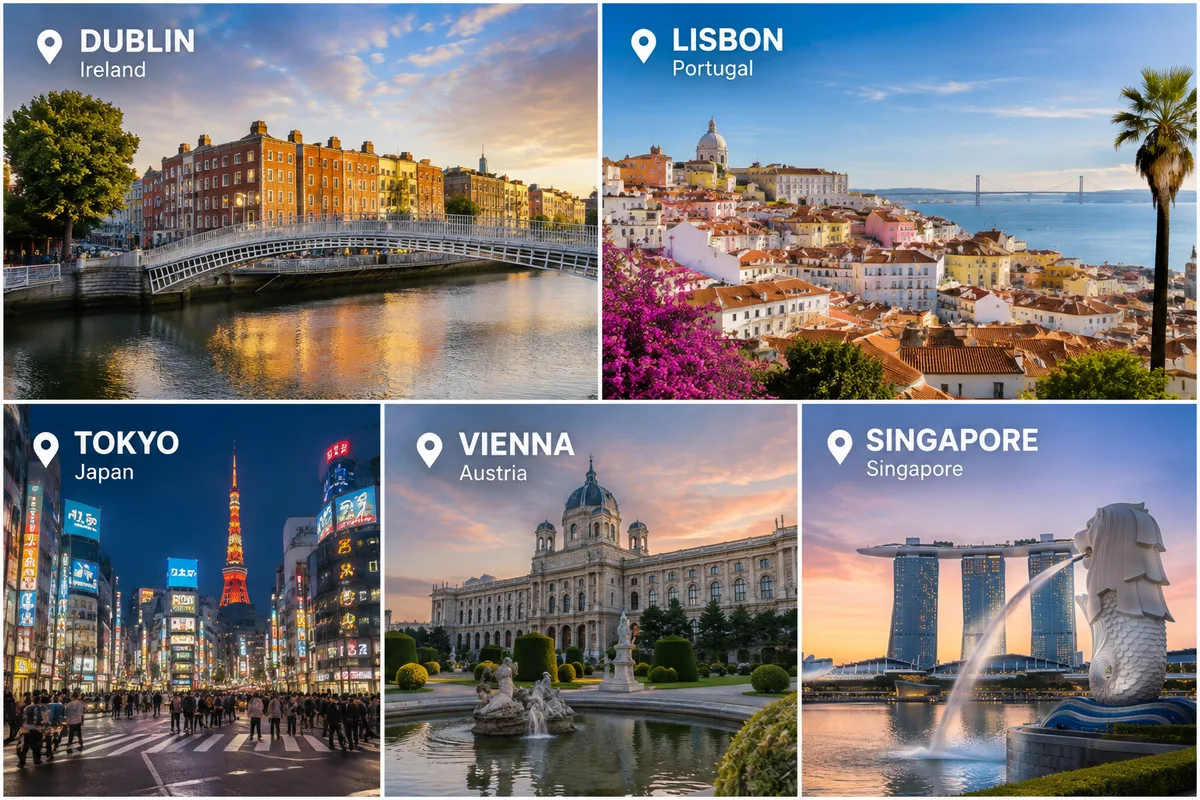
Singapore removes several of the frictions that can make a first long-distance solo journey feel daunting.
Its MRT and bus networks cover the city extensively, while contactless payment and visitor-friendly transportation options simplify many everyday journeys.
A single day can move easily between hawker centers, waterfront architecture, gardens, museums, historic districts, and modern shopping areas without needing a rental car.
That makes Singapore particularly useful for someone who wants the excitement of traveling far from home without adding complicated ground transportation to the first attempt.
Food is another advantage. Hawker centers let solo travelers try a wide range of dishes without the formality of booking restaurant tables for one.
The catch: hotel prices can be considerably less forgiving than public transportation. Tropical heat and humidity can also make an itinerary that looks modest on paper feel more demanding on foot.
10. Seoul, South Korea — Best for Travelers Worried About Eating Alone
Food can create an oddly specific anxiety on a first solo trip.
Will the restaurant seat one person? Is the dish designed for two? Will eating alone feel conspicuous?
Seoul is an interesting case because traditional group dining remains important while solo consumer culture has grown noticeably. More restaurants, cafés, convenience stores, and casual dining options now accommodate people eating alone.
The city’s extensive subway system also connects neighborhoods filled with palaces, museums, markets, cafés, shopping streets, parks, and riverside spaces.
There is little reason for a solo day to feel empty.
The catch: some Korean barbecue restaurants and shared dishes still work better for two or more people. Saving several solo-friendly meal options in advance removes that small but real source of friction.
11. Melbourne, Australia — Best for Travelers Who Like Being Alone in Public
Melbourne is particularly good at the kind of activity that makes solo travel feel normal: sitting in a café, browsing a market, visiting a gallery, walking through a neighborhood, or taking public transportation somewhere simply because it looks interesting.
Its trains, trams, buses, and central Free Tram Zone make moving around the city reasonably straightforward.
For English-speaking travelers especially, Melbourne can provide the emotional novelty of a major solo journey without adding a language barrier to every small interaction.
The city is also well suited to people who prefer a slower rhythm. You do not need to rush between landmarks for Melbourne to feel worthwhile.
The catch: getting there is the difficult part for much of the world. Long flights and the overall cost of an Australian trip make Melbourne better suited to travelers who have enough time and budget to justify the distance.
12. Montréal, Canada — Best for a First Solo Trip in North America
Montréal combines the familiarity of a North American city with enough linguistic, architectural, and culinary difference to make the trip feel distinctly elsewhere.
Its Metro system is relatively straightforward, while many of the neighborhoods visitors are most likely to explore work well on foot.
Old Montréal, Mount Royal, markets, museums, independent shops, cafés, and neighborhood streets give a solo traveler plenty to do without building every day around ticketed attractions.
You will hear plenty of French, but visitors do not need flawless French to enjoy the city. Learning a few basic phrases is still both useful and courteous.
The catch: season matters enormously. Montréal in pleasant early-fall weather and Montréal in the depths of winter can feel like two very different first-solo-trip experiences.
Popular Does Not Always Mean Beginner-Friendly
Some of the world’s most beloved solo-travel destinations are missing from this list on purpose.
Thailand, Indonesia, Iceland, and other major solo-travel favorites can be superb choices. But a destination’s popularity among experienced independent travelers does not automatically make it the simplest place for a nervous first attempt.
A trip built around driving through unpredictable weather, changing islands, renting scooters, or coordinating multiple transportation modes adds decisions.
Those decisions may be part of the adventure later.
For trip number one, there is a strong argument for choosing a city where you can arrive, check in, understand the basic transportation system, and start exploring.
Your first solo trip does not have to be your most ambitious one.
If you would rather explore one place more deeply instead of moving between several cities, see what slow travel is and what longer stays change.
A First Solo Trip Should Be Easy, Not Risk-Free
No serious travel guide can promise that a city is completely safe for solo travelers.
Conditions change, incidents can happen anywhere, and risk is not identical for every traveler. Neighborhood, time of day, local events, personal circumstances, and travel habits all matter.
Before traveling, check current government travel advice for your destination, arrange suitable insurance, keep copies of important documents, and make sure someone you trust knows your basic itinerary.
It also helps to make the first 24 hours deliberately simple.
Know how you are getting from the airport to your accommodation. Arrive with your phone charged. Save your accommodation address offline. Avoid scheduling three major activities immediately after a long flight.
Confidence tends to grow much faster once the basics are working.
Choose the Place That Lowers Your Personal Friction
The best destination on this list depends on what makes you nervous.
If language is the biggest concern, Dublin, Edinburgh, Melbourne, or Montréal may feel easier.
If transportation anxiety dominates, Copenhagen, Vienna, Singapore, or Tokyo are compelling choices.
If a giant city sounds exhausting, Ljubljana offers an entirely different scale.
If you are worried that traveling alone will feel socially isolating, Lisbon or Madrid provide plenty of ways to be around other people without committing to a group itinerary.
A successful first solo trip does not need to prove how fearless or independent you are. It only needs to give you enough freedom to discover whether you enjoy choosing the next street, meal, museum, train, or quiet afternoon entirely for yourself.
That is the moment solo travel begins to make sense.
Mastercard — The Modern Traveler Has a New Itinerary: Smarter, Bolder, More Personal Than Ever — Mastercard Travel Trendline 2026
Hostelworld — 2025 State of Solo Travel Report — Hostelworld State of Solo Travel





Join the discussion