Cooked Chicken in the Fridge: When Is It Time to Throw It Out?
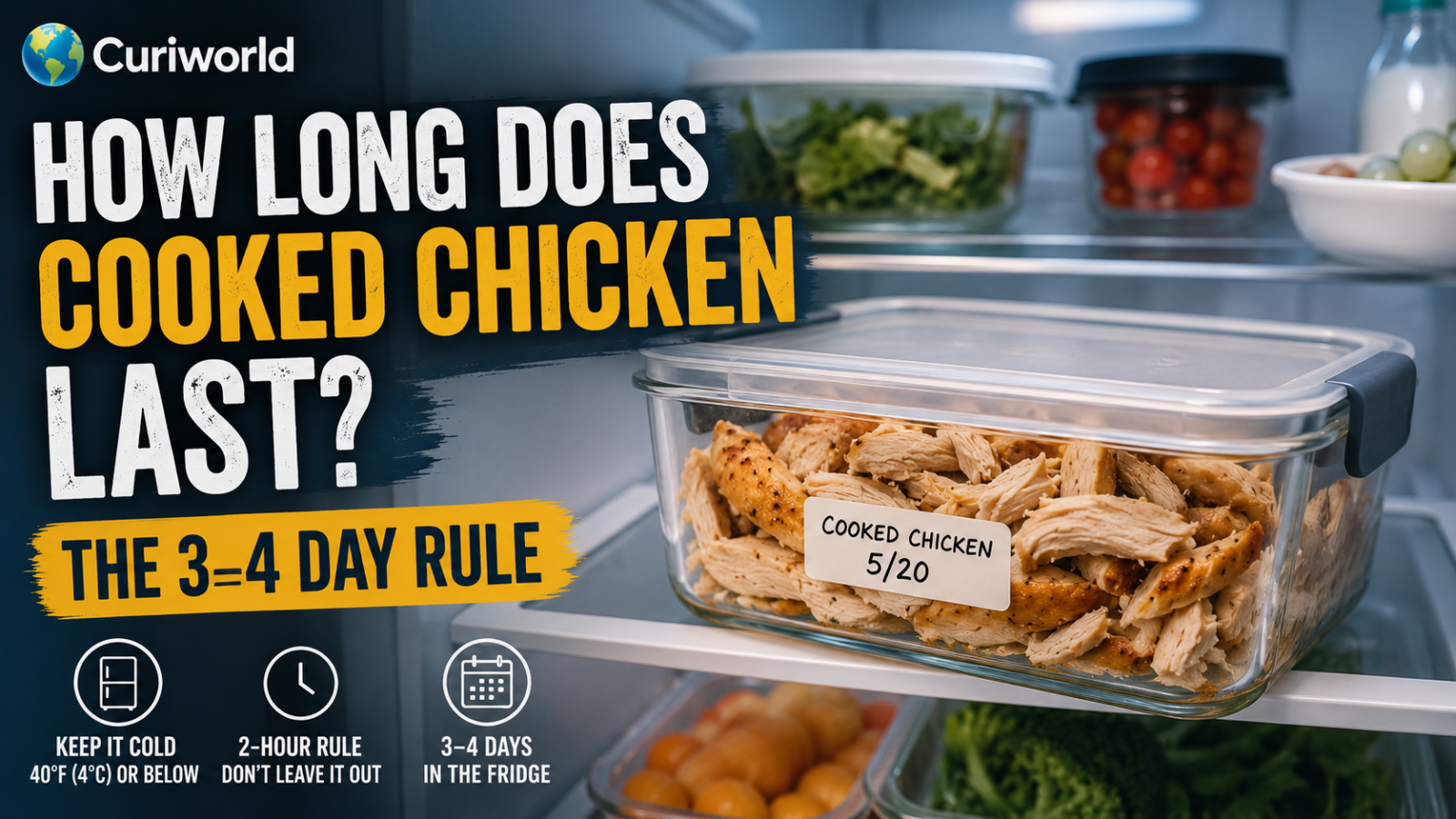
Cooked chicken generally lasts 3–4 days in the refrigerator—but only if it was chilled promptly and stored at 40°F (4°C) or below. Here's how to know when to eat, freeze or throw it out.
You cooked chicken a few nights ago, packed the leftovers into the fridge and forgot about them.
Now you’re hungry.
The chicken looks normal. It doesn’t smell strange. But you can’t quite remember whether tonight is day three, day four… or day five.
So, is it still safe to eat?
For properly stored cooked chicken, the practical refrigerator limit is 3 to 4 days when kept at 40°F (4°C) or below.
That applies to more than a plain chicken breast. USDA guidance gives the same 3-to-4-day refrigerator window for many cooked chicken foods, including fried chicken, rotisserie chicken, chicken casseroles and restaurant leftovers.
But there is an important catch:
Those four days assume the chicken was handled safely before it reached the refrigerator.
How Long Does Cooked Chicken Last in the Fridge?
For most cooked chicken, remember:
3–4 days in the refrigerator.
Here is what that looks like in practice:
| Cooked Chicken | Refrigerator Storage |
|---|---|
| Cooked chicken leftovers | 3–4 days |
| Fried chicken | 3–4 days |
| Rotisserie or takeout chicken | 3–4 days |
| Chicken casseroles or dishes | 3–4 days |
| Chicken soup | 3–4 days |
| Chicken nuggets or patties | 3–4 days |
These times assume the refrigerator stays at 40°F (4°C) or colder.
So if you cooked chicken on Monday, you should be thinking in terms of using it during the next few days—not saving it for the following weekend.
The storage window is different before cooking; see how long raw chicken can safely stay in the refrigerator.
Can You Eat Cooked Chicken After 5 Days?
This is where the internet tends to make a simple answer unnecessarily complicated.
USDA’s recommended refrigerator storage window for cooked chicken leftovers is 3 to 4 days.
That means day five is beyond the recommended refrigerated storage period.
It doesn’t matter whether someone online says they routinely eat week-old chicken without a problem. Personal experience does not extend an official food-safety recommendation.
And there is another reason not to rely on confidence alone:
Unsafe food does not always look unsafe.
If cooked chicken has already passed the recommended refrigerator window, smelling it and deciding that it “seems fine” is not a reliable way to give it extra days.
If you weren’t going to eat it within 3 to 4 days, freezing it earlier would have been the better move.
The First Two Hours Matter
The refrigerator timeline doesn’t begin in isolation.
What happened immediately after the chicken was cooked matters too.
Perishable foods should generally be refrigerated within 2 hours of cooking or purchasing.
When the surrounding temperature is above 90°F (32°C), that window drops to 1 hour.
Think about a summer barbecue.
Chicken comes off the grill at 1 p.m. and sits on the table until late afternoon.
Putting those leftovers into the refrigerator does not magically turn them into safely handled chicken with a fresh four-day window.
The same rule matters for:
restaurant leftovers;
takeout chicken;
picnics;
buffets;
and rotisserie chicken brought home from the store.
Refrigeration slows bacterial growth. It does not erase earlier temperature exposure.
Does Rotisserie Chicken Follow the Same Rule?
Yes.
That supermarket rotisserie chicken may feel different from homemade leftovers because you bought it already cooked, but the storage principle is essentially the same.
USDA recommends eating or refrigerating ready-prepared chicken within 2 hours of purchase.
If you aren’t going to eat a hot rotisserie chicken within that time, cut it into smaller pieces and refrigerate it in shallow, covered containers.
Once refrigerated properly, USDA lists rotisserie and other takeout chicken at 3 to 4 days.
So buying it on Tuesday doesn’t make it a Sunday dinner plan unless you freeze it.
Can You Tell If Cooked Chicken Has Gone Bad?
Sometimes you can tell that chicken should be discarded.
An unpleasant or unusual odor, obvious mold or a major change in texture or appearance can all be warning signs.
But those signs answer only part of the question.
Spoilage and food safety are not exactly the same thing.
Some harmful microorganisms may be present without producing an obvious smell or dramatic visual change.
That means:
Bad smell → don’t eat it.
But:
Normal smell → not proof that it is safe.
The same goes for taking a small bite to “test” old chicken.
Your storage timeline is more useful than a taste test.
If you know the chicken is beyond its recommended refrigerator period, don’t ask your nose to overrule the calendar.
What If the Chicken Was Left Out Overnight?
Discard it.
Cooked chicken is a perishable food, and an entire night at room temperature is far beyond the recommended 2-hour limit.
The same time-and-temperature principle applies to many other leftovers too. See how long cooked food can safely stay at room temperature for the broader food-safety rule.
Reheating it the next morning is not a dependable rescue strategy.
This is worth emphasizing because “I’ll just heat it really well” sounds intuitively safe.
But cooking or reheating does not necessarily undo every consequence of improper storage. Some microorganisms can produce toxins that may survive heating.
If chicken spent the night on the counter, the issue is no longer how many days it can stay in the refrigerator.
Its safe storage history was already interrupted.
Should Cooked Chicken Cool Before Going Into the Fridge?
You don’t need to leave chicken sitting on the counter until it becomes completely cold.
Prompt refrigeration is the goal.
For a small amount of cooked chicken, it can be refrigerated while still warm.
For a large batch, divide it into smaller portions and use shallow containers so it cools more quickly.
This is especially useful after:
meal prepping;
roasting a whole chicken;
making a large chicken casserole;
or cooking chicken for a party.
A huge, tightly packed container cools more slowly in the center than several smaller portions.
And smaller containers have another advantage: you can remove only what you plan to eat instead of repeatedly warming the entire batch.
What’s the Best Way to Store Cooked Chicken?
Keep things simple.
Place cooked chicken in a covered container or sealed food-storage bag and refrigerate it promptly.
If you’ve cooked a large quantity, divide it into meal-sized portions.
Then add one tiny step that prevents a surprising amount of uncertainty:
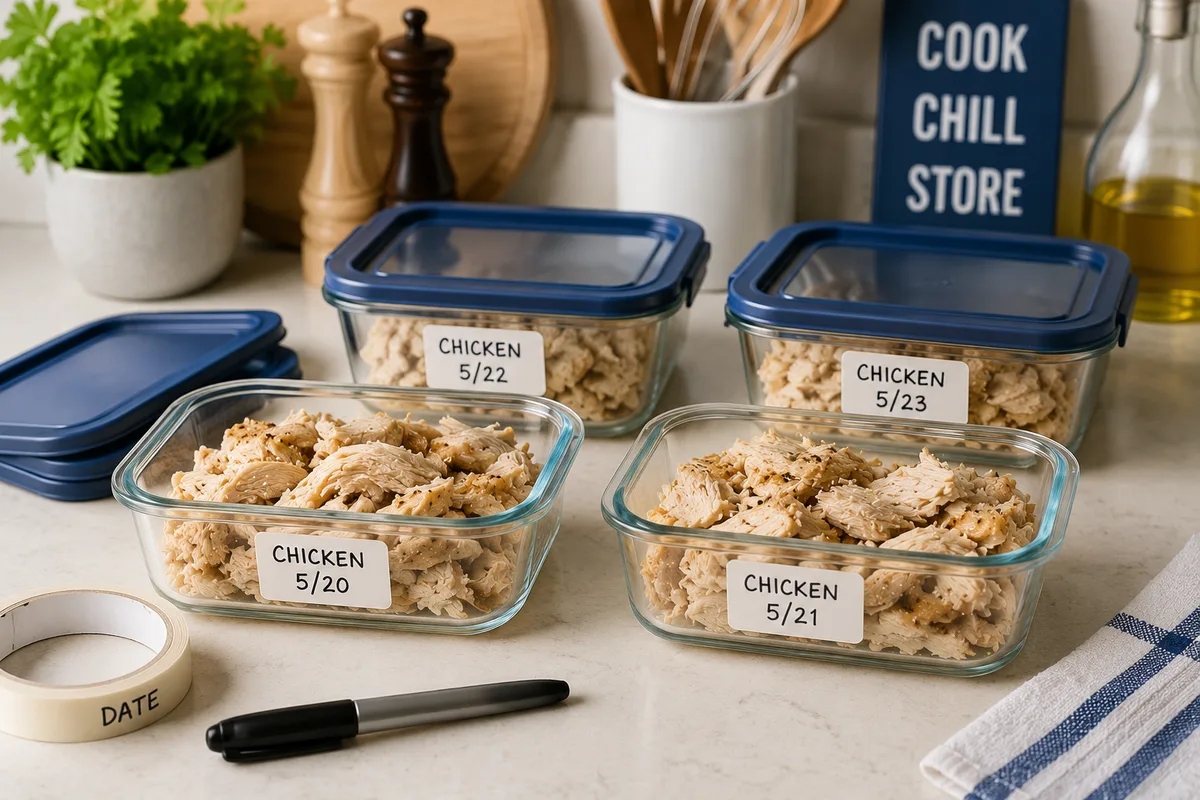
Write the date on the container.
“Chicken — Monday” is enough.
You no longer have to open the fridge on Thursday and debate whether you actually cooked it Monday or perhaps Sunday.
For food that only gets a few refrigerator days, a date label is genuinely useful.
Can You Freeze Cooked Chicken?
Yes—and if you aren’t going to eat it within 3 to 4 days, freezing is the obvious alternative.
USDA lists about 4 months in the freezer for best quality for ordinary cooked chicken leftovers and several types of prepared chicken.
That freezer timeline is mainly about quality when food remains continuously frozen at 0°F (-18°C).
For better results, freeze chicken in airtight packaging or freezer-safe containers and portion it before freezing.
That way you don’t have to thaw an entire batch when you only want one serving.
Most importantly, don’t treat freezing as something you do only when the chicken is already questionable.
If you cook too much on Monday and know you won’t eat half of it this week, freeze that half while it’s still fresh.
How Should You Reheat Cooked Chicken?
Leftovers should be reheated to an internal temperature of 165°F (74°C).
A food thermometer removes the guesswork, particularly with thick pieces of chicken or casseroles that may heat unevenly.
Microwaving deserves a little attention too.
A plate can feel scorching around the edges while the center remains cool.
Covering the food, rotating or stirring where practical, and allowing a short standing time can help distribute heat more evenly.
But remember:
165°F is a reheating target, not permission to keep chicken in the refrigerator indefinitely.
Proper reheating belongs at the end of proper storage.
It does not restart the 3-to-4-day clock.
Cooked and Raw Chicken Have Different Timelines
This is an easy number to mix up.
Cooked chicken: 3–4 days refrigerated.
Fresh raw chicken: generally 1–2 days refrigerated.
Why mention raw chicken in an article about leftovers?
Because someone meal-prepping on Sunday may have both sitting in the same refrigerator, and applying the cooked-food timeline to raw poultry would be a mistake.
They need to be treated as different storage situations.
Raw chicken should also be stored so its juices cannot drip onto cooked or ready-to-eat foods.
The container of cooked chicken you plan to eat tomorrow should not be sitting beneath a leaking package of raw poultry.
The Four Questions to Ask Before Eating Leftover Chicken
If you’re staring at a container and trying to make a decision, forget complicated rules for a moment.
Ask four questions:
When was it cooked?
If it has been refrigerated for more than 3 to 4 days, it is beyond the USDA recommendation.
How quickly was it refrigerated?
Cooked chicken should generally go into refrigeration within 2 hours—or within 1 hour in temperatures above 90°F (32°C).
Was the refrigerator cold enough?
It should remain at 40°F (4°C) or below.
Was it stored properly?
Covered containers, safe handling and protection from cross-contamination all matter.
Those questions tell you much more than simply asking whether the chicken smells okay.
The Bottom Line
Cooked chicken generally lasts 3 to 4 days in the refrigerator when stored at 40°F (4°C) or below.
The same basic window applies to many familiar forms of cooked chicken, including rotisserie chicken, fried chicken, chicken casseroles and restaurant leftovers.
Refrigerate it promptly.
Don’t leave it sitting out for more than two hours.
Freeze portions you won’t eat within a few days.
And when you reheat it, bring the leftovers to 165°F (74°C).
Most of all, don’t turn old chicken into a sensory experiment.
If you’re trying to decide whether Thursday’s chicken is still okay, knowing that it was cooked Monday and refrigerated promptly is useful.
Knowing only that “it smells fine” isn’t.
A date on the container beats a guess every time.
Sources
USDA Food Safety and Inspection Service — Chicken From Farm to Table






Join the discussion