Leftover Pizza in the Fridge: When Should You Stop Eating It?
Leftover pizza generally lasts 3–4 days in the refrigerator—but pizza left out overnight is a different story. Here's when to eat, freeze or throw it away.
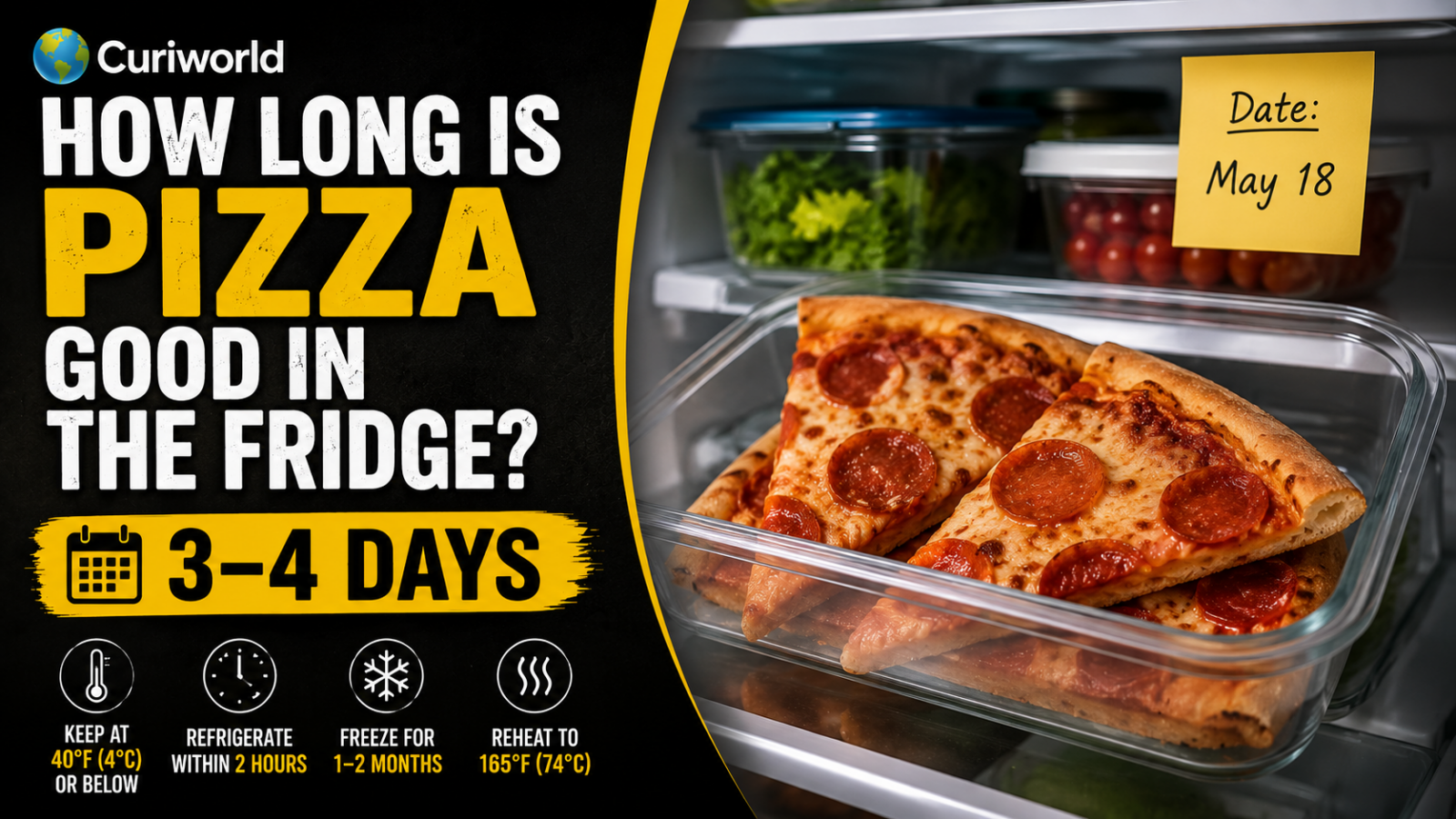
Cold pizza has a reputation for being unusually forgiving.
You order too much on Friday night, slide the box into the refrigerator, and find a few slices waiting days later. They still look like pizza. They still smell like pizza.
So how long are they actually good for?
Leftover pizza can generally be kept in the refrigerator for 3 to 4 days when stored at 40°F (4°C) or below.
But there is one condition that matters just as much as the number of days:
The pizza needs to have been refrigerated promptly in the first place.
A slice stored properly after dinner and a slice that spent the entire night on the counter may look identical the next morning. From a food-safety perspective, they are not the same situation.
The Simple Rule: Pizza Gets 3 to 4 Days in the Fridge
FoodSafety.gov lists pizza at 3 to 4 days in the refrigerator.
That’s consistent with the general recommendation for many cooked leftovers.
A useful timeline looks like this:
| Storage Situation | General Guidance |
|---|---|
| Pizza refrigerated promptly | 3–4 days |
| Pizza left at room temperature | Refrigerate within 2 hours |
| Pizza left out when above 90°F (32°C) | Refrigerate within 1 hour |
| Frozen leftover pizza | 1–2 months for best quality |
The refrigerator should be kept at 40°F (4°C) or below.
So if Friday night’s pizza went straight into the fridge, Saturday and Sunday are easy decisions. By Monday or Tuesday, you are approaching the end of the recommended storage window.
The following weekend is another story.
Can You Eat 4-Day-Old Pizza?
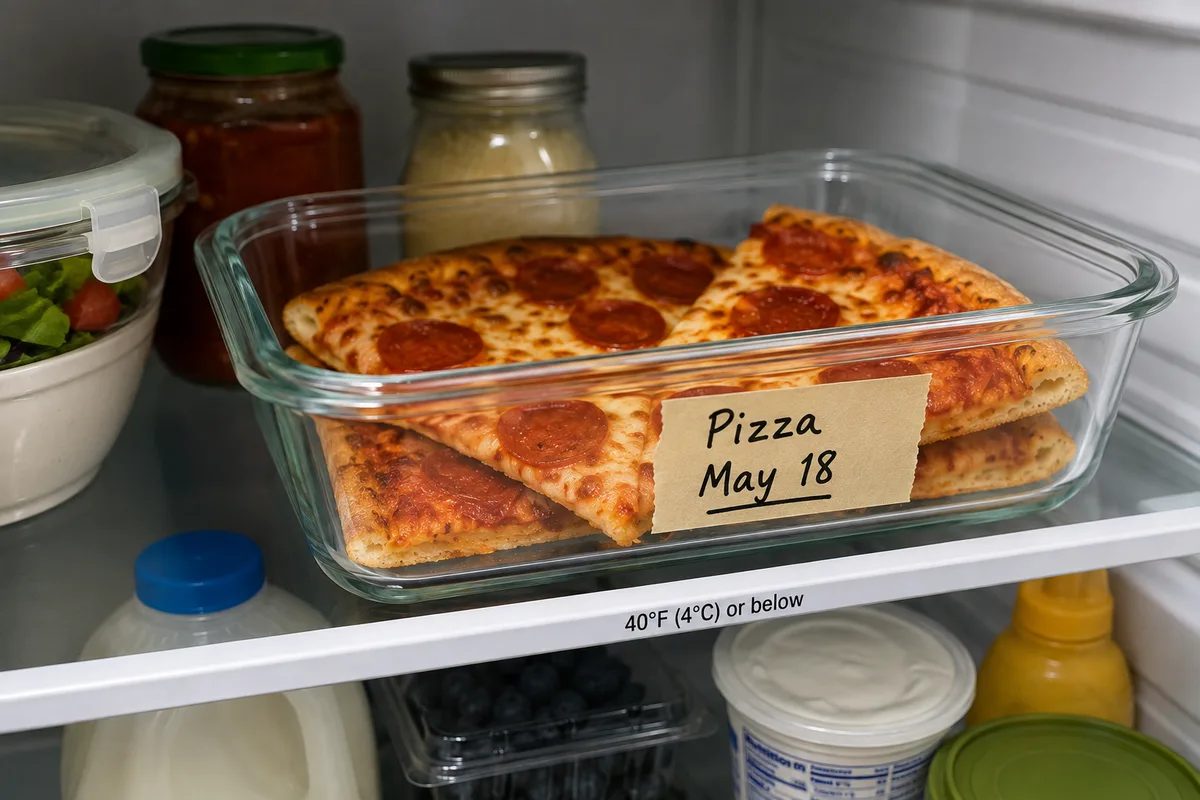
If the pizza was refrigerated promptly and has remained at 40°F (4°C) or below, day four is still within the recommended 3-to-4-day refrigerator window.
But day four is the end of that window—not the beginning of a new one.
This is where knowing when you actually refrigerated the pizza becomes useful.
“Earlier this week” isn’t a very good storage label.
“Friday night” is.
If you regularly keep leftovers, dating containers or packages takes seconds and removes a surprising amount of uncertainty later.
What About Pizza After 5 Days?
Five-day-old refrigerated pizza is beyond the recommended 3-to-4-day storage period.
This is where people often reach for another test:
It smells fine.
The cheese looks normal.
There is no visible mold.
Maybe one bite will tell me.
None of those observations extends the recommended storage window.
Food can deteriorate in ways that are obvious to your senses, but harmful microorganisms don’t always create a smell, flavor or appearance you can detect.
If you know the pizza has already been refrigerated for five days, a successful sniff test doesn’t turn it back into four-day-old pizza.
Can You Eat Pizza That Was Left Out Overnight?
This is the bigger pizza mistake.
Imagine ordering pizza at 8 p.m., leaving the box on the kitchen counter after everyone finishes eating, and discovering it there at 7 the next morning.
Putting the slices into the refrigerator at that point does not reset the clock.
FDA guidance says perishable foods and leftovers should generally be refrigerated within 2 hours. When temperatures are above 90°F (32°C), that window drops to 1 hour.
Pizza follows the same room-temperature safety principle as many other perishable leftovers. For the broader rule, see how long cooked food can safely sit out.
Pizza can contain cheese, meat and other ingredients that require temperature control.
So pizza left at room temperature overnight has spent far longer outside refrigeration than recommended and should be discarded.
The fact that people sometimes eat overnight pizza without becoming sick doesn’t change the storage guidance.
Food-safety recommendations are about reducing risk—not documenting whether someone got away with it last time.
Why Doesn’t Refrigeration Make Pizza Last Longer?
It does.
Just not forever.
Refrigeration slows the growth of many microorganisms, which is why properly chilled pizza gets several days instead of several hours.
But a refrigerator does not sterilize food.
Some microorganisms can survive cold conditions, and refrigeration only slows many biological and chemical processes rather than stopping them entirely.
That is why the temperature matters too.
Your refrigerator should remain at 40°F (4°C) or below.
A pizza stored for four days in a properly cold refrigerator isn’t equivalent to one kept in an appliance that has been running too warm.
Should You Keep Pizza in the Cardboard Box?
You can refrigerate pizza in its original box, but it isn’t always the best choice for quality.
Cardboard boxes are bulky, don’t seal tightly and allow the pizza to lose moisture.
For a couple of leftover slices, transferring them to an airtight container or wrapping them securely usually makes more sense.
That can help protect the pizza from drying out and from picking up odors from other foods in the refrigerator.
There is also a practical benefit:
A sealed container takes up far less refrigerator space than a giant box containing two lonely slices.
Storage containers don’t extend pizza beyond its recommended safety window, but they can help the slices remain more enjoyable during that window.
Can You Tell If Leftover Pizza Has Gone Bad?
Sometimes the answer is obvious.
Visible mold, an unusual odor or major changes in texture or appearance are all reasons to discard pizza.
But don’t reverse that logic.
No visible spoilage does not guarantee safety.
This is especially important when the storage history is already questionable.
If you know the pizza sat on the counter all night, there is no need to smell it closely and conduct an investigation the next morning.
Likewise, if the slices have already spent five or six days in the refrigerator, looking normal doesn’t override the recommended storage time.
The calendar and storage conditions often tell you more than your nose.
Does the Type of Pizza Change the Rule?
For ordinary leftover pizza, FoodSafety.gov provides a general 3-to-4-day refrigerator recommendation rather than separate timelines for pepperoni, cheese, vegetable or meat-lover’s pizza.
That makes the rule refreshingly easy to remember.
However, unusual toppings or ingredients may have their own storage considerations, and commercially packaged products should be handled according to their instructions.
The bigger variables for typical takeout or homemade pizza are usually:
How quickly was it refrigerated?
How cold was it kept?
How many days has it been there?
Those questions matter more than whether the final slice contains mushrooms or pepperoni.
Can You Freeze Leftover Pizza?
Yes.
And freezing is especially useful when you already know you won’t finish the pizza within a few days.
FoodSafety.gov lists 1 to 2 months in the freezer for best pizza quality.
Wrap individual slices well or place them in freezer-safe airtight packaging. Separating slices before freezing also means you can remove only what you want later instead of thawing an entire stack.
Think of freezing as part of your leftover plan—not an emergency procedure for pizza that has already been forgotten in the refrigerator.
If you order two large pizzas on Friday and know half will still be there on Tuesday, freeze some slices on Friday or Saturday.
Future you gets pizza.
Present you avoids the day-five debate.
What’s the Best Way to Reheat Leftover Pizza?
There is the food-safety answer and the pizza-quality answer.
For safety, FDA guidance recommends reheating leftovers to 165°F (74°C).
For quality, the microwave isn’t your only option.
A skillet can help restore a crisp bottom while warming the toppings. An oven or toaster oven can also bring the crust closer to its original texture.
The microwave wins on speed, although it often produces a softer crust.
Whichever method you choose, reheating does not restart the storage clock.
A slice doesn’t become “new” because it reached 165°F.
If the pizza has been stored beyond its recommended refrigerator period—or was left out overnight—reheating isn’t a reason to ignore that history.
What About Restaurant or Delivery Pizza?
The same basic rules apply.
The clock doesn’t start when you arrive home.
If you eat at a restaurant and take leftover pizza with you, the time it spends unrefrigerated on the journey home counts toward the 2-hour rule.
The same applies when pizza arrives by delivery and remains on the table throughout a party, game or movie.
If you want the leftovers, refrigerate them while you’re still comfortably inside the safe window rather than waiting until everyone goes to bed.
This is particularly important at outdoor gatherings when temperatures are above 90°F (32°C), because the recommended unrefrigerated window drops to 1 hour.
The Numbers Worth Remembering
Pizza storage doesn’t require a complicated system.
Remember these numbers:
3–4 days — refrigerated leftover pizza.
40°F (4°C) — maximum recommended refrigerator temperature.
2 hours — general limit before perishable leftovers should be refrigerated.
1 hour — the limit when temperatures are above 90°F (32°C).
165°F (74°C) — recommended reheating temperature for leftovers.
1–2 months — freezer storage for best pizza quality.
That’s enough to answer most leftover-pizza questions without staring suspiciously at a slice.
The Bottom Line
Properly stored leftover pizza generally lasts 3 to 4 days in the refrigerator at 40°F (4°C) or below.
Four-day-old pizza can still fall within that recommended window.
Five-day-old pizza has moved beyond it.
And pizza left sitting at room temperature overnight is an entirely different situation: refrigerating it the next morning doesn’t erase the hours it spent unrefrigerated.
If you won’t finish your leftovers within a few days, freeze some slices early.
And when you’re trying to decide whether that forgotten piece in the back of the fridge is still worth eating, don’t ask only:
“Does it smell okay?”
Ask the more useful question:
“When did I put it in here?”
With leftover pizza, the calendar usually tells you more than the crust does.
Sources
FoodSafety.gov — Cold Food Storage Chart
FDA — Refrigerator Thermometers: Cold Facts About Food Safety






Join the discussion