What Are AI Agents—and How Are They Different From Chatbots?
AI agents can do more than chat. They can plan tasks, use tools, take actions, and work toward goals with less step-by-step guidance.
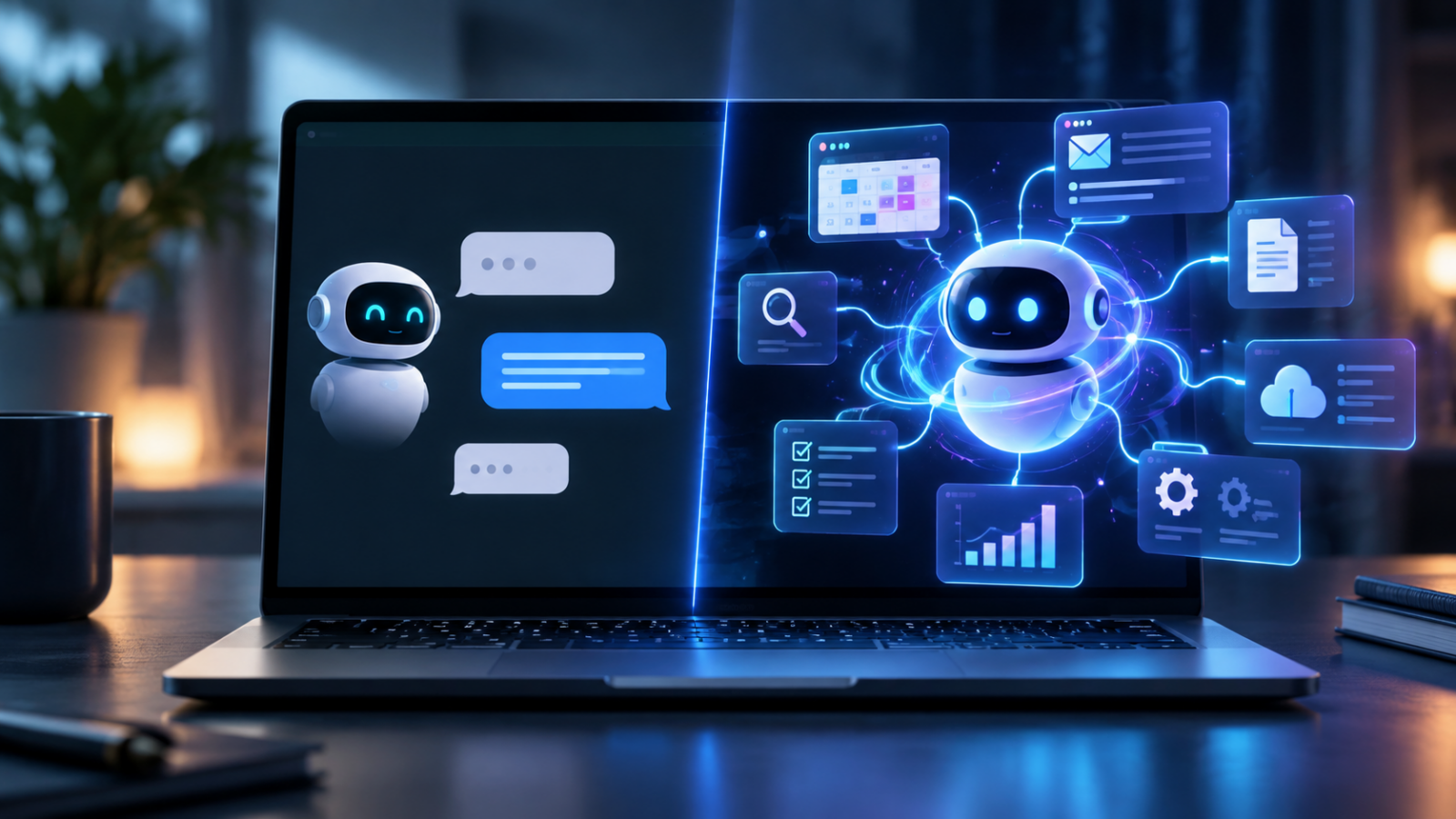
Ask a chatbot a question and it gives you an answer. Ask an AI agent to complete a task and it may decide what needs to happen next, use several tools, check the results, and continue until the job is finished.
That is the simplest difference between AI agents and chatbots.
But the boundary is not as clean as it sounds. A chatbot can have agent-like capabilities, and an AI agent may still communicate through a chat window. The real distinction is not whether you type messages to it. It is how much of the work the AI can plan and perform on your behalf.
The Short Answer: AI Agents Act Toward a Goal
An AI chatbot is primarily designed to communicate with a user. Modern AI chatbots can answer questions, explain ideas, summarize documents, write text, analyze information, and sometimes access external sources.
An AI agent goes further. It is designed to pursue a goal and take steps toward completing it, often by using external tools, software, data, or services.
For example, imagine you are planning a business trip.
A chatbot might:
- explain which neighborhood is best for your hotel,
- suggest a packing list,
- compare two flight options you provide,
- or draft an itinerary.
An AI agent with the right tools and permissions might instead:
- search available flights,
- compare departure times and prices,
- check your calendar,
- identify scheduling conflicts,
- find suitable hotels,
- prepare an itinerary,
- and ask for approval before making a booking.
The second system is not merely producing a better answer. It is managing a multi-step task.
NIST describes modern AI agents as software systems that can interact with their environment, receive information, and take self-directed actions in pursuit of an externally specified goal.
AI Agents vs. Chatbots at a Glance
| AI Chatbot | AI Agent | |
|---|---|---|
| Main purpose | Conversation and assistance | Completing goals and tasks |
| Typical behavior | Responds to a prompt | Plans, acts, checks, and continues |
| Multi-step work | Possible, often user-directed | Core capability |
| External tools | May have them | Often essential |
| Ability to take action | Usually limited | Can be significant |
| Autonomy | Generally lower | Can range from limited to high |
| Human involvement | Frequent interaction | May work independently between checkpoints |
This comparison is useful, but it should not be treated as a rigid technical rule.
The terms are still evolving, and companies sometimes use words such as agent, assistant, copilot, and chatbot differently.
The better question is therefore not:
“Does this product call itself an agent?”
It is:
“What can this system actually decide and do without me directing every step?”
What Actually Makes an AI System an Agent?
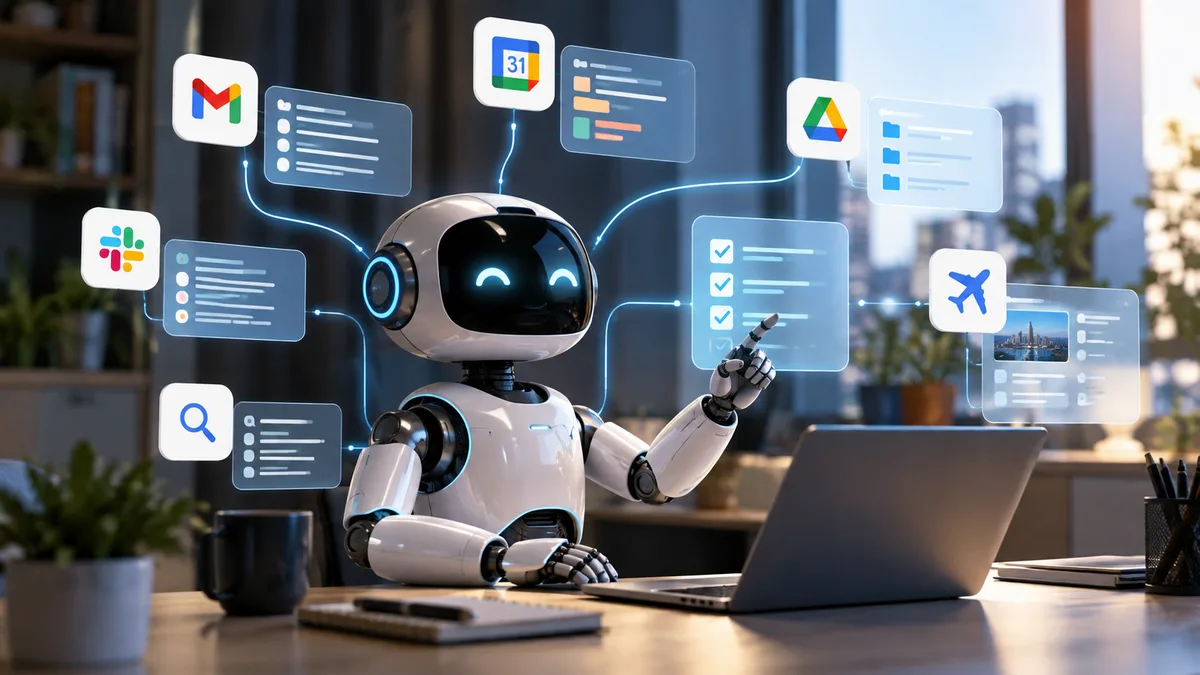
Calling an AI tool an “agent” does not automatically make it one. The more useful way to recognize an agent is to look at how it behaves.
It works toward an outcome, not just a response
A normal chatbot usually starts with a prompt and ends with an answer.
An agent may receive a broader objective such as:
Find the three most suitable meeting times for this project next week and prepare an agenda.
There is no single response that solves that request.
The system may need to inspect calendars, identify participants, compare availability, gather project information, resolve conflicts, and prepare the final output.
The goal determines the work.
It can choose the next step
Traditional software normally follows instructions written in advance.
An agent can have more flexibility.
If one search does not provide enough information, it may try another. If a tool returns an error, it may adjust its approach. If additional information is required, it may ask the user rather than continuing blindly.
This loop—plan, act, observe, adjust—is one of the clearest characteristics of agentic AI systems.
It can use tools
The language model is only part of an AI agent.
Tools are what allow the system to interact with something beyond the conversation itself.
Depending on the system and the permissions it has been given, tools might allow an agent to:
- search the web,
- inspect files,
- query databases,
- run code,
- update a spreadsheet,
- interact with business software,
- send a message,
- create a calendar event,
- or call an external API.
NIST has highlighted tool use as an important part of modern agent systems because tools allow AI models to perform actions beyond simply generating text.
It can keep track of what happened
An agent also needs some way to understand the state of a task.
Suppose an agent is comparing 40 products. It needs to know which ones it has already checked, what information it collected, which candidates were rejected, and what remains unfinished.
This does not necessarily mean the system permanently “learns” everything about you.
Memory can be temporary, task-specific, or persistent depending on how the agent is designed.
That distinction matters because marketing descriptions sometimes make AI agents sound as if every agent continuously learns from every interaction. That is not a requirement for something to function as an agent.
A Chatbot Can Also Become Agentic
This is where the terminology becomes confusing.
A chat window tells you how you interact with a system.
It does not tell you everything the system is capable of doing behind that window.
Consider four increasingly capable systems:
- A scripted support bot recognizes a few questions and returns predefined answers.
- An AI chatbot generates natural-language responses to a much wider range of questions.
- An AI assistant can search information and use selected tools when you request them.
- An AI agent can decide which tools and steps are needed to complete a broader goal.
All four could look like chatbots on your screen.
The difference is what happens after you press Enter.
That is why “AI agent vs. chatbot” is better understood as a spectrum of autonomy and action, rather than a simple choice between two completely separate technologies.
AI Agents Are Also Different From Traditional Automation
Agents are sometimes described as automation, but there is another useful distinction here.
Traditional automation is excellent when the steps are predictable.
A company might create a rule that says:
When a form is submitted → add the information to a spreadsheet → send a confirmation email.
The process is predetermined.
An agent is more useful when the path cannot be fully known in advance.
Imagine the instruction:
Investigate why this customer’s order failed and determine the appropriate next step.
The answer could depend on inventory, payment status, shipping data, account history, company policy, or information supplied by the customer.
An agent can potentially reason across those variables rather than following one fixed sequence.
That flexibility is powerful, but it also creates more uncertainty.
For tasks with perfectly predictable rules, ordinary software automation may still be faster, cheaper, and easier to control than an AI agent.
Why Giving AI the Ability to Act Changes the Risk
A chatbot that gives a bad answer can mislead you.
An agent that makes a bad decision may also do something with that answer.
That difference increases the consequences of mistakes.
An agent connected to business systems might have permission to modify files, send messages, change records, or trigger external processes. The more tools and permissions it receives, the more important safeguards become.
NIST has identified security challenges around AI agent systems, including the risks created when AI-generated decisions are connected to software capable of taking real actions.
Researchers and technology companies are also paying close attention to prompt injection, where malicious instructions hidden in content can attempt to manipulate an agent into taking an unintended action.
Human approval remains especially important for consequential operations such as financial transactions, account changes, deleting information, publishing material, or sending sensitive communications.
The same caution applies to the information you give these systems. Curiworld’s guide to what information you should never share with an AI chatbot explains why sensitive credentials, confidential documents, and unnecessary personal information deserve extra care.
Agents Can Still Hallucinate
Giving an AI model tools does not automatically make everything it does accurate.
An agent can still misunderstand an instruction, misinterpret information, choose an inappropriate tool, or rely on an incorrect model-generated assumption.
Large language models can also produce convincing information that is false, a problem explained in Curiworld’s guide to why AI makes up facts.
Agents can sometimes reduce certain errors by checking databases, retrieving current information, or observing the results of their actions.
But tool access is not the same thing as guaranteed correctness.
For important decisions, the safest systems combine useful autonomy with limits: restricted permissions, trusted data sources, logs, confirmation steps, and opportunities for human review.
Curiworld’s practical guide to checking whether an AI answer is actually correct is just as relevant when the AI is acting as an agent.
When Should You Use a Chatbot, an Agent, or Normal Automation?
The most advanced option is not automatically the best one.
Use a chatbot or AI assistant when your main goal is to:
- ask questions,
- understand a topic,
- brainstorm,
- summarize information,
- draft something,
- or work interactively with the AI.
Use traditional automation when:
- the process is predictable,
- the rules are clear,
- exceptions are rare,
- and the same sequence should happen every time.
Use an AI agent when:
- the goal requires several steps,
- the correct steps may change depending on what happens,
- information must be gathered from multiple places,
- tools or software need to be used,
- and it would be valuable for the system to manage much of the workflow itself.
Even then, greater autonomy should usually come with greater oversight when mistakes would have serious consequences.
AI Agents Are Better Understood by What They Can Do
The word agent is appearing on everything from workplace software to coding tools and customer-service platforms.
The label alone does not tell you much.
Instead, look for three things:
Can the AI decide what steps are necessary?
Can it use tools to take actions outside the conversation?
Can it keep working toward a goal without you manually directing every step?
If the answer is yes, you are moving from ordinary conversational AI into agentic AI.
A chatbot talks with you.
An AI agent can potentially work through a task for you.
And as those two capabilities increasingly appear inside the same products, that difference in behavior matters far more than what the button on the screen happens to be called.
Sources
National Institute of Standards and Technology — Agentic AI
National Institute of Standards and Technology — Lessons Learned from the Consortium: Tool Use in Agent Systems








Join the discussion