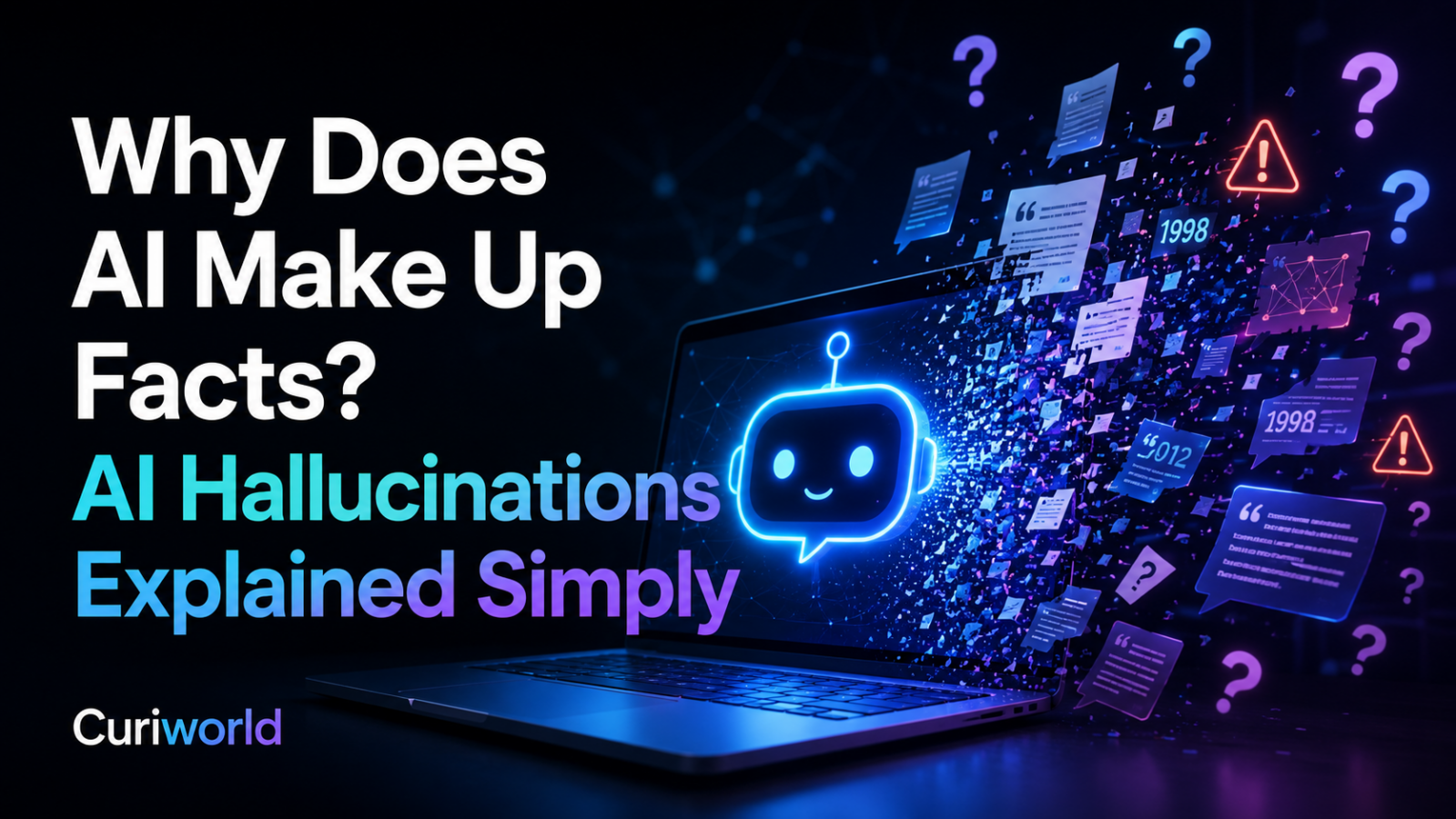
Why Does AI Make Up Facts? AI Hallucinations Explained Simply
AI can produce a completely false answer that sounds perfectly convincing. The reason lies in how language models predict text — and how they handle uncertainty.
Ask an AI chatbot for the capital of France and it will probably answer correctly in a fraction of a second.
Ask it for the title of an obscure paper, an exact historical date, or a quotation from a little-known book, and something stranger can happen: it may give you a detailed, polished answer that is completely wrong.
It might even invent the author, journal, page number, or source.
This behavior is commonly called an AI hallucination. It happens because large language models are built to generate plausible language, not to independently verify every statement against reality before producing it.
That difference sounds small. It explains a huge amount about how generative AI works.
What Is an AI Hallucination?

An AI hallucination is an output that sounds credible but contains information that is false, invented, unsupported, or inconsistent.
Examples include:
- a nonexistent academic study,
- a fabricated quotation,
- an incorrect date,
- a made-up court case,
- a fake URL,
- a wrong statistic,
- or a confident description of an event that never happened.
The National Institute of Standards and Technology uses the term confabulation for confidently stated but erroneous or false generative-AI content.
That wording is useful because “hallucination” can make an AI system sound more human than it really is.
The chatbot is not seeing something that is not there in the human sense.
It is generating text.
AI Does Not Write the Way a Search Engine Retrieves
A common misunderstanding is that an AI chatbot works like an enormous search engine.
Imagine asking:
“What year was this obscure scientist born?”
A traditional database might look for a stored record.
A search engine might retrieve webpages that contain the answer.
A language model, at its core, does something different.
It processes your prompt and predicts which token — a word or part of a word — is likely to come next. Then it predicts the next one. Then another.
That process continues until a response is formed.
Because the model has learned patterns from enormous amounts of language, its predictions can produce remarkably accurate explanations.
But likely-sounding language and factual truth are not identical things.
That gap is where hallucinations begin.
Think of It as Autocomplete on an Extraordinary Scale

The simplest mental model is an extremely sophisticated version of autocomplete.
If you type:
“The capital of France is…”
“Paris” is overwhelmingly likely.
The language pattern and the factual answer happen to align.
Now imagine asking for something extremely specific:
“What was the exact title of a little-known conference paper published by a particular researcher in 1997?”
The model may have weak, incomplete, conflicting, or effectively unusable patterns for that fact.
But it still knows what academic citations usually look like.
It knows the structure of paper titles.
It knows journal names.
It knows how publication years and author names usually appear.
So it can assemble something that looks perfectly believable.
The formatting may be excellent.
The paper may not exist.
Rare Facts Are Especially Difficult
Some parts of language are extremely predictable.
Grammar follows patterns.
Common phrases follow patterns.
Widely repeated facts often appear in many forms.
Other information is much more arbitrary.
A person’s exact birthday, the page number of an obscure article, the middle name of a little-known historical figure, or a specific statistical result may have little predictable structure.
OpenAI researchers studying hallucinations have argued that this distinction helps explain why factual errors can persist even when language models become very good at producing fluent text.
A model can learn that academic citations usually contain an author, title, publication, year, and page range.
That does not guarantee that it can reliably reconstruct one particular citation it has insufficient information about.
Knowing the shape of an answer is not the same as knowing the answer.
Why Doesn’t the AI Just Say “I Don’t Know”?

This is one of the most interesting parts of the problem.
Sometimes it does.
But language models have historically been rewarded heavily for producing correct answers, while uncertainty has not always received the same reward.
That can create an unfortunate incentive.
Imagine two students taking a test.
One leaves every uncertain answer blank.
The other guesses.
The second student may accidentally score higher, even though the first student was more honest about what they knew.
Recent OpenAI research argues that similar incentives in model training and evaluation can encourage guessing rather than abstaining.
A trustworthy system should ideally recognize uncertainty and say so.
Getting models to make that decision reliably is harder than simply making them more fluent.
Why Hallucinations Sound So Confident
A chatbot can produce a false statement in exactly the same calm tone it uses for a correct one.
That is unsettling because humans naturally use communication style as a clue to confidence.
Someone who says:
“I think it might have happened around 1985, but I’m not certain”
sounds less certain than someone who says:
“The event occurred on October 14, 1985.”
AI-generated language does not necessarily work that way.
A polished sentence is not an internal confidence meter.
The system may generate:
“According to a 2019 study published in the Journal of…”
with perfect grammar and professional formatting even when the citation is incorrect.
Fluency is evidence that the model is good at generating language.
It is not proof that the claim has been verified.
Fake Citations Are a Perfect Example
Ask an AI model to produce academic references on a narrow subject and you may encounter one of the clearest examples of hallucination.
Why?
Because references are highly structured.
A citation usually looks something like:
Author. Year. Article title. Journal. Volume. Issue. Pages.
Language models have seen enormous numbers of references written in this format.
So if the model lacks the exact source you are requesting, it may still generate something with all the characteristics of a real citation.
It might combine:
a real researcher,
a plausible paper title,
a real journal,
and a believable publication year.
Every component looks reasonable.
The combination may be fictional.
For academic, medical, legal, financial, or professional work, this is why a citation should never be trusted simply because it looks authentic.
Search for the actual publication.
Your Question Can Also Push the Model in the Wrong Direction
Consider this prompt:
“Why did NASA cancel the Apollo 20 Moon landing in 1974?”
The question already assumes there was an Apollo 20 Moon landing scheduled in that way.
A weak response may accept the premise and begin constructing an explanation instead of challenging it.
This is another path to confident misinformation.
Prompts can contain:
- false assumptions,
- ambiguous names,
- incorrect dates,
- fictional events,
- or missing context.
A stronger AI system should notice the problem and correct the premise.
But users should also remember that detailed questions are not automatically accurate questions.
Does Giving AI Access to the Web Fix Hallucinations?
It helps enormously when the task requires current or verifiable information.
An AI system with search, retrieval, or access to trusted databases can ground its response in external evidence instead of relying entirely on patterns learned during model training.
But external tools do not create perfect accuracy.
The system can still:
- misunderstand a source,
- combine information incorrectly,
- retrieve a weak source,
- miss an important qualification,
- or state something more strongly than the evidence supports.
NIST specifically recommends reviewing and verifying sources and citations in generative-AI outputs.
This is also why Curiworld’s guide on using AI to find cheaper flights recommends using AI to expand a search while verifying actual fares with live flight data.
AI can help you find the answer.
That does not mean it should always be treated as the answer’s original authority.
Access to the web changes what AI can retrieve, but it does not make every synthesized answer automatically reliable. That distinction is central to AI search vs. traditional search.
Are Newer AI Models Still Hallucinating?
Yes.
Hallucination rates can fall as models, training methods, evaluation systems, retrieval tools, and reasoning capabilities improve.
But better models do not turn probabilistic generation into guaranteed truth.
OpenAI reported in 2025 that newer systems had substantially reduced hallucinations in some settings while acknowledging that the problem remained.
The important question therefore is not:
“Does this AI hallucinate?”
A more useful question is:
“How likely is this system to make an error on this particular task, and how can I verify the answer?”
A request to rewrite a paragraph has a very different factual risk from a request for five obscure medical studies.
How to Reduce the Chance of Getting a Made-Up Answer
You cannot make every AI response perfectly reliable with a clever prompt, but you can improve the odds.
For factual questions, useful instructions include:
“If you are uncertain, say so rather than guessing.”
“Do not invent citations or sources.”
“Separate verified facts from assumptions.”
“Use primary sources where possible.”
“Give me the source for each important factual claim.”
“Search the web and verify whether this information is still current.”
Then check important details yourself.
Understanding why hallucinations happen is only half the job. For a practical verification workflow, see how to check whether an AI answer is actually correct.
Names, dates, quotations, statistics, research papers, legal rules, prices, medical information, and current events deserve particular attention.
The higher the consequence of being wrong, the less sensible it is to rely on a single generated answer.
What AI Is Better Used For
None of this makes generative AI useless.
Its strengths simply need to be understood correctly.
Language models can be excellent for:
organizing information,
explaining difficult concepts,
brainstorming possibilities,
rewriting text,
summarizing material you provide,
comparing options,
creating structured drafts,
and helping you identify questions you may have overlooked.
Problems arise when fluency is mistaken for verification.
An AI response can be extremely useful while still requiring fact-checking.
Those two statements are not contradictory.
The Most Useful Rule: Plausible Is Not the Same as True
AI hallucinations stop seeming mysterious once you understand what a language model is trying to do.
It generates highly plausible sequences of language from learned patterns. Most of the time, those patterns can lead to useful and accurate answers.
Sometimes they produce a sentence that fits perfectly but describes something that does not exist.
The unsettling part is that the wrong answer may look just as polished as the right one.
So whenever a chatbot gives you a precise statistic, quotation, source, date, legal rule, medical claim, or obscure fact, remember the distinction that matters most:
A convincing answer is not automatically a verified answer.
That habit may be one of the most important skills for using generative AI well.
Sources
OpenAI — Why Language Models Hallucinate
https://openai.com/index/why-language-models-hallucinate/
National Institute of Standards and Technology — Artificial Intelligence Risk Management Framework: Generative Artificial Intelligence Profile
https://doi.org/10.6028/NIST.AI.600-1






Join the discussion