Can AI Read Handwriting? What It Gets Right and Wrong
AI can now turn many handwritten pages into searchable text, but messy cursive, rare names, historical documents, and unclear photos still expose its weaknesses.
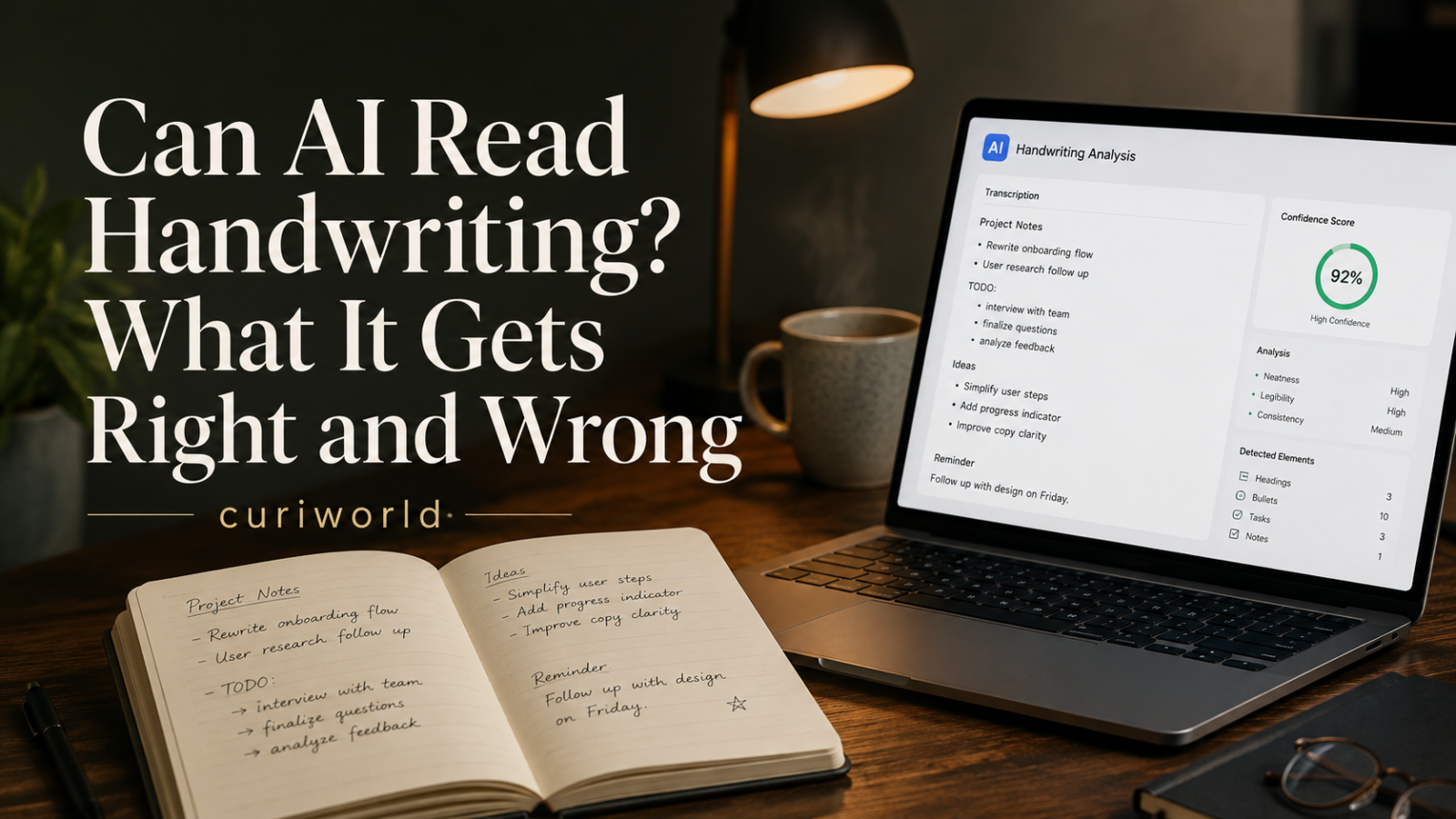
Take a photo of a neatly written shopping list and modern AI may turn it into editable text almost instantly. Give the same system a hurried doctor’s note, a century-old diary page, or densely crossed-out lecture notes and the confidence can disappear just as quickly.
So, can AI read handwriting?
Yes — often surprisingly well. But handwriting recognition is not solved.
Modern systems can recognize handwritten words, lines, and increasingly entire documents. Google Cloud Vision, for example, explicitly supports handwriting extraction, while recent research describes handwritten text recognition as having progressed from word-level systems toward end-to-end approaches capable of processing paragraphs and full documents.
The difficult part is that handwriting is not a standardized font. Every person changes the shapes, spacing, size, slant, and connections between letters — sometimes from one sentence to the next.
That variability is where AI still gets into trouble.
Handwriting Recognition Is More Than Traditional OCR
The term OCR, or optical character recognition, originally became associated with turning printed text in scans and photographs into machine-readable text.
Printed text is relatively predictable. The letter “A” in one printed book usually looks a lot like the letter “A” in another.
Handwriting is different.
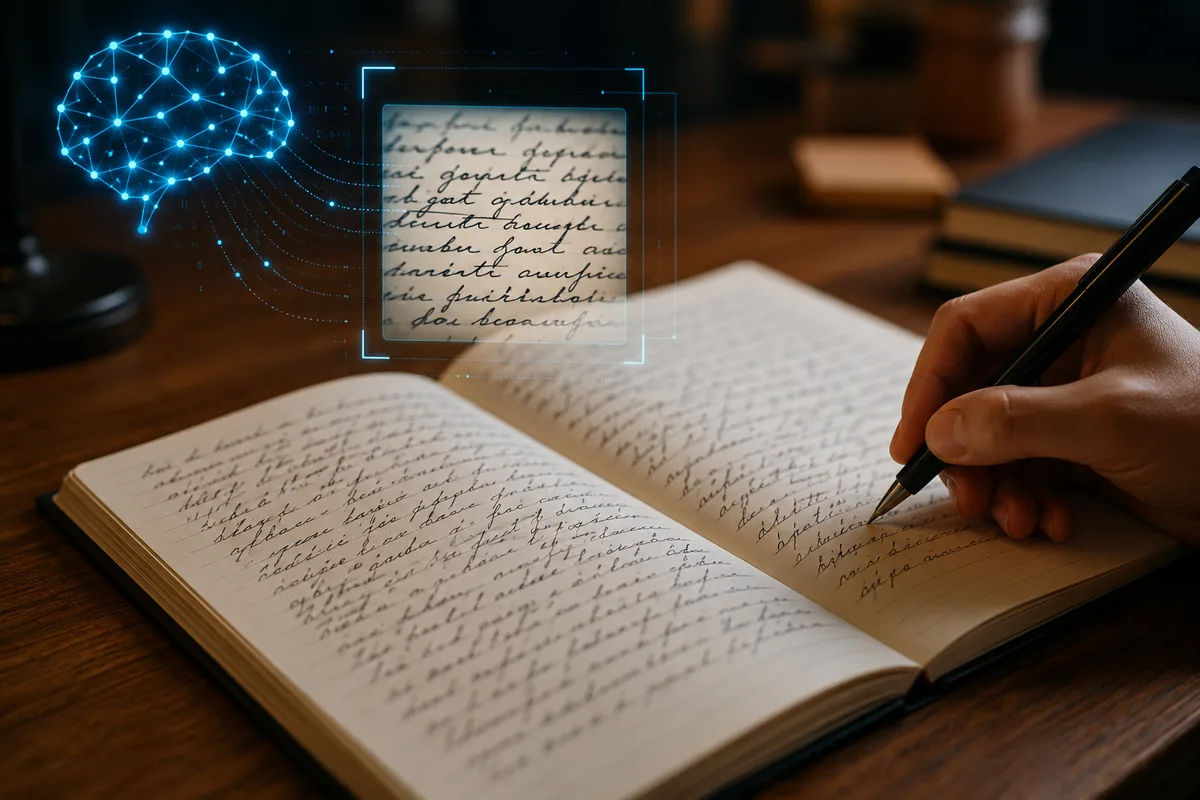
A handwritten lowercase “r” can resemble a “v.” A hurried “u” can look like an “n.” The number “1,” lowercase “l,” and uppercase “I” can become nearly indistinguishable. Some people connect almost every letter; others mix cursive and print in the same word.
Modern handwritten text recognition, often shortened to HTR, uses machine-learning models designed to deal with those variations.
Instead of simply matching each shape to a stored character template, newer systems can analyze larger visual patterns and use information from neighboring letters, words, and lines.
That context is one reason today’s handwriting recognition is far more capable than older OCR software.
The boundary between “OCR” and “AI handwriting recognition” is not as sharp as it may sound.
Modern handwriting-recognition systems increasingly use machine-learning and deep-learning methods themselves. Multimodal AI adds another layer by combining visual recognition with language context, which can help resolve ambiguous characters—but can also encourage a plausible-looking guess when the image is unclear.
What AI Reads Well
AI performs best when the document makes the problem easy.
Clear handwriting on a clean page is the ideal case.
A high-quality scan of dark ink on white paper gives the system strong visual separation between the writing and the background. Regular spacing and reasonably consistent letter shapes make recognition easier still.
Modern systems can be particularly useful for:
- handwritten forms
- surveys
- classroom notes
- questionnaires
- clearly written letters
- archival documents with readable script
- notes captured with a good smartphone camera
- documents containing both printed and handwritten text
Current commercial OCR systems can also return more than the transcription itself. Microsoft and Google systems, for example, can identify words and their positions on a page, while some services provide confidence information that indicates how certain the model is about individual results.
That makes handwriting AI useful for more than simply copying notes into a text editor. It can become part of searchable archives, document-management systems, form-processing workflows, and large digitization projects.
Messy Handwriting Is Still Messy — Even for AI
The biggest problem is human variation.
Two people can write the same sentence and produce images that barely resemble each other.
Even one person may write differently depending on speed, pen, posture, fatigue, or available space.
Deep-learning systems have become much better at learning these variations, but a major 2026 survey in IEEE Transactions on Pattern Analysis and Machine Intelligence still describes handwriting variability as one of the central challenges in building reliable recognition systems.
Problems become especially noticeable when handwriting contains:
- heavily connected cursive
- letters written on top of each other
- unusual abbreviations
- inconsistent spacing
- extreme slant
- very small writing
- incomplete letter forms
- corrections and crossed-out words
- arrows and notes inserted between lines
A human reader can also struggle with these pages. AI simply struggles in different ways.
For a broader verification workflow—especially when an AI output contains details that matter—see how to check whether an AI answer is actually correct.
AI Sometimes Guesses Instead of Admitting It Cannot Read Something
This is one of the most important limitations to understand.
Modern AI does not always treat handwriting as a sequence of isolated characters. Language context can help it predict what a difficult word is likely to be.
Usually, that is helpful.
Suppose a handwritten sentence reads:
“Please close the ___ before leaving.”
Even if one word is difficult to see, surrounding language can help a system decide that “door” is more plausible than many other combinations of letters.
The problem appears when context becomes more influential than the handwriting itself.
A system may produce a perfectly reasonable word that was never actually written.
This risk becomes particularly important when using multimodal generative AI rather than a dedicated handwriting-recognition engine. A language model is designed to generate plausible language. If part of an image is unclear, that ability can become a weakness: an uncertain transcription can look convincingly correct.
For casual notes, one wrong word may not matter.
For a historical document, legal record, research archive, medical note, or financial document, it can completely change the meaning.
AI transcription should therefore never be treated as unquestionable evidence simply because the output looks fluent.
Context can be both a strength and a risk.
If a model can read most of a sentence, language context may help it infer a difficult word. But the same process can produce a convincing word that was never actually written.
For archival, legal, medical or otherwise important transcription, uncertain words should be checked against the original image rather than accepted because the sentence sounds plausible.
Names Are Harder Than Ordinary Sentences
Imagine a handwritten note that says:
“Met Sarah at Greenhill.”
If the handwriting is poor, the AI cannot rely as heavily on ordinary language probabilities because Sarah and Greenhill are names.
Names, addresses, product codes, registration numbers, scientific terminology, and uncommon place names are often harder than predictable everyday sentences.
There is less linguistic context available to rescue an uncertain visual reading.
This creates an interesting paradox.
An AI system may correctly reconstruct a difficult sentence containing familiar vocabulary while making a mistake on a clearly important surname in the middle of it.
For archival and genealogical work, that limitation matters enormously. The words researchers care about most — people, villages, occupations, dates — may also be among those most vulnerable to transcription errors.
Old Handwriting Creates an Entirely Different Problem
Reading a handwritten letter from last week and deciphering a manuscript from 1750 are not the same task.
Historical documents introduce additional challenges:
faded ink, stained paper, obsolete spelling, unfamiliar letterforms, damaged pages, bleed-through from the reverse side, and writing conventions that are no longer common.
A model trained mainly on modern handwriting may therefore encounter a document that is visually and linguistically unfamiliar.
Specialized models trained on historical collections can perform much better because they have seen similar scripts before.
This highlights an important truth about AI handwriting recognition:
There is no single universal measure of accuracy.
A system that performs beautifully on modern English forms may perform poorly on nineteenth-century correspondence or manuscripts written in another script.
Language and Script Matter
Handwriting recognition is also not equally mature for every language.
Google Cloud’s current documentation lists different support levels across handwriting scripts. Latin, Japanese, and Korean handwriting receive supported status, while several other scripts are listed with experimental support.
That means a claim such as “AI can read handwriting with high accuracy” is incomplete unless you ask:
Whose handwriting, in which language, written how, and captured under what conditions?
A model can be excellent in one setting and unreliable in another.
Mixed-language notes create another complication. A person may write an English sentence, insert a French phrase, add an Arabic name, and finish with numbers or mathematical notation.
Humans can switch interpretation strategies almost instantly.
AI systems are getting better at doing the same, but mixed scripts remain a harder recognition problem.
Math Is Not Just Handwriting
A handwritten equation may look like text, but recognizing it requires more than identifying characters.
Consider:
x² + y² = 25
The position of the “2” matters. So do fraction bars, subscripts, matrices, integral signs, roots, and the spatial relationships between symbols.
If an AI reads every visible character but loses the layout, it can still produce the wrong equation.
The same problem occurs with diagrams, tables, chemistry notation, musical notation, and pages filled with arrows connecting different ideas.
Ordinary prose is mostly linear.
Many handwritten pages are not.
That is why understanding document layout has become an important part of modern document AI, not merely an optional extra.
The Camera Can Be the Problem, Not the Handwriting
Sometimes AI fails because the original handwriting is difficult.
Other times, the photograph is simply bad.
A phone image taken at an angle can distort text. Shadows can hide strokes. Glossy paper can create glare. Low resolution can erase the tiny distinction between similar letters.
Folded pages and curved notebook bindings can change the geometry of entire lines.
Before blaming the AI, improving the input can produce a surprisingly large difference.
For the best chance of an accurate transcription:
- photograph the page straight from above
- use bright, even lighting
- avoid shadows and glare
- keep the entire line in focus
- crop unnecessary background
- use the highest practical resolution
- process one clear page at a time when possible
And always keep the original image.
The transcription should be considered a derivative of the document, not a replacement for it.
Can AI Read Your Handwriting Better Than You Can?
Sometimes, strangely enough, yes.
If you wrote something months ago and can no longer decipher one hurried word, an AI system may identify it by comparing the shape with patterns learned from enormous collections of text.
But the reverse is equally possible.
You know your own habits.
You may remember that your “s” always resembles an “r,” recognize a personal abbreviation, or know the context in which the note was written.
AI does not automatically have that personal history.
The strongest approach is often collaboration: let the system produce a first transcription, then let a human check uncertain words against the original document.
For a broader verification workflow—especially when an AI output contains claims or details that matter—see how to check whether an AI answer is actually correct.
For hundreds or thousands of pages, that can still save enormous amounts of time.
How Much Should You Trust an AI Handwriting Transcription?
The answer depends on what happens if it is wrong.
For turning your grocery list into editable text, you probably do not need to inspect every character.
For digitizing family letters, checking names and dates is sensible.
For academic research, legal documents, medical information, financial records, or anything that may become evidence, the original should be checked against the transcription.
Confidence scores can help identify questionable words, but they are not guarantees.
A system can be confident and wrong.
The most dangerous transcription error is not obvious nonsense. It is a believable word that quietly changes what the document says.
AI Can Read Handwriting — but It Does Not Make Handwriting Unambiguous
The old question was whether a computer could recognize handwritten characters at all.
That question has largely been answered.
Modern AI can extract handwriting from photographs and scanned documents, deal with multiple languages, recognize document structure, and process collections far too large for manual transcription alone. Research has moved from isolated words and lines toward full-document recognition.
The harder question now is whether the result can be trusted without checking.
Sometimes it can.
Sometimes one ambiguous stroke changes “5” into “8,” a surname into another surname, or a negative statement into a positive one.
That is why the best way to think about handwriting AI is not as a machine that has finally learned to read every person’s writing.
It is an extremely capable first reader — fast, increasingly sophisticated, and still occasionally very wrong.
Sources
OpenAI Help Center — Image Input Limitations
Symmetry — Comprehensive Review of Handwriting Recognition Techniques






Join the discussion