AI Search vs. Traditional Search: Which Should You Use?
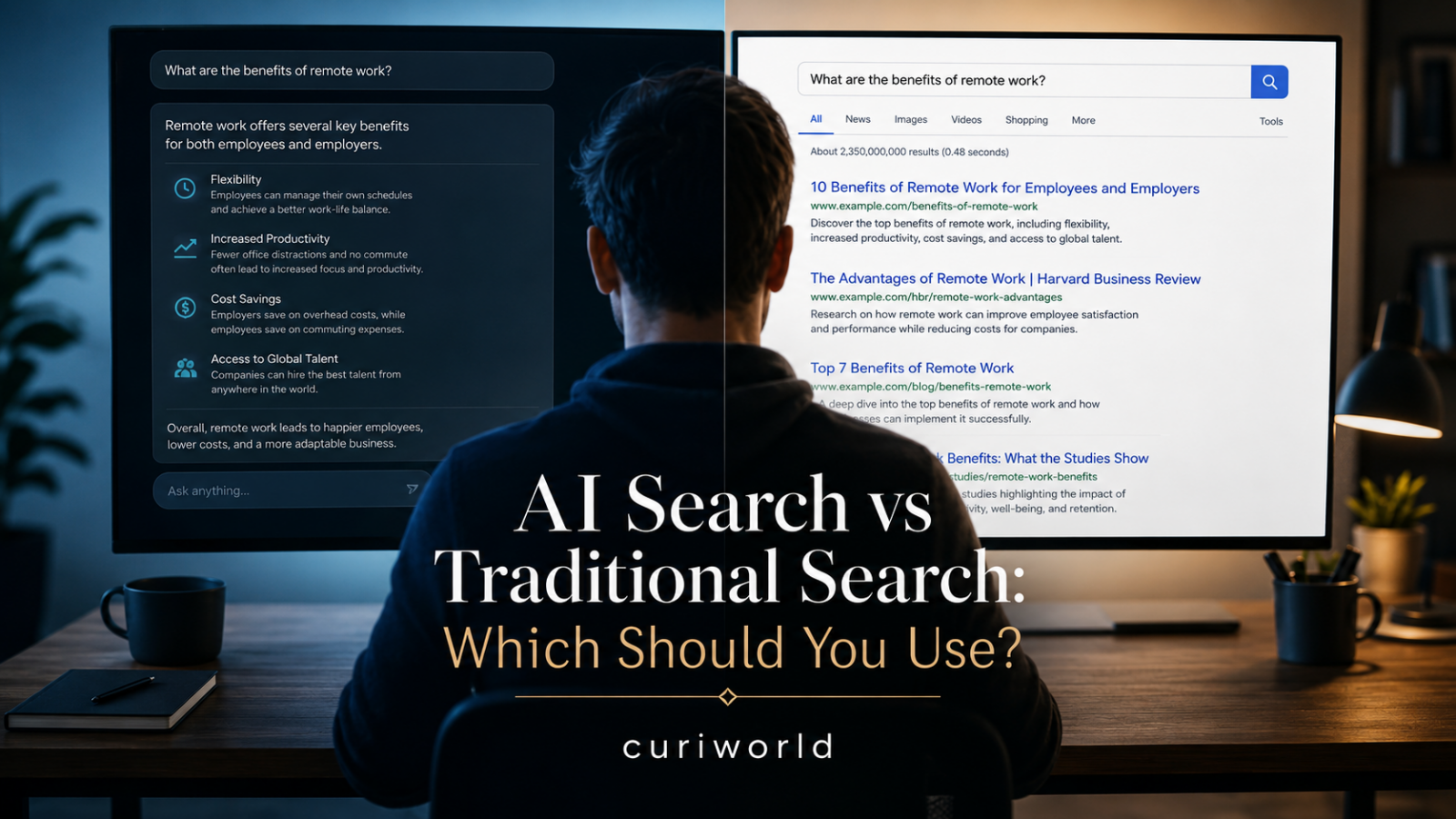
AI search can explain and synthesize while traditional search gives you greater control over what you read. The best choice depends on what you are trying to find.
Search used to mean typing a few words into a box, opening several links and deciding which page had the answer.
AI search changes that sequence. Instead of handing you only a list of pages, it can search across sources, interpret a longer question, combine what it finds and present a direct response that you can refine with follow-up questions.
That sounds like an obvious upgrade. It is not always one.
AI search is usually better when you want an answer synthesized, compared or explained. Traditional search is often better when you want to inspect the web yourself, find a specific source, verify a claim or see a wider range of perspectives.
For many searches, the smartest approach is no longer choosing one. It is knowing when to switch between them.
What Is Traditional Search?

Traditional search begins with retrieval.
You enter a query, and the search engine tries to identify pages, videos, images, products, maps or other results that are relevant to what you asked.
You then decide what to open.
Modern search engines are far more sophisticated than simple keyword-matching systems. They use language understanding, ranking systems, context, location and many other signals to decide what should appear.
But the familiar experience remains recognizable: the search engine finds sources; you do much of the reading and synthesis yourself.
Search for:
best neighborhoods to stay in Tokyo
and a traditional results page might give you hotel sites, travel publications, Reddit discussions, maps, videos and neighborhood guides.
You choose which voices deserve your attention.
That extra work can be inconvenient. It can also be useful.
What Is AI Search?
AI search moves more of that work from the reader to the system.
Instead of requiring you to open five pages and combine the information yourself, an AI-powered search experience can retrieve relevant material and generate a response based on what it finds.
The interaction is usually conversational.
You might ask:
Which Tokyo neighborhood is best for a first-time visitor who wants nightlife but doesn’t want to stay somewhere noisy?
Then follow with:
What if easy airport access matters more than nightlife?
The second question benefits from the context of the first.
Google’s current AI Mode, for example, can break a question into subtopics, search across them and assemble an AI-generated response with links that let users investigate further.
That ability to handle complicated, multi-part questions is one of the clearest advantages of AI search.
The Biggest Difference Is Who Does the Synthesis
Traditional search gives you ingredients.
AI search tries to serve the finished dish.
Suppose you want to know whether it makes more sense to buy an e-reader or a tablet for reading while traveling.
With traditional search, you might search for:
- e-reader battery life
- tablet screen visibility outdoors
- Kindle weight
- iPad weight
- e-reader eye comfort
- tablet travel advantages
Then you compare the results.
With AI search, you can ask the entire decision question at once:
I’m traveling for three months, mostly reading novels outdoors, and battery life matters more than video. Should I buy an e-reader or a tablet?
A good AI search system can organize the factors around your actual decision rather than forcing you to translate your problem into a sequence of search queries.
That is a significant improvement for certain tasks.
AI Search Is Better at Complicated Questions
Traditional search works beautifully when you know what you are looking for.
AI search becomes especially useful when you know the problem but are not sure how to search for it.
Consider:
I remember a movie set mostly in a hotel where two strangers keep meeting, but it wasn’t a romance and I think it was European.
A conventional search query may require several attempts before you find useful results.
AI systems can often work with fuzzier descriptions, constraints and natural-language context.
The same advantage applies to questions such as:
Compare three ways to get from this airport to the city center for two adults arriving after midnight.
or:
Explain this new phone feature to me without assuming I understand machine learning.
These are not merely lookup requests. They require interpretation and organization.
AI search is built for that kind of interaction.
Traditional Search Is Better When the Source Is the Point
Sometimes you do not want an answer about a source.
You want the source itself.
If you are looking for:
- an airline’s official baggage policy,
- a government visa page,
- a scientific paper,
- a company’s earnings report,
- a restaurant’s menu,
- a software documentation page,
- a court decision,
- or a particular website,
traditional search is often the cleaner route.
You can go directly to the original material and inspect it yourself.
This matters especially when exact wording, dates, exceptions or legal conditions are important.
An AI summary of an airline’s baggage rules may be convenient.
The airline’s current baggage policy is authoritative.
Those are not the same thing.
AI Search Can Save a Huge Amount of Reading
Imagine researching a simple question:
Why does my Bluetooth audio lag during games but look synchronized on Netflix?
Traditional search might lead you through technical support pages, forum discussions, codec explanations and articles about video synchronization.
AI search can potentially collect those pieces and explain the central distinction immediately: prerecorded video can compensate for predictable audio latency, while interactive games cannot simply delay the action without making controls feel slower.
That is where synthesis saves time.
You are not necessarily looking for a specific webpage.
You are looking for an understandable mental model.
For explanatory searches, that can make AI much more efficient.
But a Smooth Answer Can Hide Disagreement
Traditional results pages expose friction.
One source says one thing. Another says something slightly different. A third introduces an exception.
That can be annoying, but it also tells you something important: the subject may not have a single uncontested answer.
AI synthesis can make disagreement less visible.
A well-written generated response may combine several sources into one confident narrative, even when the underlying evidence is mixed.
Access to web sources does not eliminate this problem completely. An AI system can still misunderstand, misrepresent or combine retrieved information incorrectly. Our guide to why AI makes up facts explains why hallucinations can still occur even when external information is available.
Google itself warns that AI-generated Search responses can make mistakes and recommends checking important information in more than one place.
This is one reason presentation quality should never be confused with certainty.
A beautifully organized answer can still contain an incorrect date, miss an exception or give too much weight to one source.
If you use AI search for research, treat the generated response as a starting point rather than the final authority. Use our AI answer verification guide before relying on important claims.
Traditional Search Shows You More of the Information Landscape
Open a normal search results page and you can quickly scan who is talking about the topic.
You may see:
- official institutions,
- newspapers,
- niche publications,
- academic sources,
- companies,
- forums,
- independent creators,
- videos,
- and community discussions.
That variety can be valuable when you are trying to understand how a topic is being discussed rather than simply extracting one answer.
A 2026 research preprint analyzing millions of AI and traditional search results found meaningful differences in the sources surfaced by the two approaches. Among its findings, AI search exposed users to fewer long-tail information sources and less source variety than traditional search in the dataset studied.
That does not mean traditional search is automatically more accurate.
It does mean synthesis can narrow the window through which you see the web.
AI Search Is Better for Follow-Up Questions
One of the most frustrating things about traditional search is repeatedly rebuilding context.
You search:
best compact camera for travel
Then:
best compact camera with zoom
Then:
compact camera with zoom under $1,000
Then:
which of these has USB-C charging
Each query partly repeats the previous one.
Conversational search can preserve that context.
You can say:
Only show the ones under $1,000.
Then:
Remove anything without USB-C charging.
Then:
Which one is smallest?
The interaction feels less like searching an index and more like working through a problem with a research assistant.
This becomes even more useful when your criteria change as you learn.
Traditional Search Is Faster for Simple Navigation
Not every question needs artificial intelligence.
If you want:
Heathrow departures
Apple support
weather radar
BBC
Wikipedia Marie Curie
a traditional search result can get you where you need to go almost immediately.
Generating a synthesized explanation would add very little.
The same applies to many straightforward factual lookups when a trusted result or specialized widget already answers the question efficiently.
AI is powerful because it can do more work.
That does not mean more work is always necessary.
Shopping Shows Why You May Want Both
Suppose you are choosing noise-canceling headphones.
AI search is useful for turning vague preferences into a shortlist:
I fly often, wear glasses and care more about comfort than maximum bass. Compare the best options for me.
That is a synthesis problem.
Once you have three candidates, traditional search becomes valuable again.
You may want to inspect:
- official specifications,
- current retailer prices,
- professional reviews,
- long-term owner complaints,
- warranty terms,
- replacement-part availability,
- and actual product photos.
AI helps narrow the decision.
Traditional search helps audit it.
That pattern works for far more than shopping.
Research Requires More Caution
AI search can be extremely useful at the beginning of research.
It can identify terminology, explain unfamiliar concepts, propose subquestions and point toward potentially relevant sources.
That makes it a powerful orientation tool.
But serious research should not stop at the generated answer.
If a claim matters, open the source.
If a paper is cited, read the paper.
If a statistic is important, determine who produced it, how it was measured and when it was published.
If several sources disagree, investigate why.
The more important the decision, the less reasonable it is to outsource the entire evidence-checking process to a summary.
Travel planning is a good real-world example of combining AI exploration with live-source verification. Curiworld shows how to use AI to find cheaper flights without treating the first generated result as the final answer.
Citations improve transparency, but their presence should not be treated as proof that an AI answer is correct.
Research on generative search shows that users can place more trust in answers simply because references are displayed—even when those references are wrong.
For consequential research, the source still has to be opened and checked.
Health, Legal and Financial Searches Need the Same Rule
AI search can be helpful for understanding vocabulary.
It can explain the difference between two medical terms, summarize the general purpose of a legal document or help you formulate questions to ask a professional.
The risk begins when convenience replaces verification.
For high-impact topics, use AI search to understand the landscape—not as the final authority.
Look for primary sources such as:
- government agencies,
- recognized medical organizations,
- official regulations,
- courts,
- financial regulators,
- and peer-reviewed research.
AI may help you find them.
You should still inspect them.
What About Breaking News?
This is another situation where the best tool depends on what you need.
AI search can be excellent for answering:
What has happened so far, and why does it matter?
It can organize several updates into a readable explanation.
Traditional search can be better when you want to see the latest reporting in chronological order, compare how different outlets are covering the event or inspect the original announcement yourself.
Freshness also matters.
Always check timestamps. A confident answer based on information from three hours ago can already be outdated during a rapidly developing event.
For breaking news, source visibility matters almost as much as summary quality.
The Two Types of Search Are Already Merging
The phrase “AI search versus traditional search” makes the technologies sound more separate than they now are.
They are increasingly becoming layers of the same experience.
Google Search can show classic web results alongside AI Overviews and offers a conversational AI Mode. In 2026, Google continued expanding AI-driven Search while maintaining links to websites and conventional discovery mechanisms.
Other search products are taking similar hybrid approaches.
This matters because the future of search may not involve choosing between a chatbot and ten blue links every time.
You may simply move between an AI answer and the underlying web whenever the task requires it.
By 2026, the boundary is becoming increasingly artificial.
Traditional search engines now place generative summaries, conversational follow-up tools and direct links to supporting websites inside the same search experience.
That means the practical choice is often no longer “AI or search.”
It is whether you want a synthesized answer first, a list of original sources first, or both.
When Should You Use AI Search?
AI search is especially useful when you want to:
- understand a complicated topic quickly,
- compare several options,
- summarize information from multiple sources,
- ask a vague or highly specific natural-language question,
- refine a search through follow-ups,
- generate a research starting point,
- or turn scattered information into an actionable answer.
The more your task involves synthesis, the more useful AI search tends to become.
When Should You Use Traditional Search?
Traditional search remains especially useful when you want to:
- reach a specific website,
- find an original or official source,
- compare many viewpoints yourself,
- inspect current news coverage,
- discover niche websites,
- verify exact wording,
- search within a specialist ecosystem,
- or independently check an AI-generated claim.
The more your task involves source discovery and verification, the more valuable conventional web results become.
The Best Search Method Is a Two-Step Habit
For many important questions, there is a simple workflow that takes advantage of both systems.
Start with AI search when the problem is complicated.
Use it to understand the topic, identify the important variables and discover what you should investigate.
Then switch to the web.
Open the strongest sources. Check dates. Read the original documents. Look for disagreement. Confirm the details that matter.
You can also reverse the process.
Traditional search may uncover a long technical document, research paper or government page. AI can then help explain difficult terminology or organize what you have found.
The most useful distinction is therefore not “old search versus new search.”
It is retrieval versus synthesis.
Traditional search is excellent at letting you explore the web.
AI search is excellent at helping you make sense of it.
Knowing when you need each one is more useful than declaring either of them the winner.








Join the discussion