Why Does Your Voice Sound So Different in a Recording?
Your recorded voice can sound higher and thinner because the version you normally hear includes vibrations traveling through your head as well as through the air.

You send a voice message, play it back, and immediately think: That cannot be what I sound like.
The voice is unmistakably yours, yet it may seem thinner, higher, sharper, or simply unfamiliar. The recording is usually not revealing a distorted version of your voice. In many ways, it is removing something you normally hear every time you speak.
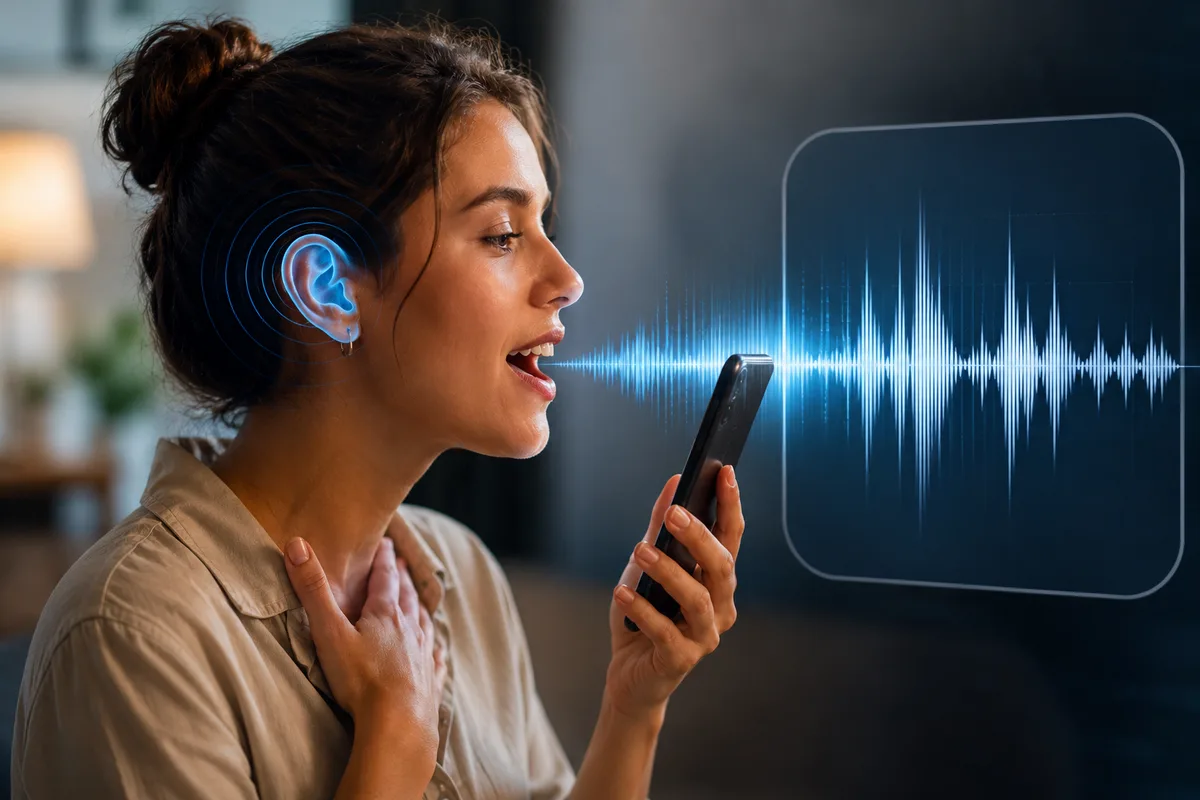
When you talk, you hear yourself through two routes at once: sound traveling through the air and vibrations traveling through the tissues and bones of your head. A recording mainly gives you the first route. That missing second pathway changes the sound enough to make your own voice feel strangely foreign.
Why Does Your Voice Sound Weird in a Recording?
Your recorded voice sounds unfamiliar mainly because you normally hear yourself in two ways at once.
While speaking, sound reaches your ears through the air, but vibrations also travel through your skull and surrounding tissues to the inner ear.
That second pathway—bone conduction—adds a different frequency balance to the voice you hear inside your own head.
A normal recording does not recreate that internal vibration in the same way.
So when you press play, your voice may sound thinner, brighter or higher than expected even though the recording is still recognizably you.
You Never Hear Your Voice the Same Way Other People Do
When another person speaks, their voice reaches you primarily through the air.
Sound waves enter your outer ear, make the eardrum vibrate, and are transmitted through the middle ear toward the cochlea, where they are converted into neural signals that the brain can interpret.
Your own voice is different because you are standing inside the instrument producing the sound.
Speech begins when air from the lungs passes through the larynx and causes the vocal folds to vibrate. The throat, mouth, and nasal cavities then shape those vibrations into the recognizable qualities of a person’s voice.
Some of that sound travels out of your mouth and returns to your ears through the air, just as another person’s voice would.
But some reaches your inner ear through your head.
That second route is the key to the mystery.
Bone Conduction Changes the Voice You Hear While Speaking
As you speak, vibrations from your vocal system travel through the skull and surrounding tissues toward the inner ear. This process is known as bone conduction.
Researchers studying self-voice perception describe the voice we normally hear while speaking as a combination of air-conducted sound and bone-conducted information. Recordings played through ordinary speakers or headphones do not reproduce that natural combination in the same way.
Bone conduction also changes the frequency balance of the sound reaching you.
Research suggests that it emphasizes lower-frequency components of your own voice. As a result, the voice inside your head can seem deeper, fuller, and warmer than the version captured by a microphone.
Remove that extra low-frequency contribution, and your recorded voice can suddenly sound lighter or higher than expected.
It may feel wrong.
To everyone else, however, it is much closer to the version they have been hearing all along.
Your Own Voice Is More Than Just Sound
There is another detail that makes speaking different from listening to a recording.
You do not merely hear your voice.
You feel yourself producing it.
Speaking creates vibrations in the skull and tissues, along with movements in the jaw, tongue, throat, and face. Research on self-voice perception suggests that this combination of auditory, vibrational, and bodily information makes our natural experience of our own voice fundamentally multisensory.
A recording removes much of that physical feedback.
You press play and hear a disembodied voice coming from a phone or speaker. The sound belongs to you, but the sensations your brain normally associates with producing that voice are missing.
That mismatch contributes to the odd feeling of listening to yourself from the outside.
Does Your Voice Actually Sound Higher in a Recording?
People frequently describe their recorded voice as higher-pitched, but the explanation needs a small distinction.
A recording does not necessarily change the actual fundamental frequency your vocal folds produced.
Instead, your perception changes because the extra low-frequency contribution you normally receive through bone conduction is missing.
Imagine listening to the same piece of music once with rich bass and once with much of the bass reduced. The melody has not moved to a different key, but the overall sound can feel thinner and brighter.
Something similar happens with your voice.
The microphone captures the sound traveling through the air, while the internally transmitted component you are accustomed to hearing is largely absent during playback.
So what feels like a dramatically “higher” voice may partly be a change in tone and frequency balance, rather than a major change in your true speaking pitch.
Your Phone or Microphone Can Change the Sound Too
Bone conduction explains the biggest perceptual difference, but recording equipment adds another layer.
No microphone captures sound perfectly.
Microphones differ in how strongly they respond to different frequencies. Recording software may apply compression, noise reduction, automatic gain control, or other processing. Smartphone voice messages can also be encoded to reduce file size.
The microphone’s position matters as well.
Speak very close to one microphone and your voice may sound warmer or bassier. Move farther away and the room contributes more reflected sound. A bare room, tiled bathroom, carpeted bedroom, professional studio, and moving car will all produce different recordings of the same person.
This is why two recordings of your voice can sound noticeably different from each other even though both are unquestionably you.
The recording is not a perfect acoustic mirror.
It is your voice filtered through a microphone, a room, a recording system, and a playback device.
Why Do Voice Messages Sometimes Sound Even Stranger?
A voice message adds another layer beyond bone conduction.
Phones may use small microphones, automatic gain control, noise reduction, compression and audio encoding. The microphone may also be much closer to your mouth than another person’s ears would normally be.
That means a voice message can differ both from the voice you hear inside your head and from the way someone hears you during an ordinary face-to-face conversation.
If one recording sounds unusually harsh or thin, it does not automatically mean every listener hears your voice that way in real life.
Is Your Recorded Voice What Other People Really Hear?
Not exactly.
There is no single perfect version of your voice.
Other people hear an air-conducted version affected by their distance from you, the room, background noise, and their own hearing. A microphone hears another version determined by its position and technical characteristics. You hear a unique combination that includes both external sound and internal vibration.
If the question is “Does a normal recording sound more like what other people hear than the voice inside my head?”, then generally yes.
But even a good recording is not identical to standing next to you during a conversation.
A smartphone placed six inches from your mouth is listening from a very different position than a friend sitting across the table.
In short: a normal recording is usually closer to what other people hear than the voice you hear inside your own head.
But it is still not a perfect copy.
Microphone position, room acoustics, audio processing and playback speakers can all change the recorded sound.
Why Does Hearing Your Own Recording Feel So Uncomfortable?
The acoustic difference explains why the voice sounds unfamiliar.
It does not completely explain why the experience can be uncomfortable.
You have heard your own voice while speaking thousands of times. Your brain has built an extremely familiar internal model of what “you” sound like under those conditions.
Then a recording presents a recognizable version of you that does not fully match that model.
The effect resembles seeing an unfamiliar photograph of yourself. Nothing necessarily looks objectively wrong, but it differs from the version of yourself you are accustomed to seeing.
Voice research provides evidence that bone-conducted information contributes specifically to recognizing our own voice. In a 2023 series of experiments, adding bone-conducted vibrotactile stimulation improved participants’ ability to distinguish their own voice from another person’s voice under certain conditions.
In other words, the physical way you normally hear yourself appears to be part of your sense of vocal identity.
Voice perception is not only acoustic. Social context can also subtly change the way we speak, which helps explain why we start talking like the people around us.
That discomfort is therefore not evidence that your voice objectively sounds bad.
Part of the reaction comes from unfamiliarity.
The externally recorded version does not match the voice representation you have reinforced through years of hearing yourself speak from inside your own body.
Why Do Singers and Broadcasters Often Seem Comfortable With Their Recorded Voices?
Familiarity helps.
Someone who regularly records podcasts, performs music, edits videos, or works in broadcasting repeatedly hears the externally recorded version of their voice.
Over time, that version stops being surprising.
This does not mean bone conduction disappears. Their natural speaking voice still reaches them through both internal and external pathways.
What changes is their expectation.
They have learned what their voice sounds like through a microphone as well as what it sounds like inside their own head.
You can experience the same effect simply by hearing yourself recorded more often.
The first playback may sound bizarre.
After dozens of recordings, the difference often becomes much less interesting.
Can You Make a Recording Sound More Like the Voice in Your Head?
You can make it closer, but reproducing your natural self-voice perfectly is difficult.
Researchers have experimented with filtering recordings and adding bone-conducted vibration because conventional playback lacks part of the sensory information present when we actually speak. The results reinforce the idea that your natural self-voice is not simply a normal recording with the bass turned up.
For everyday recordings, microphone technique can still make a major difference.
A decent microphone positioned at an appropriate distance in a quiet, acoustically controlled room will usually capture a more natural voice than a phone placed randomly on a desk.
Equalization can alter the tonal balance too, but aggressively boosting lower frequencies just to match the voice you imagine hearing inside your head may produce a recording that sounds unnatural to everyone else.
The Strange Voice in the Recording Is Still You
The unsettling part of hearing your recorded voice comes from a simple fact: you are the only person who normally hears your voice from inside your own head.
Every conversation gives you a private mix of airborne sound, skull vibration, and bodily sensation.
A microphone does not share that perspective.
It captures primarily the sound that leaves your body and travels through the air — a version much closer to the one other people encounter.
So the next time a voice message makes you wonder, Do I really sound like that?, the answer is more interesting than yes or no.
You sound like both versions.
One is the voice the world receives.
The other is the voice only you get to hear.
Sources
Orepic, P., Kannape, O. A., Faivre, N. & Blanke, O. — Bone Conduction Facilitates Self-Other Voice Discrimination — Royal Society Open Science, 2023
Read the peer-reviewed study
National Institute on Deafness and Other Communication Disorders — Taking Care of Your Voice
Read the NIDCD fact sheet








Join the discussion