Why Do Some People Sneeze When They Look at Bright Light? The ACHOO Reflex Explained
Why does bright sunlight make some people sneeze? Discover the science behind the photic sneeze reflex, also known as ACHOO syndrome, and why your eyes can trigger an involuntary sneeze.

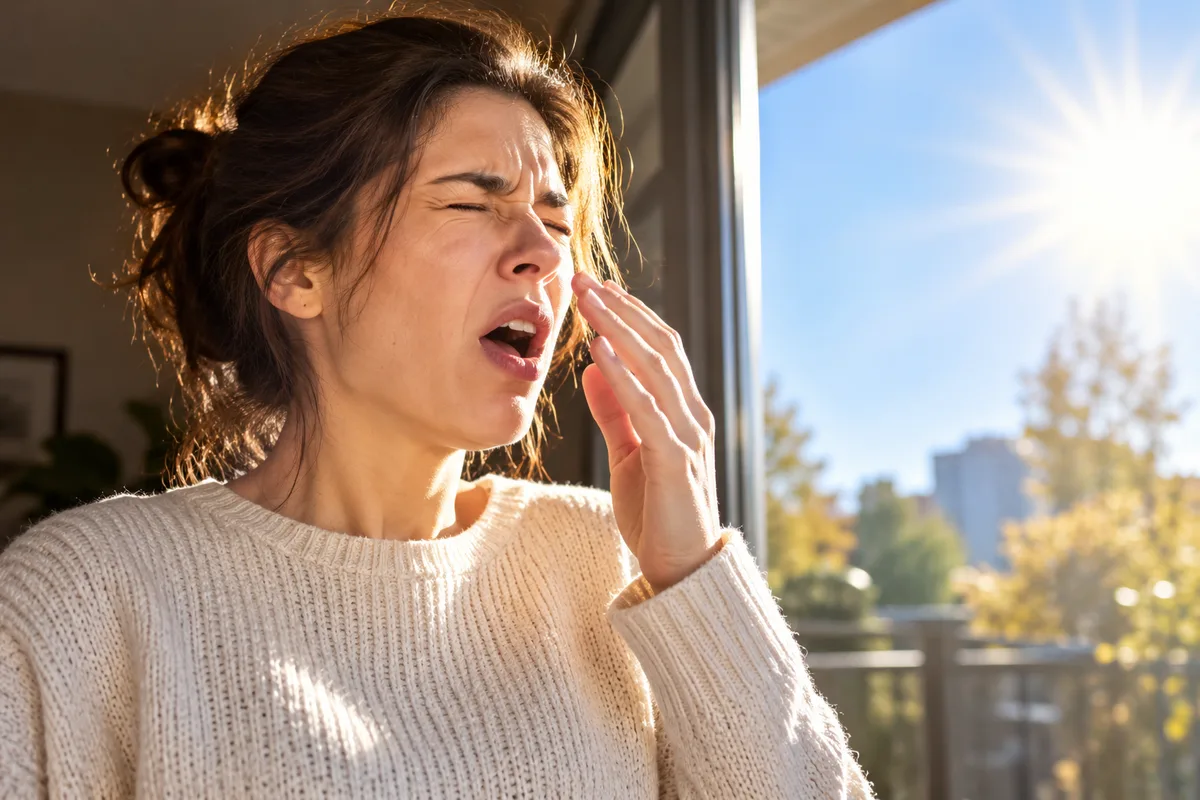
Step out of a dark movie theater into bright afternoon sunlight and—achoo.
For some people, that reaction is so predictable that they can almost feel the sneeze arriving before it happens.
The sunlight is not irritating their nose in the usual way. They are experiencing the photic sneeze reflex, sometimes called ACHOO syndrome: an involuntary tendency to sneeze after sudden exposure to bright light.
It is surprisingly common, appears to have a genetic component, and has fascinated researchers for decades.
But despite the wonderfully convenient name, scientists still do not have a complete explanation for why light can make a nose sneeze.
What Is the Photic Sneeze Reflex?

Normally, sneezing begins when something irritates sensory nerves in the nose.
Dust, pollen, pepper, respiratory infections, and other irritants can activate a protective reflex designed to expel material from the nasal passages.
Photic sneezing is different.
The trigger begins with light entering the eyes, not with something entering the nose.
People with the reflex may experience a tickling or prickling sensation in the nose followed by one or several sneezes when they suddenly encounter bright light.
Sunlight is the classic trigger, which is why the phenomenon is sometimes called the sun sneeze reflex.
But sunlight is not essential.
Bright artificial lights have also triggered sneezing in laboratory studies and clinical observations.
What seems especially important is the transition:
dark or dim environment → sudden bright light
That is why someone may sneeze when walking outside on a sunny day even though the same person can remain outdoors afterward without continuously sneezing.
Why Is It Called ACHOO Syndrome?
The name ACHOO is an intentionally memorable acronym associated with the rather elaborate phrase:
Autosomal Dominant Compelling Helio-Ophthalmic Outburst
Different scientific publications have used slightly different versions of the wording, but the acronym refers to the same basic phenomenon: sneezing triggered by exposure to bright light.
The name makes the reflex sound like a medical disorder.
For most people, it is not.
Photic sneezing is generally considered a harmless inherited trait rather than an illness requiring treatment.
There is also an important scientific caveat hidden inside the name.
The phrase “autosomal dominant” came from observations that the tendency often seemed to run in families. Modern genetic research suggests the story is more complicated than a single simple gene being responsible.
More on that in a moment.
How Common Is Sun Sneezing?
More common than you might expect.
A 2025 scientific review in Experimental Brain Research described the photic sneeze reflex as affecting approximately 25% of people.
That number should not be treated as an exact worldwide prevalence rate. Studies have used different populations, definitions, questionnaires, and experimental methods.
Still, the evidence consistently suggests that photic sneezing is far from rare.
If you sneeze when stepping into strong sunlight, there is a good chance several people around you experience exactly the same thing.
People who do not have the reflex may find the phenomenon surprisingly difficult to imagine.
For someone who does have it, the connection between sunlight and sneezing can feel completely obvious.
So How Can Light Make Your Nose Sneeze?
This is where the simple answer becomes less satisfying.
Scientists know the phenomenon is real.
They do not yet know exactly how the nervous system produces it.
One of the best-known explanations involves accidental “cross-talk” between sensory pathways.
Bright light strongly stimulates the visual system. At the same time, the trigeminal nerve plays an important role in facial sensation and in detecting irritation associated with sneezing.
One hypothesis proposes that intense visual stimulation somehow spills over into pathways associated with the trigeminal system.
The brain may effectively interpret part of the light-related activity as nasal irritation.
The result:
your nose feels tickled even though nothing touched it.
Then the sneeze reflex begins.
It is an elegant explanation—but it remains a hypothesis rather than a solved piece of human neurobiology.
A 2025 review of photic sneezing noted several competing theories, including interactions between optic and trigeminal pathways and different forms of parasympathetic nervous-system activation. None has been conclusively demonstrated.
So if you see the claim that scientists have definitively discovered a single “crossed wire” responsible for ACHOO syndrome, that goes beyond the current evidence.
Your Brain May Be More Involved Than a Simple Reflex Arc
An especially interesting clue came from an EEG study comparing people with the photic sneeze reflex with people who did not have it.
Researchers found greater visual-cortex excitability in the photic sneezers.
The stronger sensation of nose prickling was also associated with activity in brain regions involved in sensory processing, including the insula and secondary somatosensory cortex.
That suggests photic sneezing may not be a simple automatic connection occurring only deep in the brainstem.
Higher-level sensory processing appears to be involved too.
In other words, the phenomenon may reveal something broader about how the brain combines information arriving from different senses.
Your nervous system contains many responses that happen before conscious thought. Curiworld explores another familiar example in Why Do We Get Hiccups? What Your Body Is Actually Doing, where several nerves, respiratory muscles, and the airway coordinate an involuntary reflex before you have any chance to stop it.
It Is Probably the Change in Light That Matters Most
You may assume the sun causes sneezing because it is warm.
That does not appear to be the explanation.
The reflex can occur with artificial light too.
Researchers have investigated factors including:
- brightness,
- wavelength,
- duration,
- flickering,
- timing,
- and the transition from darkness to light.
The problem is that the scientific literature remains surprisingly small and inconsistent.
A 2025 review found only a handful of studies that had directly examined the characteristics of light capable of triggering photic sneezing.
Current evidence suggests sudden bright illumination is important, but scientists still do not have a reliable formula such as:
“X amount of light for Y seconds will cause a sneeze.”
Different photic sneezers may also respond differently.
One person may sneeze almost every time they walk into sunlight.
Another may experience it only occasionally.
Why Does the Nose Feel Ticklish if Nothing Is in It?
This may be one of the strangest parts of the experience.
Many photic sneezers describe a familiar sensation just before the sneeze:
a prickling or tickling inside the nose.
It feels as though something is physically irritating the nasal passage.
But the stimulus began in the eyes.
Experimental work has not found a simple direct nasal response that fully explains the sensation.
Instead, studies suggest that the feeling may be a type of referred sensory experience created as the nervous system processes the light stimulus.
Your brain is constantly combining and interpreting sensory information.
Usually, you never notice how complicated that process is.
Odd reflexes such as photic sneezing give us a glimpse behind the scenes.
That same principle—that familiar bodily reactions can involve far more nervous-system activity than they appear to—shows up in Curiworld’s look at why your fingers wrinkle in water. Those wrinkles are not simply waterlogged skin; they involve autonomic nerves and changes in blood vessels.
Is the ACHOO Reflex Genetic?
There is strong evidence that genetics contributes to photic sneezing.
Family observations have long suggested that the trait can be inherited, which is where the “autosomal dominant” portion of the ACHOO name originated.
Large genetic studies have since found specific genetic regions associated with the reflex.
A genome-wide association study involving more than 3,400 participants in China identified two genetic variants associated with photic sneezing. Earlier genome-wide research had identified other associations.
That is important because it supports a real biological and genetic contribution.
But it also makes the story more complicated.
Rather than proving that one single gene acts like a simple on/off switch, the available research points toward a polygenic trait, meaning multiple genetic factors may influence whether someone experiences the reflex.
So it is reasonable to say:
Photic sneezing can run in families and has a genetic component.
It is less accurate to say:
Scientists have discovered “the ACHOO gene.”
They have not.
Why Do Some People Sneeze Once and Others Several Times?
There is considerable individual variation.
Some photic sneezers produce one sneeze.
Others sneeze two or three times in quick succession.
The number may even vary from one episode to another.
Researchers do not yet fully understand what determines the strength or duration of the response.
Factors could include individual sensitivity of the visual and sensory systems, the intensity of the light transition, and whether the nose was already close to the threshold for sneezing.
For example, someone whose nasal passages are already irritated by allergies might conceivably respond more readily to another trigger.
That does not mean photic sneezing itself is an allergy.
Is Sneezing at Sunlight an Allergy?
No.
A photic sneeze is not evidence that someone is “allergic to the sun.”
Allergic sneezing generally involves an immune response to substances such as pollen, dust mites, animal dander, or mold.
The photic sneeze reflex is a neurological response associated with light exposure.
The confusion is understandable because both ultimately produce the same very noticeable result:
Achoo.
But the pathways that start the reaction are different.
Can Bright Indoor Lights Cause It Too?
Yes.
Sunlight is the best-known trigger because it provides one of the most dramatic increases in brightness humans commonly encounter.
But artificial illumination has also triggered photic sneezing in reports and experiments.
Examples have included:
- bright examination lights,
- flashes,
- laboratory light sources,
- and other strong visual stimuli.
That means “sun sneeze” is a convenient nickname, not a strict definition.
The eyes appear to be responding to light—not to some unique property of the Sun.
Is the Photic Sneeze Reflex Dangerous?
Usually, no.
For most people it is simply an odd trait and perhaps an occasional inconvenience.
The risk comes from when the sneeze occurs.
Imagine driving through a dark tunnel and suddenly emerging into brilliant sunlight.
A sneeze temporarily closes your eyes and can interrupt attention and control.
That makes the reflex potentially relevant to:
- driving,
- aviation,
- operating machinery,
- and some medical or dental procedures involving bright lights.
The risk is situational, not because photic sneezing is inherently harmful.
People who know they have a strong reflex can anticipate situations where a sudden transition to bright light may trigger it.
Can Sunglasses Stop Sun Sneezing?
They may help some people by reducing the intensity of the sudden light reaching the eyes.
A hat or visor can also reduce abrupt exposure.
But there is no guaranteed prevention method, and research has not established a particular lens color or wavelength filter that reliably eliminates the reflex.
The simplest strategy is awareness.
If you know stepping suddenly into intense sunlight often makes you sneeze, you can expect the reaction instead of being surprised by it.
That can matter particularly when driving.
And one thing you should not do is deliberately stare at the Sun to see whether you have ACHOO syndrome.
Looking directly at the Sun can damage the retina.
There is no reason to test the reflex that way.
Does ACHOO Syndrome Need Treatment?
Usually not.
A lifelong tendency to sneeze once or twice when entering bright sunlight generally does not require medical treatment.
It is simply part of how that person’s nervous system responds to light.
Frequent sneezing accompanied by other symptoms is a different question.
Sneezing together with persistent congestion, itchy or watery eyes, fever, breathing problems, or other new symptoms may have causes unrelated to the photic sneeze reflex.
Likewise, a new and unusual sensitivity to light accompanied by eye pain, severe headache, visual changes, or neurological symptoms should not simply be assumed to be ACHOO syndrome.
The photic sneeze reflex describes a specific, usually familiar pattern:
sudden bright light → nasal tickle → sneeze
A Strange Reflex That Science Still Hasn’t Fully Solved
The photic sneeze reflex is a perfect example of how an everyday experience can hide an unsolved scientific question.
We know bright light can trigger sneezing in a substantial minority of people.
We know the phenomenon can run in families.
We have identified genetic associations.
Brain studies show differences in how photic sneezers process visual and sensory information.
And researchers have several plausible theories about how signals from the eyes might activate the sneezing system.
What we do not yet have is one definitive mechanism explaining the entire reflex.
So the next time someone steps into sunlight and immediately sneezes, they are not imagining the connection.
Their eyes really did help trigger it.
Exactly how their brain turned bright light into achoo is the part scientists are still working out.







Join the discussion